








EIGEN large unlock is coming: 10% market value dilution every month, smart money exits in advance
 Core Viewpoint

 The article points out through on-chain data analysis that the recent sharp decline of the $EIGEN token (a 53% crash on October 10) is not merely a result of market panic, but rather a manifestation of a deeper issue. The real core risk lies in the enormous token unlocks that will continue over the next two years, which will bring significant selling pressure. The smartest profit-seeking traders have already anticipated this and systematically exited the market weeks before the flash crash.
Original Author: Cryptor, On-chain Analyst
Original Compilation: Shenchao TechFlow
On October 10, the entire crypto market plummeted due to tariff news, with $EIGEN dropping as much as 53% in a single day, from $1.82 to $0.86. At first glance, this seems like yet another victim of a market flash crash, but the reality is far more complex.
In the past 30 days, 68% of the most profitable $EIGEN traders have exited the market. They are not panic selling due to the tariff crash on October 10, but rather preemptively positioning themselves to avoid the upcoming 24-month supply shock—this shock's first unlock occurred on October 1.
I specifically checked on-chain data because my timeline was filled with overly optimistic headlines that did not align with price movements.
In fact, EigenCloud is experiencing strong momentum: a partnership with Google has been established, total value locked (TVL) has grown from $12 billion in August to $17.5 billion, the Coinbase AgentKit integration has gone live, and EigenDA V2 along with multi-chain expansion are actively being developed.
However, the issue is that starting November 1, approximately $47 million worth of $EIGEN tokens will be unlocked and flow into the market every month for the next two years. In other words, this amounts to 13% of the current market cap entering circulation every 30 days.
The most profitable traders have already seen this and exited the market early. A review of the past 30 days' data shows that smart money bought some low-position chips after the flash crash, but this was mainly driven by a single whale investor, who, according to @nansen_ai data, has remained silent since then. Meanwhile, about $12.2 million flowed into exchanges last week.
The market crash on October 10 was merely noise and distraction. The real signal lies in the timing: who exited before October 1, who bought during the flash crash, and who is now remaining silent.
Exit Patterns: September to October 2025
What stands out first is that among the top 25 most profitable $EIGEN traders in the past 30 days, 68% have completely liquidated their positions. They are not partially taking profits; they are entirely exiting.
The best-performing trader "crashman.eth" achieved a 272% return on investment (ROI) and no longer holds any tokens. The second-best exited after a 97% return, and the third after a 91% return. This pattern is repeated throughout the leaderboard.
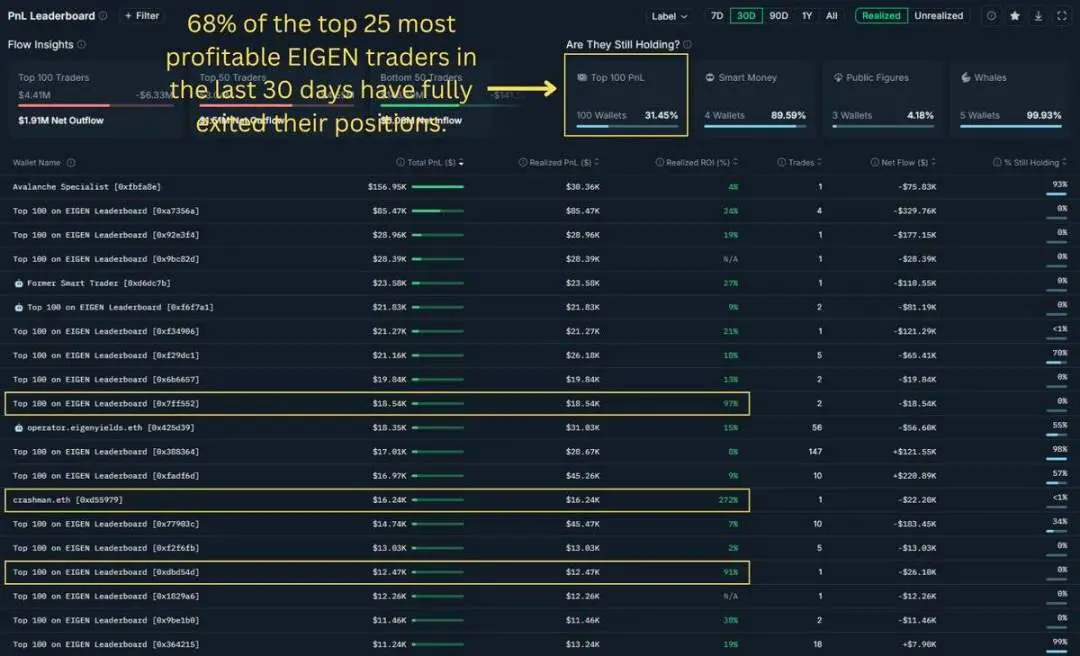
Only 8 out of the top 25 traders still hold $EIGEN, with an average "holding ratio" of just 30%. Even these traders have cut their peak positions by 70%.
This data is more meaningful than return on investment. High returns accompanied by low holding ratios indicate a shift from early confidence to caution. These exits began in mid-September, weeks before the market flash crash on October 10, when prices were still above $2.
These traders clearly saw the unlocking schedule and exited early.
Token Flow
The timeline aligns with the first unlocking event on October 1, when $EIGEN became tradable after months of restrictions. Two days before the first 36.82 million $EIGEN were unlocked, the price had already plummeted by 26%.
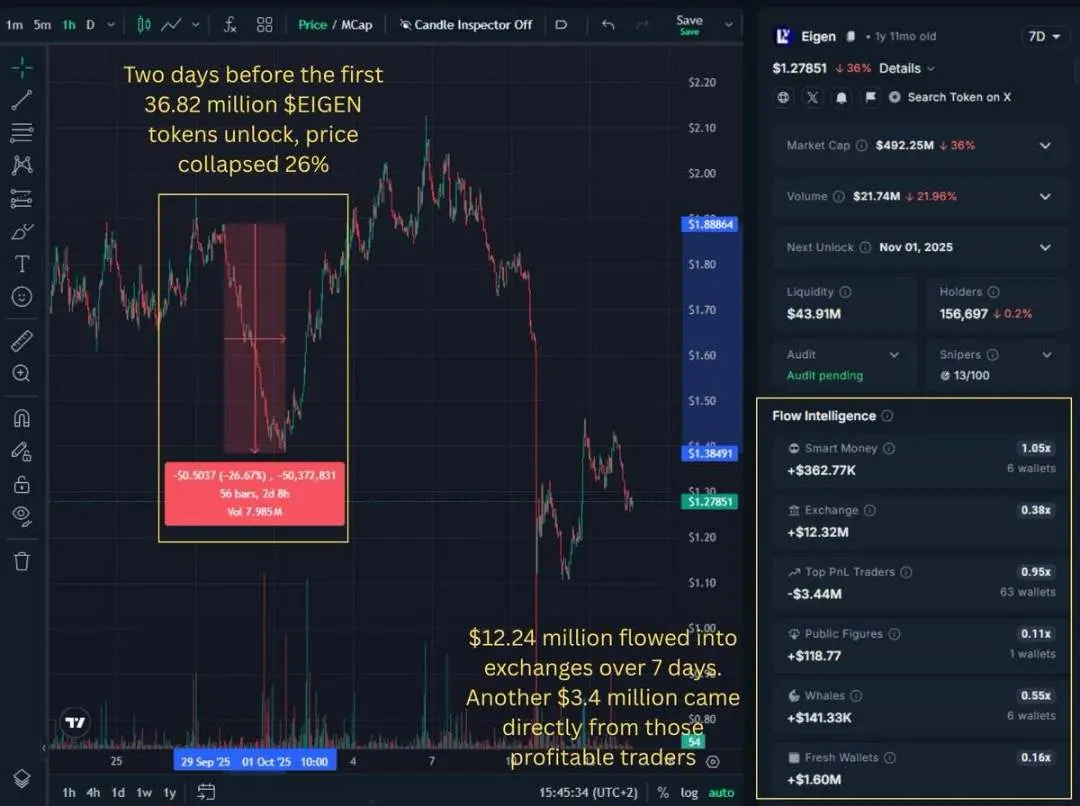
Top traders acted before this event, selling tokens into exchanges. On the surface, it may seem like the market was accumulating chips, but in reality, this was a systematic distribution. At least from the on-chain data, I believe this is a reasonable interpretation.
The fund flow data from the past 7 days shows that another approximately $12.32 million worth of $EIGEN flowed into exchanges, including $3.44 million from these top profitable traders.
Contradiction: A Smart Money Whale Buys the Dip
Smart money's holdings increased by 68% last month, from 1.4 million to 2.36 million tokens. However, the turning point is that over half of the increase came from a single wallet, which currently holds 1.23 million $EIGEN.
This whale continued to buy in September, sold near the low point of the October 1 unlock, then bought back at higher prices, and increased holdings again after the market flash crash on October 10.
While this staggered buying pattern is somewhat strange, more importantly, it does not reflect a broad consensus among smart money. The remaining smart money's total holdings are distributed across dozens of wallets, totaling about 1.2 million $EIGEN, which is not convincing to me. The total supply held by smart money accounts for only 0.13%.
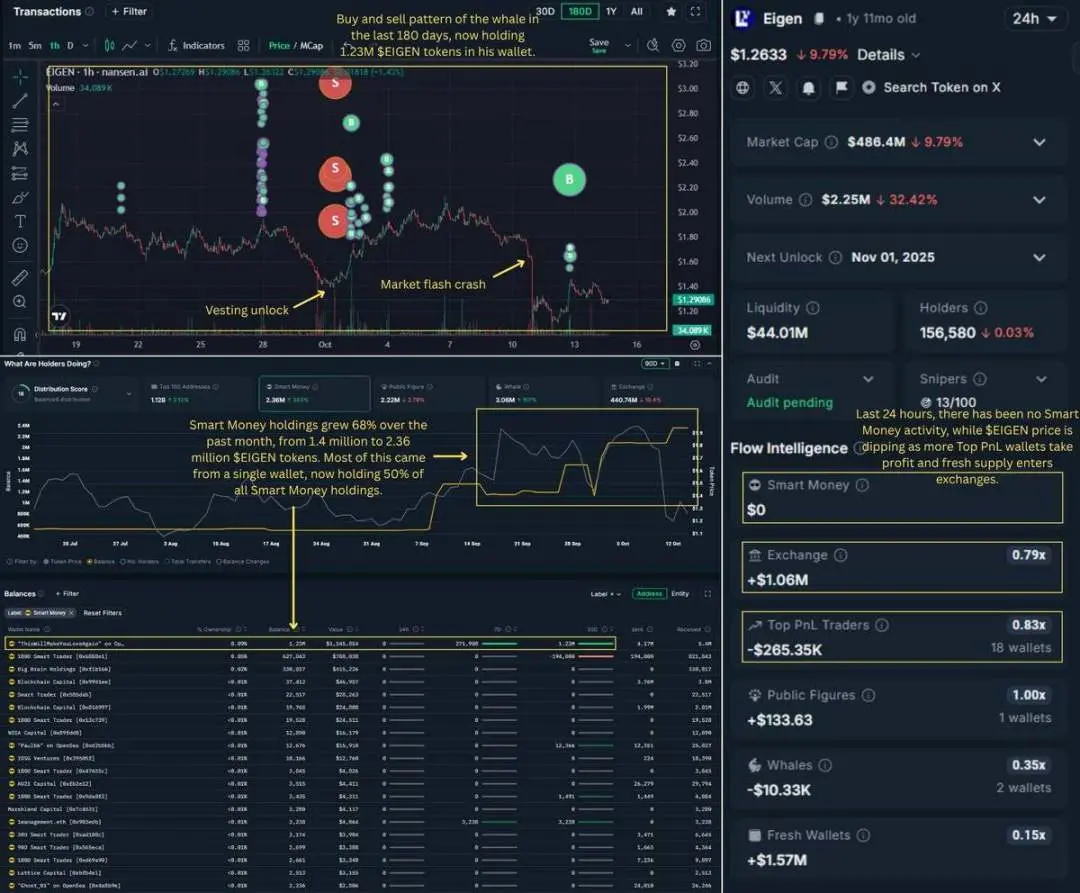
Moreover, in the past 24 hours, smart money has shown no activity, nor has there been any significant fund inflow. Even that whale has remained silent.
Meanwhile, as more top profitable accounts take profits and transfer tokens to exchanges, the price of $EIGEN continues to decline. This trend can be seen in the right column of the screenshot above.
There are two interpretations for this silence:
- Bullish Viewpoint: Confidence. Choosing to hold, ride out the volatility, and wait for fundamentals to catch up.
- Bearish Viewpoint: Uncertainty. Even with lower prices, there is not enough confidence to continue adding positions.
On November 1, we will see the outcome.
The $47 Million Dilemma
Because on November 1, the next challenge is coming: more unlocks.
The unlocking schedule is public information; it is not a secret. But it seems that few people truly pay attention to its actual implications or understand it in a meaningful context.
The unlock on October 1, 2024, lifted transfer restrictions and initiated a one-year cliff period.
On October 1, 2025, the first 36.82 million $EIGEN will unlock. Starting November 1, 2025, 36.82 million will unlock every month for about 23 months, until September 2027.
At current prices, $47 million worth of tokens will enter the circulating market every 30 days. Based on the current market cap (which is $490 million at the time of writing), these monthly unlocked tokens represent about a 10% dilution rate. This is a significant pressure.
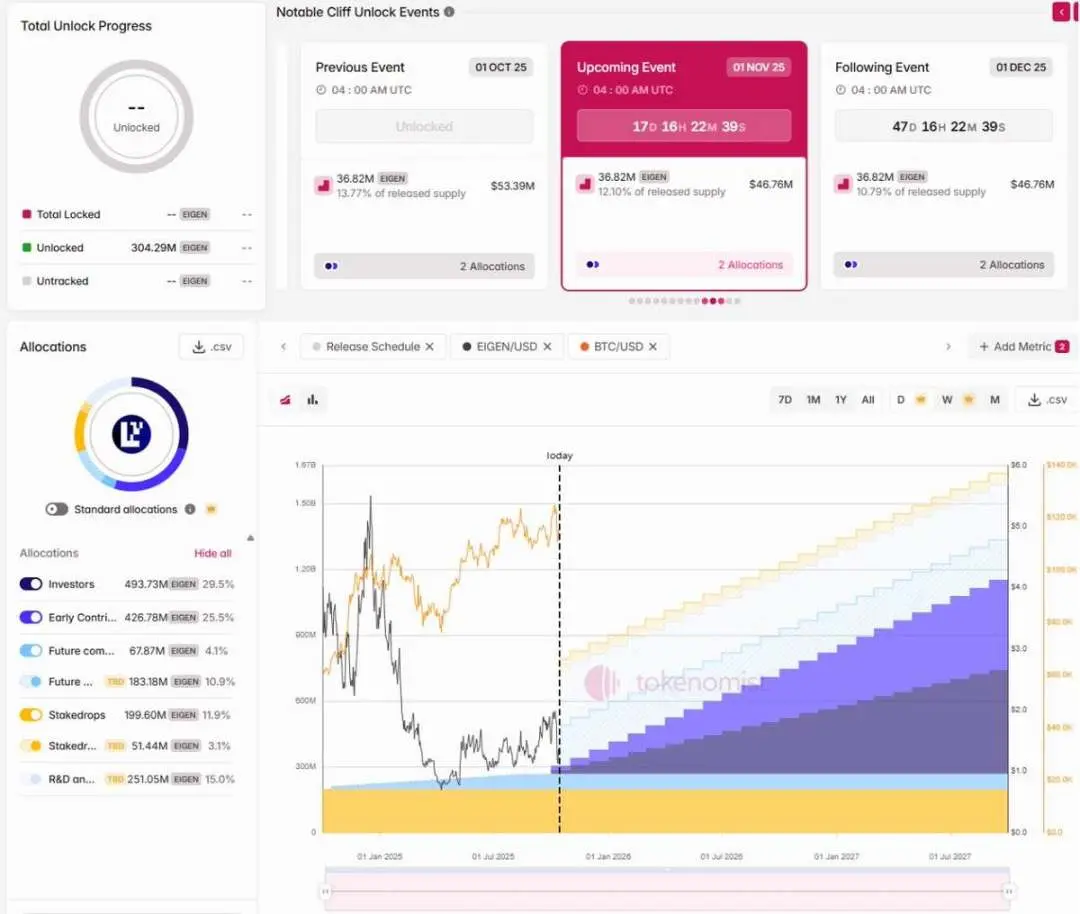
Currently, only 23% of the tokens are in circulation, with a fully diluted valuation (FDV) to market cap ratio of 4.5 times, meaning 77% of the tokens are still locked.
The top ten holding addresses control 50% of the token supply. Most of these are held in protocol wallets, exchange reserves, and venture capital allocations, all subject to the same unlocking timeline.
This means that for the next two years, there will be ongoing selling pressure rather than a one-time event.
Those who exited in September did so not because of any price movements, but to preemptively address the known date of the supply shock.
Protocol and Token: Why Both May Coexist
Ironically, EigenCloud as a protocol is actually performing well.
Total value locked (TVL) has reached $17.5 billion (around $12 billion in August). A partnership with Google Cloud for AI payment verification has been established. The Coinbase AgentKit integration supports verifiable blockchain agents. The slashing mechanism went live in April. EigenDA V2 launched in July. Multi-chain expansion is also actively underway.
Development is real, adoption is increasing, and the logic of infrastructure is being realized.
But strong fundamentals do not eliminate poor token economics. These are two separate issues. Just because a token belongs to a project does not mean they will develop in sync.
The growth story of $EIGEN is colliding with a heavy, multi-year unlocking cycle that has not yet fully begun. This is why I always separate product analysis from token analysis, as they rarely sync, especially during the vesting period.
The success of a token requires the protocol to generate enough real demand to absorb $47 million in new supply each month.
Even for a project like EigenCloud that has real appeal and scale, this is a high bar.
November 1: The Real Stress Test
I do not know who will win in this contest: the growth of the protocol or the pressure of supply.
But what I do know is that the data tells us some facts. Once again, my timeline is filled with the (few) bullish news about $EIGEN. Does this situation seem familiar? Those who follow me should know which cases I am referring to.
For $EIGEN, profitable traders had already exited weeks before the first unlock, with the most successful ones leaving when prices were still above $2. A smart money whale bought heavily during the crash but then fell completely silent. The inflow of funds to exchanges has continued to rise ahead of the next unlocking window.
The market crash on October 10, driven by tariffs, attracted everyone's attention, but the real story revolves around the wallet positioning regarding the 24-month unlocking plan, which will officially accelerate on November 1.
The insights from pattern recognition:
When the "Still Holding %" of top performers drops below 30%, when exchange inflows surge relative to market cap, and when major periodic unlocks are approaching, this is usually not your entry signal.
November 1 is the next monthly test of this supply cycle. We will see whether the whale's confidence pays off or if the early sellers were correct in their judgment.
Keep an eye on these indicators:
- Changes in smart money positions and whether more wallets are increasing their holdings.
- Whether other groups (such as the top 100 holders, top profitable accounts, whales, and funds) are increasing their positions.
- The velocity of exchange flow (will the inflow rate of $12 million per week accelerate?)
- The number of active wallets (are new participants entering, or are existing holders merely rotating?)
This framework applies to any token with an unlocking schedule. The methodology here is more important than any single trade.
On-chain data provides you with the same information that institutions and funds have. The difference is whether you know where to look before the market discovers it.
If you do? Then you have surpassed 99% of crypto Twitter users.
 Risk warning Risk warning



Popular articles





