Polymarket Profit Model Summary
 Core Viewpoint

 Summary of Ways to Make Money on Polymarket Binary Prediction Market
The original text is from Jianmei Notes
After researching the web3 binary prediction market for a few days, the goal of the study was to make money. Based on the research from a few days ago, today I will deeply analyze the ways to make money on Poly.
On Poly, the yes + no of an event always equals 1u, meaning the probability is the price. The lifecycle of a binary prediction event token includes three processes: minting, trading, and redemption.
When the platform first releases a binary prediction event, there are no circulating tokens available for trading. Market makers can spend 100u to mint 100 yes and 100 no on the platform, creating circulating tokens available for trading. Once the event result is out, if the result is yes, then no will go to zero, and the smart contract will redeem these 100 yes, each worth 1u, thus ending the token's lifecycle.
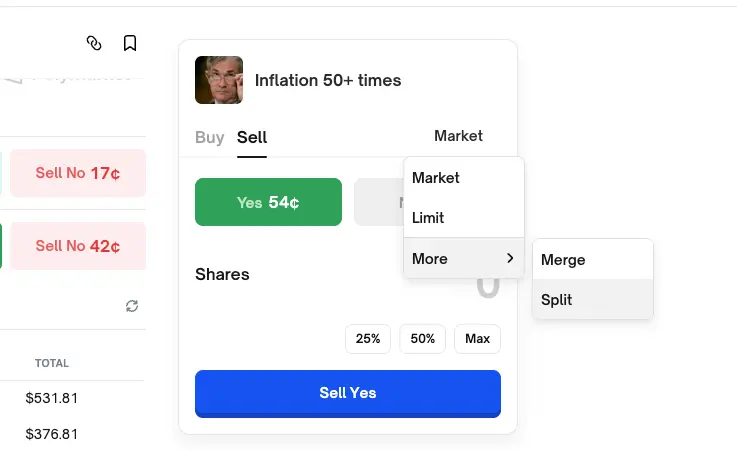 (The button to split 1u into 1 yes + 1 no on Poly)
The above is just the simplest process. In fact, as long as it is within the event cycle, anyone can mint one yes and one no for 1u at any time, thus buying and selling to make a profit, and can redeem at any time.
- Therefore, the first way to make money on Poly is as a market maker. Profit is made through buying and selling for price differences + the platform's liquidity incentive program (after each binary event ends, Poly charges the winning side a 2% profit, most of which flows directly to the market makers providing liquidity, while Poly takes less than 0.5% as operational settlement. Additionally, Poly has set up a liquidity incentive program).
- The second way to make money on Poly: become a high-cognition player in a specific field. Users who are more specialized in a certain area can earn from users with lower cognition by achieving a prediction success rate of over 50%, commonly known as profiting through high cognition + professional knowledge.
- Another way to make money: arbitrage. The essence of arbitrage is to correct erroneous markets. Because on Poly, probability is price, yes + no always equals 1u. However, yes and no are completely independent markets. When one side of the market suddenly experiences significant fluctuations, causing 1 yes + 1 no to be less than or greater than 1, arbitrage opportunities arise. If it is greater than 1 (for example, 1.1), one can mint 1 yes + 1 no for 1u and then sell it in the market to earn 0.1u. If it is less than 1, for example, yes equals 0.8 and no equals 0.1, one can spend 0.9u to buy one yes and one no, then combine 1 yes + 1 no into 1u, ultimately earning 0.1u. Another form of arbitrage is through cross-platform probability deviation arbitrage, involving operations between multiple platforms.
- The last way to make money: neimu players. Especially in political prediction events, some people can know information in advance and profit from buying in, but this is for top players, and ordinary people do not have such resources.
For ordinary people, they can monitor the market, and when there is a significant abnormal change in probability, it is very likely that someone has received information, and they can follow and buy to make money.
After a few days of research, I have a general understanding of the ways to make money in the prediction market and its basic mechanisms. However, I feel that to make money in this market, aside from the high-cognition player method, other methods require scripting, so I may study how to use its API for trading in the coming days.
In summary, there are four ways to make money on Poly: market maker, high-cognition player, arbitrage player, neimu player. Which one do you belong to?
 Risk warning Risk warning