








Zeno's digital twin ideal and the democratization of technology in DeSci

 Carbon-based intelligence and silicon-based intelligence live under the same roof.
Written by: Eric, Foresight News
More than a week ago, the DeSci platform Orama Labs successfully completed the token launch of its first project, Zeno. This launch provided 500 million ZENO tokens for the launchpad, accounting for half of the total supply. OramaPad requires users to stake their PYTHIA tokens to participate, and this "opening show" attracted a total of 3.6 million dollars in PYTHIA staking.
Orama Labs aims to address the inefficiencies in funding allocation and resource distribution in traditional scientific research, and the solution involves funding scientific experiments, achieving intellectual property verification, resolving data silos, and implementing community governance, establishing a pathway from research to commercialization.
The first project of OramaPad adopts the Crown model, meaning that the project needs to have a complete business logic system and/or strong technical development capabilities in the Web2 field, and its product must have strong practicality. Orama refers to this as OCM (Onboarding Community Market). Unlike a purely meme-based issuance, Orama essentially provides a replicable on-chain transformation path for Web2 enterprises or teams with mature business models and technical capabilities, and Zeno, the first to take the plunge, is no small player.
Hardcore Technology That’s Hard to Understand
Zeno is a project with an extremely ambitious vision, so much so that if you only look at Zeno's documentation, you might not fully understand what the team is trying to achieve. It was only after communicating with the team that I grasped the full picture of this cyber-inspired story:
In short, Zeno aims to overlay multiple virtual spaces for AI and robotic agents in the physical space of human life, allowing all "agents," including humans, to coexist in the same space.
Imagine a scenario: on a future afternoon, you are lounging on your balcony, enjoying your leisure time, while an AI housekeeper and a humanoid robot are busy managing household tasks. Suddenly, feeling a bit bored, you want to play a virtual passing game with your two brothers at home, so you put on your VR/AR glasses. In the world of the glasses, the robot appears as a human, and the AI that only exists in the network also transforms into a humanoid form. The robot sits on the sofa, while the AI sits on the floor, and the three of you pass a virtual basketball while discussing what to eat for dinner.
This is Zeno's ultimate vision: to allow carbon-based intelligent beings and silicon-based agents to live together in the same physical space.
Many of us envision cyberspace as a purely virtual realm, like the VR world depicted in the movie "Ready Player One"; our current interactions with AI also occur through flat mediums like computer or phone screens. Zeno hopes to bring these virtual spaces directly into real life, forming a "superposition state" of the physical and digital worlds "in the same time and space," making digital content feel "real and tangible," and enabling natural interactions among humans, robots, and AI in real scenarios, constructing a mixed-reality ecosystem where the virtual and real coexist in harmony.
Of course, the world we see may not be exactly the same as what robots and AI perceive. For instance, if you don't want the robot wandering into your study, you can lock the door in the robot's view, allowing entry only after you "unlock" it.
Centered Around Spatial Anchor Points
Living under the same roof as artificial intelligence sounds like a very high-tech endeavor, but it comes with a major prerequisite: you need to establish a model of the real world in the virtual realm to achieve programmability.
This requires you to first have real-world scene data, which is a problem many companies, including intelligent driving technology firms, are currently researching. Take intelligent driving as an example; if you have real scene map data of an entire city, the intelligent driving AI doesn't need to roam the streets with the car to learn how to respond to different situations; it can simulate road scenarios in the lab to continuously evolve.
While the above is not what we refer to as "spatial overlap," it is one of the important applications for establishing a model of the real world. The ultimate vision Zeno wants to achieve cannot be reached in one step; the first thing it needs to do is collect real-world scene data.
Zeno has already launched a program that allows users to use their everyday devices to help input spatial data, supporting both robots and glasses. As for smartphones, the team stated that Google's ARCore is mature enough not to require secondary development, and users can refer to the compatible models for direct use. The collected data will be used to build the algorithms for spatial construction, which are independently developed by the Zeno team.
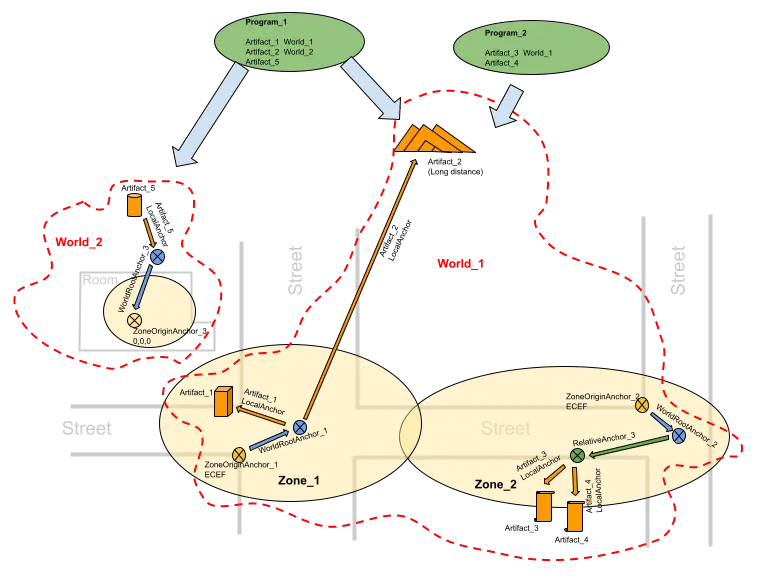
The core of building a coexistence between the real and virtual worlds revolves around spatial anchor points. From a technical implementation perspective, the real world cannot be directly programmed; the connection to the virtual world is made by associating anchor points in the real world and mapping them to a virtual space based on physical space. To put it metaphorically, for robots and AI, the display world is like an ocean at night, and these anchor points serve as lighthouses, illuminating every area for silicon-based intelligence in the display world.
The first step towards achieving Zeno's "ultimate goal" is to establish a full-stack platform. In addition to everyday electronic devices like smartphones, it also uses professional equipment such as LiDAR, 360-degree panoramic cameras, and RGB cameras on mobile devices or XR headsets for data collection. The team stated that the Zeno platform will have a powerful cloud-based visual world model and computing system capable of processing GB-level raw sensor data daily for large areas (city-level/global regions) and establishing indexes for rapid spatial queries; it can also process data for small areas (room-level/anchored areas) in parallel, achieving high-throughput real-time processing.
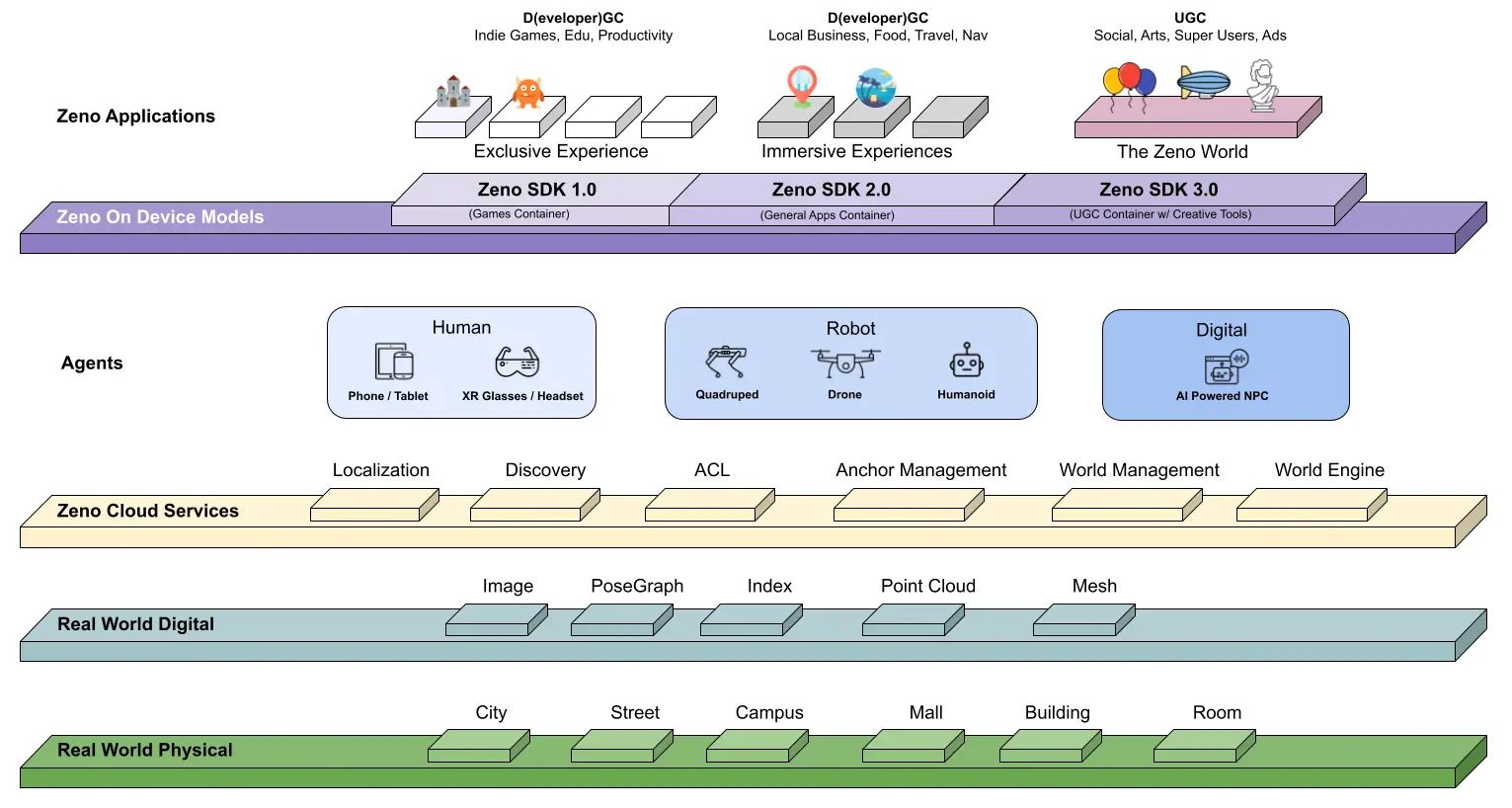
Additionally, the system has self-learning capabilities, continuously optimizing through high-quality data and third-party data. In the future, it will support hundreds of spatial queries per second, providing precise six degrees of freedom (6-DOF) positioning results, shared spatial anchor point creation, rapid 3D visual reconstruction, instant semantic segmentation, and other scene understanding functions. It has high scalability and can be widely applied in various scenarios such as AR games, navigation, advertising, or productivity tools.
The verified spatial data and the spatial intelligent infrastructure layer it builds can be called upon by various decentralized applications for autonomous driving path planning, end-to-end model data training for robots, generating verifiable automated execution smart contracts, and spatially shaped advertising distribution, ultimately achieving spatial data-driven decision-making and upper-layer applications.
Who is Behind Zeno?
Compared to some Web3 projects with ethereal visions, Zeno's goals, while complex, are very tangible. The reason the technical implementation is described so thoroughly in the project documentation is that team members have been deeply involved in this field for many years.
The members of the Zeno team all come from DeepMirror, which is also known as Chenjing Technology. If you are not familiar with Chenjing Technology, you may have heard of Pony.ai, which is listed on NASDAQ with a market value of 7 billion dollars. Harry Hu, the CEO of Chenjing Technology, was the former COO/CFO of Pony.ai.
Zeno's CEO, Yizi Wu, was one of the early members of Google X, participating in the development of products such as Google Glass, Google ARCore, Google Lens, and the Google Developer Platform. He led the overall AI architecture and World Model development at Chenjing Technology.
The core team members of Zeno also include Taoran Chen, who was a research scientist at Chenjing Technology and holds dual PhDs in mathematics from MIT and Cornell University, and Kevin Chen, who was the CFO of Chenjing Technology and an executive at Fosun Group, JPMorgan, and Morgan Stanley.
For the Zeno team, stepping into Web3 feels more like a bold attempt by a Web2 team with a technical background. The team introduced that the ZENO token will be used to incentivize users who provide spatial data and teams or individuals developing tools, applications, and games using the infrastructure built on Zeno. In addition to the 500 million tokens distributed in the launchpad, the team retains 300 million tokens, while the remaining 200 million will be used to add liquidity to trading pairs on Meteora with the 100 SOL obtained from the launchpad activities.
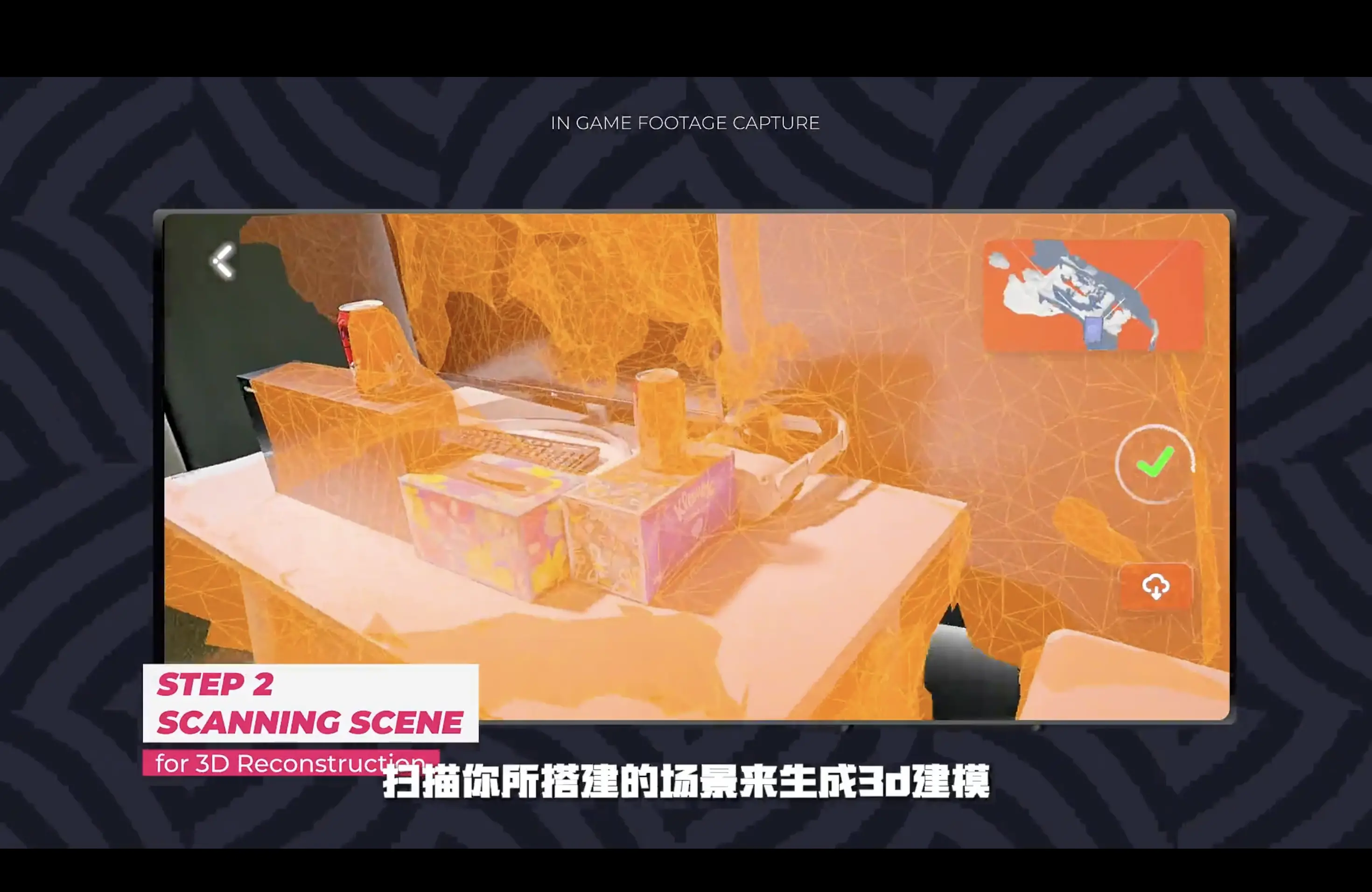
RealityGuard, a spatial application combining AR and gaming developed by Chenjing Technology
When asked why they chose Web3 as their battleground, Zeno told me that spatial data itself is a very decentralized digital asset, naturally fitting into the Web3 environment. The spatial data collected by Zeno will also be assetized in the future and traded using the ZENO token as currency, expanding the flow of ZENO within the ecosystem, with buyers being those tech companies in need of spatial data. As for more application scenarios for ZENO, they "will be further explored as the project progresses."
Through Zeno, it is believed that the role of the DeSci platform has been materialized; science does not have to be an obscure and difficult pure theoretical discipline. Like Xiaomi, the democratization of technology and lowering the threshold for technology value investment is also one of the important values of DeSci's existence.
 Risk warning Risk warning




Popular articles





