








Stablecoin Risk Guide: How to Avoid Potentially Problematic Stablecoins?
 Core Viewpoint

 Recently, this wave of DeFi pitfalls has only confirmed for us that stablecoins will never be permanently stable; they will only be "relatively stable."
Author: Chloe, ChainCatcher
Last week, the collapse of Stream Finance's xUSD and various stablecoins instantly pushed the entire DeFi market into a pit of fire. According to CryptoQuant data, the Stablecoin Supply Ratio (SSR) has dropped to a historical low, indicating that there is a lot of "gunpowder" waiting to enter the market. Perhaps retail investors have experienced the October liquidation and the November DeFi collapse, leading to more idle funds in the market waiting to be deployed. When stablecoins may essentially be unstable, retail investors should have a clear screening mechanism to determine which assets can truly generate returns.
Treasury-backed Stablecoins Become Market Mainstream, Accounting for 60%
Many stablecoins claim to be pegged to the US dollar at a 1:1 ratio, but the collateral assets and issuance mechanisms behind them vary greatly. Stablewatch's "Stablecoin Ecosystem Map," released on November 4, categorizes the stablecoins in the market into four main categories:
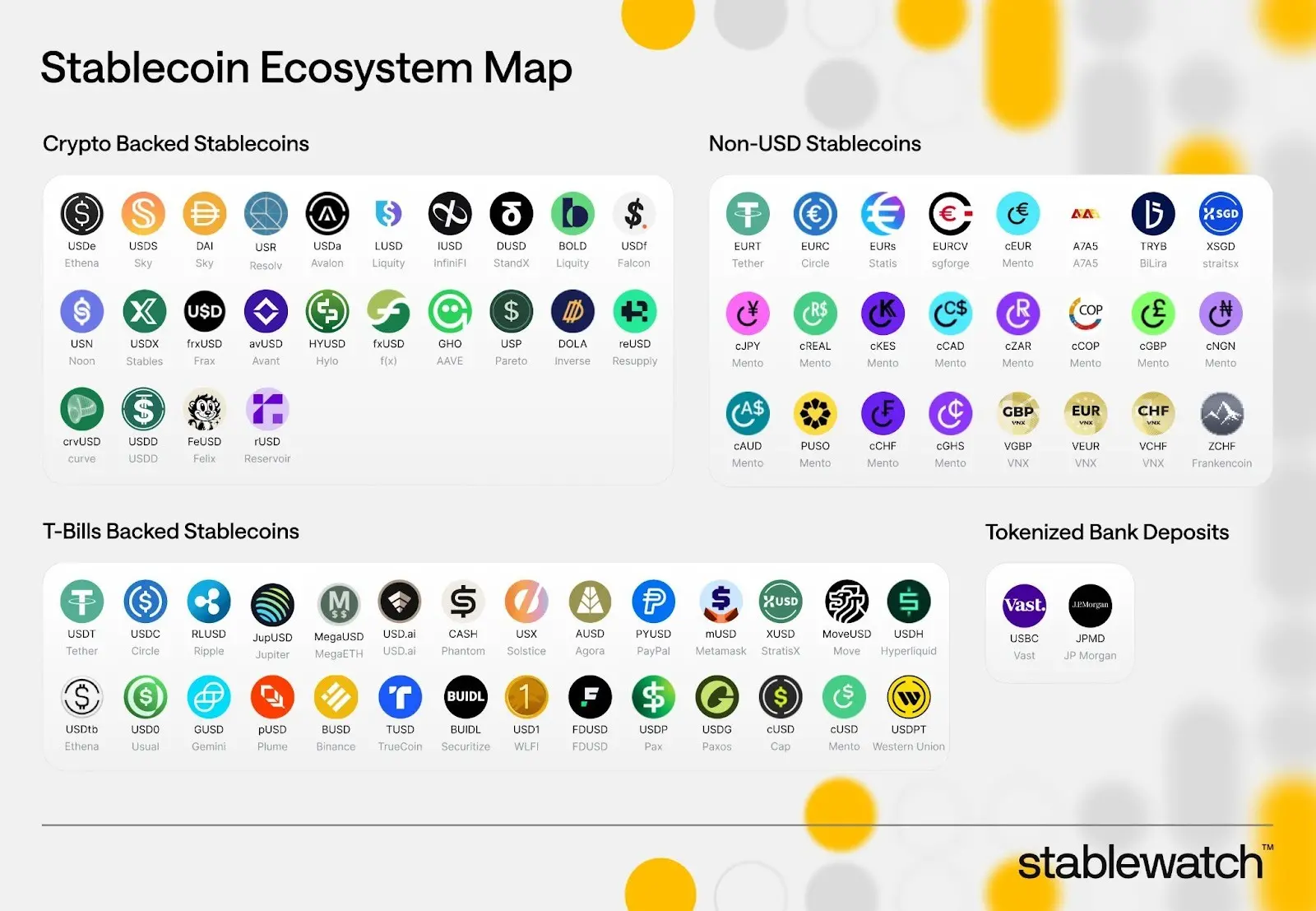
The first category is Crypto Backed, where stablecoins are over-collateralized with ETH, BTC, or other crypto assets, emphasizing decentralization and permissionless features. Representative projects include Ethena's USDe, Sky's DAI, and Curve's crvUSD, which together account for about 25% of the market share, with a Total Value Locked (TVL) exceeding $70 billion. The advantages are high transparency and programmability, while the downside is the inherent volatility of the collateral; once a black swan event occurs (like last week's USDX collapse), the chain reaction is often difficult to control.
The second category is T-Bills Backed, which is undoubtedly the market mainstream, accounting for as much as 60% with a total market cap exceeding $180 billion. These stablecoins are backed by US short-term Treasury bills or cash equivalents, are regulatory-friendly, and can provide stable yields. The leaders remain USDT and USDC, while PayPal's PYUSD has quickly risen.
The third category is Non-USD Stablecoins, which account for about 10%. They are pegged to the euro, yen, Singapore dollar, and even the Brazilian real and Kenyan shilling, targeting global payments. Circle's EURC, StraitsX's XSGD, and Mento's cEUR and cJPY are all emerging market payment needs, and there is a chance that these stablecoins could be the next trend.
Finally, Tokenized Bank Deposits currently account for only 5%, serving as the most direct bridge between traditional finance and blockchain. Projects like JPMD from JPMorgan and USBC from Vast directly put bank deposits on-chain, achieving 24/7 instant settlement.
The Closer the Collateral Assets Are to Crypto-Native or Wrapped Assets, the Higher the Decoupling Risk
@LumaoDoggie further categorizes stablecoins into "CeDeFi" (hybrid on-chain and off-chain models) and "pure on-chain" (permissionless collateral mechanisms), emphasizing that "over-collateralization does not equal safety." For the many stablecoins in the market, it is essential not only to look at surface stability but also to deeply examine the quality of the collateral, transparency, the soundness of the liquidation mechanism, and whether there is an insurance fund as a last line of defense.
First, the quality of collateral has a clear descending order: cash equivalents (Treasuries, dollar deposits) are the best, followed by USDC and USDT, and then native BTC and ETH; once wrapped tokens of BTC/ETH (like wBTC, stETH, cbBTC, etc.) are used, the risk level immediately drops to that of altcoins, with the worst being directly collateralized by meme coins.
The report "Stablecoin Security Risks in 2025" by Elliptic also points out that "the closer the collateral assets are to cash, the smaller and shorter the decoupling; the closer they are to crypto-native or wrapped assets, the larger and longer the decoupling."
Additionally, projects should ideally provide monthly or weekly third-party proof of reserves (PoR) to ensure asset details are publicly transparent. For example, Ethena's USDe provides a detailed collateral dashboard showing that BTC accounts for about 20%, ETH and LSTs (liquid staking tokens) about 11%, and liquid stablecoins about 62%, verified through Chainlink's price oracle and multiple audits from institutions like HT Digital and Chaos Labs to enhance trust.
In contrast, pure on-chain stablecoins emphasize a completely decentralized collateral mechanism. The focus here is on collateral diversification, meaning no single asset should exceed 50%, and the collateral ratio should be at least over 150%, while also having an insurance fund as a safety net. Taking Sky's USDS as an example, although some positions involve DeFi lending protocols, its insurance pool has exceeded $1 billion, effectively buffering market volatility.
Finally, LumaoDoggie named several stablecoins in the top 50 by market cap that users should avoid, mainly due to a lack of audits or overly concentrated collateral. These include StandX's DUSD, Avalon's USDa, and Gate's GUSD, which lack audit reports and data dashboards.
Additionally, Cardano's DJED is questioned because about 80% of its collateral is its own ADA token. Lastly, Celo's cUSD has 50% of its collateral in its own CELO, with the remainder in BTC/ETH and USDC/USDT, leading to overly concentrated collateral.
Notable Collapse Events: Even with Intact Collateral, Oracles or Exchanges Can Still Impact
Reviewing notable stablecoin collapse events over the past few years reveals that the reasons for failure extend far beyond collateral issues, including liquidity, reserve risks, algorithmic mechanism failures, and the accuracy risks of oracle and exchange price data.
The most famous example is the Terra UST incident in May 2022, where its pegging mechanism failed, resulting in the evaporation of tens of billions in market cap within just a few days. UST used an algorithmic stablecoin design, and algorithmic stablecoins largely rely on internal minting and burning mechanisms, which may fail when market redemptions accelerate, leading to system collapse.
There was also the reserve risk of USDC when Silicon Valley Bank (SVB) was announced to be closed by California regulators in 2023. Shortly after, USDC issuer Circle tweeted that SVB was one of Circle's six banking partners, and about $3.3 billion of the $40 billion USDC reserves were still in Silicon Valley Bank. Following this news, the stablecoin USDC dropped to a low of $0.86, briefly decoupling from the dollar.
In October of the same year, USDR faced a large number of redemption requests, leading to the depletion of DAI, which served as a liquidity reserve, causing it to drop to about $0.51. Although USDR has real estate backing, this non-liquid asset struggled to meet the short-term surge in redemption demand, resulting in panic selling and decoupling in the market.
Additionally, in October of this year, Ethena's USDe briefly dropped to $0.65 on Binance due to a localized pricing error. Although it quickly recovered on other exchanges, it highlighted that erroneous data sources or issues with the exchange's order book could lead to stablecoin decoupling, even if the collateral itself is intact.
Today, the total market cap of stablecoins continues to reach new highs, with more RWA, Treasuries, and tokenized projects emerging, but risks will never disappear. This recent wave of DeFi turmoil only confirms that stablecoins will never be permanently stable; they will only be "relatively stable." Instead of panicking, users should establish a screening mechanism in advance. If a project lacks strict risk management, a transparent collateral structure, and a sound redemption mechanism, these stablecoins are ultimately just ticking time bombs in disguise.
 Risk warning
 Risk warning






Popular articles





