








Even MicroStrategy has no ammunition to buy the dip in BTC, how is your DAT stock doing?
 Core Viewpoint

 Buy them, is it for the crypto exposure, or for that illusion of premium that no longer exists?
Original Title: "Even MicroStrategy Has No Ammo to Bottom-Fish BTC, How's Your DAT Stock?"
Original Author: David, Deep Tide TechFlow
In the past month, BTC has fallen from its historical high of $126,000 to below $90,000, a 25% pullback that has plunged the market into panic, with the fear index now in single digits.
But that man is still buying.
On November 17, Michael Saylor tweeted as usual on X: "Big Week."
Subsequently, an announcement revealed that MSTR bought another 8,178 BTC, spending $835.6 million, bringing its total Bitcoin holdings to over 649,000 coins.
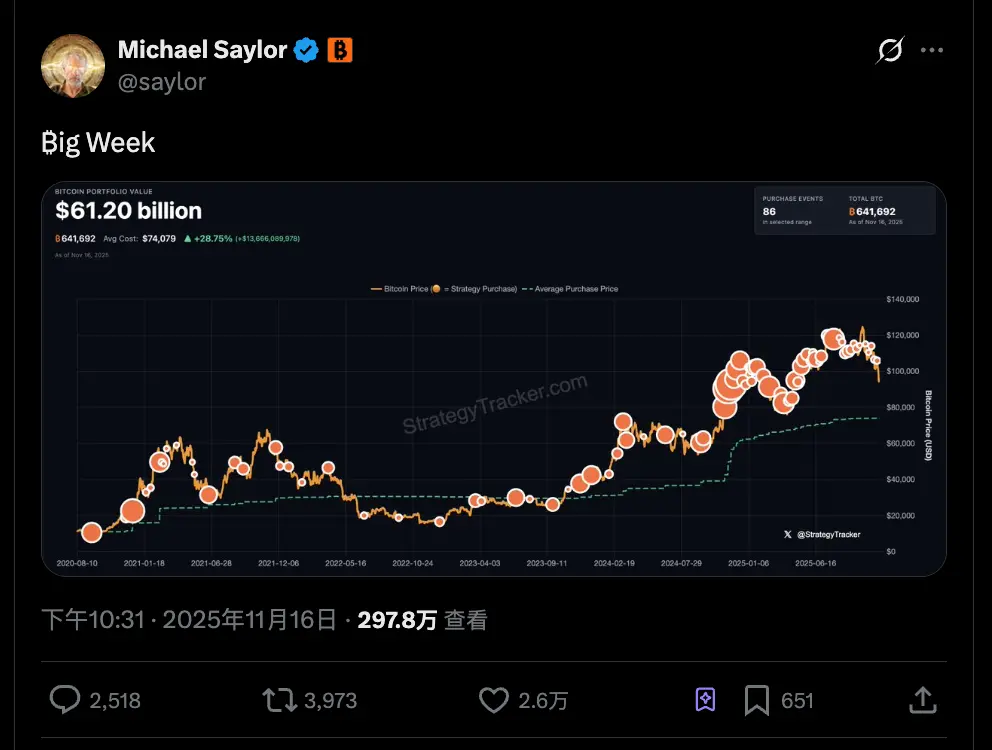
Don't panic, the biggest bull is still in the game. But is that really the case?
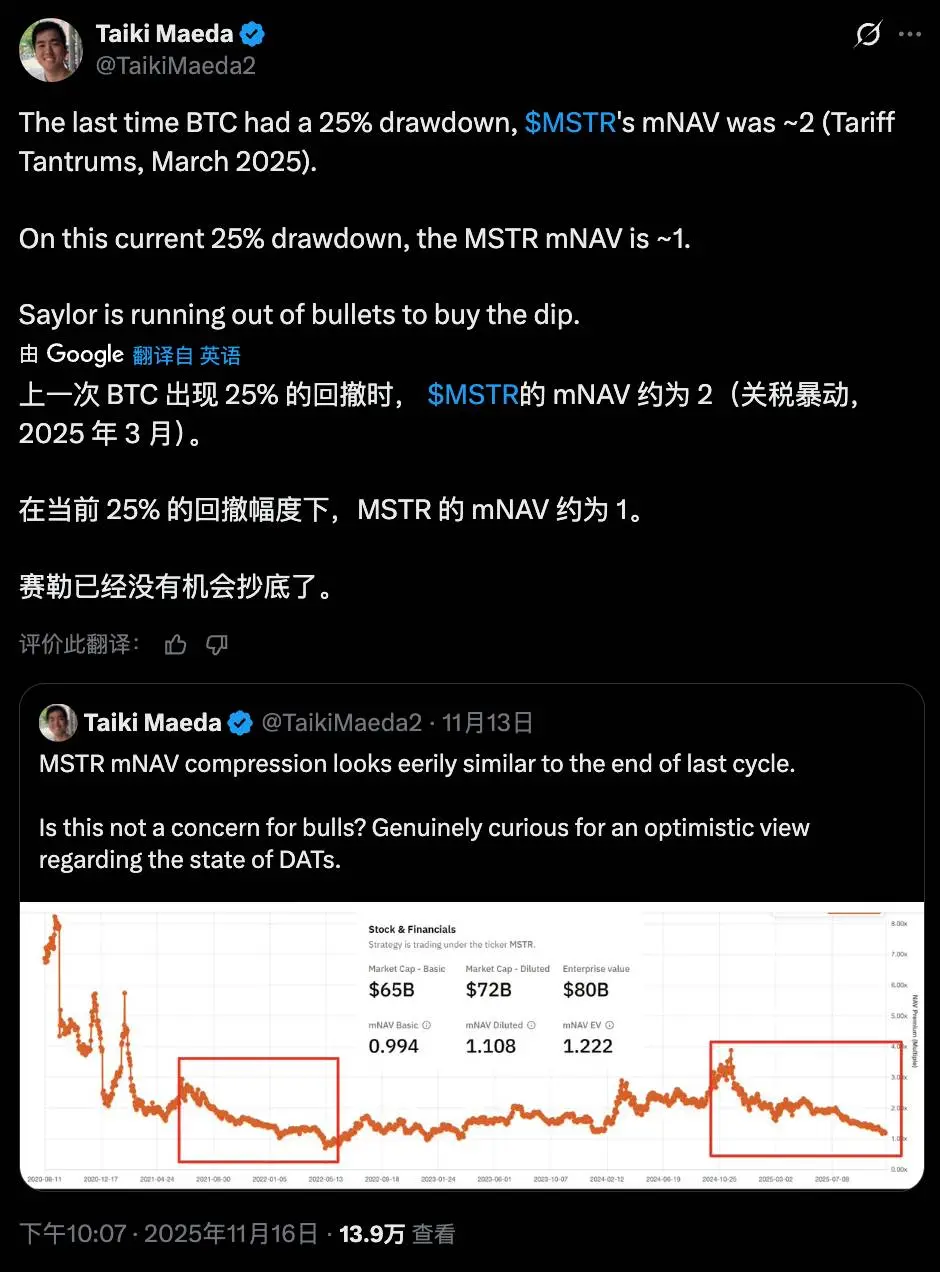
While Saylor's comment section is filled with excitement, someone unearthed a key piece of data:
MSTR's mNAV is about to drop below 1.
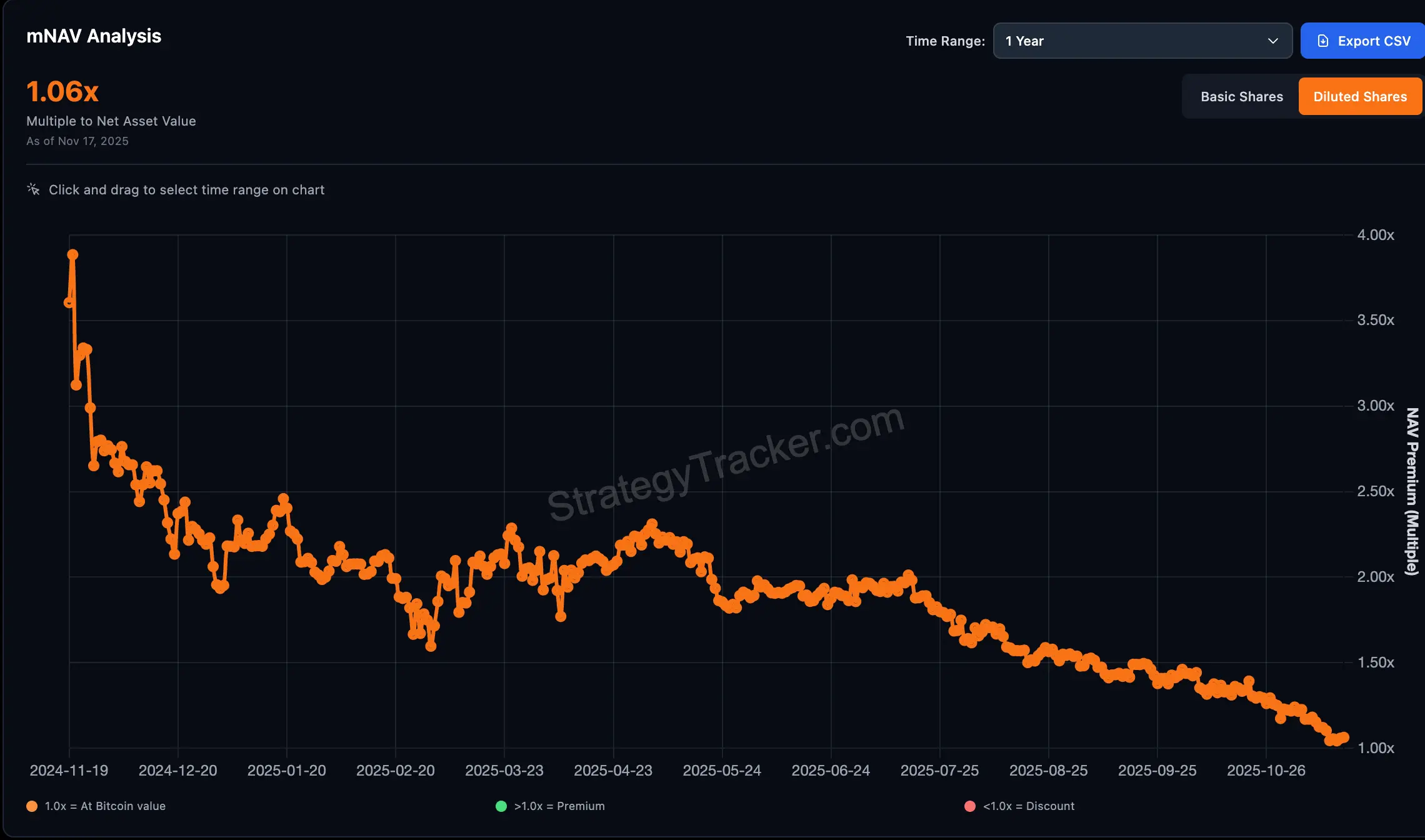
mNAV, or market net asset value, is a key indicator of MSTR's stock price relative to its BTC asset premium.
Simply put, mNAV=2 means the market is willing to pay $2 for $1 worth of BTC assets; mNAV=1 means the premium disappears; mNAV<1 means trading at a discount.
This metric is the lifeblood of Saylor's entire business model.
By comparison, when was the last time BTC dropped 25%? The answer is March of this year.
At that time, Trump announced tariffs on multiple countries, leading to widespread market despair, with the Nasdaq plummeting 3% in a single day, and the crypto market following suit.
BTC fell from $105k to $78k, a drop of over 25%. But at that time, MSTR was in a completely different state.
mNAV was still around 2, and Saylor had a full suite of financing tools: convertible bonds, preferred stock, ATM issuance… he could conjure up money to bottom-fish at any time.
What about this time? mNAV has dropped below 1.
This means that issuing stock to buy coins is gradually becoming unfeasible. For example, if they issue $1 worth of stock now, investors might only be able to buy $0.97 worth of BTC, which doesn't feel like bottom-fishing; it feels like a loss.
According to MSTR's Q3 financial report, the company's cash on hand is only $54.3 million.
In other words, it's not that Saylor doesn't want to bottom-fish with a big hand; it's that he might really not be able to buy.
Last November vs This November
Don't believe Saylor can't buy? You might want to check the books from this time last year.
In November 2024, Trump was elected, and BTC soared from $75k to $96k.
What was Saylor doing? Buying coins in large amounts.
Where did the money come from? Issuing bonds. A $3 billion convertible bond, maturing in 2029, and the key point is that there are no interest payments.
A year later, the situation has drastically changed.
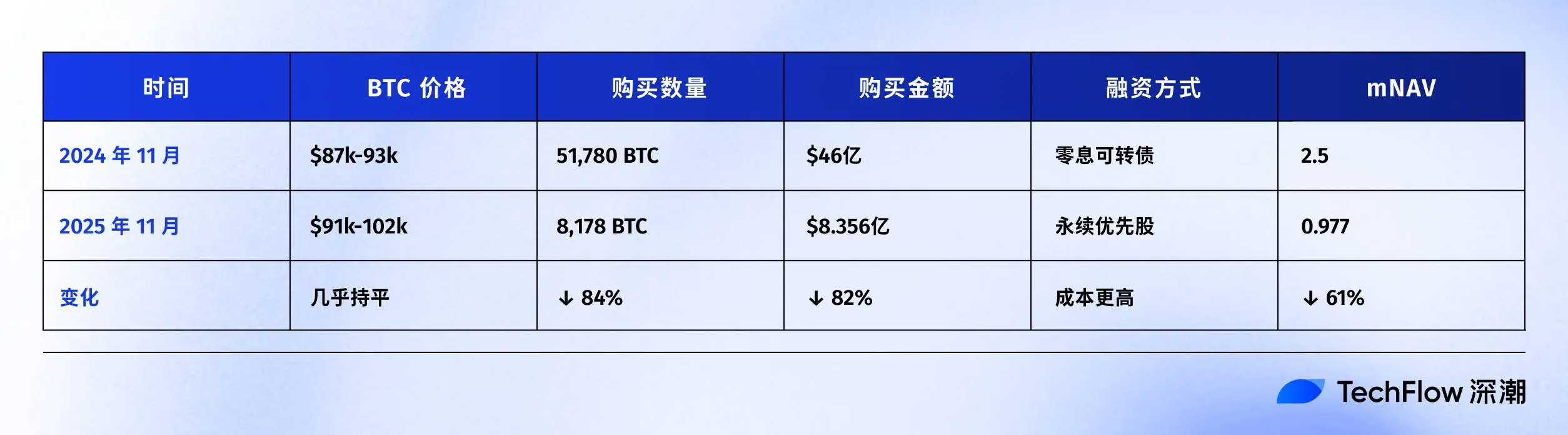
In addition to price changes, the shift in financing methods is also noteworthy.
Last year, Saylor borrowed $3 billion to buy BTC, with no interest payments, and just had to pay back the money in 2029. This was essentially free borrowing.
This year, Saylor can only sell a special type of stock (perpetual preferred stock), which requires him to take out 9-10% of MSTR's funds each year to distribute to those who buy these stocks.
The conditions have worsened; the market may have lost confidence in MSTR and is unwilling to lend him money for free anymore.
But with mNAV dropping below 1, the real trouble lies in the spiral chain reaction:
mNAV declines → financing ability weakens → must issue more stock → equity gets further diluted → stock price drops → mNAV continues to decline.
This spiral is happening.
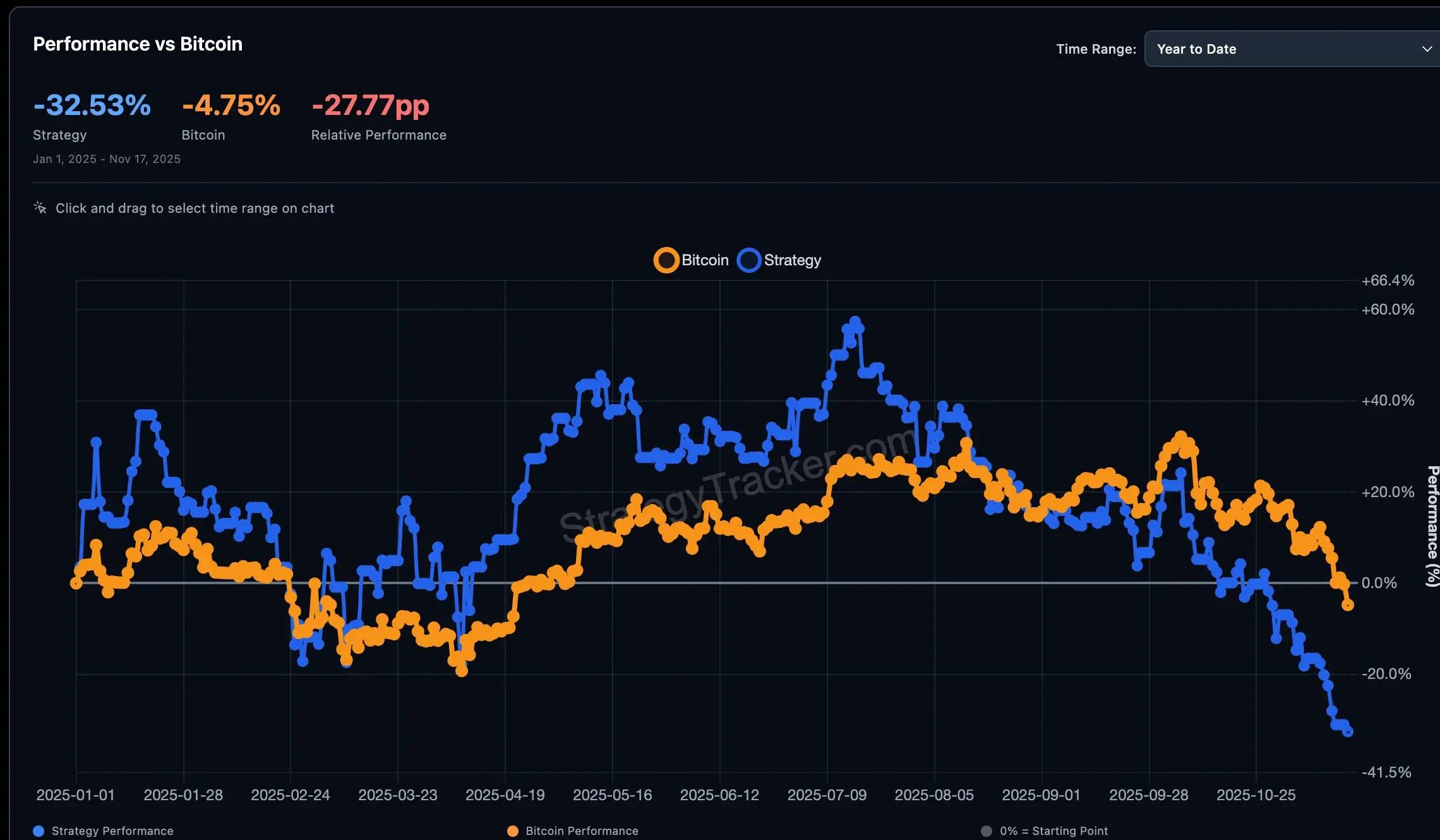
Since the beginning of this year, BTC has only dropped 4.75%, but MSTR's stock price has already fallen 32.53%.
On November 17, MSTR's stock price hit a 52-week low of $194.54, falling for six consecutive days. From the year's high, the stock price has dropped 49.19%.
MSTR's stock has underperformed BTC by 27 percentage points. The market is voting with its feet; rather than buying MSTR, it’s better to buy BTC directly.
Moreover, in the 2025 market, more and more companies are adopting Bitcoin and other tokens as a reserve strategy, and MSTR is no longer the only option.
As competition increases and the crypto market becomes less favorable, why should investors pay a premium for MSTR?
The logic of MicroStrategy's entire model is actually quite clear: continuously financing to buy BTC, using the value growth of BTC to support the stock price, and using the stock price premium to continue financing.
But when BTC plummets and mNAV drops below 1, this cycle is no longer as smooth as before.
In November, Saylor is still buying, but the ammo is clearly running low.
Other DAT Companies Are Also Struggling
MSTR's predicament is not an isolated case.
The entire Digital Asset Treasury (DAT) sector has been hit hard in November.
First, let's look at companies holding BTC:

These companies are Bitcoin miners + treasury model, and in the first two weeks of November, BTC dropped about 15%, but their stock prices fell by over 30%.
But worse off are those holding altcoins.
Companies holding ETH:

These companies use ETH as their main treasury asset. In the first two weeks of November, the price of ETH fell from $3,639 to $3,120 (-14.3%), but their stock prices dropped by 17-20%.
Companies holding SOL:

The most surreal case here is DFDV, whose stock price soared 24,506% in early 2025 due to its SOL treasury strategy. But by November 17, it had plummeted from a high of $187.99 to around $6.74.
Companies holding BNB:

Why do altcoin treasury companies fall even harder?
The logic is simple:
In this round of market correction, BTC dropped 25%, but altcoins like ETH, SOL, and BNB fell much more than BTC.
When the treasury assets themselves are more volatile, the stock prices will be further magnified. Moreover, altcoin treasury companies face an even bigger problem: liquidity risk.
BTC is the most liquid crypto asset; even holding hundreds of thousands of BTC, MSTR can slowly sell them through the OTC market or exchanges.
However, the liquidity of ETH, SOL, and BNB is far inferior to BTC. When market fear sets in, the selling pressure of millions of ETH can further crush prices, creating a vicious cycle.
This major drop in November is a comprehensive stress test.
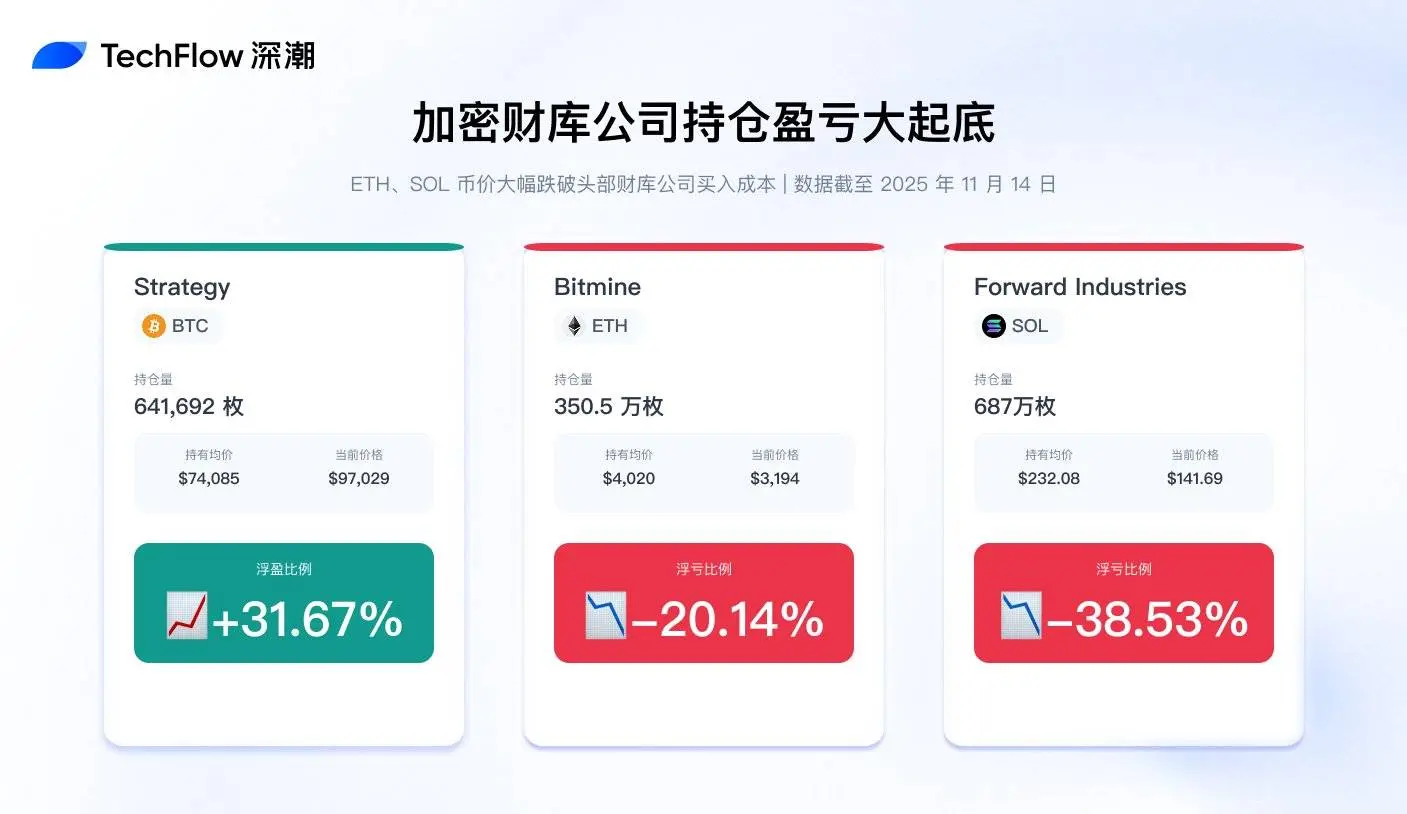
The results are clear: whether holding BTC or altcoins, DAT companies' stock prices have fallen far more than their treasury assets.
And companies holding altcoins face even more severe impacts.
When the Money Printer Fails
Returning to the question at the beginning of the article: if even Saylor can't buy, how's your DAT stock doing?
The answer is already clear.
The November market has stripped away the last layer of shame from DAT stocks. According to the latest data from SaylorTracker, the market value of MSTR's Bitcoin holdings has fallen below $60 billion, and its holdings of 649,870 BTC are about to see their unrealized gains drop below $10 billion.
When mNAV drops below 1, MSTR's "BTC money printer" model gradually fails. The path of issuing stock to buy coins is no longer smooth; rising financing costs and insufficient ammo are problems Saylor must face.
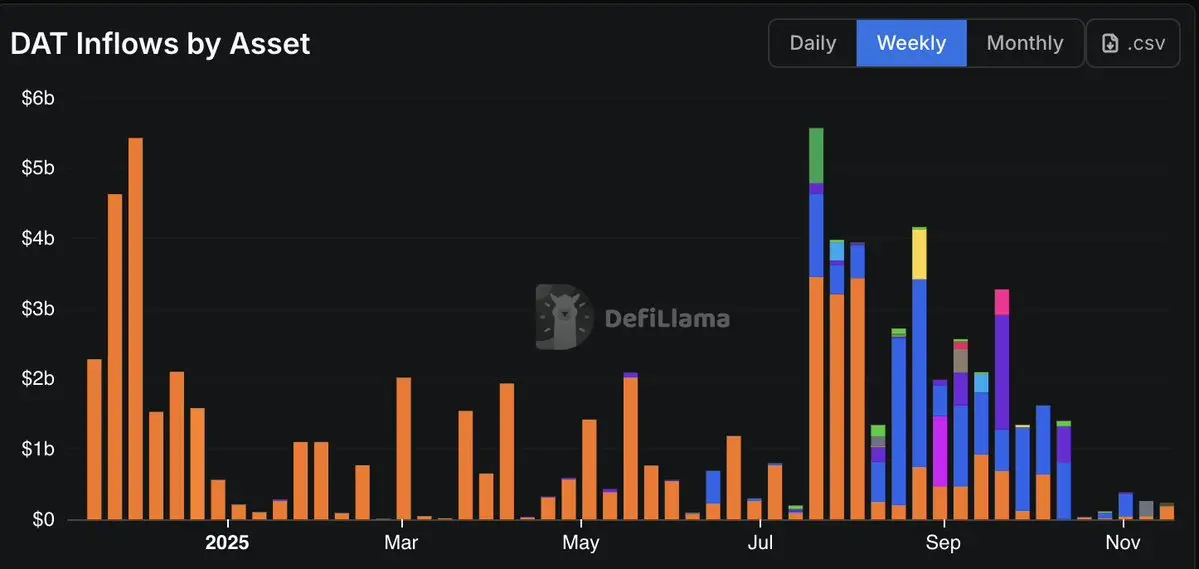
Data also corroborates this point: the inflow of funds into DAT companies has shown a downward trend, with October's inflow hitting the lowest record since the 2024 election.
BTC miner stocks generally fell by 30%, ETH treasury companies fell by 20%, and the stock prices of SOL and BNB treasury companies have plummeted to the point of questioning life. Regardless of which company you favor, the stock price declines far exceed the treasury assets themselves.
While there is certainly a broader market environment affecting investors in the current phase of the U.S. stock market, leading them to sell off in search of safety; the structural issues inherent in the DAT model are becoming increasingly tricky in a headwind:
When the crypto market corrects, the leveraged nature of DAT stocks amplifies the declines. You might think you're buying "BTC exposure with a premium," but in reality, it's a leveraged downturn accelerator.
If you still hold these stocks, perhaps you should ask yourself:
Are you buying them for crypto exposure, or for that now non-existent premium illusion?
 Risk warning
 Risk warning



Popular articles





