The "Bankruptcy" of Metcalfe's Law: Why Cryptocurrencies Are Overvalued?
 Core Viewpoint

 The current pricing of crypto assets is largely based on network effects that have yet to materialize, with valuations clearly outpacing actual usage, retention, and cost-capturing capabilities.
Original Title: Crypto Is Priced for Network Effects It Doesn't Have
Original Author: Santiago Roel Santos, Founder of Inversion
Original Compilation: AididiaoJP, Foresight News
The Dilemma of Network Effects in Cryptocurrency
My previous viewpoint on "cryptocurrency trading prices far exceeding their fundamentals" has sparked heated discussions. The strongest opposing voices are not about usage or fees, but stem from ideological differences:
· "Cryptocurrency is not a business"
· "Blockchain follows Metcalfe's Law"
· "The core value lies in network effects"
As a witness to the rise of Facebook, Twitter, and Instagram, I am well aware that early internet products also faced valuation challenges. However, the pattern has become increasingly clear: as users join social circles, the value of the product experiences explosive growth. User retention strengthens, engagement deepens, and the flywheel effect is clearly visible in the experience.
This is the true manifestation of network effects.
If we argue that "cryptocurrency value should be assessed from a network rather than a business perspective," then we should delve deeper into the analysis.
Upon further investigation, an undeniable issue emerges: Metcalfe's Law not only fails to support the current valuation but also exposes its fragility.
The Misunderstood "Network Effects"
The so-called "network effects" in the cryptocurrency space are mostly negative effects:
· User growth leads to a deterioration of experience
· Transaction fees soar
· Network congestion intensifies
The deeper issues are:
· Open-source characteristics lead to developer attrition
· Liquidity is profit-driven
· Users migrate across chains based on incentive measures
· Institutions switch platforms based on short-term interests
Successful networks have never operated this way; the experience never declined when Facebook added millions of users.
But New Blockchains Have Solved Throughput Issues
This indeed alleviates congestion, but it does not address the fundamental problem of network effects. Increasing throughput merely eliminates friction and does not create compound value.
The fundamental contradictions still exist:
· Liquidity may dissipate
· Developers may relocate
· Users may leave
· Code can be forked
· Value capture capability is weak
Scalability improves usability, not necessity.
The Truth Revealed by Fees
If L1 blockchains truly possess network effects, they should capture most of the value like iOS, Android, Facebook, or Visa. The reality is:
· L1 occupies 90% of total market capitalization
· Fee share plummeted from 60% to 12%
· DeFi contributes 73% of fees
· Valuation share is less than 10%
The market is still pricing based on the "fat protocol theory," yet the data points to the opposite conclusion: L1 is overvalued, applications are undervalued, and ultimately, value will aggregate towards the user layer.
User Valuation Comparison
Using common metrics, the market value per user:
Meta (Facebook)
· 3.1 billion monthly active users
· $1.5 trillion market cap
· Value per user: $400-500
Cryptocurrency (excluding Bitcoin)
· $1 trillion market cap
· 400 million general users → $2,500 per person
· 100 million active users → $9,000 per person
· 40 million on-chain users → $23,000 per person
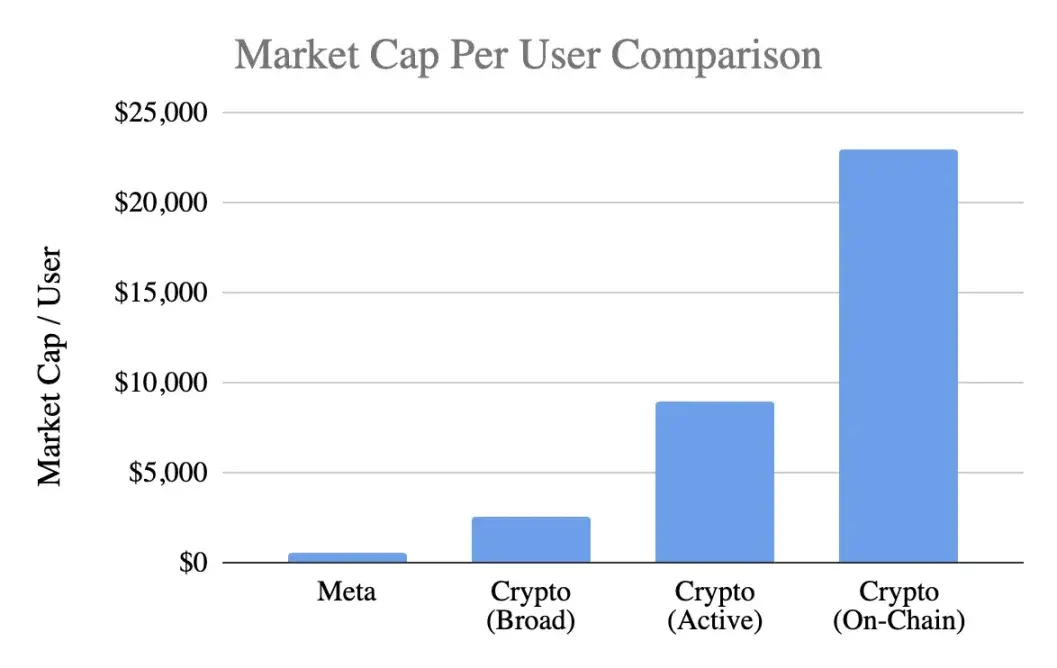
Valuation levels reach:
· Most optimistic estimate premium of 5 times
· Strict standards yield a premium of 20 times
· Based on real on-chain activity, a premium of 50 times
And Meta is arguably the most efficient monetization engine in the consumer tech space.
Analysis of Development Stages
The argument that "Facebook was the same in its early days" is debatable. Although Facebook also lacked revenue in its early days, its product had already built:
· Daily usage habits
· Social connections
· Identity recognition
· Community belonging
· Value enhancement from user growth
In contrast, the core products of cryptocurrency remain speculative, leading to:
· Rapid influx of users
· Even faster attrition
· Lack of stickiness
· No established habits
· No improvement with scale
Unless cryptocurrency becomes "invisible infrastructure," a bottom-layer service that users are unaware of, self-reinforcing network effects will be difficult to achieve.
This is not a matter of maturity but rather a fundamental issue with the product.
The Misuse of Metcalfe's Law
While the law describes value ≈ n² beautifully, its assumptions contain biases:
· Users need to interact deeply (which is rare in practice)
· The network should have stickiness (which is lacking in practice)
· Value should aggregate upwards (which is actually dispersed)
· There should be switching costs (which are very low in practice)
· Scale builds a moat (which has not yet manifested)
Most cryptocurrencies do not meet these prerequisites.
Insights from the Key Variable k Value
In the V=k·n² model, the k value represents:
· Monetization efficiency
· Level of trust
· Depth of participation
· Retention capability
· Switching costs
· Ecosystem maturity
The k values for Facebook and Tencent range from 10⁻⁹ to 10⁻⁷, due to the vast scale of their networks.
Calculating the k value for cryptocurrency (based on a $1 trillion market cap):
· 400 million users → k≈10⁻⁶
· 100 million users → k≈10⁻⁵
· 40 million users → k≈10⁻⁴
This implies that the market presumes each cryptocurrency user is worth far more than a Facebook user, despite their lower retention rates, monetization capabilities, and stickiness. This is no longer early optimism but rather an overextension of future potential.
The Current State of Real Network Effects
Cryptocurrency actually possesses:
Bilateral network effects (users ↔ developers ↔ liquidity)
Platform effects (standards, tools, composability)
These effects exist but are fragile: easily forked, compounded slowly, and far from achieving the n² level flywheel effects of Facebook, WeChat, or Visa.
A Rational Perspective on Future Prospects
The vision that "the internet will be built on encrypted networks" is indeed enticing, but it needs to be clarified:
This future may be achievable, but it is not yet here,
The existing economic model has not reflected this.
Current value distribution shows:
· Fees flow to the application layer rather than L1
· Users are controlled by exchanges and wallets
· MEV captures value surplus
· Forking weakens competitive barriers
· L1 struggles to solidify the value created
Value capture is undergoing a migration from the foundational layer to the application layer to the user aggregation layer, which benefits users, but they should not pay a premium for this ahead of time.
Characteristics of Mature Network Effects
A healthy network should exhibit:
· Stable liquidity
· Concentrated developer ecosystem
· Increased fee capture at the foundational layer
· Continued retention of institutional users
· Growth in cross-cycle retention rates
· Composability defending against forking
Currently, Ethereum shows early signs, Solana is poised for growth, but most public chains are still far from this.
Conclusion: Valuation Judgments Based on Network Effect Logic
If cryptocurrency users:
· Have lower stickiness
· Find monetization more difficult
· Experience higher attrition rates
Then their unit value should be lower than that of Facebook users, rather than exceeding them by 5-50 times. The current valuation has overextended the yet-to-be-formed network effects, and the market pricing seems to assume that a powerful effect already exists, which is not the case, at least not yet.
 Risk warning Risk warning




Popular articles