








ARK Invest: Stablecoins are building the next generation of monetary systems
 Core Viewpoint

 The current situation of stablecoins is very similar to privately issued currencies before 1913.
Original Title: Will Stablecoins Become The Backbone Of A New Monetary Order?
Original Author: Lorenzo Valente, Director of Digital Asset Research at ARK Invest
Original Translation: Chopper, Foresight News
In 2025, the supply, trading volume, and active user count of stablecoins reached an all-time high, thanks to the introduction of the GENIUS Act, which legalized the status of stablecoins as privately issued digital currencies.
The views in this article stem from an interview on the Bitcoin Brainstorm podcast by ARK Invest, featuring guests including Tether CEO Paolo Ardoino, renowned economist Dr. Arthur Laffer, and ARK Invest CEO and Chief Investment Officer Cathie Wood.
In the interview, we explored the similarities between stablecoins and privately issued currencies prior to 1913 (when the U.S. government designated the Federal Reserve as the sole issuer of the dollar). Arthur Laffer compared the explosive growth of privately issued dollars based on blockchain today to the monetary system before the Federal Reserve terminated "free banking."
While the underlying technological infrastructure of stablecoins is entirely new, privately issued currency is not a novel concept. In fact, private currency was a crucial foundation for the establishment of the U.S. economy.
Against this backdrop, this article will answer three core questions: How did stablecoins come into existence? What is the underlying technology of stablecoins? What will the future trajectory of stablecoins look like?
How Did Stablecoins Come Into Existence?
In 2014, Giancarlo Devasini launched USDT and the Tether platform, at a time when the digital asset industry was still in its infancy. The crypto ecosystem was in a "wild west" phase, lacking regulatory oversight, facing security risks, and having weak infrastructure, with the global trading market dominated by a few exchanges like Kraken, Bitfinex, Coinbase, Poloniex, and Bitstamp. The bankruptcy of Mt. Gox, then the largest Bitcoin exchange, in February 2014 further highlighted the industry's fragility.
At that time, other exchanges were scattered across different jurisdictions and only traded the then sole mainstream token—Bitcoin. Although Bitcoin trading had become global, arbitrageurs could not quickly and cheaply transfer dollars between banks, brokers, and countries, making it difficult to seize arbitrage opportunities.
For example, when Bitcoin was quoted at $115 on Kraken and $112 on Bitfinex, an arbitrageur should have sold Bitcoin on Kraken, transferred the dollars to Bitfinex, and then bought back Bitcoin at $112. However, in practice, this transfer often took 1 to 2 days.
It was the efforts of Giancarlo and Paolo that made USDT the solution to this problem, enabling the internet-speed transfer of dollar equivalents. In July 2014, USDT was initially launched under the name "Realcoin," developed on the Omni Layer protocol based on the Bitcoin network, at a time when Ethereum and other smart contract chains had not yet emerged. In November 2014, the project was officially renamed Tether and launched three tokens pegged to fiat currencies: USDT (pegged to the dollar), EURT (pegged to the euro), and JPYT (pegged to the yen).
In 2015, Bitfinex, one of the world's leading exchanges, began supporting USDT and built the first deep liquidity pool. From 2017 to 2019, Tether expanded the issuance network of USDT from Omni to Ethereum, and subsequently to public chains like Tron, Solana, and Avalanche, while continuously improving transaction speed, reducing fees, and enhancing cross-chain interoperability.
By 2019, USDT became the most traded crypto asset globally, with daily trading volumes even surpassing Bitcoin. At the end of 2019, when competitors claimed their stablecoins were backed by 100% cash or cash equivalents, Tether disclosed for the first time that its reserve assets included A1 and A2 rated commercial paper and announced plans to gradually shift its reserves towards U.S. Treasury bills and cash.
The outbreak of the COVID-19 pandemic propelled USDT into a period of rapid growth. Between 2020 and March 2022, as the global financial system faced immense pressure, the supply of USDT skyrocketed from $3.3 billion to $80 billion, a 25-fold increase, primarily driven by emerging markets. The core use of USDT also shifted from a speculative and arbitrage tool in the crypto market to a "lifeline" against local currency depreciation.
From 2020 to 2023, local currencies in emerging market countries like Venezuela, Lebanon, and Argentina depreciated significantly against the dollar, leading residents to choose USDT to preserve their assets. For many, USDT serves as a savings account, payment tool, and store of value.
As countries restricted offline transactions, access to black market dollars diminished, and young people began teaching their parents and grandparents how to use this "digital dollar." People could hold dollar assets through USDT in a faster, safer, and more scalable way without relying on fragile banking systems and volatile local currencies.
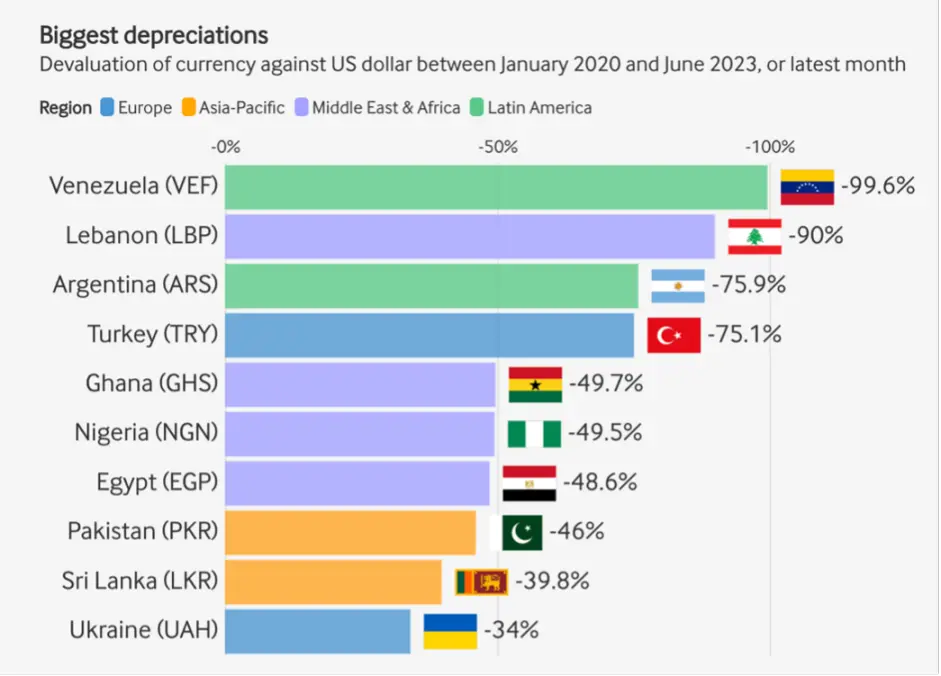
Depreciation of fiat currencies against the dollar in some countries. Data source: rwa.xyz, as of December 31, 2025.
What Stage Have Stablecoins Reached Today?
Currently, Tether's USDT supply has reached $187 billion, capturing 60% of the market share, making it the largest stablecoin in the digital asset industry, with its only competitor being Circle's USDC, which has a supply of $75 billion. USDT has over 450 million global users, with approximately 30 million new users added each quarter; Tether is headquartered in El Salvador and regulated locally, with reserve assets held by Cantor Fitzgerald.
The U.S. government has begun to take strategic interest in Tether. The vast majority of Tether's balance sheet consists of U.S. Treasury bills, with holdings comparable to those of some developed countries, making it one of the largest and fastest-growing demanders of U.S. Treasury bonds.
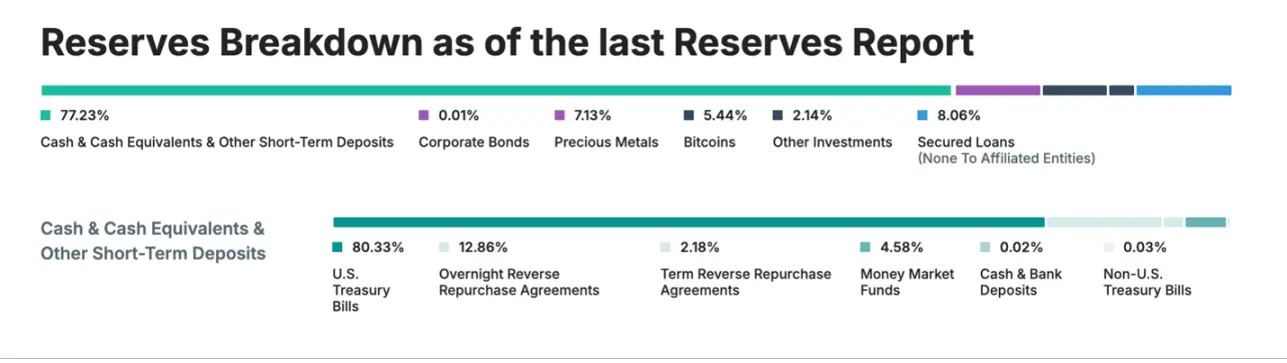
Tether's reserve assets, data source: Tether, as of December 31, 2025.
As of January 2026, Tether's reserve assets, excluding corporate bonds, gold, Bitcoin, and secured loans, included over-collateralized assets exceeding $5 billion, far surpassing the total liabilities of USDT in circulation. With the continued growth of stablecoin supply and Tether's strengthening dominance in emerging markets, coupled with the introduction of the GENIUS Act, some observers have noted that the current banking landscape is highly reminiscent of the free banking era of the late 19th century; critics often cite this period as a case study when discussing the risks of privately issued currency.
In the interview, Dr. Arthur Laffer argued that stablecoins will introduce a new, more efficient model of free banking to the U.S., and that the negative perceptions surrounding them are unfounded.
Critics claim that the issuance of stablecoins by private entities like Tether and Circle will recreate the "wildcat banking" chaos of the 19th century. Dr. Laffer explained that the reason private banknotes in the 19th century often traded at a discount was that users had to assess the creditworthiness of the issuing institutions themselves, and the U.S. government did not guarantee these banknotes; they were essentially liabilities of the banks, redeemable only when the issuing bank was solvent.
Historians at the Laffer Center, including Brian Domitrovic, noted that before the establishment of the Federal Reserve in 1913, various currencies in the U.S. were in a state of competition.
Dr. Laffer further elaborated that in 1834, the U.S. government set the price of gold at $20.67 per ounce, establishing the gold standard, but did not guarantee the redemption of every banknote in circulation; the ability of banknotes to be redeemed depended entirely on the balance sheet and market reputation of the issuing bank. This mechanism contradicted the principle of "unconditional redemption" of currency. Nevertheless, prices remained remarkably stable over the long term: from 1776 to 1913, the cumulative inflation rate in the U.S. was 0, with prices fluctuating slightly around fixed values without a long-term upward or downward trend.
Some free banking systems outside the U.S. performed even better, particularly in Scotland (1716-1845) and Canada (1817-1914). These regions achieved low inflation and extremely low bank failure rates, with their issued banknotes circulating at or near face value. Part of this success was due to the establishment of competitive redemption mechanisms and note exchange systems, both of which constrained banks through market forces.
In contrast, in the U.S. (1837-1861), restrictive regulations in various states became obstacles to industry development, such as prohibiting banks from establishing branches and requiring banks to use high-risk state government bonds as collateral. After a turbulent period in the early 1840s, the average discount rate of "bankrupt banknotes" (i.e., currency issued by banks unable to redeem) fell below 2%. Interestingly, this figure is precisely the inflation target of the Federal Reserve today. During this period, the U.S. economy experienced robust growth, laying the financial foundation for the full-blown industrial revolution after the Civil War in 1865.
Stablecoins share many similarities with the currency of this period. Both are privately issued liabilities supported by reserve assets. However, modern technology and regulatory oversight have addressed many of the shortcomings of the "wildcat banking" era. Stablecoins are not constrained by bank branch regulations, as they are essentially global digital currencies.
Today, functions similar to clearinghouses exist in the form of highly liquid secondary markets, trading platforms, and arbitrage mechanisms that ensure stablecoins remain closely pegged to market prices. Compared to the illiquid government bonds held by free banks in the late 19th century, the quality of collateral from regulated issuers (such as cash and short-term Treasury bills under the GENIUS framework) and some non-regulated issuers (like Tether) is significantly higher. Due to regular audits, on-chain transparency, and federal oversight, the risk of fraud for large issuers has also been greatly reduced.
Just as the free banking system emerged when central banking systems were weak or not yet established, the birth of stablecoins stems from the market void left by inefficient banking and payment systems, strict regulations, and high transaction costs. In the 18th and 19th centuries, railroads, telegraphs, and advanced printing technology propelled the development of the free banking system; today, blockchain and global internet infrastructure are becoming the core driving forces behind the development of stablecoins.
The era of free banking in the U.S. ended after the Civil War and the passage of the National Banking Act, which centralized the power to issue currency under federal control. At the beginning of the Civil War, the U.S. suspended the gold standard, and during the war from 1861 to 1865, states required banks to hold state government bonds as reserve assets, creating market demand for state government bonds; at the same time, the U.S. government taxed all bank-issued currency not backed by high-quality federal government bonds, ultimately forcing the currency issued by free banks out of the market.
In 1879, the U.S. restored the gold standard, and the 1870s and 1880s became the fastest-growing period in U.S. history.
Against the backdrop of the U.S. economy growing far faster than government development, the requirement for currency issuers to hold large amounts of federal bonds as reserves became meaningless. As the supply of federal bonds could not meet reserve requirements, banks had to frequently reduce the scale of currency issuance, leading to deflation and banking panics; ultimately, Congress passed the Federal Reserve Act in 1913, nationalizing the reserve system and establishing the Federal Reserve.
Before 1913, during banking panics, the private note exchange system and interbank temporary certificate agreements could provide significant liquidity, but federal regulation tied currency issuance to federal bond reserves, restricting the money supply. After the establishment of the Federal Reserve in 1913, the U.S. began to experience persistent inflation: the consumer price index skyrocketed over 30 times. In stark contrast, in the century before the establishment of the Federal Reserve, the coexistence of the gold standard, bimetallism, and competitive currency issuance resulted in a cumulative inflation rate of 0, even as the industrial revolution fully erupted.
Future Development Directions of Stablecoins
Issuers of stablecoins like Tether and Circle cannot maintain pegged exchange rates through active issuance or redemption of tokens; only institutions that enter a whitelist and meet anti-money laundering customer identification requirements can issue new USDT by depositing cash or redeem tokens and return them to Tether. The pegged exchange rate of stablecoins is maintained by institutions through arbitrage mechanisms, while Tether and Circle promise that every circulating USDT and USDC can be redeemed for 1 dollar.
Dr. Laffer believes that this model holds significant value in emerging markets and high-inflation economies, but to achieve widespread application in developed countries, a more advanced stablecoin model is needed: one that can maintain a pegged exchange rate with the dollar while appreciating in line with inflation, thus preserving purchasing power for goods and services.
Based on the recently introduced GENIUS Act, Tether co-founder Paolo Ardoino believes that any stablecoin that directly distributes profits to users should be classified as a security and subject to regulation by the U.S. Securities and Exchange Commission. Currently, interest-bearing "tokenized money market funds" are only open to accredited investors. Dr. Laffer argues that future stablecoins will be linked to a basket of commodity and service indices, supported by long-term assets like Bitcoin and gold.
In fact, Tether has launched gold-backed stablecoins, such as the Gold Coin (AUSDT) and tokenized gold products (XAUT). As Ardoino stated, this structure allows users to hold long positions in Bitcoin and gold while using these value-stable tools for transactions; as collateral assets appreciate, users' borrowing capacity will also increase.
It is worth noting that this model is not the first of its kind in the crypto space. One of the earliest and most vibrant experiments in decentralized finance, the Sky protocol (formerly MakerDao), pioneered the concept of collateralized stablecoins. Sky, as a decentralized bank, issues the dollar stablecoin USDS, allowing users to deposit assets like Ethereum into smart contracts to borrow USDS. To ensure solvency, all loans are made on an over-collateralized basis, triggering automatic liquidation when the value of collateral falls below a safety threshold.
Currently, USDS is introducing a diversified collateral asset portfolio to minimize risk while maximizing efficiency and returns.
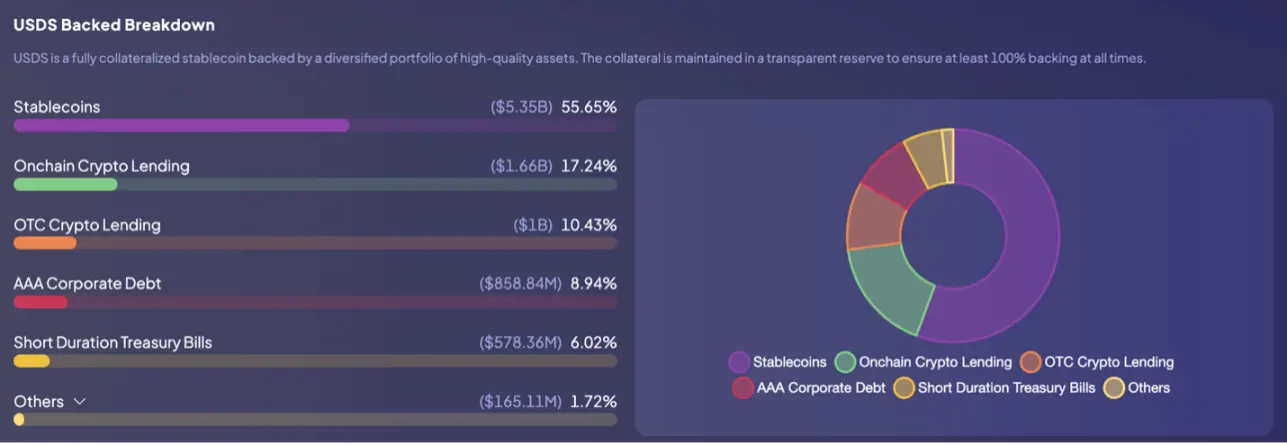
Composition of collateral assets behind USDS.
To further stabilize the pegged exchange rate, Sky has launched a Peg Stabilization Module (PSM), supporting direct exchanges between USDC and USDS, allowing arbitrageurs to maintain the price of USDS near $1 while providing liquidity and redemption capabilities for stablecoins, compensating for the volatility of crypto collateral prices.
In addition to trading functions, Sky has introduced a savings mechanism through the interest-bearing token sUSDS, with yields sourced from interest paid by borrowers, tokenized money market funds, U.S. Treasury bonds, and returns from decentralized finance investments. In other words, USDS serves both as a medium of exchange and a global savings tool.
After the introduction of the GENIUS Act, many observers are focused on how Tether will enter the U.S. market. In Ardoino's view, one of the fastest-growing applications for stablecoins is in commodity trading settlements, as more and more commodity traders realize that stablecoins are the most efficient settlement tools. In 2025, Tether began providing settlement services for oil trading, significantly boosting global demand for USDT in the commodity market.
Ardoino stated that if stablecoins do not integrate into the local economy, they typically serve only as a temporary settlement layer, ultimately being exchanged back into local currency; however, in emerging markets where local currencies are unstable, USDT serves not only as a payment tool but also as a savings and store of value, allowing it to circulate continuously and be widely used locally.
Tether understands that the U.S., Latin America, and Africa are distinctly different markets. In developed countries, people can use electronic dollars through platforms like Venmo, Cash App, and Zelle. In the coming months, Tether will launch a new stablecoin, USAT, designed specifically for developed country markets, marking the global largest stablecoin issuer's entry into the world's largest financial market, which is worth our close attention.

 Risk warning




Popular articles





