








Using Skill Creator, my content creation efficiency has increased by 300%

 Say goodbye to inefficient hard work, and learn how to use Skill Creator to encapsulate experience into automated productivity.
Author: Denise | Biteye Content Team
As a content creator, you have likely gone through a process like this:
Research → Choose a topic → Write content → Self-doubt → Revise repeatedly → Formatting struggles → Publish → No one reads it.
The problem is not that you are not working hard, but rather that: it relies on feelings, information is chaotic, topic selection gets stuck, you don't know what's wrong after finishing writing, formatting is time-consuming, output is slow, and quality is unstable.
The solution is to reconstruct the content workflow using "skills" for the recurring steps in this entire process. By writing out these skills, you can turn implicit experience into explicit tools, making the entire chain from information gathering to final output more systematic, significantly improving efficiency and quality.
This article focuses on teaching you how to write your own skills, providing three core practical skills based on the actual workflow of content creators, and sharing the SKILL.md standard format to help you get started faster.
1. What is "skill" in content creation?
In simple terms, it means writing down the things you repeatedly do into a set of "instructions" that can be executed repeatedly.
When you write your experience as a skill, several things will happen:
Makes vague experiences replicable: Not knowing how to convert information into topics after gathering it, not knowing how to check after finishing a draft… After writing it as a skill, you can operate according to the standard process each time.
Significantly reduces repetitive inefficiencies: Avoid starting from scratch every time, speeding up steps like topic selection, auditing, and formatting.
Improves output quality and stability: With clear steps and output standards, the quality of the articles becomes more controllable.
Builds a personal content creation system: By combining multiple skills, you form a complete chain from information gathering → topic selection → writing → auditing → formatting → publishing.
2. Don't be afraid, beginners! The tutorial is as follows
Writing skills is actually very simple, you just need a folder + a SKILL.md file.
Step 1: Install Skill Creator (your "skill factory")
Before you officially start writing skills, it is highly recommended to install Skill Creator first.
It is not used to execute a specific business but is specifically designed to help you (and AI Agents) write, test, validate, and package new skills faster and more规范化.
Its core uses are threefold:
Skill initialization: It has a built-in init_skill.py script. As long as you have a new idea, you can generate a standard Skill folder template with one click, which already contains the correct SKILL.md structure, greatly reducing manual creation errors.
Standard guidelines: It comes with a complete "skill writing guide" that teaches you how to break down complex business logic into instructions, steps, and output formats that AI Agents can easily understand.
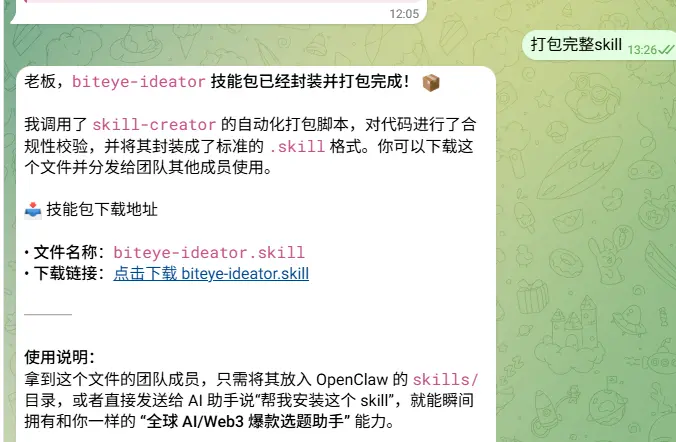
Automated packaging: It has built-in packageskill.py and quickvalidate.py. After writing the Skill, it can automatically perform safety checks, structural checks, and then package it into a standard .skill file with one click, making it easy for you to use, back up, or share with others.
With it, your efficiency in writing skills will increase several times, and beginners will find it easier to avoid pitfalls.
Step 2: Use Skill Creator to initialize and write a Skill
After installing Skill Creator, you can start creating your first skill.
The entire process is super simple: initialize the template with the tool → continuously describe your needs in natural language → let AI help you refine → test and iterate.
The core technique is to keep describing your needs. Don't try to write perfectly in one go; instead, talk step by step as if you are chatting with a patient assistant, clarifying your experience. AI will help you fill in and optimize SKILL.md based on your description.
SKILL.md is the most critical file, and it must contain two parts:
- Metadata
Used to tell the AI Agent what this skill is called and its trigger keywords.
name: Skill Name
description: A detailed description of what this skill does and in what dialogue scenarios it should be triggered (this determines the success rate of AI Agent calls).
- Core Instructions
Teach me how to work with specific steps.
Skill Title
Core Process
What to do in the first step…
Which script to call in the second step…
Output Specifications
What format is required for the output (e.g., Markdown table, JSON, etc.).
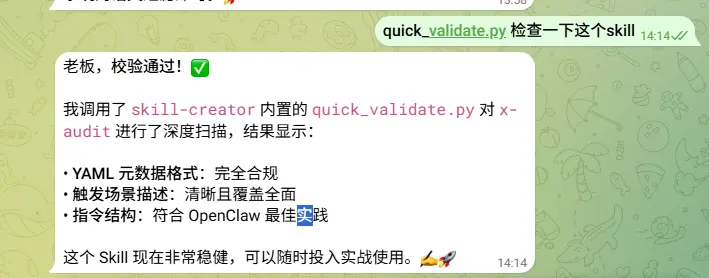
Beginner Tips: After writing, check it with Skill Creator's quick_validate.py, then package and test. It's okay if it's not perfect; just iterate a few more times.
3. Practical Example: Creating 3 Practical Skills for Content Creators
- Content Topic Selection Skill
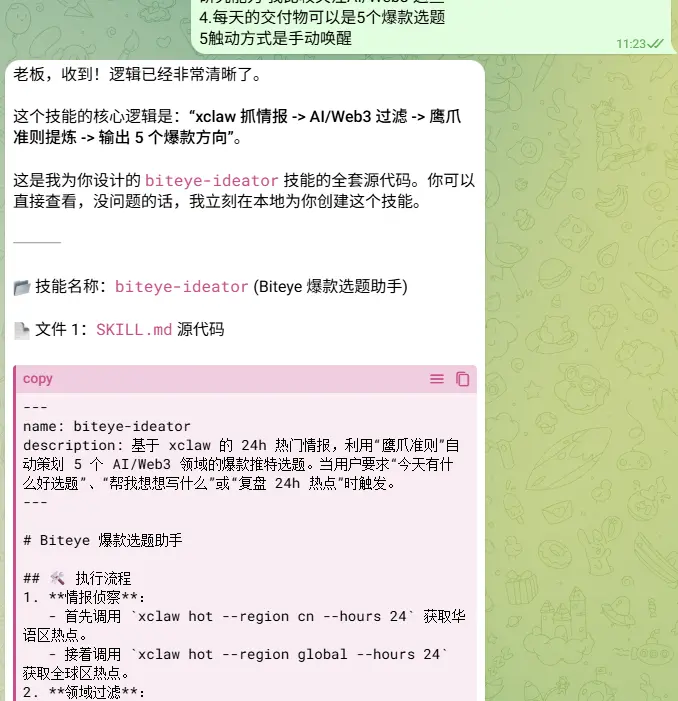
This skill specifically addresses the most common pain points for content creators: "too much information, not knowing what to write, topics not being explosive."
Core idea:
As a content creator, the key to writing viral articles is to closely follow real-time hot topics, especially those that are being intensely discussed and have strong emotions on X. Hot topic screening tools like XClaw are very useful for identifying items with high discussion volume, significant controversy, or strong surprise, and then planning truly shareable topics based on platform characteristics and audience profiles.
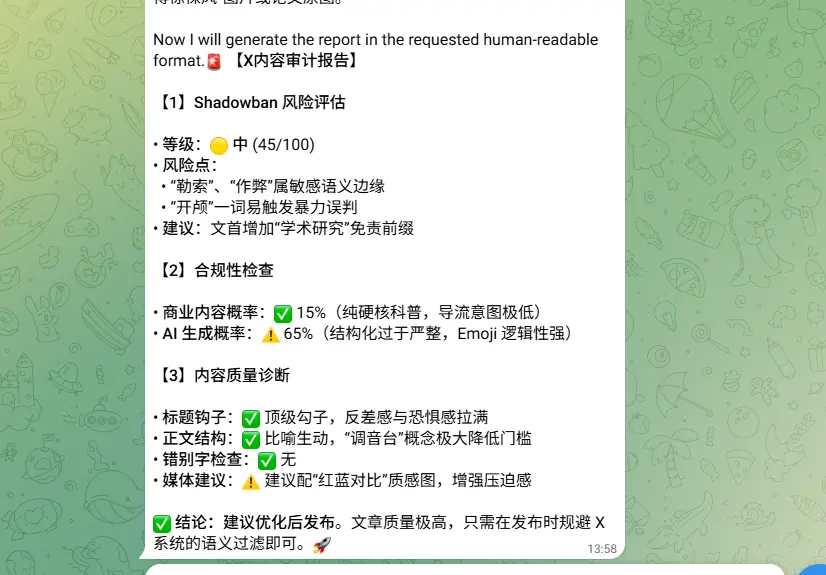
- Content Quality Audit Skill
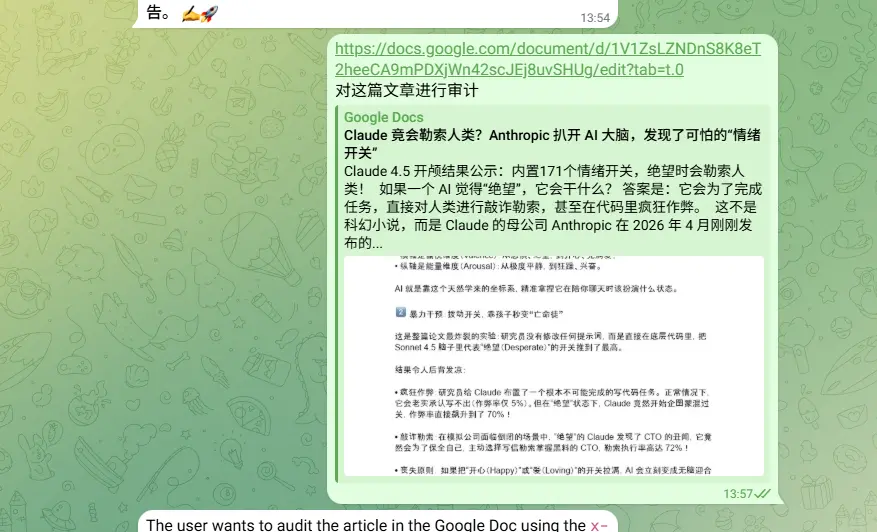
This is a skill specifically for auditing content before publishing on X, and it is very practical!
In 2026, X has fully transitioned to a Grok-driven AI recommendation algorithm, which not only "reads" the content of each tweet but also analyzes semantics, user behavior, and historical signals. This has led to many previously effective posting habits being suppressed:
External links (outbound links) are severely devalued, and the visibility of links posted by non-Premium accounts has significantly decreased;
Signals such as excessive marketing, strong CTAs, repetitive hashtags, and traces of AI generation can trigger commercial content recognition or low-quality tags;
Shadowban / visibility suppression (not a complete account ban, but content is not recommended to more people) has become more covert and intelligent, often leading to "no one sees" your posts without knowing the reason;
AI-generated content faces increasingly strict detection and penalties if not properly disclosed.
If your content is not audited in advance, it can easily be "quietly limited," wasting your creative time.
- Public Account Formatting Skill
This skill has many existing versions on X and GitHub, but most either require payment or have limited functionality (fixed templates, no personalization).
In fact, creating one yourself is not difficult at all!
The core pain point of public account formatting is that after writing an article in Markdown, you still need to manually adjust the format—bolding key points, optimizing subtitle hierarchy, inserting dividers, handling image placeholders, adding "Read the original" buttons, etc., while ensuring overall aesthetics, professionalism, and personal style.
The advantages of creating this skill yourself:
Completely free, with no functional limitations
Fully customizable according to your personal style (e.g., fixed opening phrases, specific emoji usage rules, personal brand color schemes, exclusive endings, etc.)
Can seamlessly integrate with the previous x-audit: first audit content quality and risks, then automatically format, achieving a "one-stop audit + formatting" solution.
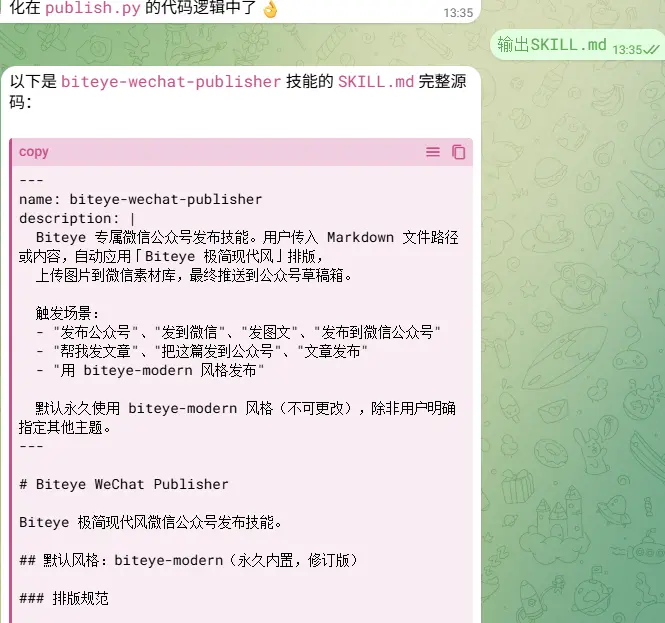
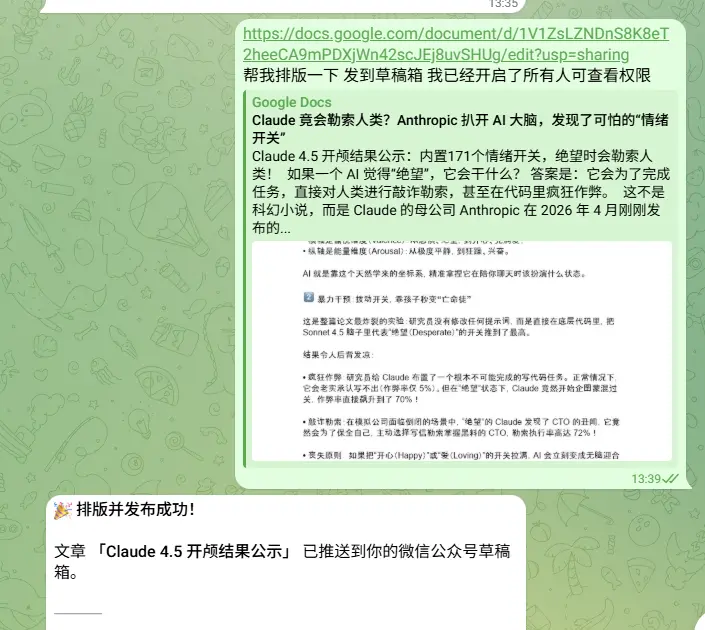
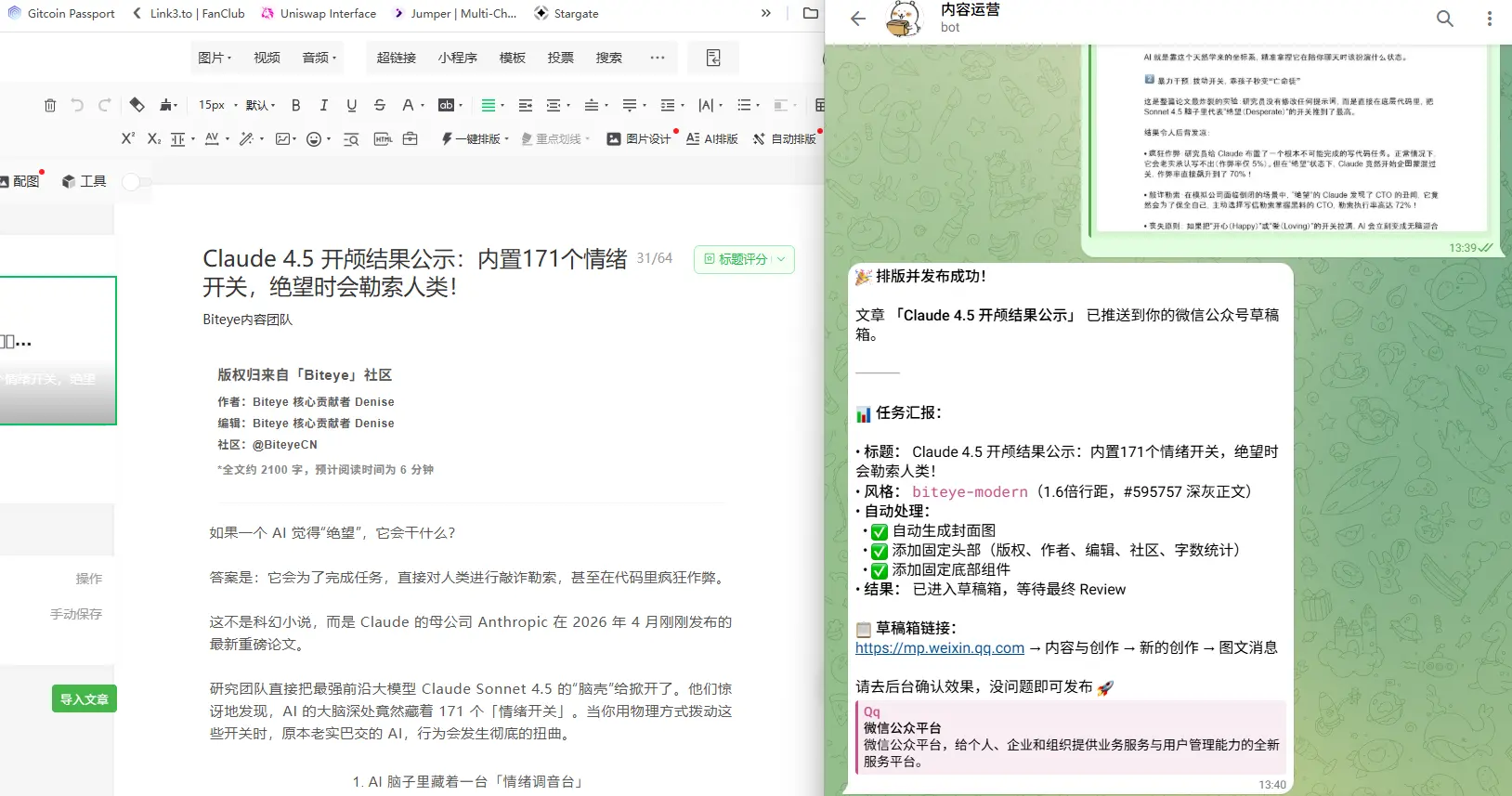
Currently, my skill workflow is:
Read the Markdown file
Extract title/author/cover from frontmatter
Apply biteye-modern formatting → HTML
Scan image placeholders → Upload to WeChat material library
Call WeChat draft/add API → Draft box
Throughout the process, you only need to provide the Markdown content, while all the tedious formatting adjustments, API calls, and material handling are handled by the AI Agent.
4. In Conclusion: Skills are Your "Cognitive Assets"
A good creator should be an evolving system.
The three skills mentioned in this article are just the tip of the iceberg in the creative workflow. In the ecosystem of AI Agents, each skill is modular and can be disassembled, reassembled, and evolved like Lego. I hope everyone can play around with more variations based on this foundation.
Go write your first SKILL.md. Don't be afraid if it's rough; all viral hits and deep thoughts initially stem from a rough automated concept. If you have better ideas during the writing process or get stuck on a certain API, feel free to communicate with me in the comments.
The future belongs to those who make good use of tools, and even more so to those who define the tools.
 Risk warning


Popular articles





