








Coinbase stuffed USDC into Hyperliquid; who benefited from this transaction?
 Core Viewpoint

 On the surface, it seems like a good deal for Hyperliquid with doubled revenue, but in reality, Coinbase has acquired something more valuable: a global distribution channel for USDC. In a situation where it is besieged domestically and locked out by USDT overseas, embedding stablecoins into the largest perpetual contract exchange on the blockchain may be the best way for USDC to break through at present.
Author: David Christopher
Compiled by: Jiahua, ChainCatcher
Tether dominates Binance, but Coinbase has just integrated USDC into Hyperliquid. The battle for stablecoin distribution channels is intensifying.
Hyperliquid is currently the most fiercely contested battleground in the crypto space. Last week, the HYPE spot ETFs from 21Shares and Bitwise were listed on U.S. exchanges, followed closely by Grayscale and VanEck.
Beneath this institutional frenzy lies a protracted battle for interests, with all parties eager to share in the profits of this exchange.
Last fall, Hyperliquid launched a public tender for a native stablecoin called USDH, aiming to reclaim revenue lost to Coinbase and Circle.
At that time, approximately $5.6 billion of USDC was stored in the exchange's cross-chain bridge, generating about $200 million in interest annually, all of which flowed to its centralized competitors, while the platform that truly created demand received nothing.
Ultimately, Native Markets won the community vote in the bidding against companies like Paxos and Ethena, and USDH was officially launched.
Bankless: Hyperliquid's USDH Bidding War
However, just last week, Native Markets sold USDH to Coinbase, agreeing to phase out this native stablecoin and allow USDC to become the primary quote asset for the exchange again.
In exchange, 90% of the revenue will flow back to Hyperliquid, although the specific revenue capture mechanism remains unclear. The general perception is that this deal is a victory for Hyperliquid, while Coinbase and Circle are seen as the losers. This interpretation is understandable but not entirely accurate.
The benefits Hyperliquid gains from this deal are evident: significantly increased revenue sharing, roughly double that of the USDH period; regulatory backing through an alliance with the most influential forces in the crypto industry in Washington; and the user experience advantages brought by returning to a trusted stablecoin.
After all, the exchange was originally built around USDC, and USDC has dominated the HIP-3 market, which has garnered countless headlines for Hyperliquid over the past six months.
Coinbase and Circle's actions are viewed as a form of image enhancement, a strategy to ally with one of the most crypto-native and successful projects of the last cycle.
But when considering the actual market positioning of USDC alongside the growth trajectory of perpetual contracts, a second beneficiary emerges.
Coinbase and Circle are gaining a massive distribution channel for USDC, which may be the most crucial aspect of the entire deal.

My interpretation: Coinbase and Circle have gained a defensive means to counter USDT and a new growth point, essentially aligning with Binance's quote assets.
Hyperliquid has gained regulatory support and substantial revenue, although the exact amount remains unclear, it is certainly higher than before.
What is the status of USDC's home ground?
Since the passage of the GENIUS Act, USDC has shown strong momentum. Circle has prepared the regulatory environment created by this framework in advance, with USDC being U.S.-based and highly compliant. This positioning has translated into actual trading volume.
Data from Allium shows that in May 2026, USDC's trading volume reached $355 billion, surpassing USDT for the first time in recent months, indicating a significant acceleration in growth since the GENIUS Act was passed last July.
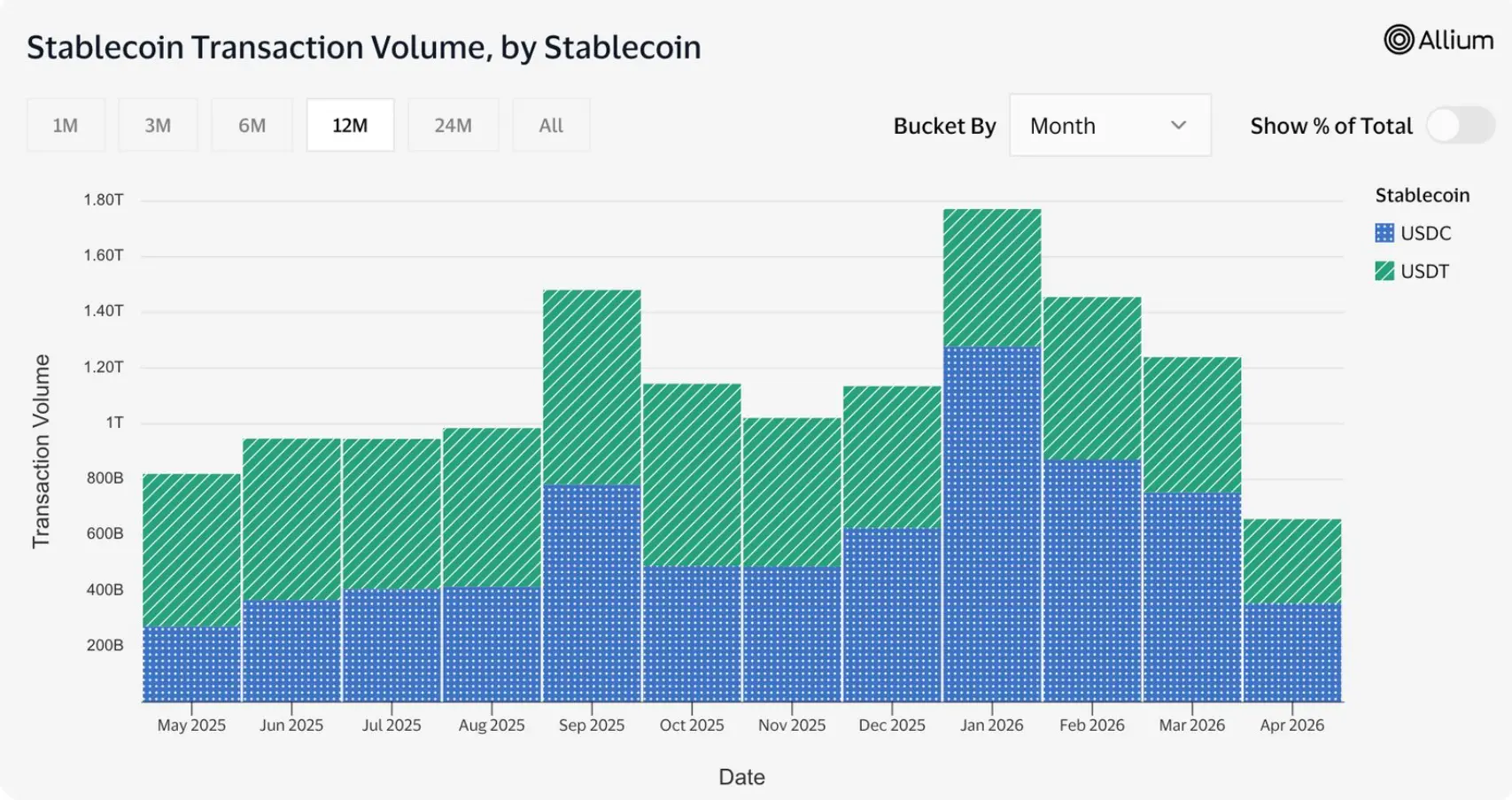
What has not changed is the overall structural pattern. In April 2025, just before the GENIUS Act was introduced, USDT held 67% of the stablecoin market share, while USDC accounted for 27.6%.
A year later, USDT's share was 67.3%, and USDC's was 28.1%. The change was only half a percentage point. Despite the accelerating growth of USDC's trading volume, its supply share remains stagnant.
A report from Artemis last October pointed out that the U.S. is the strongest market for USDC. Considering the growth trend after the GENIUS Act, the U.S. has consistently been the largest growth engine for USDC.
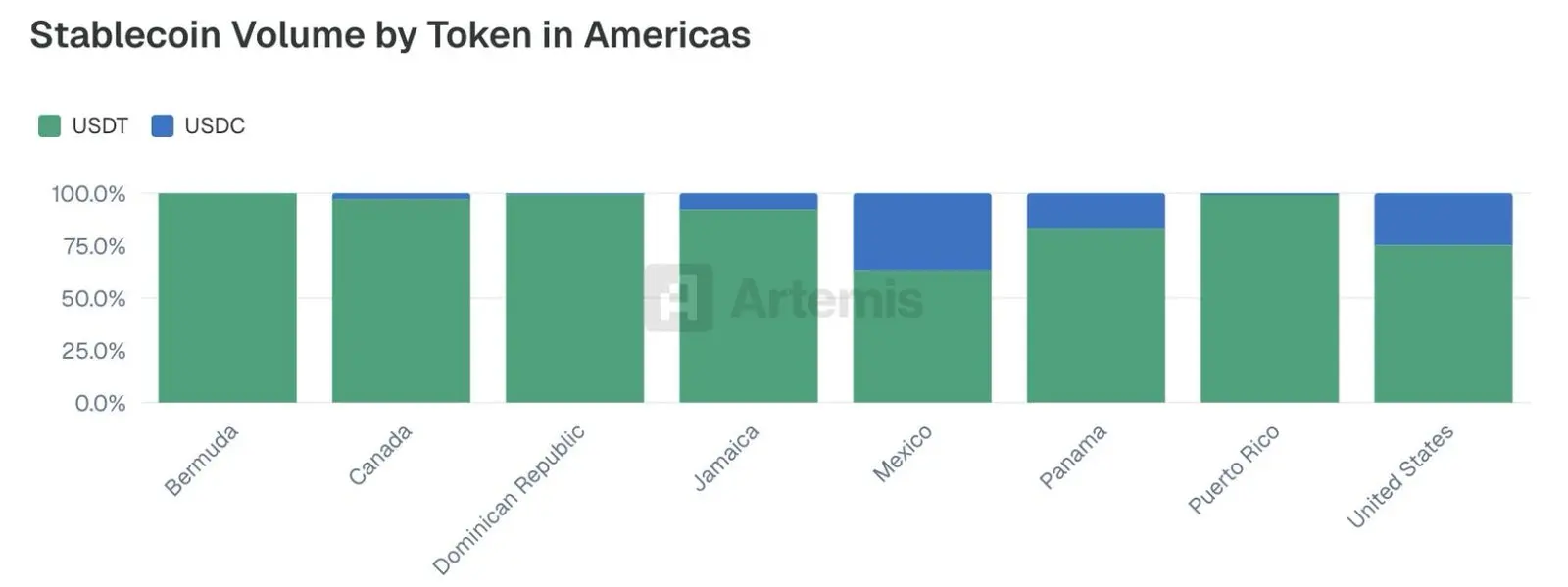
However, this is precisely where the new round of competition is concentrated. Stripe has decisively entered the market by acquiring companies like Tempo. Major financial institutions are also launching local stablecoins that meet GENIUS standards. USDC's home ground is being encroached from all sides.
Once competition intensifies domestically, USDC has almost no fallback positions overseas. In other regions, USDT dominates as the default dollar, widely used for savings, investment, and trading, and is still actively expanding.
In the past year, several new public chains have launched specifically to expand USDT's distribution channels, and Tether has also introduced USAT to attack USDC within the GENIUS-compliant U.S. regulatory framework.
Coinbase and Circle have momentum for further expansion but face a brief window to secure distribution positions before competition escalates. The trading sector, especially perpetual contracts, is the best breakthrough point.
Bankless: Tether Launches U.S. Regulated USA₮ Stablecoin
Perpetual Contracts are the Main Arena
Like stablecoins, perpetual contracts are one of the fastest-growing segments in the crypto space, consistently maintaining double-digit or even triple-digit year-on-year growth.
They are structurally deeply tied to stablecoins, with stablecoins primarily serving as the quote assets for building perpetual contract markets. USDT has already established a major foothold here, becoming the primary quote asset for most markets on Binance, the world's largest perpetual contract exchange.
Anyone trading in Binance's largest markets is primarily using USDT, which solidifies the supply of USDT within the exchange and drives surrounding deposit, withdrawal, and on-chain activities.
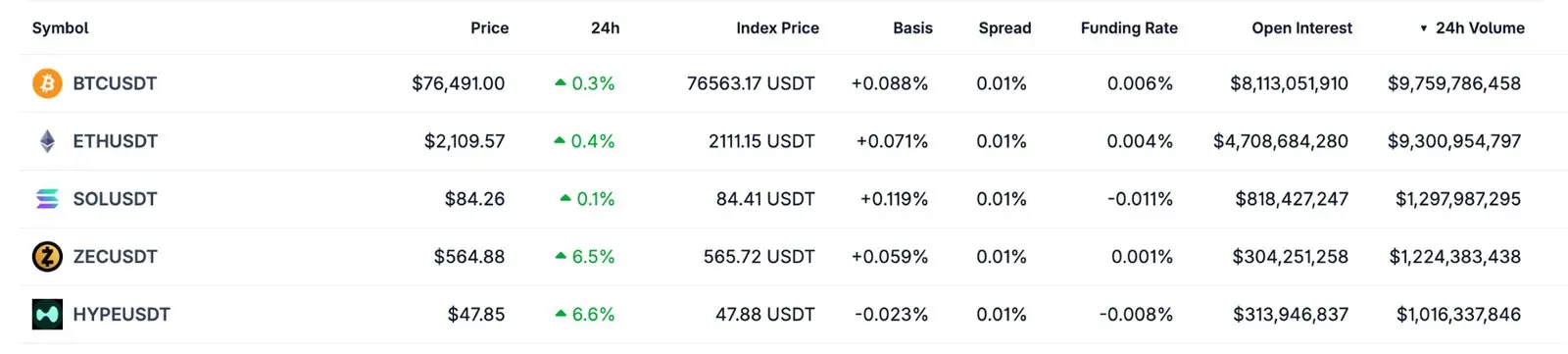
Although Hyperliquid's trading volume is far less than Binance's, it is the largest on-chain perpetual contract exchange, holding 30% of the on-chain perpetual contract market share and controlling 46% of open contracts. Despite repeated challenges from competitors, this position remains solid.
While it is not a centralized platform, it competes effectively. As of April 30, its trading volume was about 50% of Bybit's, 30% of OKX's, and 79% of Coinbase's international site. Combined, it only accounts for 13% of Binance's, but this number has been steadily increasing.
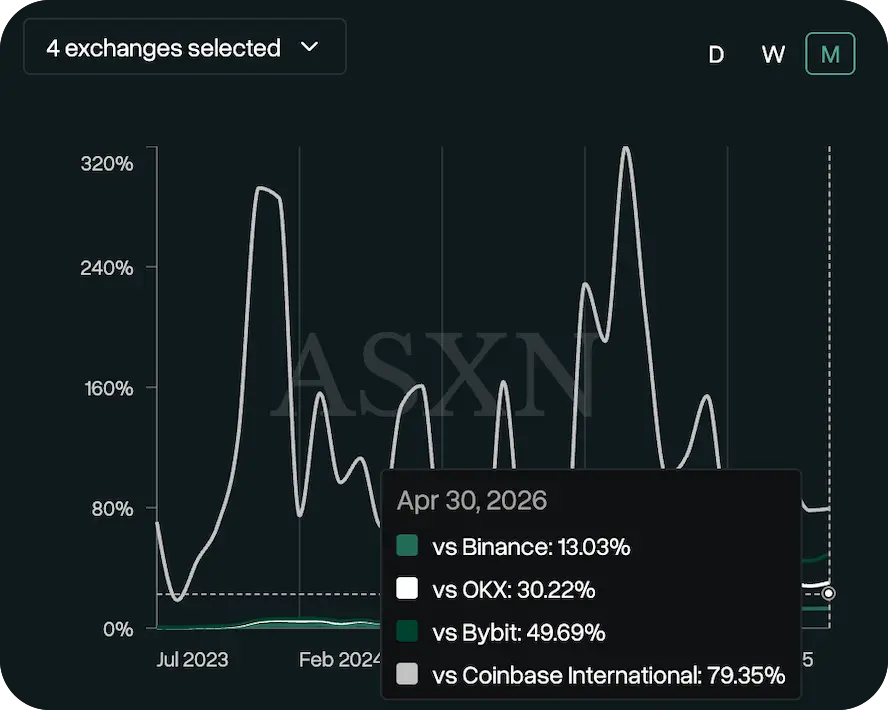
Although still in its early stages, Hyperliquid's dominance in the on-chain perpetual contract space, along with its trading volume that can rival or sometimes exceed centralized exchanges, gives it global influence to compete with Binance outside the U.S.
This opens a channel for Coinbase and Circle to compete with Tether, turning Hyperliquid into a structural distribution channel for USDC.
Coinbase Recognizes Its Path
However, this raises a question: Why doesn't Coinbase establish this distribution channel directly by expanding its own perpetual contract products?
Because Coinbase is constrained by regulatory frameworks, limiting the number of customers it can serve and the markets it can open. Currently, Coinbase operates in about 100 countries, slightly more than half of Binance's 180 countries.
Thanks to a more relaxed environment, Hyperliquid can reach more regions, providing advantages over both Binance and Coinbase, which Coinbase cannot replicate.
Therefore, Coinbase and Circle let Hyperliquid take on the task of global expansion, while USDC rides along.
This deal captures upward space through the growth of USDC's supply and the resulting revenue, while allowing Coinbase to avoid getting embroiled in an unwinnable jurisdictional battle. The slice of the pie may not be large, but it is a pie they could not reach on their own.
Tether is Attempting a Similar Strategy
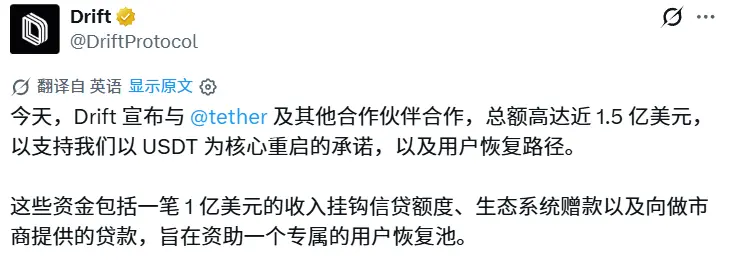
Tether is also executing a similar strategy, albeit on a much smaller scale. Following the Drift vulnerability incident in April, Tether pledged to provide up to $147.5 million in funding for recovery.
This deal set USDT as the settlement asset for Drift, establishing a Tether-supported USDT liquidity pool for designated market makers and funding a trading incentive layer.
In other words, Tether leveraged the Drift crisis to flip the base currency of a major perpetual contract DEX on Solana.
Before this deal, USDC's stablecoin scale on Solana was more than twice that of USDT, a trend that was common across the entire chain. Both sides of the stablecoin battle have recognized the same thing: perpetual contracts are the key battleground for stablecoins.
Overall, to leverage the momentum brought by the GENIUS Act, Coinbase and Circle need broader distribution channels, and the Hyperliquid deal may be key.
It allows USDC to penetrate the core battleground of on-chain trading, riding the fastest-growing segment in the crypto space, and positions it to compete directly with USDT and Binance.
This may also be a bet on the loosening of domestic regulatory boundaries. CFTC Chairman Selig has explicitly stated a desire for perpetual contracts to be offered within the U.S., and the passage of the CLARITY Act may ensure this.
Reports this week indicate that the SEC is preparing to establish an "innovation exemption" under its "crypto project" initiative, which would allow crypto-native platforms to offer tokenized U.S. stocks for on-chain trading under more relaxed registration requirements.
Combined with the stance of the CFTC led by Selig and the SEC reforms pushed by Atkins, Coinbase seems to be laying the groundwork in advance, allowing Hyperliquid to enter the U.S. market with USDC already embedded within it.
Bankless: Perpetual Trading Finds Its Moment
All of this is speculative, but it aligns closely with how Wall Street and institutional investors view Hyperliquid: they see it as an entry point into the upcoming new landscape of perpetual contracts. This may be the strongest tailwind an asset can encounter.
 Risk warning



Popular articles





