








AIDC, computing power leasing, and cloud: The "three-part thesis" of AI transformation in cryptocurrency mining farms
 Core Viewpoint

 The "AI transformation" of cryptocurrency mining farms is not just a slogan; it is unfolding in three identifiable stages.
Author: Guosheng Blockchain
Abstract
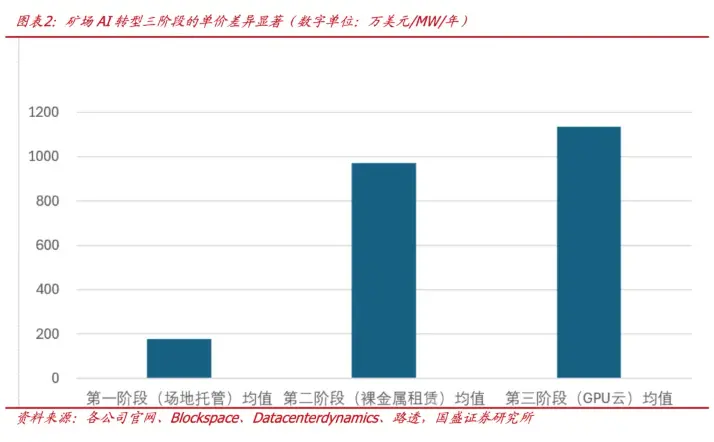
The "AI transformation" of crypto mining farms is not just a slogan; it is unfolding in three identifiable stages: the first stage involves directly leasing electricity, land, and facilities to AI computing clients as "Colocation," the second stage is renting out owned GPU servers in "Bare Metal" form to cloud clients, and the third stage is packaging GPUs into managed cloud services with container orchestration, scheduling, and enterprise services (Neocloud). The differences between the three stages are not conceptual but rather in the vertical extension of production factors—each additional layer requires the mining farm to supplement a set of key capabilities, while at the same time, the contract value per MW roughly jumps from $1.78 million/MW/year (first stage) to $9.7 to $11 million/MW/year or more (second and third stages), representing a steep value leap.
On May 7, 2026, IREN signed a five-year, $3.4 billion AI cloud contract with NVIDIA, marking a significant transition of crypto mining farms into the third stage, as the original mining company directly provides managed GPU cloud services to leading semiconductor manufacturers. At the same time, NVIDIA obtained the right to acquire up to 30 million shares of IREN common stock at a price of $70 per share over five years (corresponding to an equity consideration cap of about $2.1 billion). The two companies also announced a strategic cooperation framework for AI infrastructure that could reach up to 5GW. The "long-term contracts + strategic equity options" model directly binds the operators' interests to the GPU supply chain, which has no precedent in the sector.
We believe this transaction will further drive a revaluation of the sector, but differentiation will become more pronounced: operators with substantial grid-connected power and the ability to strengthen all three layers of "power - machine - cloud" will achieve higher contract density and longer contract durations. The current sector presents a clear three-tier structure: the first tier consists of five "stronger and stronger" companies that have signed contracts with major cloud providers or equivalent orders—IREN, Hut 8, Applied Digital, Cipher, TeraWulf; the second tier includes Galaxy Digital, Core Scientific, and Riot, which only have new cloud or chip manufacturer clients; the third tier comprises Bitdeer, Marathon, CleanSpark, Bitfarms, and Hive, which have not yet signed contracts but possess North American AI power and/or self-operated GPU cloud experience.
Investment Recommendation: We recommend focusing on the "three golden flowers"—leading company IREN (IREN.O) is the full-stack leader in the three stages, holding a $9.7 billion bare metal order from Microsoft (including a $1.94 billion advance payment) and a $3.4 billion Neocloud contract with NVIDIA, while also acquiring Mirantis to complete its software control layer; second-tier Hut 8 (HUT.O) has the largest "triple net, no negotiation" order in the sector (totaling $9.8 billion, unit price over $1.85 million/MW/year), with the highest contract quality and cash flow certainty; potential target Bitdeer (BTDR.O) has self-operated GPU cloud and significant AI power in the U.S.
Risk Warning: High concentration risk of counterparties and clients; risks of power grid connection and tightening regulatory cycles; risks of GPU depreciation and rapid hardware generational iteration; risks of cryptocurrency price fluctuations affecting cash flow from the original main business.
1. Event: IREN Secures $3.4 Billion AI Cloud Order from NVIDIA
On May 7, 2026, IREN Limited (stock code: IREN.O, hereinafter referred to as "IREN") announced that it has signed a five-year managed GPU cloud services contract with NVIDIA (NVIDIA Corporation, stock code: NVDA.O) with a total contract value of approximately $3.4 billion. The contract will be delivered within IREN's existing data center in Childress, Texas, USA, with approximately 60MW of critical IT load, utilizing NVIDIA's air-cooled Blackwell system; orchestration and cluster management software will be jointly provided by IREN and Mirantis, a Kubernetes software company with which it recently signed an acquisition agreement. At the same time, NVIDIA obtained the right to acquire up to 30 million shares of IREN common stock at a price of $70 per share over five years, corresponding to an equity consideration cap of about $2.1 billion; the two companies also announced a strategic cooperation framework for AI infrastructure that could reach up to 5GW. We believe the key implications of this transaction are threefold: (1) NVIDIA deeply binds a computing power supplier with a background in former crypto mining farms in the form of "long-term contracts + strategic equity options," equivalent to a "dual endorsement" of credit and technology recognition within the industry; (2) the contract target is "managed GPU cloud services," meaning that what IREN provides is not just a data center or GPU servers, but a complete cloud service with orchestration, scheduling, and operations, commonly referred to in the industry as "Neocloud" capability; (3) IREN had already signed a $9.7 billion GB300 bare metal contract with Microsoft in November 2025, and this $3.4 billion order runs parallel to it, demonstrating that the same mining asset can support multiple business models simultaneously. 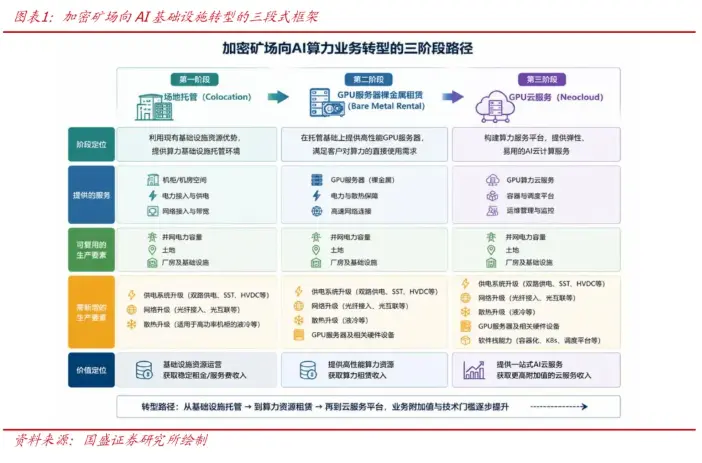
2. Three Stages of Crypto Mining Farm Transformation
Placing IREN's and NVIDIA's and Microsoft's two orders back into the evolutionary sequence of the entire sector, we can distill the "three-stage theory" of the transformation of crypto mining farms into AI infrastructure. The three stages are not strictly sequential in time—many companies are simultaneously operating in two stages—but the structural differences in production factors and the value per MW contract are very clear, serving as the most intuitive coordinates for identifying a company's position.
First Stage (Colocation)
- Current number of signed contracts: 15;
- Total critical IT load and total contract amount involved: 2941MW, $78.3 billion;
- Average critical IT load price: $1.78 million/MW/year;
- Average contract duration: 14 years.
Second Stage (Bare Metal Rental)
- Current number of signed contracts: 1;
- Total critical IT load and total contract amount involved: 200MW, $9.7 billion;
- Average critical IT load price: $9.7 million/MW/year;
- Average contract duration: 5 years.
Third Stage (GPU Cloud Services/Neocloud)
- Current number of signed contracts: 1;
- Total critical IT load and total contract amount involved: 60MW, $3.4 billion;
- Average critical IT load price: $11.33 million/MW/year;
- Average contract duration: 5 years.
2.1 First Stage: Colocation
2.1.1 Services Provided by Mining Farms in This Stage Colocation means that the mining farm leases its critical IT load capacity (MW) in its own data center to clients on a long-term basis, where clients bring their own GPU servers and operate their own AI clusters. The product of the mining farm is essentially a "grid-connected, built facility, modified according to AI specifications power - space combination."
2.1.2 Reusable Production Factors from Existing Business: Power, Land, Facilities
- Capacity and grid interconnection: This is the most scarce aspect of current data center expansion.
- Land: Large contiguous land close to main grid nodes and near fiber optic trunks;
- Facilities and power supply framework: Existing mining facilities can reuse some of the shell and medium-voltage distribution but require large-scale modifications.
2.1.3 Additional Production Factors Required to Provide This Service: AI Power, Network, Cooling
- Power: Dual power supply and redundancy modifications at the AIDC level, solid-state transformers (SST), high-voltage direct current (HVDC) solutions, etc.;
- Network: Data center-level fiber access (multiple independent routes), optical interconnection within the park, especially long-distance low-latency connections to accommodate cross-building GPU cluster training;
- Cooling: According to IDC, as computing power density continues to soar, the power limit of AI training servers per rack is about to exceed 100kW, making liquid cooling technology a necessary configuration rather than an optional upgrade.
2.2 Second Stage: Bare Metal Rental
2.2.1 Services Provided by Mining Farms in This Stage
Bare metal rental means that the mining farm no longer just rents out "space + power," but integrates GPU servers into the data center, selling whole racks/clusters to cloud clients based on reserved capacity, connecting with hyperscalers or large AI labs. The client's workload runs directly on physical servers, but the mining farm does not provide software stack services above the operating system; the main deliverables are bare metal performance, power availability, network, and operations.
2.2.2 Reusable Production Factors from Existing Business: Power, Land, Facilities
- All factors from the first stage: grid-connected power capacity, land, facilities.
2.2.3 Additional Production Factors Required to Provide This Service: GPU Computing Power
- Power, network, cooling: Similar to the first stage.
- GPU servers (e.g., Blackwell B200/B300, GB300 NVL72, etc.).
2.3 Third Stage: GPU Cloud Services (Neocloud)
2.3.1 Services Provided by Mining Farms in This Stage In the third stage, the mining farm packages GPUs into standardized cloud services with container orchestration, scheduling, monitoring, billing, and enterprise SLAs, charging based on GPU hours, token calls, or inference instances, directly facing end enterprises or AI labs. At this point, the mining farm is no longer just a "landlord" or "data center distributor," but has become a cloud service provider with a complete software stack (commonly referred to in the industry as "Neocloud"), competing on the same level as similar companies like CoreWeave, Lambda, and Nebius.
2.3.2 Reusable Production Factors from Existing Business: Power, Land, Facilities, GPU
- All factors from the second stage: grid-connected power capacity, land, facilities, GPU servers.
2.3.3 Reusable Production Factors from Existing Business: Power, Land, Facilities, GPU
- Power, network, cooling, computing power: Similar to the second stage.
- Software stack capabilities: Containerization, Kubernetes, SLURM, and other cluster scheduling software, as well as a complete cloud control plane covering account management, SLA guarantees, security and compliance, APIs, and billing.
3. Current Three-Tier Structure of AI Transformation in Crypto Mining Farms and Key Competitive Factors
As of early May 2026, the total number of signed colocation/bare metal/Neocloud contracts in the sector amounts to approximately 3,201MW of critical IT load (either implemented or under construction), with a total contract value exceeding $91.4 billion (within the initial contract period). We find that these contracts are highly concentrated among AI cloud-native manufacturers CoreWeave, Fluidstack (part of its agreements backed by Google), as well as leading hyperscalers and semiconductor manufacturers like Microsoft, Amazon, and NVIDIA. Additionally, we observe a clear positive correlation between company market capitalization and the total AI power in North America, as well as the AI power contracted in North America. Based on the composite dimensions of "client level - contract quality - order scale - North American AI power reserves," we categorize the 13 listed companies in the sector into three tiers. 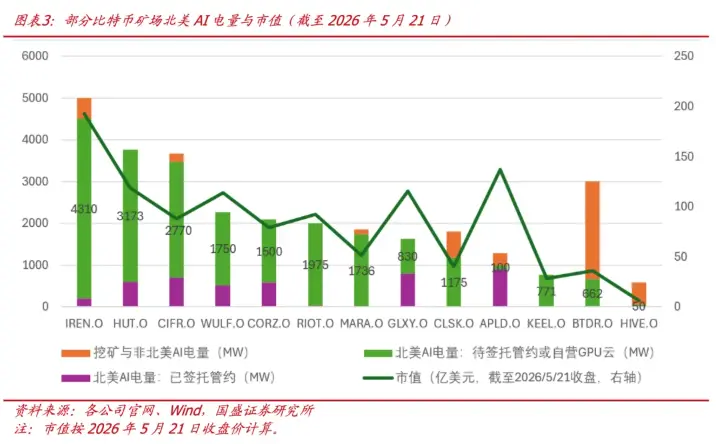
3.1 First Tier: Leaders (Have Signed Contracts with Major Cloud Providers or Equivalent Orders)
3.1.1 Sorting Criteria: Client Level, Contract Quality, and Funding Endorsement Amount Within the first tier, we adopt the following hierarchical sorting logic: (1) business stage priority—cloud orders (third stage Neocloud) > bare metal (second stage) > colocation (first stage); (2) contract quality priority—among colocation contracts, "triple net, no negotiation" > "large advance payment" > "none of the above"; (3) client level—direct contracts with hyperscalers (Microsoft, Amazon, NVIDIA, etc.) > new clouds supported by hyperscaler funding > new clouds without hyperscaler funding; (4) scale of funding support from hyperscalers. Based on these dimensions, the first tier ranks from high to low as follows: IREN > HUT > APLD > CIFR > WULF.
3.1.2 Representative Company Ranking: IREN > HUT > APLD > CIFR > WULF
IREN (IREN.O): Secured a $3.4 billion AI cloud order from NVIDIA (5-year term, approximately 60MW, unit price $11.33 million/MW/year), making it one of the few companies in the sector that has entered the third stage Neocloud business.
At the same time, the company signed a $9.7 billion GB300 bare metal contract with Microsoft (200MW, unit price $9.7 million/MW/year), which includes a 20% advance payment (approximately $1.94 billion), ensuring strong cash flow security.
The acquisition of Mirantis, announced in the same week as this order, is a key piece for IREN's entry into the Neocloud business: Mirantis is a founding ISV partner of NVIDIA's "AI Cloud Ready Initiative," and its k0rdent AI platform can uniformly manage AI infrastructure across bare metal, virtual machines, and Kubernetes environments, integrating its original Docker Enterprise business and covering over 1,500 enterprise clients.
Through this acquisition, IREN will gain the "software control plane" capability that it previously lacked as a bare metal/GPU cloud service provider, directly competing with the full-stack Neocloud models of Nebius and CoreWeave.
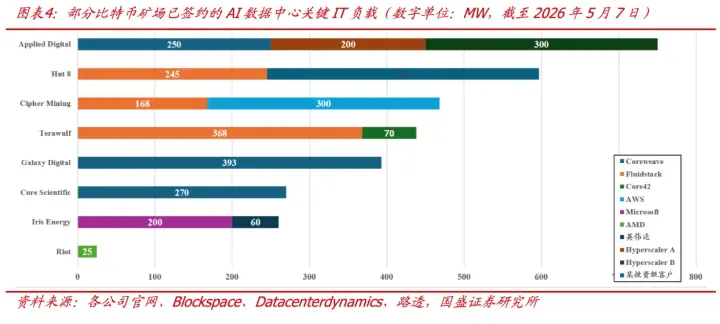
Hut 8 (HUT.O): The company with the largest "triple net" (NNN, Net 1 refers to Property Taxes, Net 2: Building Insurance, Net 3: Common Area Maintenance (CAM)) order in the sector—signed a 245MW, $7 billion contract with Fluidstack (Anthropic as the end user, backed by Google) (December 2025, 15-year term, unit price $1.905 million/MW/year), plus a new contract signed on May 7, 2026, with "a certain investment-grade client" for 352MW, $9.8 billion (15-year term, unit price $1.856 million/MW/year, no negotiation), totaling 597MW, $16.8 billion.
The "triple net, no negotiation" format is currently the highest quality contract form in the sector: property taxes, building insurance, and common area maintenance costs are borne by the lessee, and regardless of actual usage, tenants must pay the full contract amount, ensuring the highest cash flow certainty for operators, and optimal terms for leveraged financing.
Applied Digital (APLD.O): The only company in the sector currently holding long-term contracts with two "investment-grade hyperscalers"—signed contracts with "a certain investment-grade hyperscaler A" (200MW, $5 billion, 15-year term, unit price $1.667 million/MW/year, October 2025) and "a certain investment-grade hyperscaler B" (300MW, $7.5 billion, 15-year term, April 2026), with a total contract amount of $12.5 billion.
The "investment-grade hyperscaler" counterparties of these two orders have significantly higher credit levels than new cloud clients like Fluidstack or CoreWeave, which is a core difference that distinguishes APLD from other first-tier companies.
Additionally, APLD has signed a separate contract with CoreWeave for 250MW, $7 billion.
The company has signed a total of 750MW of critical IT load, the highest in the sector.
Cipher Mining (CIFR.O): Signed a 300MW, $5.5 billion, 15-year contract with Amazon Cloud (November 2025, unit price $1.222 million/MW/year, to go live in July 2026, with rent payments starting in August), making it the first and only order directly signed by a "Big Seven" level public cloud provider in the sector.
The company also signed a 168MW, $3.8 billion, 10-year contract with Fluidstack, backed by Google with $1.73 billion in lease guarantees.
Cipher has signed a total of 468MW of critical IT load.
TeraWulf (WULF.O): Signed two contracts with Fluidstack, totaling 368MW, $13.2 billion, both supported by long-term lease guarantees from Google (totaling $3.1 billion).
In addition to a 70MW/$1 billion contract signed with Core42 in 2024, TeraWulf has signed a total of 438MW of critical IT load, with a contract amount of $14.2 billion.
In the first tier, WULF's counterparties are entirely composed of new clouds Fluidstack and Core42, with no direct hyperscaler counterparties, hence it ranks last.
3.2 Second Tier: Backbone (No Direct Support from Hyperscalers, Clients are New Clouds or Chip Companies)
3.2.1 Sorting Criteria: Order Amount, Execution Progress The counterparties of second-tier companies are neither hyperscalers (Microsoft, Amazon level) nor have received long-term funding endorsements from hyperscalers, relying solely on new cloud clients (CoreWeave) or chip manufacturers (AMD) to support orders. In the absence of top-tier endorsements, we adopt a composite sorting of "order amount × execution progress": the larger the contract amount, the higher the client's recognition of the operator's power, land, and modification capabilities; the earlier the execution progress, the faster the cash flow realization and the firmer the valuation anchor.
3.2.2 Representative Company Ranking: GLXY > CORZ > RIOT
Galaxy Digital (GLXY.O): Signed two contracts with CoreWeave, totaling 393MW, $13.5 billion, the largest contract amount in the second tier of the sector.
Core Scientific (CORZ.O): Signed two contracts with CoreWeave, totaling 270MW, $4.725 billion, making it the earliest company in the sector to sign AI data center colocation contracts.
In CORZ's two contracts, CoreWeave bears all capital investments related to the infrastructure, of which approximately $405 million will be allocated to colocation payments not exceeding 50% of the monthly fee.
Riot Platforms (RIOT.O): Signed a 25MW, $311 million, 10-year contract with AMD (January 2026, unit price $1.244 million/MW/year). The order size is significantly smaller than other second-tier companies, but AMD, as a leading semiconductor manufacturer, provides a certain credit uniqueness.
Considering that RIOT has 2,000MW of AI power in North America but has only signed for 25MW of colocation (accounting for only 1.25%), there is significant future pipeline space, and its ranking does not imply a denial of its potential revaluation elasticity.
3.3 Third Tier: Potential Sector (No AI Data Center Contracts Yet)
3.3.1 Sorting Criteria: Scale of North American AI Power and Experience in Self-Operated GPU Cloud Business
Third-tier companies have not yet announced large AI data center colocation/bare metal/cloud contracts, but they possess hundreds to over a thousand MW of North American AI convertible power reserves, making them potential subjects for the next round of orders in the sector. Within this tier, we use "scale of North American AI power × experience in self-operated GPU cloud" for composite sorting—the scale of AI power determines the order ceiling, while experience in self-operated GPU cloud determines whether the value can leap to the second or third stage at the time of signing rather than being locked at the first stage price.
3.3.2 Representative Company Ranking: BTDR > MARA > CLSK > KEEL > HIVE
Bitdeer Technologies Group (stock code: BTDR.O): Holds 662MW of North American AI power in the U.S., currently focusing on the Asia-Pacific market as its primary GPU cloud client base.
BTDR is one of the companies in the third tier with self-operated GPU cloud business, meaning it does not need to start from scratch to build a software stack when signing second or third stage orders. However, its absolute value of North American AI power (662MW) is significantly lower than MARA (1,736MW) and CLSK (1,175MW), and the latter two may have greater marginal elasticity for single orders if they sign contracts.
Marathon Digital (MARA.O): Holds 1,736MW of convertible AI power in North America, the largest power reserve in the third tier; has no AI data center contracts or self-operated GPU cloud business.
CleanSpark (CLSK.O): Holds 1,175MW of convertible AI power in North America, second only to MARA; has no AI business orders or self-operated cloud business.
Bitfarms (KEEL.O): Holds 771MW of convertible AI power in North America; has no AI business orders or self-operated cloud business.
HIVE Digital Technologies (HIVE.O): Holds only about 50MW of convertible AI power in North America; however, it conducts GPU cloud services through its Canadian subsidiary BUZZ HPC, with relatively mature self-operated cloud business experience. The absolute value of AI power being too small is the main reason for its lower ranking.
4. Investment Recommendation: Focus on "Three Golden Flowers"
We recommend focusing on three companies, each corresponding to different competitive positions and investment logic in the three stages of transformation.
4.1 Leader: IREN (IREN.O) ------ Full-Stack Leader Across Three Stages IREN is currently the only company in the sector that has secured large-scale contracts in both the second stage (Microsoft's $9.7 billion bare metal order) and the third stage (NVIDIA's $3.4 billion Neocloud order), and it has filled the critical gap in software control through the acquisition of Mirantis. Its differentiated advantages are reflected in five dimensions: (1) highest client level—both Microsoft and NVIDIA are "Big Seven" or leading semiconductor manufacturers, an unparalleled combination of counterparties in the industry; (2) highest unit price—Microsoft contract at $9.7 million/MW/year, NVIDIA contract at $11.33 million/MW/year, far exceeding the average of $1.78 million/MW/year in the first stage; (3) contract security—Microsoft contract includes a 20% advance payment of approximately $1.94 billion; (4) growth pipeline—both parties announced a strategic cooperation framework for AI infrastructure that could reach 5GW; (5) ample power reserves, with up to 4.5GW of convertible AI power in North America. NVIDIA's five-year equity options directly bind the operators' interests to the GPU supply chain, a "client as capital" cooperation model that has no precedent in the sector.
4.2 Second Leader: Hut 8 (HUT.O) ------ The "Cash Cow" with the Best Contract Quality HUT is the company with the best contract quality in the sector—its contract with Fluidstack (Anthropic as the end user, backed by Google) for 245MW, $7 billion (December 2025) and its contract with "a certain investment-grade client" for 352MW, $9.8 billion (May 2026, no negotiation) both adopt a "triple net" (NNN) structure, totaling 597MW, $16.8 billion, the largest "triple net" order combination in the sector, with a unit price of over $1.85 million/MW/year. Under the "triple net" format, operators bear the least operational expenses while locking in the lowest income floor for the entire contract period, ensuring cash flow certainty significantly higher than other colocation peers.
4.3 Potential Target: Bitdeer (BTDR.O) ------ Self-Operated GPU Cloud Business with Significant North American AI Power BTDR is one of the companies in the sector, aside from IREN and HIVE, that has a self-operated GPU cloud business, meaning it does not need to build a software stack from scratch when signing second or third stage orders. However, its absolute value of North American AI power (662MW) is significantly lower than MARA (1,736MW) and CLSK (1,175MW), and the latter two may have greater marginal elasticity for single orders if they sign contracts.
Risk Warning
Concentration Risk of Clients and Counterparties
If there is an unexpected decline in AI inference or training demand, the counterparty's performance capability will be put to the test, and the net present value (NPV) of contracts in the sector may collectively be revised downwards.
Risks of Power Grid Connection and Regulatory Cycles The core competitiveness of all companies in the sector is currently built on the scarcity of "grid-connected power capacity." If regulatory rhythms tighten or power price reforms (such as imposing "usage fees" on data centers) are implemented, the launch of new capacity will be delayed, and unit prices will rise, putting dual pressure on operators' profit margins and the valuation assumptions of uncontracted orders.
Risks of GPU Depreciation and Rapid Hardware Generational Iteration
If the AI training market rapidly shifts to new-generation chips, older GPUs will face the risk of sharp declines in residual value, which will affect operators' ability to "dilute" the gross margins of bare metal and cloud service contracts through GPU depreciation.
Risks of Cryptocurrency Price Fluctuations and Cash Flow from Original Main Business
Before the scaling of AI business, the majority of cash flow for most companies in the sector still comes from Bitcoin mining. Once Bitcoin prices fall, it will weaken the company's capital expenditure capacity for transforming AI data centers, thereby delaying order delivery and creating "endogenous" risks disconnected from AI demand.

 Risk warning


Popular articles





