








Collective Change of Ownership for Crypto Exchanges? The Positioning Competition Among South Korean Financial Giants
 Core Viewpoint

 Brokerages and banks work together to reposition the cryptocurrency landscape in South Korea.
Author: Chloe, ChainCatcher
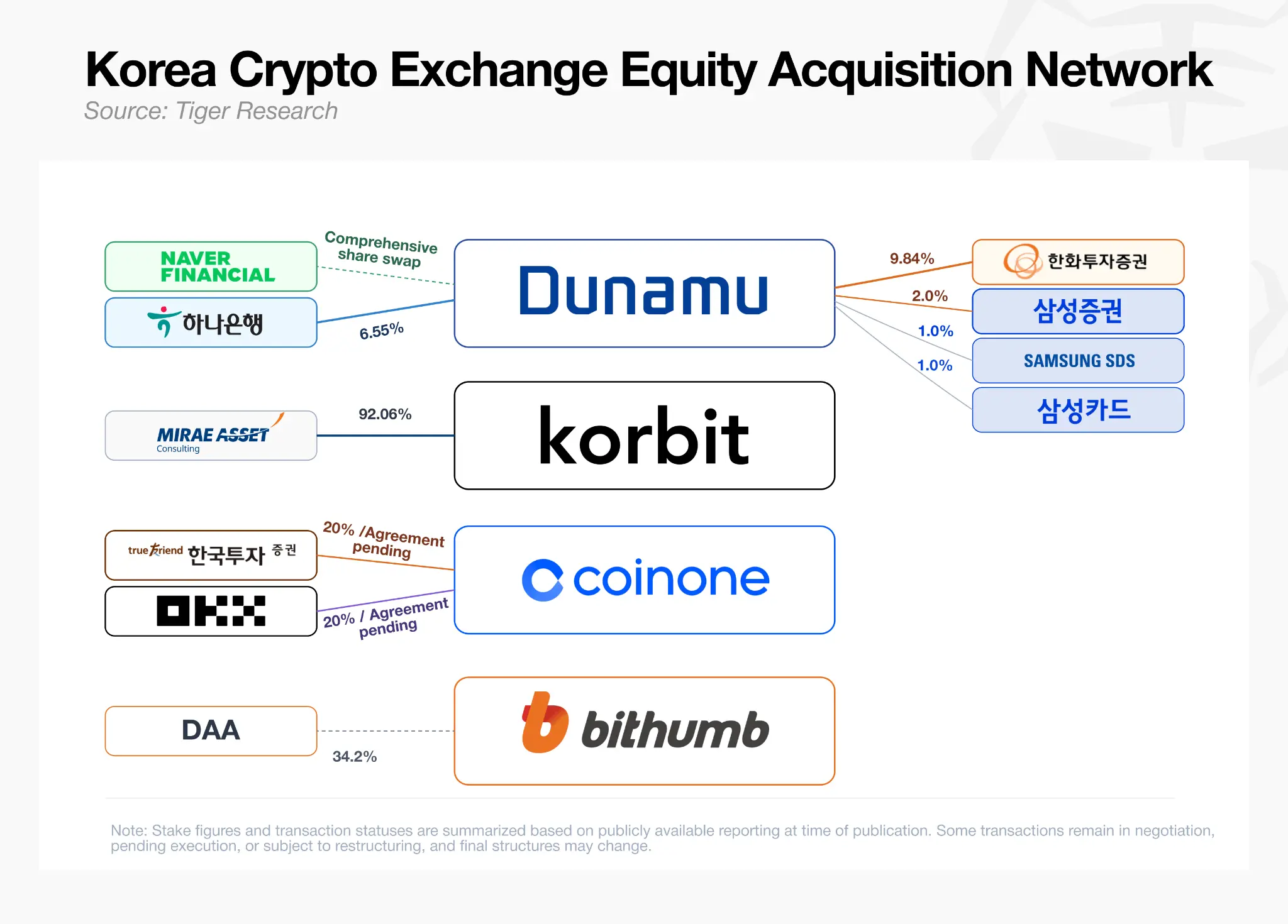
Last week, the South Korean cryptocurrency exchange Coinone officially announced the introduction of two heavyweight new shareholders. The global exchange OKX's venture capital arm, OKX Ventures, and South Korea's major brokerage Korea Investment & Securities (KIS) will each acquire approximately 19.6% to 20% equity for 80 billion KRW (about 53 million USD), totaling nearly 40%. OKX Ventures and KIS will be tied as the third-largest shareholders.
On the surface, this transaction is a story of "foreign capital knocking on South Korea's door," with OKX becoming another international player holding significant equity in a licensed exchange in Korea after Binance's acquisition of Gopax. However, zooming out, the true protagonist of this transaction is actually the Korean brokerage that is同行 with OKX.
KIS CEO Kim Sung-hwan also revealed the motivation: "This is our first step from traditional finance to blockchain digital financial services." For KIS, Coinone serves as a springboard, allowing it to enter new arenas such as the issuance and circulation of security tokens (STO), stablecoin-related services, digital asset brokerage, and institutional-level crypto business.
It can be said that even this transaction, packaged as "foreign capital entering the market," is primarily driven by a local Korean brokerage, with foreign capital acting more like minority financial investors hitching a ride. Moreover, when placed in the context of the past three months, this transaction involving Coinone is just the tip of the iceberg in the entire South Korean crypto landscape.
Samsung Subsidiaries Each Enter with Different Calculations
Just a day before Coinone signed the agreement, on May 28, three companies under the Samsung Group—Samsung Securities, Samsung SDS, and Samsung Card—also jointly announced plans to invest approximately 612.8 billion KRW (about 408 to 446 million USD) to acquire a total of 4% equity in Dunamu, the parent company of South Korea's largest crypto exchange Upbit. Samsung Securities will take 2%, while Samsung SDS and Samsung Card will each acquire 1%. The transaction will be conducted in cash to acquire about 1.39 million shares from the Kakao Group's funds (including Kakao Investment, Kakao Ventures, etc.), with the deal expected to close on June 19.
Notably, the valuation: at a price of about 439,000 KRW per share, this implies that Dunamu's overall enterprise value is estimated at around 15.3 trillion KRW, equivalent to about 1.11 billion USD. The seller, Kakao Group's funds, will completely exit Dunamu through this bulk transaction, symbolizing that the "old shareholders" in the South Korean crypto landscape are being replaced by "new faces."
Moreover, the three Samsung subsidiaries each have different calculations for entering the market, and these calculations almost perfectly correspond to the three pillars of the "Digital Asset Basic Law," which is expected to be finalized in South Korea by 2026:
Samsung Securities is focused on the issuance and circulation of security tokens and virtual asset-related services, corresponding to STO and tokenized securities.
Samsung SDS, as the group's IT and cloud department, plans to integrate its capabilities in artificial intelligence, information security, and data governance into Dunamu's blockchain operating infrastructure, corresponding to underlying technology infrastructure.
Samsung Card aims at the digital asset payment ecosystem, planning to integrate crypto payments into Samsung's financial network's unified platform Monimo after the launch of a KRW stablecoin, corresponding to the stablecoin payment track.
In other words, Samsung is not treating this 4% as a mere financial investment but as a piece of the puzzle in the group's financial services strategy for the next decade. A Samsung insider told the Korea Times that this move aims to strengthen the competitiveness of each subsidiary in the digital asset business and assist the group in achieving a leading position in the market.
For one of South Korea's most significant conglomerates, this is equivalent to announcing to the market that it is building a complete digital asset infrastructure rather than making a gamble.
Traditional Capital is Eager, Is Virtual Asset a Blue Ocean?
Looking back a bit further, in mid-May, Hana Bank agreed to acquire 6.55% equity in Dunamu for about 1 trillion KRW (approximately 670 to 720 million USD), becoming the first South Korean financial holding group to directly hold equity in a crypto exchange. Less than ten days later, Hanwha Investment & Securities approved an additional investment of about 3.90%, raising its stake to 9.84% with an additional 597.8 billion KRW, becoming one of Dunamu's largest non-founder shareholders.
Additionally, Mirae Asset had already signed a contract through its subsidiary Mirae Asset Consulting in February to acquire a controlling stake of up to 92.06% in Korbit, South Korea's fourth-largest exchange, for about 133.5 billion KRW. From the leading Upbit, the third-largest Coinone, to Korbit, almost every major exchange in South Korea has, in just a few months, replaced its backers with new faces from traditional finance.
Why is traditional capital so eager? Dunamu's financial figures provide part of the answer: for the fiscal year 2025, it reported revenues of 1.56 trillion KRW and a net profit of 708.8 billion KRW, capturing over 80% of South Korea's virtual asset trading volume. The significance of this pie is naturally self-evident for banks and brokerages.
Market Landscape is Chaotic, Institutions are Early to Position
A report released last week by research firm Tiger Research reviewed 150 institutions and 196 partnerships in South Korea, concluding that no single hub currently holds dominant control over the market.
The entire relationship map is complex, reflecting the current chaos in the market, indicating that various institutions are positioning themselves across different tracks before regulations are finalized.

This can be described as a "The Exchange Equity Scramble," reflecting the series of actions from Hana, Hanwha, Samsung, Mirae Asset to KIS. Analysts believe that the essence of this competition is a "re-evaluation" of the value of crypto exchanges: exchanges are no longer just trading platforms that collect fees but are key customer touchpoints for distributing stablecoins, custody services, security tokens, and RWA products.
For banks and brokerages, investing in exchanges is a shortcut: it allows them to indirectly obtain licenses such as VASP registration while simultaneously gaining access to the exchange's existing user base and liquidity.
Further analysis of this competition revolves around three fronts: stablecoins, STO, and custody.
The maturity of these three fronts varies. The most active is the custody sector, where several players have begun providing services after crossing regulatory thresholds, with four major custodians—KODA, KDAC, BDACS, and BitGo Korea—each binding financial and technical partners; RWA and STO are mostly stuck in contract or MOU stages, waiting for legislation to take effect; stablecoins are similarly stagnant, with no party able to claim dominance in standard-setting.
The biggest bottleneck is not technical but legislative; the Bank of Korea is pushing for a "51% rule," arguing that only alliances with majority bank ownership can issue stablecoins, which has faced strong backlash from fintech players, causing negotiations in the political arena to be repeatedly delayed.
Currently, this wave of cooperation and acquisition should not be interpreted as ordinary business development but as institutions rushing to secure advantageous arrangements before regulations are finalized, using these arrangements to influence the final regulatory framework. The current alliances and collaborations are less about seizing the market and more about "designing regulation."
Supporting this judgment is the clear shift in market focus. Analysts point out that the South Korean crypto market has been significantly restructured in just six months: a custody camp has formed, STO alliances are gathering, and financial giants are competing to invest in exchanges, while retail trading volume has rapidly shrunk, with the combined trading volume of the five major exchanges decreasing by about 48% year-on-year. The market's core is quickly shifting from retail to institutional.
Conclusion
Putting together the pieces of OKX's investment in Coinone, Samsung's acquisition of Dunamu, Hana and Hanwha's increased stakes, and Mirae Asset's acquisition of Korbit, one can see that they are actually different facets of the same story, led by brokerages and banks working together to reposition the South Korean crypto landscape from a "retail speculative trading ground" to a "traditional financial digital asset distribution gateway."
However, since the operational mergers have not yet materialized, most collaborations remain as MOUs, and STOs and stablecoins are still awaiting legislation, the market remains cautious and skeptical.
This shift is also changing the way overseas cryptocurrency projects enter the South Korean market. Just as Solana has become a partner of Shinhan Card and Avalanche has partnered with Mirae Asset, projects entering the South Korean market have shifted their primary targets from exchanges to financial institutions and large enterprises.

 Risk warning

Popular articles





