








Blockchain Capital Partner: The Core Secret of Arbitrage
 Core Viewpoint

 On cold starts, breaking the circle, and the toughest hurdle for founders to overcome.
Author: Yuan Han Li
Compiled by: Jiahua, ChainCatcher
Tether's average daily transaction settlement volume exceeds that of most traditional payment networks. Its success lies in becoming something that banks avoid: a stable dollar that exists on-chain, circulates around the clock, and requires no permission.
When Bitfinex launched it in 2014, its use case was merely for transferring funds between exchanges without touching banks.
It succeeded, with USDT becoming the core liquidity trading pair for spot and contract trading on all major centralized exchanges, deeply embedded in the underlying infrastructure of exchanges, to the extent that Binance's attempt to replace it with its own stablecoin was unsuccessful.
Then Tron emerged. Low transfer costs made USDT the default dollar in Latin America, Sub-Saharan Africa, and Southeast Asia. Its users became those in high-inflation economies who needed a practical dollar. Tether originally built a network for one audience but found they were serving a completely different group.
Today, it is one of the largest holders of physical gold in the world.
Technology is almost not the focus here. What truly matters is the huge gap between the role people need the dollar to play and the role that the traditional banking system allows it to play. The top crypto companies discovered this gap and built a growth flywheel on it before others could fill it.
More accurately, it is arbitrage. This is not a narrow definition of financial arbitrage but rather discovering a sufficiently large gap between markets or systems that lasts long enough and is difficult for existing giants to fill immediately. Utilizing this gap to cold-start a growth flywheel. Then, before the window closes, converting this temporary advantage into a lasting barrier.
Arbitrage consists of three steps: discovering the gap, building the flywheel, and advancing the advantage. In the crypto space, almost every team that discovers a gap can build a flywheel on it. The real difficulty lies in the third step.
The first and second steps require proficiency in crypto-native capital markets, such as understanding where liquidity is or what kind of products can attract funds.
The third step requires a completely different language system: compliance, institutional trust, consumer-grade product standards, and collaboration with banks and fintech companies.
Founders who can successfully navigate all three steps are "bilingual": they are native speakers of the crypto capital market while having self-taught mainstream business language. Such individuals are rare, but they are the ones who build enduring companies.
Cold Start
The first two steps of arbitrage (discovering the gap and building the growth flywheel) rely on a deep understanding of the crypto-native market. There is a strong demand for this in the market. Between 2022 and 2023, 76.9% of crypto trading volume in North America was driven by large transfers of over $1 million.
On Polymarket, a historical trading volume of over $50,000 is enough to place you in the top 5% of users. Crypto users are not just a customer group; they are a capital market themselves: whales, market makers, and mature advanced users who view these platforms as core economic infrastructure.
Therefore, the formation of moats in the crypto space occurs later than in traditional software and collapses faster. Those truly enduring moats (trust, infrastructure networks, deep integration, liquidity depth, brand) take years to build, and even if the underlying code can be copied, these barriers cannot be easily replicated.
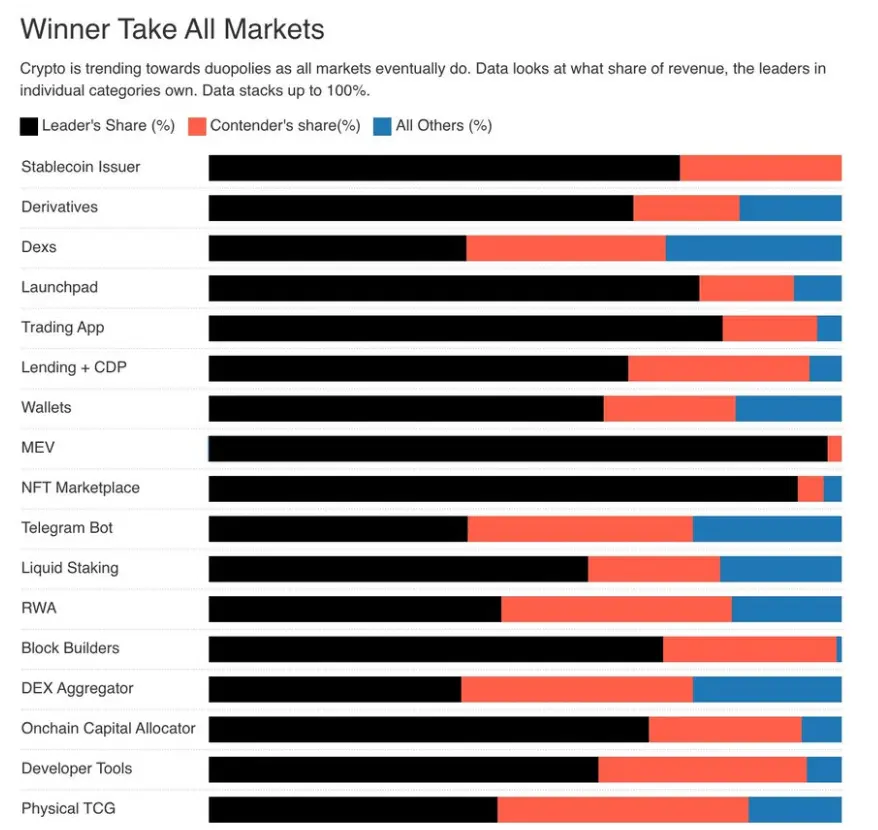
In the early days, there were no such moats, only communities and a profound understanding of where funds would flow next. The fuel for cold starts comes from three aspects. They often intertwine, but each tests your understanding of the crypto-native market from different dimensions.
Speculation is the most common cold start mechanism in the crypto space. In discussions within the crypto circle, people tend to either blindly praise speculation or judge it from a moral high ground. Both attitudes miss the point, but moral judgment may be worse. Frankly, speculation has always been the most reliable cold start method in crypto history.
Tether's cold start was purely a trading channel provided for speculators.
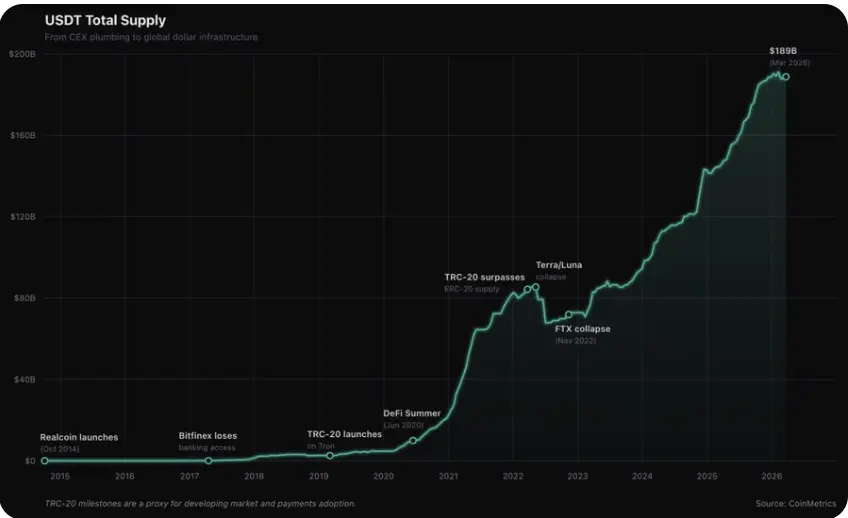
Circle found its moment in the summer of DeFi when liquidity miners needed a trustworthy stablecoin to circulate among various governance token pools. Although the mined tokens often proved worthless in the end (to be fair, everyone knew that at the time), the demand for a reliable on-chain dollar was very real.
Circle did not foresee the summer of DeFi. But they had already built a compliant, transparent product (even somewhat boring by crypto standards) that was ready when the frenzied market needed a trustworthy dollar.
Ethena captured another type of user. Yield-seeking users were attracted to USDe, a synthetic dollar that generates yield through the basis between spot and perpetual contract markets.
Its total locked value (TVL) reached $14.5 billion, making it the third-largest stablecoin and generating over $480 million in fees. Its cold start was purely crypto-native financial engineering, with an expansion speed that almost surpassed any project in DeFi history.
But not all cold starts begin with speculation.
When existing financial networks collapse or become exclusive, urgent needs drive adoption. High inflation environments, expensive remittance channels, and people excluded from dollar-denominated savings.
When the pain points are strong enough, people will switch without needing persuasion. They just need a usable network.
RedotPay is a great example. Founded in mid-2023, this crypto card company saw its annual revenue grow to over $150 million by the end of 2025. It allows people to save and spend stablecoin balances through a new banking-like interface.
You cannot shut yourself off in an ivory tower in New York or London; you need to understand the on-the-ground situation. Pitching the same product to people in Manhattan is just a novelty; pitching it to those without reliable dollar savings channels or usable bank cards is a lifeline. This is arbitrage.
RedotPay's advantage lies in their deep familiarity with both ends: the crypto network and emerging market channels. Moreover, since users are not chasing yields but solving a long-standing urgent need, this retention is more durable.
Subsidies (token incentives, points programs, venture capital-supported customer acquisition) can fill the gap until organic demand can sustain itself. Before subsidies stop, the activity brought by them may appear indistinguishable from real traction. Only with honest design and careful measurement can incentive programs accelerate the discovery of genuine demand rather than fabricate it out of thin air.
Hyperliquid is a recent typical case of correctly using subsidies. A large-scale points program and airdrops attracted traders to the platform, but its underlying product is indeed industry-leading: fast execution, deep liquidity, and a trading experience comparable to centralized exchanges.
Subsidies bring people in, and the product gives them a reason to stay. Activity did not collapse after the incentives ended; instead, it achieved growth.
These three fuels often first attract crypto-native participants. Even in emerging markets driven by urgent needs, before reaching the end users, it requires crypto-native intermediaries (exchanges, wallets, on-chain protocols).
Almost every successful crypto company's early growth required a mastery of how crypto-native capital markets operate. Otherwise, you are blindly starting in a market you do not understand.
But merely understanding crypto-native rules is not enough to complete the advancement.
Breaking Out
Executing a cold start is difficult. But what is even harder, and where most companies fail, is how to advance from crypto-native traction to mainstream market viability. Every company mentioned in this article faced the same question at some stage: when crypto-native traders are no longer the core audience, can the product still function?
Many teams excel in the cold start phase but ultimately cannot escape defeat.
Intuitions that work in the cold start phase (speed, community intuition, rapid delivery) may backfire in the next phase. The basic requirements of new user groups are consumer-grade customer service, intuitive interfaces, and compliance.
Growth channels shift from crypto Twitter (CT) and airdrop activities to collaborations with banks, fintech companies, and merchants. The quality of revenue is more important than trading volume. Organizations need predictability that they have never had before.
Circle is a model of successful advancement. For many years before the compliance framework was introduced, they were investing in building compliance infrastructure, learning the language of institutions while the crypto circle was still talking to itself.
When the GENIUS Act was passed in July 2025, establishing the first federal stablecoin framework, Circle's early bets no longer seemed conservative but rather visionary. They went public on the New York Stock Exchange and achieved $2.7 billion in revenue and $75 billion in USDC circulation by the end of the year. Speculators still exist; they just are no longer the whole story.
Ethena illustrates what it looks like when the future is uncertain. When Ethena's yields were compressed at the end of 2025, its TVL shrank by nearly half. Its cold start relied entirely on a single mechanism: basis trading between spot and perpetual contracts.
Advancement requires diversification. Ethena is taking multiple approaches: outputting yields to institutional investors through regulated packaged instruments; launching USDtb supported by the BlackRock BUIDL fund; establishing a perpetual contract exchange HyENA built on Hyperliquid; and introducing a "Stablecoin-as-a-Service" model that allows other ecosystems to issue their own stablecoins on Ethena's infrastructure.
The underlying assets themselves have undergone a transformation: by mid-2026, the proportion of perpetual contracts in USDe collateral dropped from 93% to over 5%. Whether any of these new initiatives can massively replace the growth engine of the cold start period remains unknown. But the direction is clear: Ethena is striving to become a "bilingual" entity in real-time, and time is running out for them.

The failure of "monolingual" founders is entirely foreseeable. Teams mistake incentive-driven activity for product-market fit. Founders cannot simplify their products for mainstream users. Compliance issues drag on until court subpoenas arrive. Even as the customer base dwindles, organizations do not restructure hiring, KPIs, or product roadmaps.
There is also a more insidious form of "monolingualism": founders attempt to skip the crypto-native cold start entirely and push crypto-driven products directly to mainstream users, wondering why no one is interested.
Cold starts are the ignition system (you cannot skip it), but teams that continue to optimize the ignition system after the engine needs to run normally will also find themselves stuck. Both are "monolinguals," just speaking different languages.
Not everything has an arbitrage opportunity. The concept of tokenizing Manhattan commercial real estate is constantly hyped but repeatedly fails (every cycle fails, without exception) because such products cannot attract the crypto-native capital market (low liquidity, lack of composability, unattractive returns) nor traditional investors (who already have channels for investing in real estate).
Sometimes you have to wonder if the people promoting these projects have really communicated with the target buyers. This is not arbitrage; it is a product that pleases neither side.
What makes the advancement phase exceptionally perilous is that the form of arbitrage itself has changed.
In the cold start phase, you are leveraging the gap between crypto-native demand and a service-scarce market.
In the advancement phase, you are dealing with another gap: the infrastructure and trust you have built versus the mainstream channels eager to access this infrastructure. The gap has shifted, and only those founders who have already become "bilingual" can stand firmly on the other side.
Bilingual Founders
In the 1790s, Mayer Amschel Rothschild sent his five sons to five cities: London, Paris, Vienna, Naples, and Frankfurt.
Each of them learned the local language and financial customs. They coordinated through private codes that outsiders could not decipher, and their intelligence network operated faster than government agencies.
Many European banking families had capital; but only the Rothschild family could simultaneously grasp situations across all borders and act with unparalleled speed because they invested energy in mastering the rules on both ends of every critical gap.
The same logic applies to the crypto space, but the type of "bilingual" founders is not entirely the same.
Some founders are born bilingual. They have deeply engaged in the crypto-native capital market and have a profound understanding of mainstream or institutional language from past experiences or hard-earned explorations. Circle has been like this from the beginning. They are a sought-after investment target and one of the very few.
More commonly, there are founders who "master a second language": they possess crypto-native genes and have enough founder-market fit, making it natural for them to cultivate institutional and mainstream sensitivity rather than undergoing painful transformations.
RedotPay falls into this category: a combination of crypto networks and emerging market channels, with a team that deeply understands the needs on both ends of this gap from the start. They certainly need to learn and adapt, but they do not need a complete transformation.
Next are those founders who can never adapt.
Sometimes, it is those who won too easily in the cold start phase, making it hard to imagine that the rules of the game would change. The first language is so useful that learning a second language seems unnecessary. The result is the same: while they are still optimizing for the phase they have already won, the window for advancement has closed.
Sometimes the situation is the opposite: they possess mainstream business acumen but lack crypto-native intuition. Everything looks perfect on paper, but no one is interested in the cold start phase because the founders never learned how to communicate with the market that could support them through the first phase.
To discern which type you are facing, it is more about intuition than frameworks. You need to cultivate this intuition over multiple cycles, just like the Rothschild family did over generations; each experience sharpens your pattern recognition.
The questions any founder faces are the same as those defining each arbitrage: what gap are you leveraging? How does your growth flywheel generate compounding returns? And what will the advancement phase look like?
As the crypto space matures, arbitrage opportunities will not disappear. They will only become more elusive, requiring higher operational demands, and will be harder to discover without bilingual capabilities that understand both worlds.
The advantage of the Rothschild family can be passed down through generations precisely because of the compounding effect of this bilingual ability: each crossing of boundaries makes the next insight easier. The same is true here. This is the most enduring advantage in this market, and it cannot be faked.
 Risk warning



Popular articles





