








Is the era of freedom in the cryptocurrency world coming? Do virtual currency projects in the U.S. no longer need to register for regulation when raising funds?
 Core Viewpoint

 The SEC officially proposed new regulations for cryptocurrency asset supervision: exemptions of either 5 million or 75 million, and a safe harbor that can be detached from the definition of securities.
Original Zhu Shiming Chain Law Notes
In the past few days, besides the meme coin Niulai becoming extremely popular, another very important piece of news is the SEC's proposal for Regulation Crypto Assets submitted on August 18.
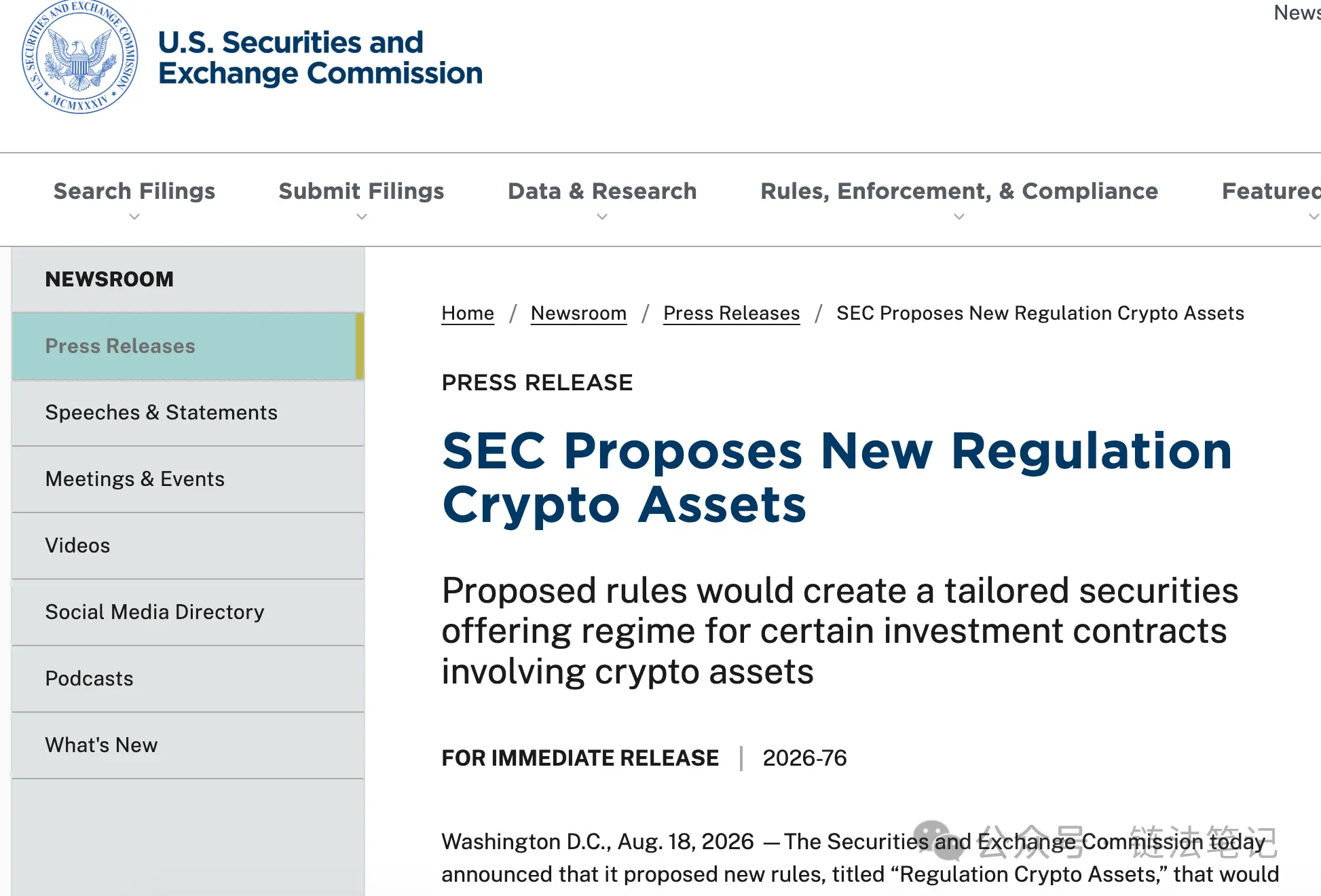
Many people excitedly shared: "No need to register for issuing coins in the U.S.!""The crypto circle is free now!""The spring of project parties has arrived!"
Is this correct? Half right, half wrong.
What exactly has been exempted? What price do project parties have to pay? What are the differences from existing Reg A and Reg D? Where are the risks?
1. The core of this proposal consists of three things
The SEC's Regulation Crypto Assets essentially opens a "customized window" specifically for crypto assets within the existing securities issuance exemption system in the U.S.

It does not aim to abolish regulation but to provide crypto projects with a compliant and predictable financing path. The core consists of three things:
First, two exemption channels.
If it is an early-stage small project that raises no more than $5 million within four years, it can go through the "startup exemption" channel, which has relatively simple procedures and does not require audited financial statements.
If you are a slightly larger project, you can raise $75 million every 12 months through the "financing exemption" channel, but you need to submit financial statements and fulfill ongoing reporting obligations.
Second, a "safe harbor" clause.
This is the most interesting part of the entire set of rules. If a token is considered a security at the time of issuance, it doesn't matter—once you complete the core development work promised by the project (or permanently cease it), you can prove this to the SEC, and then the token can be decoupled from the "investment contract" and no longer be regarded as a security, thus escaping SEC oversight.
Third, federal law takes precedence.
Previously, Web3 projects had to deal with the SEC as well as the registration requirements of 50 states. The new proposal states: as long as it meets federal exemptions, all state securities registration requirements will give way. This is a substantial benefit for cross-border projects.
2. Don't misunderstand it as "no one is in charge"
"Exemption from registration" and "exemption from regulation" are two different things. The proposal clearly states: anti-fraud and anti-manipulation clauses have not been abolished.
What does this mean? You can skip submitting a several hundred-page registration statement to the SEC in advance, but if the project engages in false advertising, misleads investors, or manipulates the market, the SEC can still come knocking afterward. SEC Commissioner Uyeda aptly stated: "This set of rules replaces the past guessing game with fixed thresholds, clear disclosure obligations, and a whole set of measurable conditions."
In other words, it used to be unclear whether a certain token counted as a security, relying solely on guesswork, and if guessed wrong, penalties would follow. Now the rules have drawn the lines clearly, and as long as you operate within those lines, you're fine—but if you cross the line, you bear the consequences.
3. What is the real issue to be resolved? The Howey Test
To understand the deeper significance of this proposal, one must first grasp an unavoidable concept in U.S. securities law: the Howey Test.

This is a four-element standard established by the U.S. Supreme Court in the 1946 SEC v. W.J. Howey Co. case—if all four are met simultaneously: (1) money is invested; (2) it is in a common enterprise; (3) there is an expectation of profit; (4) profits are primarily derived from the efforts of others—then it constitutes an "investment contract" and must be regulated as a security.
The problem arises. Almost all token issuances and early token sales can somewhat meet these four criteria. This has led the entire industry to be in a long-term state of "Schrödinger's security": if you say it is not a security, the SEC may not agree; if you register it as a security, the costs are prohibitively high, and the process is not suitable.
The safe harbor clause in Regulation Crypto Assets is specifically designed to address this issue: it provides project parties with a clear "decoupling" path—once the core management work of the project is completed or terminated, the token is no longer a security. This removes the sword hanging over their heads.
However, it should be noted that SEC Commissioner Peirce also admitted: this exemption will not cover all types of crypto projects. Which can enter and which cannot, the details have not been fully finalized, and the upcoming 60-day comment period will be the battleground for various parties.
4. What are the differences compared to Reg A and Reg D?
Many people ask: isn't this just a specialized version of Reg A? Not really. I made a simple comparison table:
Regulation Crypto Assets is aimed at crypto assets, with limits of $5 million or $75 million per year, has a safe harbor, disclosure requirements are relatively flexible, and provides a specific solution for the classification of token securities. Regulation A is aimed at small and medium-sized issuers, Tier 1 is $20 million per year, Tier 2 is $75 million per year, has no safe harbor, Tier 1 requires registration in each state, and disclosure requirements are relatively moderate. Regulation D is aimed at private placements, with no upper limit but limited to accredited investors, has no safe harbor, must comply with state laws, and disclosure requirements are relatively limited. Form S-1 (IPO) is aimed at public companies, with no upper limit, no restrictions on investors, federal law takes precedence, but disclosure requirements are extremely detailed and costs are very high.
The key differences are twofold:
One is the safe harbor. Reg A and Reg D do not have this— they only care about how you raise funds, not whether your token is considered a security afterward. Reg Crypto specifically solves this problem.
The second is state law. Reg Crypto clearly takes precedence over state securities laws, eliminating the need to navigate through 50 states. Reg A's Tier 1 requires registration in each state, which is very cumbersome.
Another point to note: Reg D can only target accredited investors (i.e., wealthy individuals), while Reg Crypto, if it allows broader participation from investors, would have a completely different level of appeal for project parties.
5. How much will project parties actually spend?
"Exemption from registration" does not mean "free." There is no such thing as a free lunch in the regulatory world.
Information disclosure costs. Although not as burdensome as S-1, the required disclosure documents cannot be omitted, and professional legal and financial teams are needed to handle them.
Audit costs. Those going through the $75 million channel must provide audited financial statements. Finding an auditing firm that understands crypto assets can be costly—and how to price the tokens and confirm revenue is itself an accounting challenge.
Ongoing compliance costs. The $75 million channel requires ongoing reporting; this is not a one-time deal, and project parties need to maintain a compliance team or outsource to law firms and auditing firms long-term.
Legal fees. From choosing a channel, writing disclosure documents, communicating with the SEC, to responding to potential enforcement actions, every step requires lawyers.
Conservatively estimating, to properly complete this process, legal and compliance costs will range from hundreds of thousands to millions of dollars. This is not something small projects can easily bear.
6. Three risk lines must be monitored
The most important reminder is: this is just a proposal, not the final rule. Three risk lines are still hanging.
First risk line: 60-day comment period.
The proposal has just been released, and the next two months will be the public comment period. The industry, law firms, and Wall Street institutions will all submit opinions. After reviewing the comments, the SEC may accept them all, make significant changes, or even abandon the proposal—everything is still uncertain.
Second risk line: Senate vote on September 15.
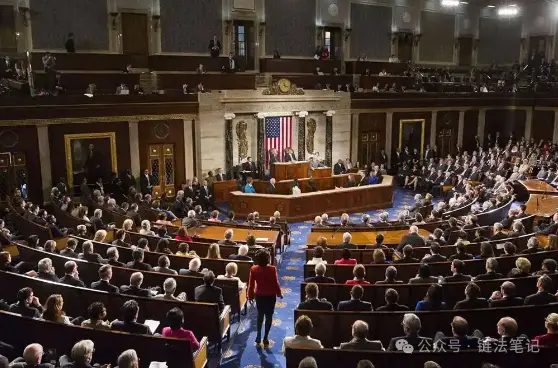 An important background for the proposal's introduction is the stalled progress of Congress's CLARITY Act. However, this bill is not dead— the Senate has scheduled a procedural vote for September 15, 2026, requiring 60 votes to move forward.
Ripple's Chief Legal Officer Alderoty has specifically warned: the vote on September 15 is a key juncture in determining the fate of this bill. If the bill passes, it will establish the legal status of most crypto activities at the legislative level, and Regulation Crypto Assets may be replaced or adjusted. If the bill fails, the SEC's administrative rules will be the main basis.
In other words, both paths are being pursued simultaneously, and no one can guarantee which one will succeed.
Third risk line: Wall Street's opposition.
SIFMA, representing mainstream Wall Street institutions, has consistently opposed granting broad regulatory exemptions to crypto companies. They believe such a significant change should go through formal legislative procedures rather than relying on the SEC to unilaterally issue rules. If SIFMA ultimately sues the SEC and wins, the legitimacy of this set of rules could be undermined.
GSR's Chief Legal Officer Riezman even warned: "In the next government term, we are likely to see a situation similar to Gensler 2.0."—meaning that even if the rules are ultimately passed, a change in government could easily overturn them.
7. Several suggestions
First, do not treat "exemption from registration" as "free to issue." Anti-fraud and anti-manipulation clauses remain effective. Those who think they can take advantage of this opportunity to exploit investors will ultimately face consequences from the SEC.
Second, monitor both regulatory paths simultaneously. The CLARITY Act and Regulation Crypto Assets are both advancing, and it is uncertain which will be implemented or replaced. It is advisable to prepare two plans and not put all your chips in one basket.
Third, carefully study the conditions of the safe harbor. This "decoupling" path is the most innovative part of the entire proposal, but the specific conditions—such as the required level of decentralization and the depth of information disclosure—have not yet been finalized. These details will determine whether it is a truly viable escape route or just a decorative feature.
Fourth, calculate the cost in advance. Compliance costs ranging from hundreds of thousands to millions of dollars must be factored into the financing planning stage. Don't wait until you've raised money to find out you don't have enough to cover compliance fees.
Fifth, keep an eye on the Senate on September 15. The voting results that day will directly affect the direction of the entire regulatory framework. For project parties, the information obtained that day may determine the next strategic choice.
In conclusion
The introduction of Regulation Crypto Assets marks an important shift in the SEC's approach to crypto regulation—from "enforcement-led" to "rules-first."
But this is not the arrival of a "freedom era." A more accurate expression is: moving from an era of "vague rules, relying on guesswork" to an era of "clear rules, which must be followed."
SEC Chairman Atkins quoted the legislative intent of Congress in his statement—"The design of securities law is to expand opportunities for innovation within a specific regulatory framework." This statement is worth pondering: regulators should delineate the regulatory track, not let athletes run amok in an unregulated state.
For us legal practitioners, the real value lies in recognizing a fact: all "exemptions" are granted by the system, never a retreat from regulation. True freedom is never the absence of rules, but rather clear and predictable rules.
As for whether Regulation Crypto Assets can ultimately be implemented, it depends on the interplay of the 60-day comment period, the Senate vote on September 15, and potential legal challenges from Wall Street.
Until the dust settles, any celebration is premature.
 Risk warning




Popular articles





