Blockchain Capital: Stablecoin Cross-Border Payments Are Different from What You Think
 Core Viewpoint

 Everyone says stablecoins are more suitable for cross-border payments, but is that really the case?
Author: Jonah Burian, Investor at Blockchain Capital
Compiled by: Jiahua, ChainCatcher
If you want to transfer money to someone who already wants to hold stablecoins, then stablecoins are indeed a great tool for cross-border payments. You can transfer funds almost at zero cost around the clock, and it arrives almost instantly.
But the trickier question, and the real topic of this article, is cross-currency payments: What happens if one end is transferring in US dollars, and the other end ultimately needs to receive another fiat currency, such as the Mexican peso?
Most people in the crypto industry will tell you that stablecoins can significantly reduce costs and increase speed in this scenario. However, supporters of stablecoins often do not mention one point: fintech companies have long been able to make cross-border payments fast and cheap without stablecoins.
So, what problem do stablecoins actually solve?
To answer this question, we first need to look at how the traditional correspondent banking system operates, and how modern fintech companies like Wise have transformed this model. Once we understand both, it will be much clearer what stablecoins truly change.
Correspondent Banking System
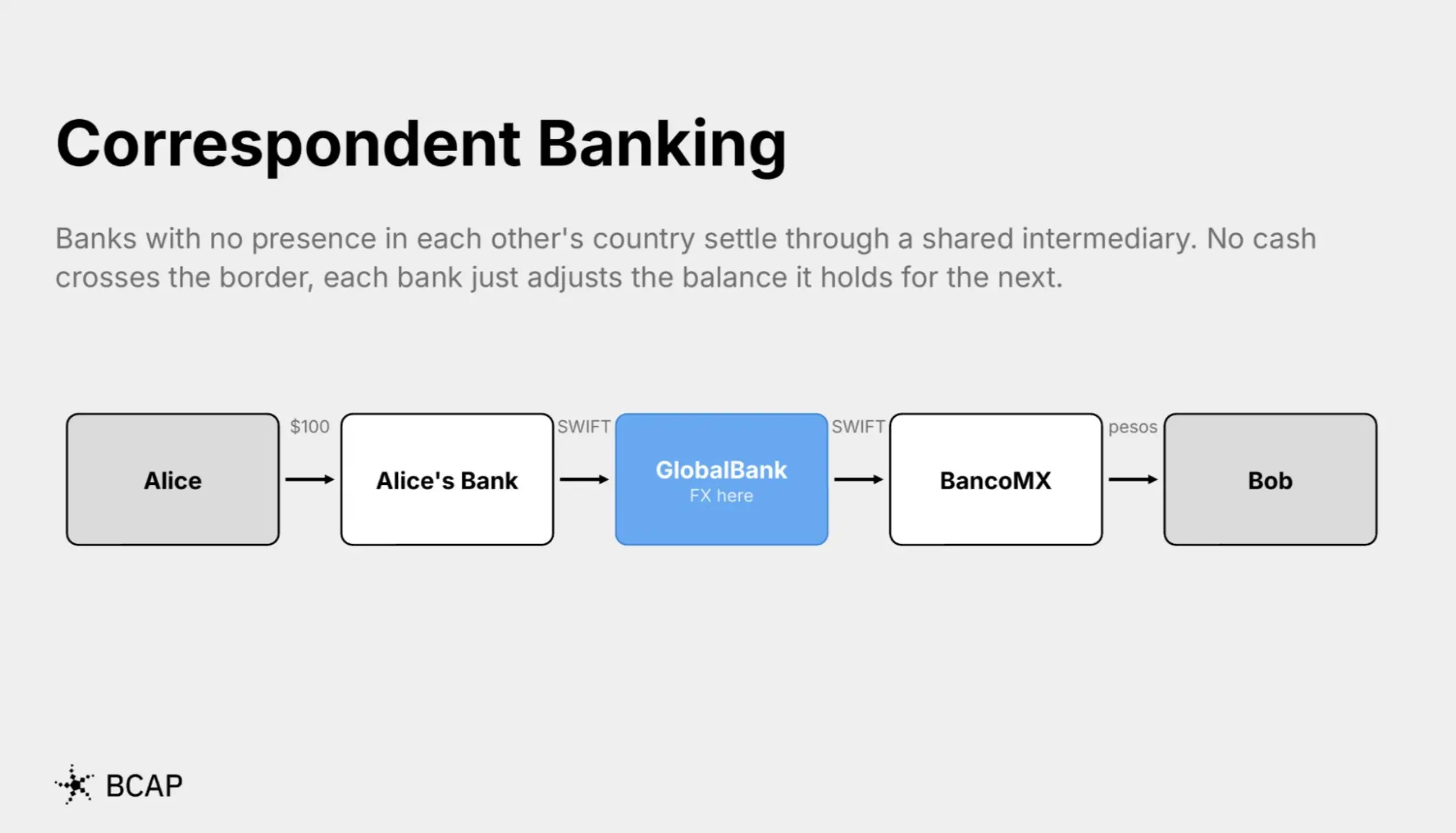
Suppose Alice in the United States wants to send some pesos to her friend Bob in Mexico.
Neither of their banks has a local presence in the other’s country, so they cannot complete the payment directly. Therefore, they need to establish a connection through a larger bank, known as a correspondent bank.
Alice's bank will pre-deposit a portion of US dollars with such a correspondent bank. Let’s assume this bank is called GlobalBank, and GlobalBank has deposited some pesos with a bank in Mexico, BancoMX.
After Alice initiates the payment, her bank deducts the amount from her account and notifies GlobalBank. GlobalBank deducts $100 from the US dollars pre-deposited by Alice's bank, converts it into pesos at its own exchange rate, earns a spread from the exchange rate, and then notifies BancoMX to credit Bob's account. BancoMX may also charge its own fees.
Throughout this process, the banks typically coordinate information through the SWIFT system, and SWIFT messages themselves also incur fees.
This system is both expensive and slow, one significant reason being that it involves too many layers of intermediaries, each taking a portion of the revenue.
According to World Bank data, the average cost of consumer cross-border remittances through bank channels, including fees and exchange rate spreads, is nearly 15%. Additionally, an international bank transfer typically takes 1 to 5 business days, as each intermediary needs time to complete its processing.
How Fintech Companies Transform Cross-Border Payments
In 2011, two friends in London happened to face completely opposite problems.
One person's salary is paid in euros but lives in the UK and needs pounds; the other person's income is in pounds but needs to repay a euro mortgage in Estonia.
So, the two decided to bypass the cross-border transfers between banks and pay each other directly locally: pounds go into an account in London, and euros go into an account in Estonia.
From start to finish, no money actually crosses borders.
Later, this idea developed into Wise.
They realized that if they could match a large volume of opposite funding needs, this model could be scaled. And it turned out to be feasible. Since then, many fintech companies have adopted similar methods.
Let’s revisit Alice and Bob’s example, this time assuming they are using a system similar to Wise.
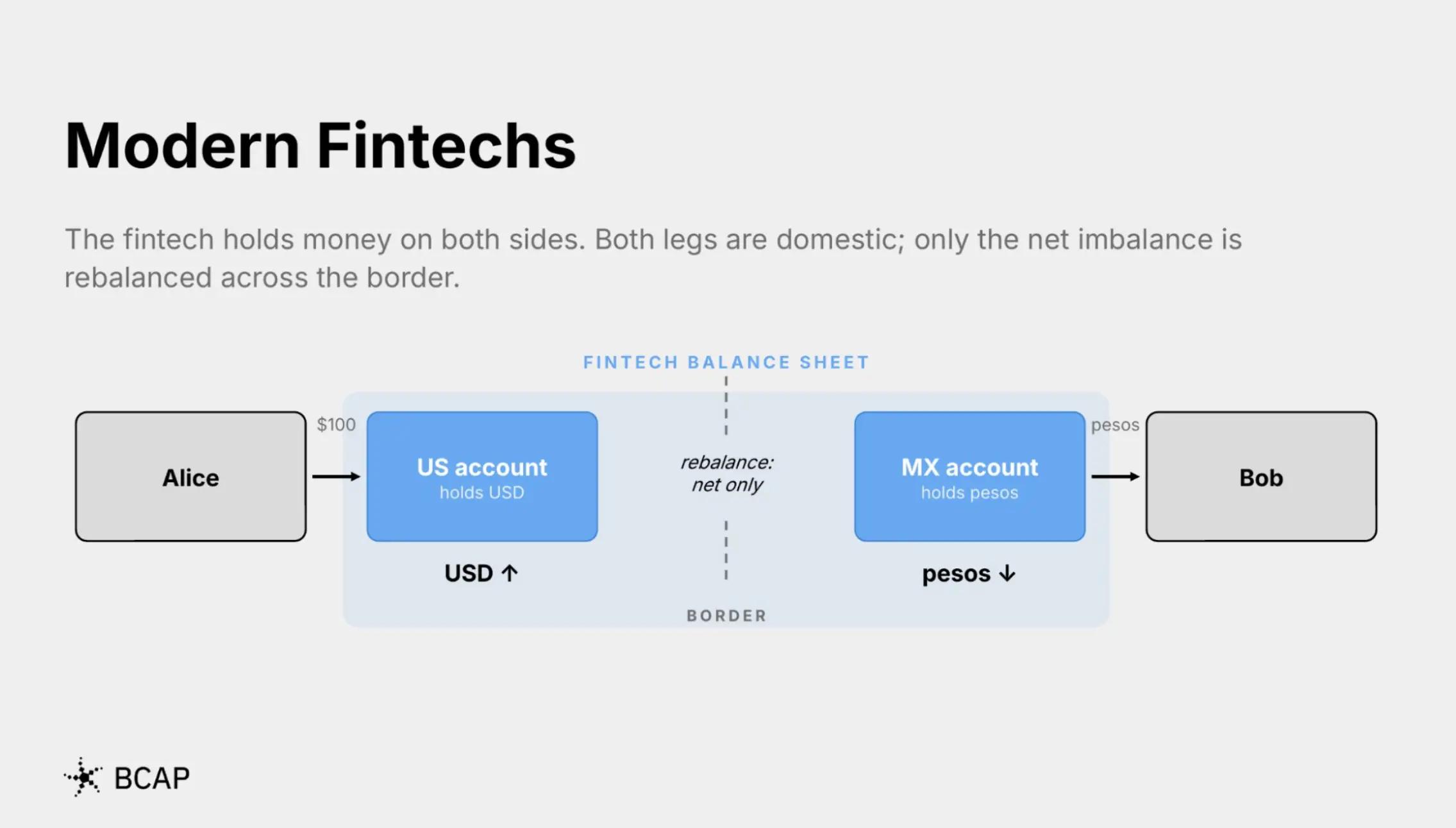
Alice first pays dollars into this fintech company's US account, and the company pays Bob directly from the pesos it already holds in Mexico.
Again, no funds actually cross borders.
Alice thinks she has completed a cross-border remittance from the US to Mexico, but at the underlying level, the company is simply collecting money from one pocket and paying it out from another pocket.
Because of this, the transfer appears to be almost instantaneous to the user.
Of course, this also means that fintech companies need to bear the balance sheet risks associated with holding different currencies.
To avoid reusing the traditional banking system as much as possible, these companies will try to "net settle" transactions in opposite directions.
For example, while Alice is converting dollars to pesos, there might be someone who needs to convert pesos back to dollars. The fintech company can offset the two opposing cash flows internally without needing to actually conduct two cross-border fund transfers.
Only when the funding pool of a particular currency is severely imbalanced do they need to rely on the traditional financial system to allocate funds.
At the core, these companies build networks relying on numerous partner banks, financial licenses, and local partners. If a country lacks its own business qualifications, local partner institutions can fill that gap.
If this system operates smoothly, its efficiency will far exceed that of traditional models.
Wise clearly states a small fee in advance while converting at the real market mid-rate, no longer profiting from hidden spreads. Its FY26 cross-border business comprehensive fee rate has dropped to about 0.5%, with the latest Q1 FY27 data at 0.50%.
In contrast, the average cost of purely digital remittance service providers, as reported by the World Bank, is about 3.5%, and Wise is already on the lower end of the industry in terms of fees.
Stablecoin "Sandwich"
Since Wise and similar fintech companies can already provide fast and cheap cross-border transfers, what is different about stablecoins?
Let’s look at Alice and Bob again.
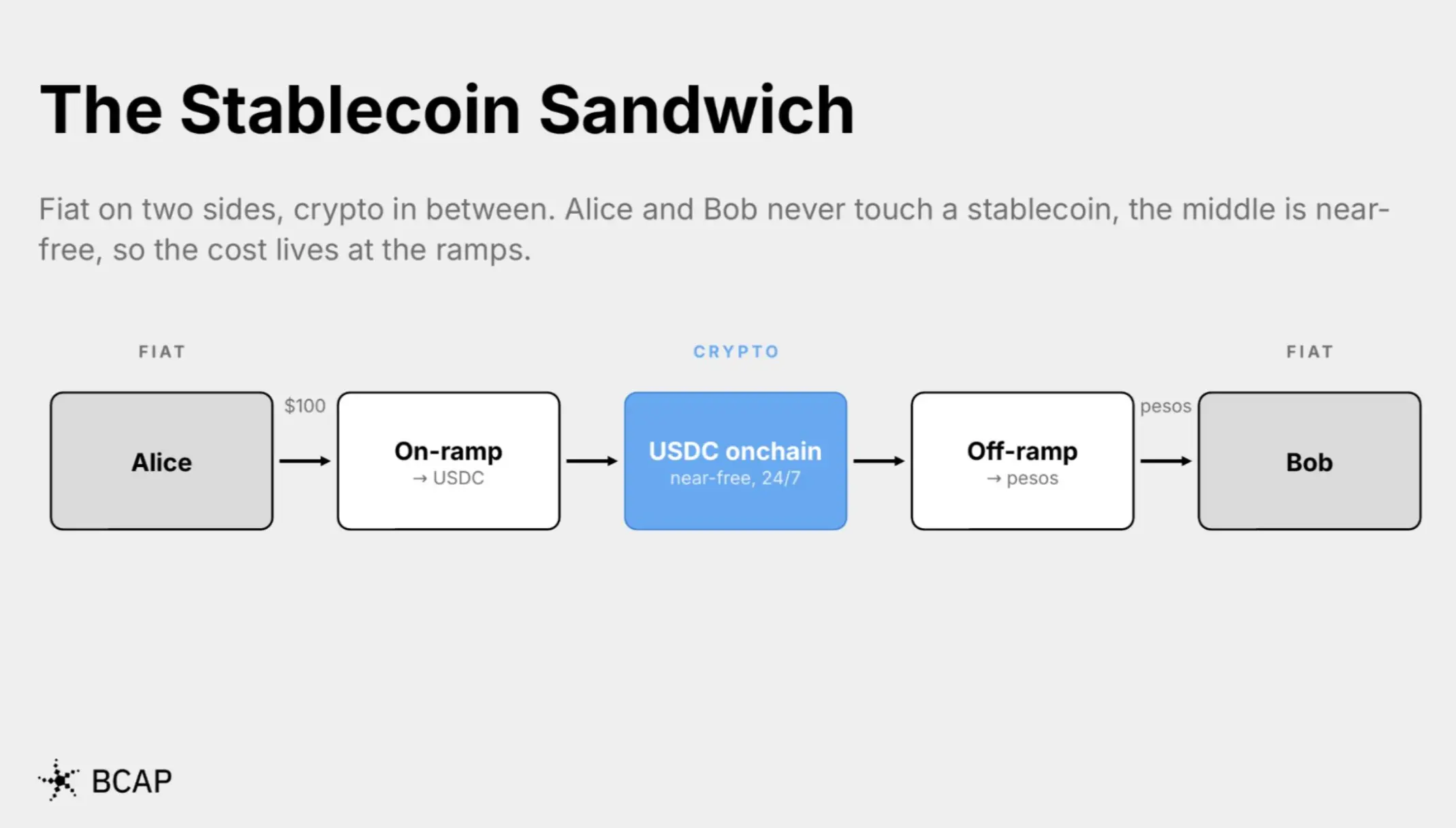
Alice first converts $100 into 100 USDC.
USDC is then sent to Bob in Mexico via blockchain, which can be completed in seconds, with on-chain transfer costs even less than a cent.
After receiving USDC, Bob then exchanges it for pesos through a local cash-out service and transfers it to his bank account.
This structure is commonly referred to as the "stablecoin sandwich":
Fiat → Stablecoin → Fiat.
But from Alice and Bob's experience, it’s hard to say this is necessarily better than Wise.
From a cost perspective, stablecoins are not inherently cheaper.
The on-chain transfer of USDC is almost free and instantaneous. As competition for cash-in services intensifies, the fees for converting dollars into stablecoins are also approaching zero.
The real issue still arises in the final cash-out phase.
What Bob ultimately wants is Mexican pesos, not USDC. Therefore, he still needs to convert the dollar stablecoin into local currency. In some markets, the exchange rate spread between the dollar and the local fiat currency can still be quite substantial.
In other words, the blockchain makes the transfer of funds in the middle extremely cheap, but it does not automatically eliminate the costs of converting fiat currencies at both ends.
What Stablecoins Truly Open Up: Open Competition
Building a global payment network like Wise is extremely difficult, so there are only a handful of companies that have successfully done so.
Stablecoins have lowered this barrier.
Now, if you want to run a cross-border payment company, you no longer need to build a global banking network from scratch.
You just need to find a good cash-in channel on one end and a good cash-out channel on the other end, connecting them directly through stablecoins.
From this perspective, what stablecoins truly do is break apart the previously integrated fintech payment network.
In the past, these capabilities were encapsulated within the closed networks of companies like Wise; now, they can be broken down into different modules and enter an open market.
In the past, a payment company might control the entire payment corridor and earn a spread from the entire process.
However, under the stablecoin system, local cash-out service providers in different regions can compete directly around each currency exchange. In the long run, this competition has the potential to further reduce costs.
This advantage may be particularly evident in long-tail cross-border payment corridors where transaction volumes are small and were previously difficult to cover by global payment networks.
Because businesses no longer need to build a global network, regional service providers can focus solely on a portion of the market rather than trying to cover the entire globe.
Yellow Card has adopted a similar model, focusing on stablecoin payments and fiat exchange services across multiple African countries. The company is also part of Blockchain Capital's portfolio.
Breaking apart the originally integrated network will lead to market fragmentation; but it is precisely this fragmentation that allows more participants to enter the market and create genuine competition that lowers costs for consumers.
Of course, counterarguments can be made.
There are now many stablecoin payment orchestration platforms responsible for recombining different cash-in, on-chain settlement, and cash-out services; the largest companies are also beginning to vertically integrate again.
Therefore, the market may very well trend back toward concentration in the future, and the advantages brought by stablecoins may gradually diminish.
But the issue is: open payment rails are always open.
They are hard to be truly monopolized by any one company.
If a particular intermediary starts to earn excessive profits from exchange rate spreads, another local cash-out service provider can directly compete at a lower price.
Anyone can enter this game.
As the comprehensive fee rates in the cross-border payment industry continue to be compressed, the portion of value that was previously taken by layers of intermediaries should ultimately return more to consumers and businesses.
And its most direct manifestation is: cross-border fund transfers will become increasingly cheaper.
 Risk warning


Popular articles