From Web3 phones to Agent infrastructure: What stage has MAGNE.AI's product roadmap reached?
 Core Viewpoint

 From RootData financing coordinates, project transparency to product delivery verification
Core Judgment: MAGNE.AI is expanding from Web3 mobile phones to edge AI and Agent infrastructure; a verifiable progress route has emerged, but mass production, customer validation, and production payments still need to be proven.

LATEST MOVES · Quick Overview of Recent Actions

Note: This article is compiled based on RootData, public regulatory materials, and MAGNE.AI's official disclosures; company disclosures, verified capabilities, and subsequent goals are marked in the text, with data as of August 23, 2026.
If MAGNE.AI is only viewed as a Web3 mobile phone, it is easy to overlook its recent changes extending into edge AI and Agent infrastructure over the past six months. Financing, team, and event information can be continuously viewed on the MAGNE.AI RootData project page; product, certification, and engineering progress are updated by the MAGNE.AI official website.
From the company's disclosed additional strategic financing of $2.64 million to Phone Gen1 entering PVT P2; from publicly available compliance materials like FCC, GMS, GSMA TAC, to the launch of a disassemblable phone engineering structure viewer; and further to the testnet evidence of MAGNE AI BOX and Agent Pay, MAGNE.AI is expanding its early positioning of "mobile phone as Web3 entry point" into a product route covering devices, edge computing, identity, and machine payments.
This route is still in the engineering realization phase, but a batch of verifiable materials has already emerged. At this stage, what is more suitable for observation is not the size of the vision, but whether mass production of the phone, AI BOX prototype validation, Agent Pay testnet progress, and community participation can be converted into real device users.
Therefore, the focus of evaluating MAGNE.AI should be on system integration, delivery speed, public verification, and ongoing operational capability, rather than a single parameter or conceptual label.
Signals from RootData: Entering Projects and Financing Coordinates That Can Be Continuously Tracked
There has been discussion in the market about "Tier 1.5" or "Tier 2," but RootData has not publicly assigned a unified Tier rating to MAGNE.AI. The verifiable fact is that MAGNE.AI has established a RootData project page and appeared in the AI sector financing Top 30 chart of RootData's "2025 Web3 Industry Annual Report" with a publicly disclosed financing amount of $10 million at that time. ^[1]^
On August 5, 2026, MAGNE.AI announced the completion of an additional strategic financing of $2.64 million, with participants including GAEA Ventures, Titans Ventures, and Go2Mars Labs. According to the company's disclosure, its cumulative public financing has reached $12.64 million. The funds will be used for engineering validation and commercial delivery of MAGNE AI BOX, integration of AI BOX with MAGNE L1/MHash L2, and the research and development of MAGNE Agent Pay and x402 compatible payments. ^[2]^
$12.64 million does not automatically prove industry status. It is more suitable as a signal for ongoing financing observation: after the first round of strategic financing in 2025, the company disclosed new funds in 2026. However, the structure, status of funds received, and rights arrangements of the new round mainly come from company press releases and still require more independent materials for confirmation.
From a third-party observation perspective, public materials have already shown clearer Pre-TGE preparation signals, but they are still insufficient to prove that TGE or exchange listings are imminent. MAGNE.AI's official milestone page lists exchange due diligence, token disclosure, protocol audits, exchange coordination, and market-making/liquidity arrangements as ongoing matters, while marking the TGE preparation checklist and launch window as planned and clearly constrained by legal, audit, exchange, liquidity, and operational conditions. ^[14]^ Season 2 will also link subsequent MHA distribution with future TGE arrangements. ^[13]^ Combined with additional financing, these changes make "TGE is being prepared" a reasonable market judgment; however, before complete audits, final token contract/mainnet information, confirmed dates, or exchange announcements are made public, a more rigorous statement should still be "TGE is being prepared," rather than "TGE is imminent."
The Phone Is Not Outdated; It Is Becoming the First Trusted Endpoint of the Entire Infrastructure
The configuration of MAGNE Phone Gen1 does not win by flagship consumer electronics parameters. The current specifications on the official website show that it uses UNISOC T9100 5G SoC, IMG AX3596 10 TOPS INT8 NPU, up to 12GB RAM, and 512GB UFS 3.1 storage, running Android 15, with a 5000mAh battery and a 6.78-inch 120Hz screen. ^[3]^ What truly constitutes differentiation is the three-layer security structure built around keys, recovery, and isolation: TEE undertakes trusted execution isolation, an independent secure element is responsible for private key storage and signing, and the NFC recovery card brings offline backups outside the device.
This makes MAGNE Phone more like "a hardware wallet and Agent control terminal for daily use," rather than a simple Android phone with a wallet app added. When personal Agents begin to call external services, request permissions, and initiate payments, the phone can simultaneously serve as an identity carrier, human authorization interface, and secure signing terminal. Its role in the entire MAGNE stack has also transformed from a final consumer product to a network entry point.
More than parameters, what reflects engineering progress is the project's proactive disclosure of production and compliance traces. The progress page on the official website shows that Phone Gen1 has completed Pre-EVT and EVT P1 and is currently in the PVT P2 production validation phase; design freeze, component procurement, and alignment with manufacturing partners have been marked as completed, with the first manufacturing targets aimed at the third quarter of 2026. ^[4]^ The public record of FCC ID 2BVCPGC603606 covers testing materials for cellular communication, Wi-Fi, Bluetooth, NFC, EMC, and SAR. ^[5]^
The project has also launched a 3D phone engineering structure viewer, which lists 31 visible components, including 6 STEP precision parts, 13 V51 appearance parts, and 12 modeling supplements, allowing users to disassemble layer by layer according to the shell, camera, and core structure. ^[6]^ A web viewer cannot replace mass production acceptance but indicates that the team is willing to turn industrial design, internal stacking, and product structure into publicly communicable assets. For the DePIN track, which has long been troubled by "PPT hardware" skepticism, such engineering transparency itself holds market value.
AI BOX Complements a Larger Commercial Space Beyond the Phone
If Phone Gen1 targets individual users, MAGNE AI BOX brings the project into enterprise private AI and edge computing scenarios. Its technical specifications, verification boundaries, and Release Gate status are continuously disclosed by W3.MAGNE.AI.
The product logic of AI BOX is not complicated: models, knowledge bases, and Agents run as much as possible locally, with enterprise original files not directly on-chain, retaining only device identity, task summaries, authorization statuses, and settlement vouchers on-chain. High-risk tool calls or payment requests still require manual confirmation via a bound phone or wallet, and private keys do not enter the model. This makes it not just "a smaller cloud server," but attempts to become the AI physical boundary that enterprises can control. ^[7]^
Its public specification control page provides 56 TOPS INT8 NPU, over 600GB/s bandwidth, 8---15W AI power consumption, and a capacity list composed of main system memory, NPU near-end memory, and extended memory of 34GB/38GB; at the same time, the page also clearly marks some indicators as "vendor statements" or "needs testing," and explains that capacity addition does not equal unified available memory. ^[7]^
Notably, the page separates "PDF configuration," "vendor statement," "already verified," and "to be tested." The page shows that the Qwen3.6-35B-A3B Q4KM model product has completed its first local operation verification; the project is currently in the Gate 0 specification freeze phase, with the next step being Gate 1, which will manufacture three prototypes for performance, power consumption, heat dissipation, offline, security, upgrade, and recovery testing, before entering design partner validation and small batch stages. ^[7]^
This indicates that the technical team’s understanding of hardware industrialization does not just stop at "making a demo." It has begun to manage risks from specifications, prototypes, customer validation to small batches using Release Gate. For the outside world, AI BOX also expands MAGNE.AI's commercial imagination from crypto users to fintech, digital asset institutions, Web3 teams, and enterprise clients needing local knowledge boundaries.
Agent Pay Truly Connects Hardware, Identity, and On-Chain Payments
One of the recent noteworthy technical moves by MAGNE.AI is Agent Pay.
x402 utilizes the HTTP 402 status code, allowing the server to return prices and payment requirements, with the Agent completing payments and re-requesting resources after obtaining authorization. This provides a machine payment path for APIs, data, inference, and digital services without the need for traditional account systems. Cloudflare has already provided x402 payment capabilities in the Agents SDK, indicating that "Agent native payment" is moving from concept to development tool level. ^[8, 9]^
The goal of MAGNE Agent Pay is to integrate x402 related payment processes into the device identity and hardware signing environment. According to the current official status page, the project has demonstrated local contract demos and testnet evidence; the HTTP 402 end-to-end process is still under development, MHash L2 receipts are in the testnet path, and production payments have not yet been opened. ^[10]^
Its design goal is to form an auditable control link: the Agent initiates a request, the policy checks permissions and budgets, high-risk actions enter manual confirmation, payments are executed after the phone or wallet signs, and the system generates task receipts. Computing, identity, authorization, and settlement are undertaken by AI BOX, MAGNE L1, MHash L2, and Agent Pay respectively, but this cross-module closed loop still requires public testnet transactions and third-party service access for verification.
This link explains why MAGNE.AI is simultaneously developing phones, AI BOX, L1, L2, and payments. Viewed individually, each layer is not scarce; combined, it attempts to answer four real questions of the Agent economy: where the model runs, how the device proves identity, who approves machine spending, and how transactions leave a record of responsibility.
Operational Team: Transforming Engineering Progress into Sustainable Trackable Information
TEAM OPERATING MODEL · Team Capability Profile
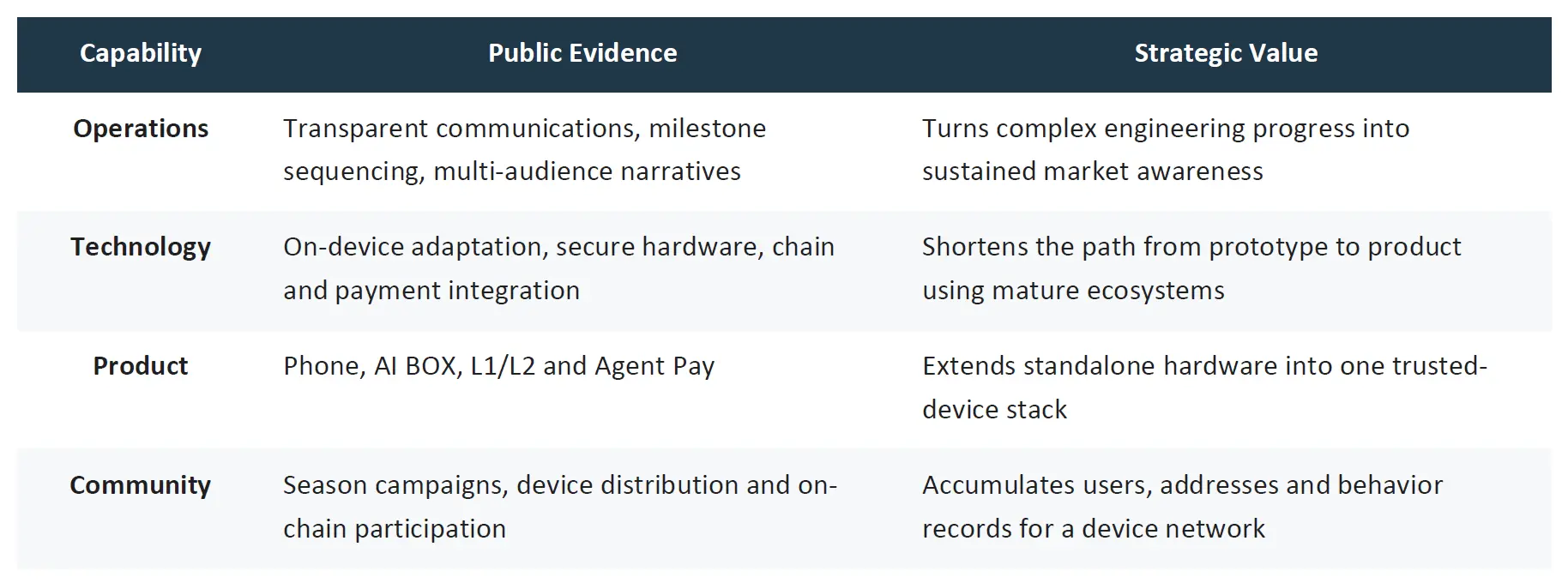
From the public actions of the past year, continuous disclosure and milestone arrangement are MAGNE.AI's prominent operational capabilities.
First, it excels at "transparency marketing." Ordinary projects typically create attention with grand visions, while MAGNE.AI turns FCC inquiry pages, GMS support materials, GSMA TAC, PVT progress, 3D engineering structures, AI BOX Gate, and Agent Pay status into publicly viewable content. Many ordinary users may not understand every engineering material, but these details create an intuitive understanding: the team is dealing with certification, supply chain, and testing issues that real hardware projects encounter.
Second, it continuously arranges product milestones. After the phone completes a batch of security and compliance disclosures, the project introduces AI BOX, expanding the direction to enterprise edge AI; subsequently, it connects AI BOX, dual chains, and x402 research with Agent Pay; financing and Season 2 respectively cater to institutional and community interests. Different actions form a continuous context, but each capability should still be expressed according to its actual verification stage.
Third, it understands how to provide different entry points for different audiences. Consumers see phones, wallets, and NFC recovery; institutions see certifications, data rooms, and production phases; developers see L1, L2, x402, and Agent Pay; community users participate in device distribution and points systems through Season 1/2. The ability to organize these narratives simultaneously indicates that the team is not just doing social media exposure but is building a market infrastructure aimed at products, capital, developers, and the community.
Such operational capabilities are not mere accessories outside of technology. Hardware projects have long cycles and high explanation costs; the team needs to continuously transform stage progress into verifiable information to help the supply chain, investors, developers, and community understand the project's current stage. MAGNE.AI has already established a relatively complete public information path, and the next key step is to ensure that disclosures align with actual deliveries.
Technical Team: Not Basic Model Inventors, but Pragmatic System Engineering and Productization Team
The evaluation of MAGNE.AI's technical team should not only be measured by "whether there are self-developed large models."
Phone Gen1 uses mature mobile SoCs, NPUs, secure elements, and the Android ecosystem; AI BOX adapts the open-source Qwen3.6-35B-A3B model; Agent Pay is built on open standards like x402 and ERC-20. In other words, the team's advantage is not to replace chip manufacturers, Google, Qwen, or protocol ecosystems, but to integrate these mature capabilities into the same product architecture and complete the connections of edge-side optimization, security isolation, authorization state machines, device identity, and on-chain settlement.
This is closer to an excellent system engineering team: knowing which links should be self-built and which should leverage the supply chain and open-source ecosystem; knowing how to define the interfaces between phones, boxes, chains, and payments; and understanding that consumer electronic products must go through EVT, PVT, certification, recovery, upgrades, and after-sales, rather than directly turning laboratory prototypes into mass-produced products.
More notably, its engineering expression is becoming more restrained. The AI BOX page proactively marks vendor statements, items to be tested, and Gate conditions; the security page explains that EAL levels correspond to components or evaluation scopes, and do not automatically equate to full machine certification; the Agent Pay page distinguishes between testnet evidence, capabilities under development, and production payments that have not yet been opened. ^[7, 10, 11]^ This boundary awareness helps the outside world understand product progress based on engineering status rather than marketing completion.
If the operational team excels at clarifying complex projects, the technical team's strength lies in "leveraging without losing control": using mature supply chains to reduce the cost of building hardware from scratch, utilizing open-source models to shorten the development cycle of edge-side AI, while keeping more project-identifiable security architecture, device identity, and Agent payment control layers in their own hands.
At the current stage of Web3, the combination of "sustained operation + pragmatic research and development" may benefit the project in completing the transition from prototype to delivery, but ultimately it still needs to be validated by mass production, customer usage, and public network data.
Season 1/2 Is Not Just a Simple Lottery, but a Cold Start Mechanism for the Device Network
MAGNE.AI's community operations also serve the product route. The progress page on the official website reveals that Season 1 had a total of 76,650 independent on-chain addresses participating; this number represents participating addresses and does not equate to the final number of device users or deliveries. Season 2 announced 1,600 active devices, a participation fee of 17 USDT each time, and rules that trigger a phone draw for every 100 valid participations, introducing MS2 as an activity record and subsequent qualification certificate. ^[12, 13]^
If the phone is viewed as an ordinary consumer product, this is merely a customer acquisition activity; if the phone is seen as an endpoint with hardware signatures, on-chain identities, and future Agent capabilities, then the Season mechanism simultaneously undertakes device distribution, address retention, on-chain behavior education, and network cold start.
This is also where MAGNE.AI's operations and technical routes align most clearly: the operational team generates user participation through activities, while the technical system connects participation records, devices, identities, and future network rights. As long as subsequent shipments, activations, and continuous online data can appear as planned, these activities will not just be noise but will become the early foundation of network scale.
The "Complete Stack" Is Transitioning from Narrative Advantage to Organizational Advantage
Many projects that simultaneously develop hardware, chains, and payments may be questioned for having overly extended battle lines. For MAGNE.AI, this concern is not without reason, but recent progress provides another perspective: the complete stack is not just about having many products, but may also reflect the team's collaborative capabilities.
The phone provides user entry and secure signing, AI BOX offers local models and enterprise knowledge boundaries, L1 provides device identity and ownership logic, L2 offers low-cost execution, Agent Pay handles service calls and settlements, and Season activities undertake community cold starts. Increasingly clear causal relationships have emerged between the modules, rather than unrelated product assortments.
Therefore, what is currently worth observing about MAGNE.AI is not "each item has already succeeded," but whether it can gradually organize capital, supply chains, hardware, AI, chains, and communities into a verifiable delivery path. Certification, PVT, model adaptation, payment control, and community activities have already left public traces, but the execution results still need to be proven by data in the next phase.
What Should MAGNE.AI Prove Next?
FROM ATTENTION TO NETWORK · Three-Stage Growth Path
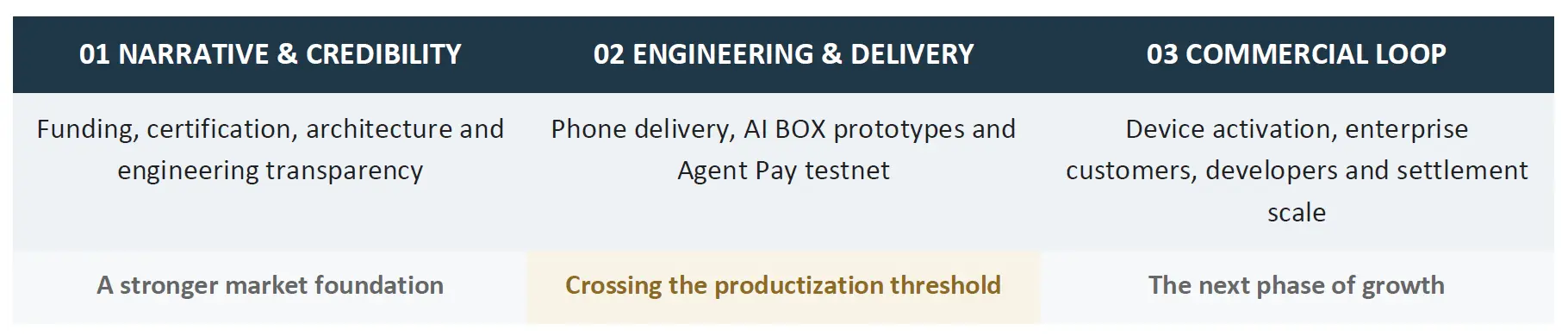
The judgment on MAGNE.AI can remain positive, but it needs to translate into verifiable results.
On the narrative level, it is extending from Web3 mobile phones to Agent infrastructure; on the credibility level, it has RootData financing records, public FCC documents, compliance pages, engineering structures, and phased progress; on the product level, Phone Gen1 has entered PVT P2, AI BOX has established Release Gate, and Agent Pay has demonstrated local demos and testnet evidence; on the organizational level, it shows sustained operational and engineering integration capabilities.
The next real steps that can translate this advantage into industry status are several harder advancements: Phone Gen1 completes its first batch of production and delivery; AI BOX prototypes pass performance, power consumption, heat dissipation, and offline security tests; design partners begin to validate products with real contracts or knowledge base tasks; Agent Pay generates third-party verifiable service payments on the public testnet; and Season participation addresses further convert into real device users and active network nodes.
These are not meant to "pick faults" with the project, but are steps that a rising dark horse must take to become a mature project.
Overall, MAGNE.AI's characteristics are not a single parameter or concept, but an attempt to form a relatively complete organizational and product path: the operational team continuously discloses engineering progress, the technical team utilizes mature ecosystems to complete system integration, and the product route converges the phone, AI BOX, chain, and Agent Pay towards "local intelligence + trusted identity + programmable payments."
MAGNE.AI has not yet completed all validations from engineering signals to large-scale delivery, but it has already provided enough public materials for the market to continue tracking. Financing, team, and event updates can be viewed on the MAGNE.AI RootData project page; phone, certification, and production progress can be seen on the MAGNE.AI official website; the technical status of Agent Pay and AI BOX can be found at W3.MAGNE.AI.
References
[1] RootData: MAGNE.AI project page and "2025 Web3 Industry Annual Report." MAGNE.AI entered the AI sector financing Top 30 in the report with a publicly disclosed financing amount of $10 million at that time; RootData did not provide a publicly unified Tier rating based on this.
[2] Chainwire: MAGNE.AI completes $2.64 million additional strategic financing. The financing amount, investors, cumulative financing, and fund usage belong to the company's press release.
[3] MAGNE.AI: Phone Gen1 specification page. Used to verify the 6.78-inch screen, 10 TOPS INT8 NPU, three-layer security architecture, dual space, and edge-side AI positioning.
[4] MAGNE.AI: Project progress page. Used to verify Pre-EVT, EVT P1, PVT P2, design freeze, and manufacturing target stage information.
[5] MAGNE.AI: FCC document inquiry page. FCC ID is 2BVCPGC603606, which can continue to be cross-verified through regulatory databases.
[6] MAGNE.AI: Phone Gen1 3D engineering structure viewer. The page publicly displays 31 visible components and layered disassembly information but does not equate to mass production acceptance proof.
[7] W3.MAGNE.AI: MAGNE AI BOX technology and Release Gate page. Parameters include vendor statements, items to be tested, and capacity derivation limitations; formal submissions should retain these limitations.
[8] x402 official website. Used to explain the background of Agent payments based on HTTP 402; dynamic transaction data is not included in the text.
[9] Cloudflare Agents: x402 payment documentation. Used to explain that x402 has entered the available capabilities of mainstream development tools.
[10] W3.MAGNE.AI: Agent Pay status page. The current page distinguishes between local contract demos, testnet evidence, the developing HTTP 402 process, and production payments that have not yet been opened.
[11] MAGNE.AI: Security architecture page. EAL levels correspond to components or evaluation scopes and should not be broadly stated as the entire machine configuration obtaining the same level of certification.
[12] MAGNE.AI: Project progress page and Season 1 page. The progress page reveals 76,650 independent on-chain participation addresses; this metric does not equate to the final number of device users or deliveries.
[13] MAGNE.AI: Season 2 Campaign Hub. Used to verify 1,600 active devices, 17 USDT, MS2, and rules such as triggering a phone draw for every 100 participations.
[14] W3.MAGNE.AI: Capital market and TGE preparation milestones. The official status lists exchange due diligence, token disclosure, audits, exchange coordination, and liquidity preparation as ongoing matters; the TGE preparation checklist and launch window remain conditional planned matters.
 Risk warning