Gemini, MoonPay, Dallas Fed, BIS converged on Agentic Finance this week
 Core Viewpoint

 AI is moving from "help me pay" to "manage my balance sheet for me." The core of Agentic Finance is not automation, but empowerment—what may be most valuable in the future is no longer the daily active users of an app, but who is written into the machine's "acceptable counterparty list."
Author Charlie
In the past week, several events occurred in the financial industry that seemed completely unrelated on the surface.
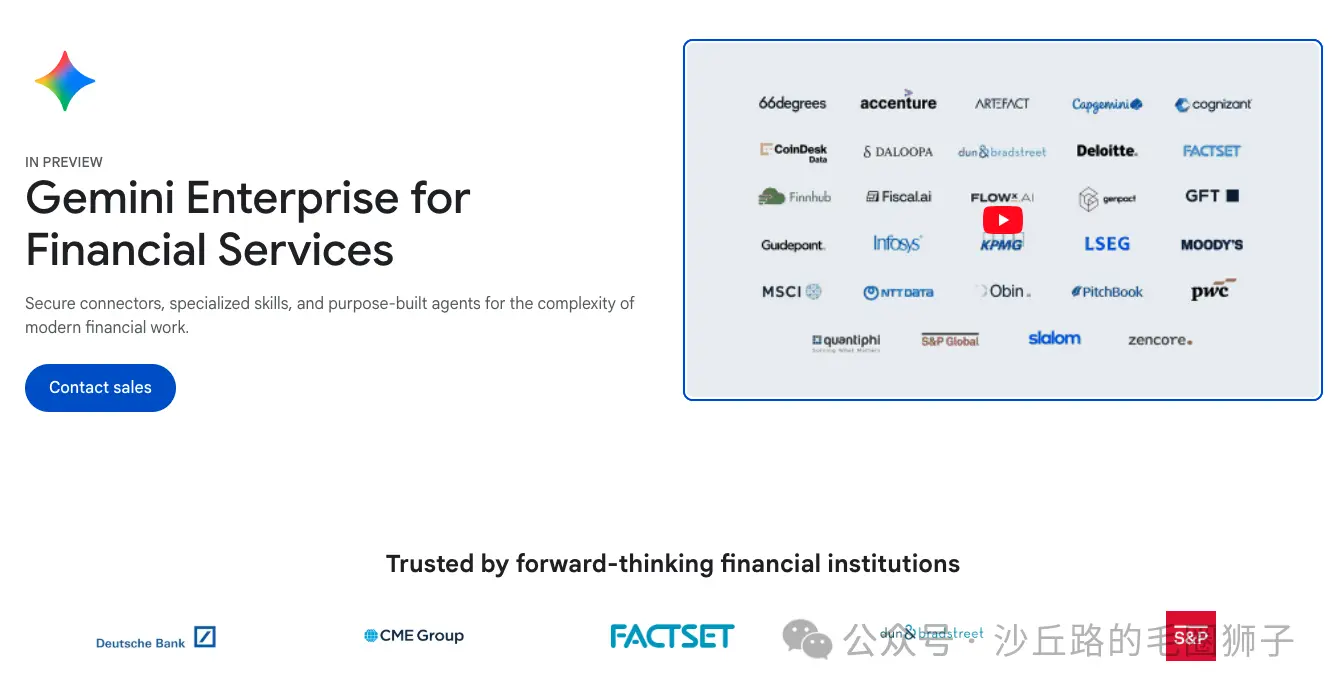
On August 25, Google Cloud launched Gemini Enterprise for Financial Services aimed at financial institutions, further advancing AI in workflows closely related to core business such as KYC, credit analysis, portfolio monitoring, bond issuance, and financial research.
Two days later, MoonPay announced the integration of PayBox with Kamino on Solana, allowing users to initiate lending and earn yields through interactive interfaces like Claude or ChatGPT.
Meanwhile, the Dallas Fed released a research paper that appeared less exciting, discussing what would happen to the deposit stickiness that banks have relied on if deposits could be transferred in real-time 24/7, and AI could automatically compare yields for businesses and individuals.
The following day, the BIS mentioned Project Agorá, which had just completed real funds testing, while discussing stablecoins and tokenized deposits.
Individually, each event can be categorized into familiar news segments: Google is about enterprise AI, MoonPay is about crypto finance, the Dallas Fed is about banking research, and Project Agorá is about central banks and commercial banks researching next-generation cross-border payment infrastructure.
However, when viewed together, a more noteworthy thread emerges.
For the past two to three years, we have been discussing when AI will truly change finance. But I increasingly feel that the question is not accurately framed. The real dividing line has never been when AI "understands finance better," but rather when it is allowed to represent people in making financial decisions and can actually move funds.
The difference between these two aspects may be greater than the leap from search engines to ChatGPT.
A few years ago, when I first began researching the combination of generative AI and Fintech, my overall judgment was relatively conservative. At that time, the most practical applications in the financial industry were still customer service, reporting, fraud prevention, expense management, internal knowledge retrieval, and various tools to improve employee efficiency. These are certainly valuable, but they essentially remain at the level of "AI standing next to money helping out," without truly touching the money.
The reason is simple. If a model writes a wrong piece of market copy, it can be revised; if a model mistakenly transfers $5 million for a company, clearly, it cannot be resolved by simply clicking "undo." Financial institutions naturally have a much lower tolerance for black boxes than ordinary software companies. Accuracy, permissions, auditing, accountability, regulatory requirements—if any one of these aspects is unresolved, no matter how smart the model is, it can only serve as an assistant.
However, the truly noteworthy change in recent months is not that the industry suddenly believes "fully automated AI wealth management" is imminent, but that more and more companies are beginning to break down the task of "letting AI move money" into a series of smaller, more controllable authorizations.
When Robinhood launched Agentic Trading this year, it did not allow a model to directly take over all user assets but instead set up a separate account that permits AI operations. By the end of the second quarter, such accounts had approached 100,000, managing over $100 million in assets.
Ramp's approach is less glamorous but may be closer to the evolutionary path of real corporate finance. Its AI does not directly replace the CFO but first reads the company's reimbursement, payment, and accounting policies, automatically handling high-confidence situations while returning anomalies to humans.
Rocket Money's recent launch of Rowan also reflects a similar trend: it no longer just shows users a chart of "how much you spent this month," but can discover subscriptions in the background, send message reminders, help cancel services, negotiate bills, and even complete savings transfers according to preset rules.
When these products are viewed together, it becomes clear that the market has not jumped directly from "manual operations" to "fully autonomous machines," but is progressing along a more realistic path: first observing, then suggesting, then preparing actions, then having humans approve, and finally gradually handing over those clear, low-risk actions to machines.
This is also why I believe the truly important concept of Agentic Finance is not "automation," but "authorization."
Today, when corporate employees use a company credit card, it is itself a form of financial authorization. They certainly cannot spend all the money in the company's bank account, but they can autonomously consume within certain merchant categories, amounts, and approval rules. Fund managers, corporate finance heads, and procurement managers are essentially managing funds for others within a pre-defined authorization framework.
What an AI Agent is truly meant to do is not invent a brand new financial system, but transform this authorization relationship, which we have long taken for granted, into rules that machines can understand and execute.
For example, a company can fully inform an AI financial agent: it must retain at least 30 days of operational cash; the remaining funds can only be placed in designated banks or high-rated products; it cannot incur foreign exchange risks; any single fund movement over $500,000 must be manually approved; only when the yield difference exceeds 20 basis points is it worth switching; any newly emerging counterparties must undergo manual review.
Once these rules can be directly understood by machines, a fundamental change occurs. AI does not need to gain unlimited power, nor does it need to become a completely unregulated "robot hedge fund." It only needs to act autonomously within boundaries.
This is also a direction increasingly evident in the recent actions of companies like Google, MoonPay, Visa, and Mastercard as they engage in Agent payments. On the surface, everyone is discussing how AI can make payments, but the real effort is focused on permissions: who authorizes, how much is authorized, until when, which merchants and accounts can be interacted with, under what circumstances must it stop to seek human confirmation, and how to leave a complete audit trail when problems arise.
Thus, I am increasingly convinced that one of the most important products of future Agentic Finance may not necessarily be a smarter large model, but a sufficiently reliable "financial authorization system": it can translate a vague human instruction—such as "help me manage the company's idle funds"—into hundreds of rules that can be strictly executed by machines.
From this perspective, looking at MoonPay's actions over the past six months becomes much more interesting than simply viewing its collaboration with Kamino.
In March, MoonPay launched the Open Wallet Standard, focusing on how AI can safely use wallets and obtain limited signing permissions without touching private keys; in May, it acquired DFlow to enhance transaction execution infrastructure; in June, it acquired Entendre to add reconciliation, finance, fund management, and reporting capabilities; in July, it launched PayBox, directly integrating cards and wallets into interactive environments like Claude and ChatGPT; by August, it integrated lending and yield management through Kamino.
Individually, each step is not earth-shattering. However, viewed together, it resembles assembling a foundational capability for AI Agents in finance: first addressing identity and permissions, then execution, then financial operations, and finally beginning to touch on credit, lending, and asset allocation.
This is also the true distinction between Agentic Payments and Agentic Finance.
The former answers: How can AI pay for me?
The latter asks: How can AI manage my balance sheet for me?
Once we enter the second question, payment becomes just one action among many. Where to hold cash, when to borrow money, what assets to collateralize, how much yield to earn on idle funds, when to rebalance, and how to manage liquidity and risk—these judgments that previously required corporate finance teams, bankers, or investment managers to make continuously may begin to fall within the execution range of machines.
However, there has always been a fundamental contradiction in the infrastructure.
If AI can calculate the best solution every second, but money itself can still only move according to bank operating hours, cross-border correspondent banks, batch clearing, and manual reconciliation speeds, then even the smartest Agent has limited significance. It is like a high-performance sports car that can only drive on a bumpy country road.
This is also why Project Agorá deserves to be included in this article.
Project Agorá is not an AI project in itself. It is an experiment jointly promoted by the BIS Innovation Hub and the International Financial Association, researching how to incorporate tokenized commercial bank deposits and central bank reserves into a multi-currency, programmable platform to improve wholesale cross-border payments.
The real connection between it and Agentic Finance is not that "BIS is also starting to do AI," but that it is researching another piece of financial infrastructure that AI will ultimately need to call upon: whether money itself can become easier for machines to read, combine, and execute.
In July of this year, 28 financial institutions and central banks completed real funds testing in a controlled environment, involving Swiss francs, euros, pounds, yen, won, and dollars. The scale of the tests is very small, far from a production environment, but it at least validates one thing: commercial bank deposits and central bank currencies are not inherently confined to today's slow, fragmented systems; they can also enter an environment that supports condition-triggered, atomic settlement, and automatic execution of rules.
The BIS itself remains very cautious about this. How systems interconnect, how legal final settlements are determined, who is responsible when smart contracts fail, cybersecurity, governance, and how to migrate decades-old systems—these issues are far from resolved. Therefore, to write Agorá as "the next generation of the global financial system has been built" is clearly an exaggeration.
But it at least proves a question that is easily obscured by crypto narratives: programmable money does not necessarily equal stablecoins, nor does it mean that banks are bypassed. Traditional bank deposits themselves may also become financial assets callable by software.
And the truly interesting part begins precisely here.
Because banks today are investing significant resources to eliminate friction in the flow of funds, but this friction has, to some extent, been part of the bank's business model.
This is precisely what makes the Dallas Fed's article noteworthy.
Why are a bank's deposits valuable?
Of course, there are many lofty reasons. A company placing $50 million at JPMorgan does so not just because it is too lazy to open an account; it may be tied to credit limits, foreign exchange, payroll, cash management, custody, and years of customer relationships. These factors do not suddenly disappear just because a neighboring bank's interest rate is 10 basis points higher.
But another reason is less grand yet equally real: moving money is too cumbersome.
Today, if a company has $2 million temporarily idle in its account, Bank A offers 4.20%, and Bank B offers 4.35%. Should the finance team check again every morning for a mere 15 basis points? Is it worth logging in again, comparing counterparty risks, making fund transfers, considering clearing times, and then reconciling again? They also need to ensure that tomorrow's payroll and vendor payments are not affected.
Most of the time, the answer is simply no.
The money just stays there.
This represents an asset in the financial system that is rarely discussed on its own: human inertia.
The Dallas Fed's article states directly that the stickiness of operational deposits partly comes from the real friction of funds not being quickly reconfigured. If instant settlement, tokenized deposits, and AI Agents mature simultaneously in the future, clients seeking higher yields could theoretically switch funds with almost no action on their part.
AI will not find 15 basis points "not worth the hassle."
It does not have Monday morning meetings, will not forget, and will not delay this matter until next week just because it is busy today. For it, the marginal attention cost of continuously comparing different financial products is almost zero.
This certainly does not mean that all corporate deposits will suddenly switch banks every five minutes like hot money. Customer relationships, credit limits, regulatory requirements, and risk management still exist, and fund switching will never truly reach zero cost.
But the point is, it does not need to develop to such extremes to impact banks.
The Dallas Fed conducted a sensitivity analysis based on the nearly $17 trillion in related deposits in the U.S. banking system. If the average stay duration of deposits shortens by 10%, the banking system's capacity to bear term transformation could reduce by about $580 billion in "10-year equivalent risk exposure"; if the sensitivity of deposit interest rates to market interest rate changes increases by 10%, the duration risk that banks can bear could decrease by about $700 billion.
This does not mean that AI will suddenly reduce U.S. banks' lending by $700 billion. Simply interpreting this figure as "lending capacity reduced by $700 billion" is inaccurate.
What it truly indicates is something else: the stickiness of deposits has immense economic value.
If future programmable money and AI Agents merely make this stickiness slightly weaker, the cost and term structure on the bank's liability side could change accordingly.
In the past, when discussing programmable money, the benefits seen were usually faster settlements, fewer reconciliations, lower costs, 24/7 operation, and the ability to write payment conditions directly into transaction logic.
But there is another side that is rarely emphasized: once money becomes easier to move, those holding money gain more options.
For asset holders, this is efficiency; for institutions treating this money as a stable source of funds, it means more intense competition.
To make money operate like software, banks may also have to accept a result: money begins to compare prices at the speed of software.
This brings the issue to another direction I have been contemplating recently.
In the past, I have always believed that finance is essentially a distribution business.
Banks compete for who gets salaries deposited directly, credit card companies compete for who becomes the most commonly used card for consumers, brokers compete for who occupies investors' mobile screens, and wealth management institutions compete for who owns customer relationships. Many Fintech products spend billions to acquire customers, fundamentally competing for the same thing: who can stand between users and financial products.
Because whoever owns distribution has the opportunity to decide which products are seen.
But AI Agents may gradually shift this competition from "distribution" to "fund routing."
Previously, you would ask: Which bank do I like the most?
In the future, a more important question may be: Which banks does my financial Agent include in its acceptable counterparty list?
Previously, fund companies would find ways to have their money market funds appear on the app's homepage.
In the future, Agents may directly determine: when the yield difference exceeds 18 basis points, liquidity meets requirements, and counterparty risk is below a certain threshold, where should the funds automatically go.
Previously, lending institutions competed through advertising, branding, and sales channels.
In the future, Agents may directly compare actual interest rates, collateral requirements, prepayment conditions, and the current cash flow status of enterprises to decide whose funds should be called upon.
At this point, what is truly valuable is no longer just "whether users have downloaded your app," but whether you have entered the machine's default rules.
Whoever is written into the authorization scope has the qualification to participate in the competition; whoever ultimately wins fund routing has secured the flow of funds.
Agentic Commerce changes where demand flows.
Agentic Finance changes where capital flows.
So if I were a bank CEO today, I would certainly care whether AI can reduce the time analysts spend writing reports, whether it can automate KYC and fraud investigations—these are all very real efficiency improvements.
But the longer-term question may be another one:
When my corporate clients have a 24/7 financial Agent, why should I continue to have their next dollar?
The smartest banks may not resist this change; rather, they may be the first to integrate Agents into their systems. Clients' daily operational funds remain in checking accounts, temporarily idle money automatically enters higher-yield deposits or funds, and when liquidity is needed, it automatically returns; foreign exchange, loan limits, collateral, and payments can also be optimized together. This way, even if Agents continuously seek better solutions, funds can still remain within the same bank's ecosystem.
From this perspective, explorations like Project Agorá may not weaken banks; they may even help regulated commercial bank currencies maintain their core position in the era of stablecoins.
Thus, this is not a simple story of "AI and Crypto ultimately taking down banks." The real danger may not be the banks themselves, but those financial business models that have long relied on customers' unwillingness to compare, unwillingness to switch, and the hassle involved as their moat.
In the past, a significant advantage for a bank was that moving customers was too cumbersome. The truly strong banks in the next phase may need to prove a completely opposite proposition: customers can leave at any time, but after their AI has calculated, they still decide to keep their money here.
In the past decade, the fiercest battles in Fintech have occurred on mobile screens. Everyone competed for daily active users, primary accounts, the most commonly used card, and who was closer to the user.
The next round of many truly important financial battles may not even have an interface.
It happens within a set of authorization rules in the background, within an acceptable counterparty list, within yield differences of a few basis points, and also in the moment when AI judges "where this money should go right now."
Therefore, the truly worthwhile question for Agentic Finance may never have been: When will AI manage our money for us? But rather, as more and more money begins to automatically seek its best destination according to rules that machines can understand—
Who still has the right to decide where this money ultimately stays?
 Risk warning