Refuting the argument that Ethereum "abandoned" ETH: What does it really mean to pay Gas without ETH?
 Core Viewpoint

 Ethereum bets that when the Gas threshold disappears, more people will truly start using Ethereum.
Author: imToken
If you play on-chain, you have likely encountered these awkward situations:
Receiving a stablecoin in a new address but unable to send it out due to a pop-up indicating no ETH for Gas; wanting to swap a coin on a DEX but getting stuck; withdrawing USDC from a trading platform only to realize you haven't prepared Gas…
In all these cases, you have to first find a fiat channel elsewhere or ask around for some "water," which is one of the classic deterrents for newcomers in the Crypto world.
Recently, Vitalik Buterin mentioned the progress of EIP-8141 (Frame Transactions), which has once again presented new possibilities: in the future, wallets without ETH can still make transfers, with Gas deducted directly from USDC, and some applications might even cover the Gas for you to attract users.
Once the news spread, it quickly fermented into a frightening statement: "In the future, using Ethereum won't require ETH, so what value does ETH have?"
The answer is not that simple.
What users use to pay fees and what the Ethereum protocol ultimately uses to settle fees are actually two completely different matters.
1. What does it mean to not use ETH to pay Gas?
Let's start with a regular Ethereum transaction today.
For example, if Frank has 1000 USDC in his wallet and wants to send 100 USDC to a friend, as long as there is no ETH in the wallet, this transaction cannot be sent.
The reason is simple: currently, the logic of a regular Ethereum account is very rigid. The person initiating the transaction is also responsible for paying the network Gas—Frank signs, Frank initiates the transaction, and Frank's ETH balance pays for Gas; these three things are essentially tied together.
What EIP-8141 aims to do is to separate them.
According to the current design, a Frame Transaction can be broken down into multiple different "Frames," each responsible for verifying the transaction, confirming who pays for Gas, and actually executing the user's operation.
So in the future, when Frank makes a transfer, it can become Frank still signing to prove "this 100 USDC is indeed what I want to transfer," but another Paymaster or account is responsible for providing ETH to pay Gas to the Ethereum network, and Frank pays a small fee in USDC to this Paymaster.
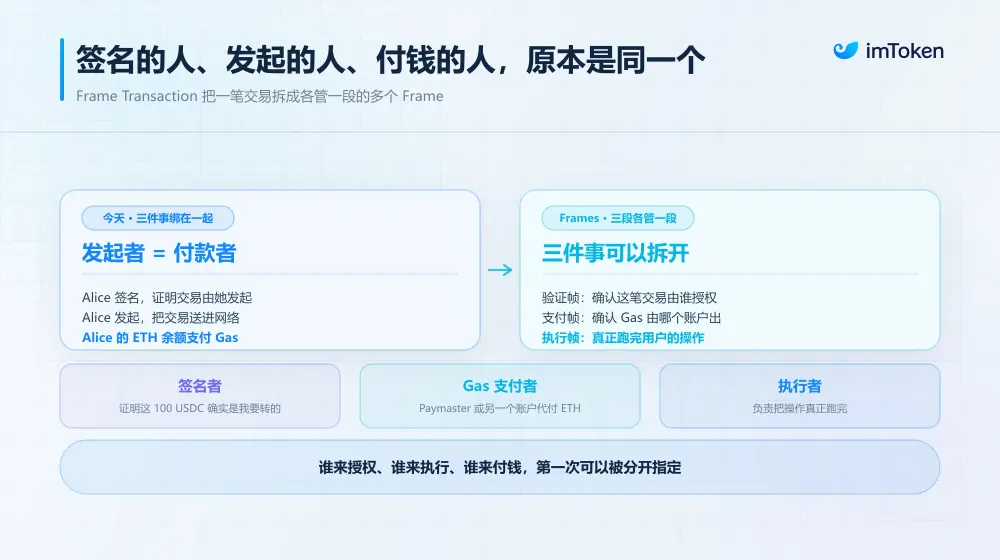
For Frank, he might only see a transfer of 100 USDC and a network fee of 0.1 USDC; throughout the process, he doesn't even need to know how much ETH Gas is or prepare ETH in advance.
But from the perspective of the Ethereum protocol, it hasn't turned into "Ethereum starts accepting USDC as Gas"; it's just that someone in the background is using ETH to pay for Gas on behalf of Frank, and then settling with Frank using USDC.
The official ERC-20 payment example provided by EIP-8141 has a similar structure, where the Sponsor is responsible for approving and bearing the Gas, while users can transfer ERC-20 Tokens to the Sponsor as payment.
If we compare it to real-life consumption, it becomes easier to understand.
When we use a Chinese Yuan credit card in Japan, what the user perceives is "deduction in Chinese Yuan," while the merchant receives Japanese Yen, but this does not mean that the underlying settlement currency in Japan has become Chinese Yuan; the front-end payment asset and the back-end settlement asset can inherently be different things.
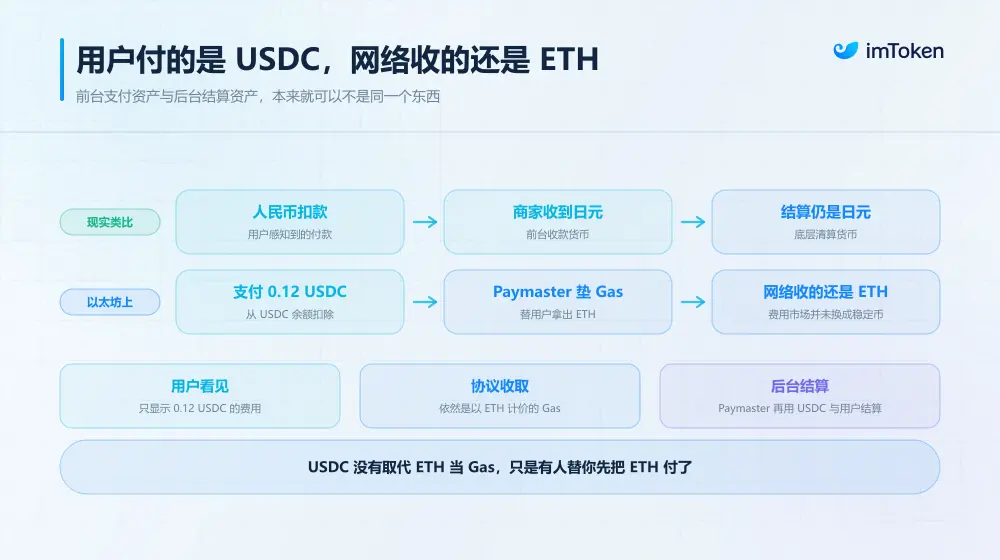
What EIP-8141 does is essentially a similar abstraction. Ultimately, users no longer need to personally hold ETH; other accounts can pay ETH Gas on their behalf, and then use assets like USDC to complete the fee settlement.
The difference may seem minor, but the implications for ETH are completely different.
2. Why does Ethereum need to "hide" Gas?
In fact, "not needing to prepare ETH yourself" is not a brand new idea.
The Account Abstraction and Paymaster introduced by ERC-4337 have already allowed smart accounts to implement Gas Sponsorship, where applications can pay fees on behalf of users, and users can use stablecoins to bear the costs.
However, what ERC-4337 can do is more about adding a set of UserOperation, Bundler, EntryPoint, and Paymaster infrastructure outside the protocol, while EIP-8141 attempts to integrate such capabilities more intrinsically into the Ethereum transaction structure itself.
Ultimately, the core is to solve a problem that should have been addressed long ago: why should ordinary users have to understand what Gas is?
In real life, when you transfer two hundred yuan to a friend via WeChat, WeChat will never pop up and ask you to "first go to another platform to buy two yuan worth of settlement tokens."
But Crypto has been torturing people like this in the past.
In Ethereum, you need to prepare ETH; in Solana, you need to swap for SOL; in BNB Chain, you need to stock up on BNB; even when switching to a new L2, the first reaction is to check if there is starting capital in the wallet. Experienced users might spend two minutes to cross a chain, but for outsiders, this is a chasm that can directly make them close the webpage and leave.
In addition to hiding Gas, Frame Transactions can also conveniently solve many stubborn issues.
For example, when trading a new token on a DEX, you have to click once to approve authorization and then click again to swap, with the wallet popping up to confirm twice. If the subsequent swap fails, the previous authorization remains on the chain for a long time, leaving a risk of theft.
But if using Frames, these two actions can be packaged into one atomic batch: if the swap fails, the previous authorization automatically rolls back, clean and tidy.
This opens up a larger imaginative space; in the future, who authorizes, who executes, who pays, and how verification is done can all be separated and recombined.
3. So is ETH a positive or negative factor?
This is also the aspect of the discussion that is most likely to lead to two extremes.
One viewpoint is, "In the future, not needing ETH to pay Gas means ETH has no value," while another viewpoint is, "Lowering the user threshold will lead to a surge in transaction volume, which is super positive for ETH."
For major structural reforms involving the user experience of the underlying protocol, it is still difficult to draw a conclusion, but one thing is certain: EIP-8141 has not eliminated ETH's role as the underlying Gas and fee settlement asset for Ethereum.
Users may not perceive ETH, but the Paymaster, applications, or other accounts responsible for paying on behalf of users still need to have the ability to bear network fees priced in ETH; the existing EIP-1559 fee market has not been replaced by stablecoins due to Frames.
What changes is the position of ETH demand.
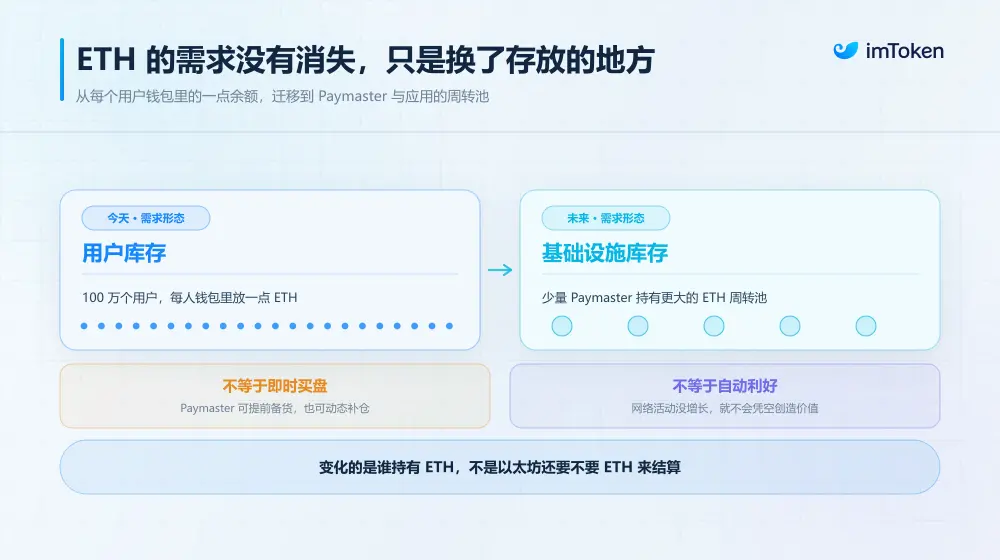
Today, there may be one million users, each holding a little ETH in their wallets for Gas; in the future, it may turn into a small number of Paymasters, wallet service providers, and applications holding a larger ETH turnover balance, handling Gas for a large number of ordinary users uniformly.
Of course, don't naively think that "for every stablecoin payment made by users, the backend will go to the secondary market to buy an equivalent amount of ETH at market price." Payment providers have their own inventory management and hedging strategies, which are difficult to directly translate into the instant buying power imagined by retail investors.
Paymasters can prepare inventory in advance, can dynamically restock, and can adopt other capital management methods; therefore, merely relying on "in the future, you can pay Gas with stablecoins" makes it hard to directly deduce how much new buying pressure ETH will generate.
The real decisive factor is one logic: after optimizing the experience, whether it ultimately brings more genuine demand for Ethereum usage, and whether it can truly expand the market?
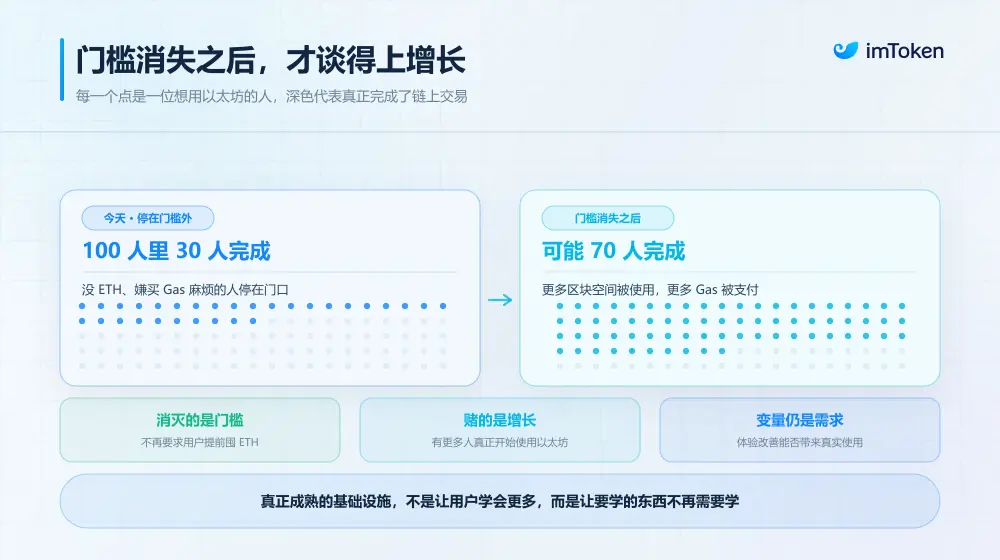
Doing the math is quite straightforward:
- If in the past, 100 people planned to enter the market, and 70 of them gave up halfway due to buying Gas, calculating Gwei, or cross-chain hassles, leaving only 30 to complete the transaction;
- In the future, if wallets swallow all these troubles in the background, allowing 80 people to smoothly complete their transactions—even if they don't hold a single bit of ETH, the actual ETH consumed and destroyed by the network will be much more than in the past;
Conversely, if the entire ecosystem fails to bring incremental activity, merely replacing "paying out of pocket" with "finding someone to pay," it will indeed not generate any new incremental value.
In conclusion
From my perspective, it weakens the notion that "every user must stock up a little ETH in advance to use Ethereum," but the gamble is that when this threshold disappears, more people will genuinely start using Ethereum.
For ordinary users, there is no need to change their usage habits because of this EIP just yet, but from the perspective of wallet development, the direction it points to is already very clear.
In the future, a good wallet may increasingly not require users to first understand Gas; users should be responsible for deciding where assets go and what operations to execute; the wallet should inform them of the risks and the final costs; as for which account to use for payment, whether to charge in ETH or stablecoins, and whether there are available Gas Sponsors, these complex protocol details should gradually be hidden in the background.
Truly mature infrastructure often works this way.
 Risk warning

Popular articles