The China-U.S. economic and trade consultations will kick off tonight. Which China-U.S. AI, trade, and biopharmaceutical companies might benefit?

 This article summarizes the key topics of this consultation, recent signals of capital games in the market, and the mapping of potential beneficiary sectors such as AI computing power chains, semiconductors, and innovative drugs.
As the new round of high-level economic and trade consultations between China and the United States unfolds in New York, along with the anticipated subsequent summit meeting and visits by business delegations to the U.S., the capital market is experiencing short-term trading catalysts. This article compiles the key topics of this consultation, recent signals of capital market dynamics, and potential beneficiary sectors such as AI computing chains, semiconductors, and innovative pharmaceuticals.
I. Consultation Preview: From the New York Negotiation Table to the White House State Dinner
Economic and Trade Consultation: The Chinese Ministry of Commerce announced on September 17 that Vice Premier He Lifeng will lead a delegation to the U.S. from September 19 to 23. The first round of consultations was held on the morning of September 20 at the headquarters of JPMorgan Chase in New York, led by U.S. Treasury Secretary Janet Yellen and U.S. Trade Representative Katherine Tai, with both sides agreeing to conduct dialogue guided by the important consensus of the two heads of state.
Summit Meeting: The U.S. side has confirmed that a state dinner will be held at the White House on September 24 to host the Chinese leaders. This will be the second meeting between the two heads of state since May of this year. The rhythm of "preview consultations to build a framework + summit meeting to implement a checklist" constitutes the core vehicle of current market expectations.
Core Negotiation Topics: The topics of this consultation are broader than before, covering artificial intelligence, AI safety and technology export controls, tariff extensions, rare earth and critical mineral supply chains, and trade procurement lists. The market is particularly focused on two hard indicators: whether the tariff truce period expiring on November 10 this year can be further extended; and whether a more stable and predictable mechanism for rare earth and critical mineral export controls can be established.
Strong Delegation of Attending and Accompanying Enterprises: According to reports from Reuters and other media, although the Chinese delegation is still being finalized, it has already revealed participation from industry leaders such as BYD, Xiaomi, CATL, Guoxuan High-Tech, Hisense, Wanxiang Group, as well as Bank of China and COFCO Group. Confirmed attendees at the U.S. state dinner will include NVIDIA CEO Jensen Huang, OpenAI CEO Sam Altman, Qualcomm CEO Cristiano Amon, and Apple CEO Tim Cook is also expected to attend.
II. Market and Exchange Rate Review: Signals of Early Layout in the Capital Market
Since the announcement from the Ministry of Commerce on September 17, Chinese concept stocks and the offshore renminbi exchange rate have shown a significant strong tendency.
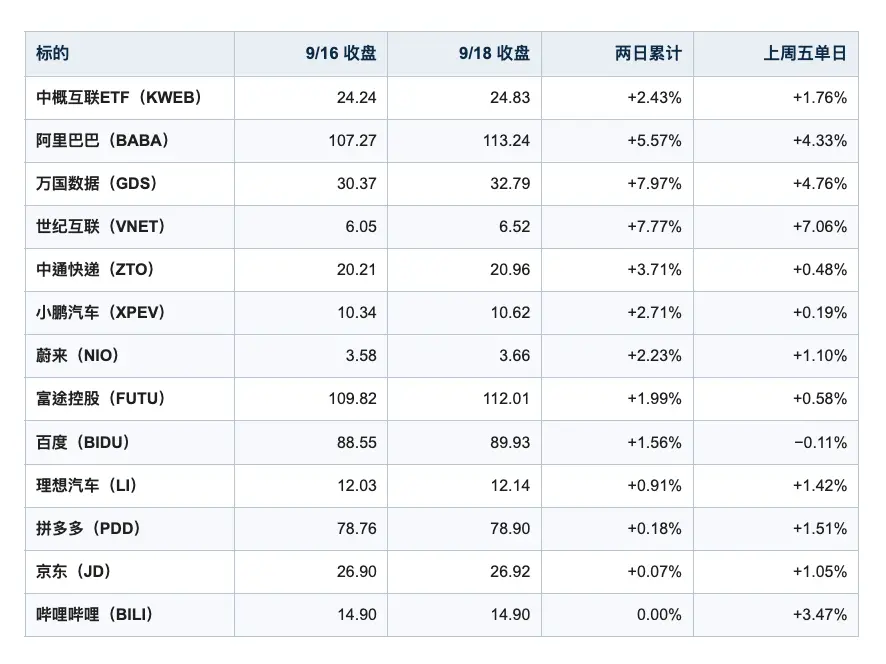 Review of Chinese concept stocks and key target trends (9/17 -- 9/18) Data source: Investing.com, Yahoo Finance
Four Core Observations of the Market
Chinese concept stocks significantly outperformed the U.S. stock market: Last Friday, the three major U.S. stock indices had mixed results (Dow -0.18%, S&P 500 +0.17%, Nasdaq +0.39%), while the Nasdaq Golden Dragon China Index surged 0.76%, with core assets like Alibaba, Bilibili, and Pinduoduo generally rising against the trend.
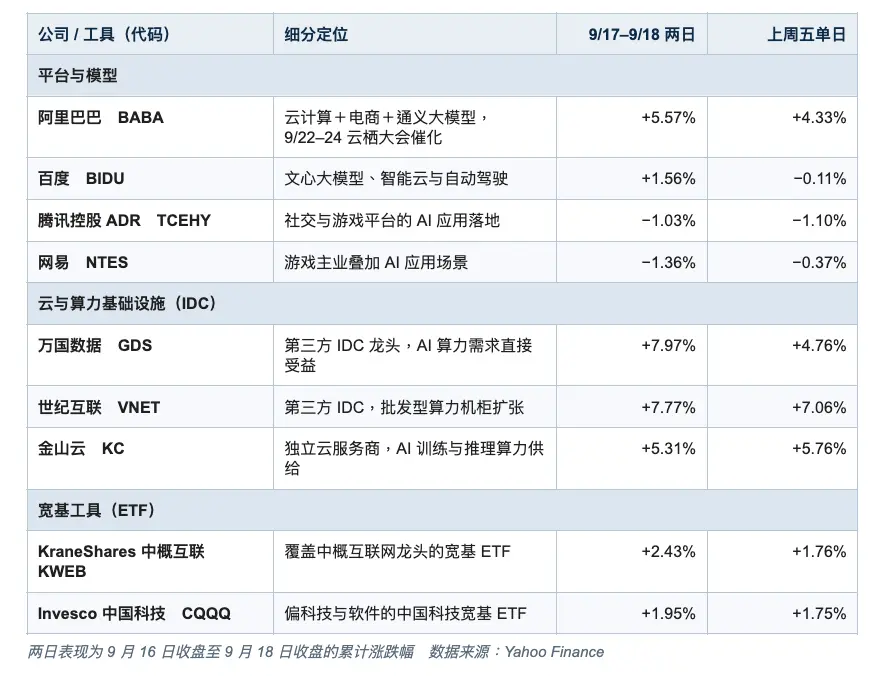
AI and cloud computing as the main driving force, with clear structural differentiation: The capital rush shows structural characteristics, with gains highly concentrated in Alibaba and IDC computing chains (GDS Holdings, Century Internet), mainly driven by Alibaba's upcoming Cloud Summit and the resonance of the AI cycle, while consumer and e-commerce-related stocks performed relatively flat.
Significant appreciation of the renminbi provides valuation support: On September 18, both onshore and offshore renminbi broke through the 6.70 mark against the U.S. dollar, reaching a new high since February 2023. High export growth and corporate foreign exchange settlement demand constitute the intrinsic support for the renminbi exchange rate, which directly benefits the valuation elasticity of Chinese concept stocks priced in U.S. dollars.
Domestic policies and foreign investment ratings create a positive resonance: Beijing released the first provincial-level "Ten Articles on the Word Element Economy," clearly promoting the construction of "word element factories"; at the same time, Morgan Stanley raised its expectations for AI monetizable income on the Chinese consumer side, providing independent logical support for AI computing chains.
III. Which Chinese Concept Stocks are Related to AI and Computing Chains
IV. Other Positive News: The U.S. Plans to Ease Authorization Transactions for Chinese Innovative Drugs
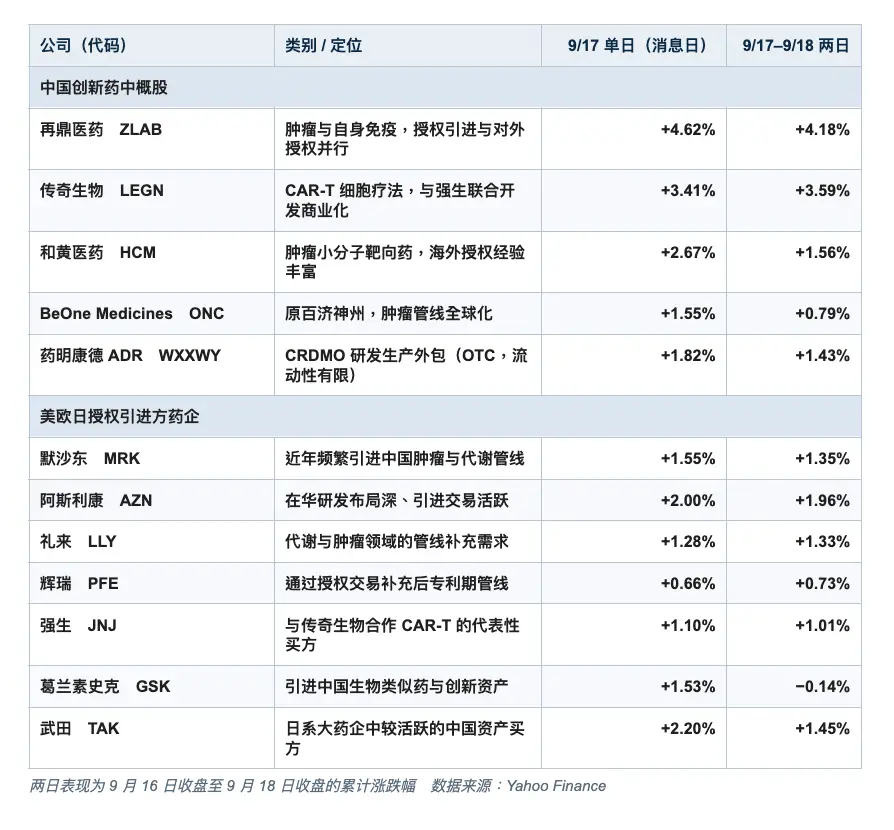
On September 18, Reuters cited three informed sources reporting that the U.S. Treasury is drafting new regulations regarding pharmaceutical investments in China, intending to retain the ability for U.S. pharmaceutical companies to complete most license-in transactions for Chinese drugs, with restrictions only in cases involving pathogens or biotechnologies that could be weaponized. The report states that this framework is much more lenient than what some members of Congress have advocated, with amounts potentially reaching the tens of billions of dollars.
What are the related concept stocks for innovative drugs?
Disclaimer
This document is for general informational reference and market commentary only, and is a compilation and analysis of publicly available information. It does not constitute any investment advice or recommendation, nor does it constitute an offer or invitation to buy or sell any securities or financial instruments, and it has not considered the specific investment objectives, financial situation, or particular needs of any specific recipient.
 Risk warning