








AMD plans to acquire World Labs, founded by Fei-Fei Li, for 8.2 billion USD. Will NVIDIA's physical AI moat be breached?

 $8.2 billion to buy a two-year-old laboratory with an undisclosed revenue scale and 70 employees, and Wall Street did not applaud. But Su Zifeng is not calculating for this quarter.
Introduction: On September 28, AMD announced that it had reached an agreement to acquire World Labs, founded by Fei-Fei Li, for approximately $8.2 billion in an all-stock deal. On the day the news was announced, AMD's stock fell by 3.61%, closing at $607.87; the next day (September 29), the stock price stabilized, closing at $607.57, with a slight increase in after-hours trading. $8.2 billion for a two-year-old lab with 70 employees and undisclosed revenue did not earn applause from Wall Street. However, Lisa Su is not calculating this deal based on this quarter.
1. What did AMD really acquire for $8.2 billion?
World Labs, established in 2024 and headquartered in San Francisco, was founded by "AI Guru" Fei-Fei Li and focuses on spatial intelligence and world modeling. On September 1, 2026, it released the next-generation world model Atlas, claiming to be "the world's first multimodal world model"—natively supporting text, images, video, and 3D joint modeling, capable of reconstructing three-dimensional scenes from a small number of 2D images and generating interactive physical environments.
In simple terms, Atlas predicts what a scene looks like from a different perspective, just like a large language model predicts the next word. With pixel-level camera control, spatial reconstruction, spatiotemporal simulation, and image generation, it can output up to 1-minute 1440p videos and surpass dedicated models in 3D reconstruction tasks.
The valuation curve is more intuitive:
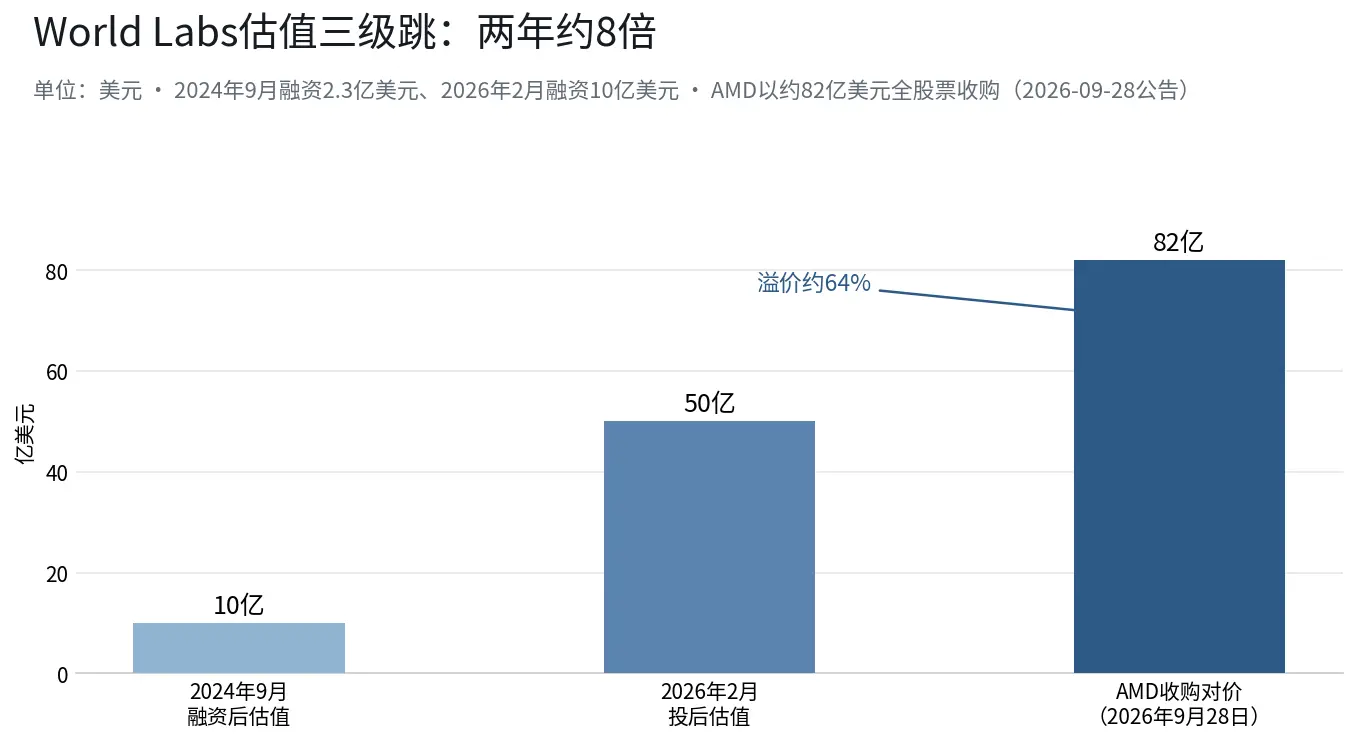
In September 2024, when it raised $230 million, its valuation was approximately $1 billion; after completing a $1 billion financing round in February 2026, its post-money valuation was about $5 billion. AMD's offer of $8.2 billion represents a premium of about 64%.
Personnel arrangements are the core of this transaction: Fei-Fei Li will serve as AMD's Executive Vice President and Chief Scientist, reporting directly to Lisa Su.
2. Why Physical AI, and why now?
First, let's look at NVIDIA. Omniverse rebuilds the world, Newton constructs the physics engine, Cosmos generates world models, Isaac and GR00T train robots, and Jetson Thor is responsible for edge deployment—five layers of technology stack that interlock, from chips to physics engines to robotic brains, creating a complete production line. Customers purchasing NVIDIA's solutions receive a one-stop closed loop covering training computing power, simulation environments, and robot deployment, with extremely high migration costs.
Now, let's look at AMD. Previously, its layout in physical AI was nearly blank, with AI capabilities aimed at developers mainly concentrated in the ROCm software ecosystem and hardware adaptation for the Ryzen AI edge NPU, lacking independent and controllable native world model technology reserves. Lisa Su almost succinctly articulated the logic behind the acquisition in an interview with Bloomberg TV: "The deeper your understanding of the entire end-to-end process, the better systems you can build."
The market size for physical AI is not large, but the growth rate is astonishing:
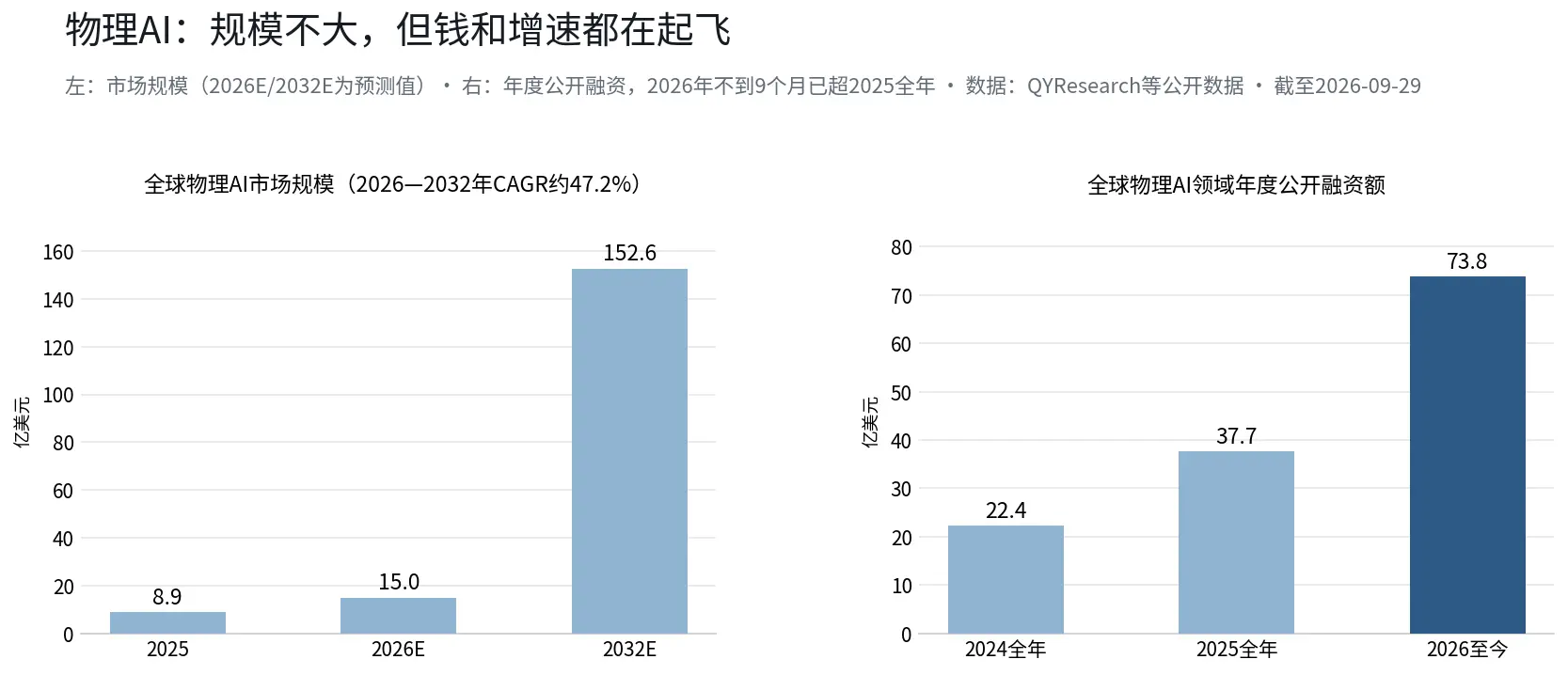
According to QYResearch data, the global physical AI market size is expected to be about $890 million in 2025, reaching $1.5 billion in 2026, and projected to reach $15.26 billion by 2032, with a compound annual growth rate of about 47.2% from 2026 to 2032. Capital is moving faster than the market: since 2026, public financing in the global physical AI field has reached about $7.38 billion, exceeding the entire year's $3.77 billion in 2025 and more than three times the $2.24 billion in 2024.
AMD may be acquiring not just current revenue but also the technical capability of "how models are calculated." The all-stock transaction is more like a ticket to the main battlefield of physical AI.
3. Why is World Labs willing to sell?
Why would a two-year-old team of 70 people, which has raised only $1.2 billion, sell at this point? The simultaneous battles for computing power, talent, and capital put immense pressure on small teams.
In terms of computing power, World Labs has raised a total of about $1.23 billion in two rounds; NVIDIA, on the other hand, feeds Cosmos with its own chips, while Google uses TPUs to feed Genie, which are simply not on the same scale.
In terms of talent, large companies are spending lavishly to compete for AI talent, making a 70-person team more like a "Huangpu Military Academy."
In terms of capital, the costs of model training continue to rise, while World Labs' commercialization is still in its infancy, with revenue barely covering the training bills. More critically, NVIDIA's open weights for Cosmos further compress the monetization space at the model layer.
The timing of the acquisition is noteworthy: Atlas was just released on September 1, 2026, and the narrative around physical AI is currently at a high point, which may also be a favorable valuation moment.
4. NVIDIA's role: Competitor or shareholder?
There is an easily overlooked detail in this transaction: NVIDIA just participated in World Labs' $1 billion financing in February this year. This means that NVIDIA is not only AMD's main competitor in the AI chip field but also a current shareholder of World Labs. How to handle the rights of a competitor who is also a shareholder in the acquired company has not been disclosed by either party—this unresolved issue may become one of the variables in the delivery process.
5. Why did the market not applaud?
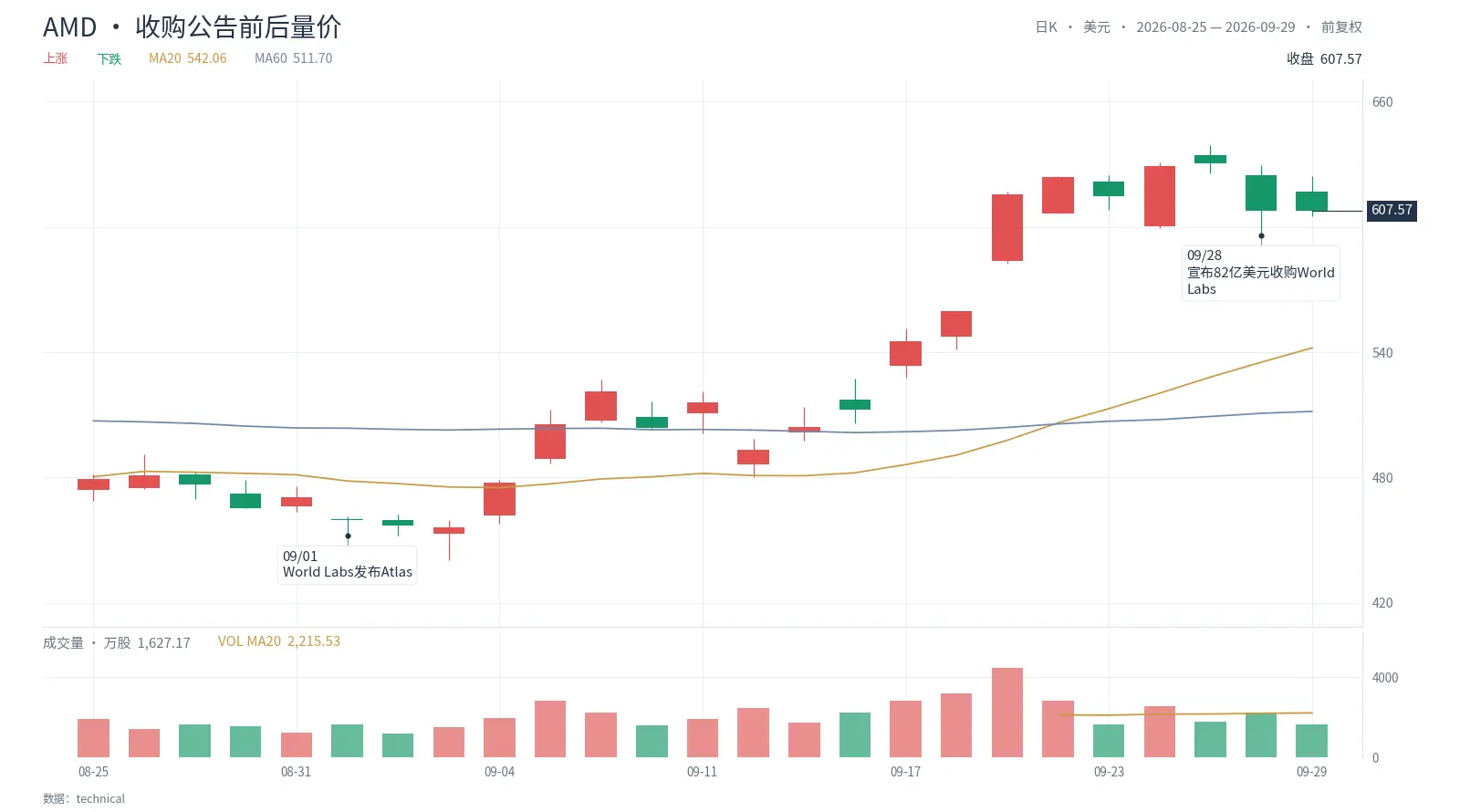
Wall Street's view on this transaction is divided: some analysts maintained their positive ratings and target prices for AMD after the announcement. However, AMD's stock fell by 3.61% on September 28, and the second trading day only stabilized, with the overall market attitude still cautious.
Three risks need to be monitored:
Regulatory approval. In an environment where AI merger reviews are becoming stricter, completing the delivery before the end of the year is not a mere formality.
Integration risk. A lab that has been established for two years, with products just launched and undisclosed revenue, is valued at $8.2 billion in stock, while its most core asset is a team centered around personal reputation. A hardware company swallowing a research organization faces real issues of cultural conflict and talent loss.
The test of ecological openness. Whether World Labs' models and tools will continue to be compatible with other vendors' platforms after the acquisition will become a touchstone for assessing AMD's promised open ecosystem.
Conclusion
AMD spent $8.2 billion to buy a ticket to physical AI, filling part of its layout in this field. The technical route of Atlas is worth paying attention to, Fei-Fei Li has significant industry influence, and the physical AI market continues to grow rapidly. However, transitioning from a ticket to a complete competitive system involves the maturity of the software ecosystem, the breadth of hardware adaptation, and the stability of talent organization.
Lisa Su stated that AMD's ambition is to "define the future of AI computing." This $8.2 billion is just the first step.
Disclaimer: This article is for general information and educational purposes only and does not constitute any investment advice, investment recommendations, securities research, or an offer or solicitation to buy or sell any securities or other financial products. The market views, analyses, and third-party materials mentioned in this article are for reference only and should not be the basis for any investment decisions. Investment involves risks, and you should make independent investment decisions based on your own circumstances and seek professional advice when necessary.
 Risk warning



Popular articles





