As Fintech merges with the underlying cryptocurrency, the next decade of digital finance
 Core Viewpoint

 The most successful companies do not treat cryptocurrency as a speculative asset, but rather as a backend infrastructure that can enhance settlement speed, reduce costs, and expand global financial connectivity. Stablecoins, in particular, are becoming a bridge between traditional financial systems and on-chain markets.
Author: Benji Siem @IOSG
I. Introduction
Stripe acquires Bridge for $1.1 billion. Mastercard acquires Zerohash for approximately $2 billion. Robinhood launches its own L2. These are not isolated bets but signals of a structural shift—major fintech giants are embedding blockchain infrastructure, stablecoins, and decentralized finance directly into their core products. Over the past decade, fintech companies have transformed payments, banking, and investing through software-native platforms and large-scale digital distribution. The next phase has begun: crypto is becoming the backend.
This report analyzes the strategies of ten leading fintech companies in the digital finance space, focusing on their business models, revenue drivers, and strategies for integrating crypto payments with DeFi infrastructure. A consistent pattern emerges: the most successful companies do not treat crypto as a speculative asset but as backend infrastructure that can enhance settlement speed, reduce costs, and expand global financial connectivity. Stablecoins, in particular, are becoming the bridge between traditional financial systems and on-chain markets.
II. Insights into the Fintech Industry
Consensus on Digital Finance: How Different Players View the Opportunity
The digital finance foundations of these ten companies can be summarized as:
"Financial services should be borderless, real-time, software-defined, and composable—compliance should be invisible to end users."
Different types of players understand the opportunity as follows:
#Infrastructure Players (Visa, Mastercard, Stripe, Adyen)
- Core View: Transform the underlying pipes of capital flow without holding customer relationships.
- Opportunity: Each new payment rail (stablecoins, A2A, instant payments) expands the addressable market.
- Crypto Entry Point: Stablecoins reduce settlement friction, enabling 24/7 capital management.
#Consumer Platform Players (Nu, Revolut, PayPal, Cash App)
- Core View: Capture the primary financial entry point for users and cross-sell a suite of services.
- Opportunity: Combine banking + payments + investing + crypto into one app to enhance LTV.
- Crypto Entry Point: Treat crypto as a layer to enhance engagement and monetization (transaction fees, interest products, cross-border).
#Hybrid Players (Robinhood, Block, SoFi)
Aggregators bid their capacity across various markets:
- Core View: Vertically integrate at both the consumer product and infrastructure ends.
- Opportunity: Capture profits across multiple layers (consumer engagement, B2B infrastructure, asset custody).
- Crypto Entry Point: Bilateral crypto strategy (consumer distribution + infrastructure ownership).
Major Trends in the Fintech Space
Based on the analysis of these ten leading companies, several clear patterns emerge. These are the core arguments of this report, with subsequent company cases and integration playbooks serving as validation.
#Infrastructure First, Not Speculation
Almost all companies view crypto as backend infrastructure rather than frontend speculative assets. Visa, Mastercard, Stripe, and Adyen are upgrading their settlement layers with stablecoins while keeping the consumer experience unchanged. Crypto only succeeds when it is "invisible." This is the most consistent pattern among the ten companies and runs through all subsequent integration strategies.
#Stablecoins as the "Bridge Asset"
Every company engaging with crypto is betting on stablecoins as the transitional layer between traditional finance and crypto:
- Visa: USDC settlements on Solana, 130+ stablecoin card programs.
- Mastercard: Four stablecoins—USDC, PYUSD, USDG, FIUSD—covering multiple chains.
- Robinhood: Collaborating with USDG and sharing revenue.
- PayPal: Spontaneously issuing PYUSD, internalizing the settlement process.
- Stripe: Using USDC for cross-border merchant payouts.
Stablecoins can compress settlement times, reduce FX friction, and enable programmable capital management without exposure to volatility.
#"Regulated Distribution" as a Moat
Companies with large user bases (PayPal 400 million, Revolut 50 million+, Nu 122 million, Cash App 58 million) position themselves as compliant transaction gateways rather than protocol builders. Their competitive advantage lies not in technology but in trust, compliance, and scalable distribution.
#DeFi as Wholesale, Not Retail
No company exposes native DeFi protocols directly to end users. Instead, DeFi exists as a wholesale backend: sources of yield (tokenized government bonds, money markets), liquidity optimization (faster settlements, cheaper cross-border), and product packaging (compliant savings accounts supported by DeFi yields). DeFi has become the infrastructure supporting regulated products rather than a user-facing experience. This foundation also determines the subsequent integration opportunities and investment themes in this report.
#Multi-Rail Strategy
Companies are building infrastructure independent of payment methods:
- Stripe: "No matter which rail I take, I want to own that layer of programmable currency."
- Mastercard: "Multi-rail company," covering cards, A2A, real-time payments, blockchain.
- Adyen: "Global operating system for enterprise payments."
As payment methods become increasingly fragmented (cards, A2A, stablecoins, BNPL), the winners will be those companies that can intelligently route across all rails.
#Convergence Points
Winning strategies can be distilled as: create a compliant shell for programmable currency, capturing value through distribution, trust, and compliance, rather than relying on holding protocols or exposing speculative positions.
The most advantageous companies possess at least one of the following: large-scale distribution (Nu, PayPal, Revolut, Cash App), infrastructure control (Visa, Stripe, Mastercard), or vertical integration (Robinhood, Block, SoFi).
Good Models vs. Bad Models
Scalable and Strong Business Models
#Toll Booth Model of Payment Networks (Visa, Mastercard)
- Marginal cost per transaction is nearly zero; huge fixed cost leverage; network effects are nearly insurmountable.
- Essentially infinitely scalable: each new transaction increases revenue, but incremental costs are almost zero.
- Crypto integration risk: theoretically, stablecoins and A2A payments could bypass card organizations, but Visa and Mastercard's response is to position themselves as "networks of networks," sitting above all rails, including crypto.
#Infrastructure-as-a-Service (Stripe, Adyen)
- Once embedded in the merchant tech stack, switching costs are extremely high; revenue compounds as merchants grow; value-added services (anti-fraud, tax, billing) continuously raise ARPU.
- Stripe processed $1.4 trillion in 2024 (about 1.3% of global GDP).
- Stripe's Bridge/Tempo bet is currently the most aggressive infrastructure play. If stablecoin payments scale, Stripe may capture the developer layer of crypto-native businesses.
#Recurring Revenue + Float (Coinbase subscriptions and services, Revolut Premium)
- Interest from stablecoin reserves (Coinbase alone is expected to earn $332.5 million from USDC in Q4 2025), staking rewards, and subscription fees provide much more stable revenue than transaction commissions.
- Revenue expands with AUM/AUC rather than just transaction volume, making it more predictable.
#Low-Cost Digital Banking for Underserved Markets (Nubank)
- Monthly service cost is only $0.80, while traditional banks charge $5–10+; monthly active rate is 83%+; net interest margin is 17.7%.
- In underserved banking markets, customer acquisition is almost viral; 122.7 million customers, with huge cross-selling potential.
Higher Risk / Poor Scalability Models
#Pure Transaction Fee Dependency
- Companies deriving over 90% of revenue from transaction fees are entirely at the mercy of market cycles. During a crypto bear market, transaction volumes may drop by 70–90%.
- Diversification is crucial: Coinbase's transaction revenue share has dropped from 96% in 2020 to an expected 59% in 2025. Robinhood now has 11 business lines.
#PFOF (Payment for Order Flow) Dependency
- PFOF has been banned in the EU and is under continuous scrutiny in the U.S. Companies reliant on PFOF face existential regulatory risks to their core revenue models.
- A better path: Shift to subscriptions (Robinhood Gold), interest income, and institutional clients (acquiring Bitstamp).
#Crypto Businesses Without Recurring / Sticky Revenue
- Crypto exchanges relying solely on spot trading fees, without staking, stablecoin interest, custody, DeFi protocol revenue, or subscriptions—this is an extremely cyclical business.
- Good crypto business models will layer multiple revenue streams (trading + staking + interest + protocol fees + subscriptions).
#Unprofitable "Bitcoin Revenue Line"
- Block reported $1.97 billion in Bitcoin revenue in Q3 2025, but the cost of Bitcoin revenue was $1.89 billion, with a gross margin of only about 4% on BTC channel revenue. It boosted revenue but contributed little to gross profit.
- Its strategic value lies in ecosystem lock-in (users buying BTC on Cash App are more sticky), rather than directly profiting from BTC.
Framework: What Constitutes a "Good" Crypto Fintech Business Model?
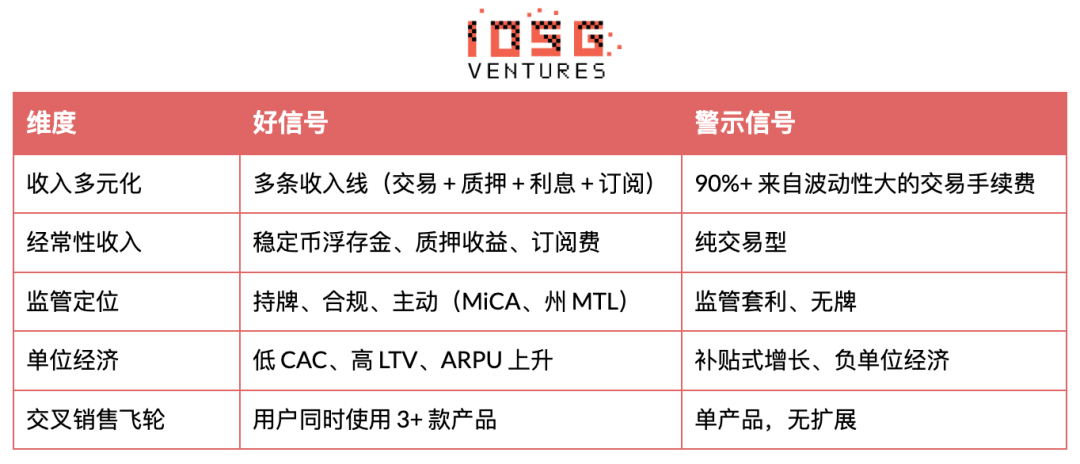
Fintech Crypto Integration Playbook
The following playbook outlines how the ten companies execute the aforementioned foundations. To understand why these strategies work, please refer back to the earlier "Major Trends" section.
#Stablecoin Integration (Most Common, Most Momentum)
- Visa: USDC settlements within the network.
- Mastercard: Card collaboration with OKX; acquisition of Zerohash.
- PayPal: Spontaneously issuing PYUSD ($3.6 billion in circulation); supporting DeFi usage.
- Stripe: $1.1 billion acquisition of Bridge for stablecoin orchestration; building Tempo L1.
- Coinbase: Co-issuer/partner of USDC; expected stablecoin revenue of $1.4 billion in 2025.
#Making Cryptocurrency Trading a Feature
- Robinhood: Native integration of cryptocurrency trading with stocks/options
- Revolut: Trade 200+ tokens within the app
- Nubank: NuCripto
- Block/Cash App: Buy, sell, transfer Bitcoin
The cost of addition is very low; it can capture retail demand in a bull market; and it can deepen user stickiness.
#Building Blockchain Infrastructure In-House
- Coinbase → Base Chain (L2 based on OP Stack)
- Stripe → Tempo (L1, in collaboration with Paradigm)
- Robinhood → Robinhood Chain (L2 based on Arbitrum)
Owning a chain = owning an economy (Sequencer fees, MEV, ecosystem network effects). The analogy is that Visa builds VisaNet itself rather than relying on third-party networks.
#Full-Stack Approach to Bitcoin (Block's Method)
Consumer wallet (Cash App) → Merchant acceptance (Square Bitcoin/Lightning) → Self-custody (Bitkey) → Mining (Proto) → Open-source development (Spiral).
This is a high-confidence vertical bet: If Bitcoin truly becomes a daily payment rail, Block will own every layer; if not, this is a significant resource investment with uncertain outcomes.
#Custody and Institutional Services
- Coinbase Prime: Custodian for most Bitcoin/Ethereum spot ETFs in the U.S.
- Mastercard and Visa: Provide compliance/KYC/AML layers for institutional crypto adoption
Institutional funds require trustworthy, regulated custody—this is a high-barrier, high-profit business.
#DeFi Trading and Protocol Participation
- PayPal: PYUSD supports DeFi lending/trading on Ethereum
- Coinbase: Base Chain hosts DeFi protocols; USDC is the dominant stablecoin in DeFi
- Revolut & Robinhood: Staking services (ETH, SOL)
Integration opportunities for crypto payments and DeFi
Upstream (Wholesale / Infrastructure Layer)
#Stablecoin Settlement Network
Use stablecoins for interbank settlement, fund management, and merchant withdrawals. Settlement time compressed from T+2 to near real-time, reducing correspondent bank costs.
- Beneficiaries: Visa, Mastercard, Stripe, Adyen
- Example: Visa settles VisaNet obligations using USDC on Solana
#Tokenized Money Market as Liquidity
Use tokenized government bonds (e.g., Ondo OUSG, Franklin OnChain) as interest-bearing reserves, maintaining liquidity without taking on credit risk.
- Beneficiaries: PayPal, Nu, Revolut, SoFi
- Example: Mastercard MTN supports tokenized government bond assets
#Cross-Border Remittance Rail
Use stablecoin rails to replace SWIFT/correspondent banks for B2B and C-end remittances. Instant settlement, lower fees, better FX rates.
- Beneficiaries: Stripe, PayPal (Xoom), Revolut, Nu
- Example: Stripe enables USDC withdrawals for global merchants
#Programmable Compliance Layer
AML/KYC, transaction monitoring, and sanctions screening based on smart contracts. Automate compliance, reduce manual effort, and achieve real-time risk scoring.
- Beneficiaries: All regulated players (especially Visa, Mastercard selling value-added services)
- Example: Visa Protect for A2A payments, Mastercard Crypto Secure
Downstream (C-end / Merchant Layer)
#Stablecoin-Linked Cards
Cards that allow direct spending from stablecoin balances, converting to fiat at the POS.
- Beneficiaries: Visa, Mastercard (infrastructure), Revolut, Cash App (distribution)
- Example: Visa's 130+ stablecoin card program, Mastercard OKX Card
#Crypto Collateralized Lending
Use crypto assets as collateral for fiat loans without triggering taxable events.
- Beneficiaries: Robinhood, SoFi, Block, Revolut
- Example: Bitcoin collateral loans offered through Cash App or SoFi
#Interest-Bearing Savings Accounts
Savings products supported by tokenized government bonds or DeFi lending protocols, delivered with a compliance shell.
- Beneficiaries: Nu, Revolut, PayPal, SoFi
- Example: "Crypto earn" products offered by Revolut, with returns close to staking yields
#Merchant Stablecoin Settlement
Allow merchants to settle in stablecoins instead of fiat, reducing FX risk and speeding up withdrawals.
- Beneficiaries: Stripe, Adyen, Square, PayPal
- Example: Mastercard enables merchants to settle in USDC, PYUSD, or USDG through Nuvei/Circle
#Instant Cross-Border P2P
Stablecoin-driven remittances, with seconds-level arrival and rates below 1%. Pressuring Western Union/MoneyGram in LatAm and Asia.
- Beneficiaries: PayPal (Xoom), Revolut, Cash App, Nu
- Example: Nu facilitates BRL → USDC → local currency transfers in Latin America
Differentiated / High-Profit Niche Opportunities
#Self-Custody Wallet-as-a-Service
White-label self-custody solutions for institutions and high-net-worth users. Can charge custody fees while meeting self-custody compliance requirements.
- Beneficiaries: Robinhood (Bitkey), Block, Stripe (via Bridge)
- Example: Block's Bitkey hardware wallet
#Blockchain-Based Loyalty Programs
Issue points in token form for cross-ecosystem redemption. Increase stickiness and create new revenue from tokenized rewards.
- Beneficiaries: Mastercard, Visa, PayPal
#Institutional DeFi Protocol Integration (Huge Potential)
Provide regulated DeFi lending, staking, and liquidity mining access through compliance middleware for institutions.
- Beneficiaries: SoFi (Galileo), Stripe (Bridge), Mastercard (MTN)
- Example: SoFi Galileo provides white-label crypto staking for banks
#Privacy-Preserving Payments
Use zero-knowledge proofs to achieve "both private and compliant" stablecoin transfers. Support confidential corporate payments while meeting AML compliance requirements.
- Beneficiaries: All companies (especially B2B players like Visa/Mastercard)
Unbundling-Rebundling: Structural Perspective
Connecting to insights from another report: The Architecture of Value: Structural Evolution of Financial Innovation and Deep Dive Report on Venture Capital Strategies
(https://claude.ai/30284df5d6ec8003aa52f792bb549832?pvs=25)
#Winners of Rebundling are Infrastructure Providers, Not Consumer Platforms
The most enduring and scalable fintech businesses are those that let others do the bundling rather than bundling themselves:
Infrastructure players (Visa, Mastercard, Stripe, Adyen)
- 90-98% gross margins, 50-62% operating profit margins
- Customer acquisition cost is nearly zero (developers/banks bring users)
- Network effects or developer lock-in are the moat
- Revenue grows as the ecosystem expands, rather than through direct customer acquisition
Consumer Platforms (Robinhood, Nu, Revolut, PayPal):
- 30-50% gross margins, 10-25% operating profit margins
- Customer acquisition costs of $200-450
- Must achieve 3+ product adoption to be profitable
- More vulnerable to regulatory changes and market cycles
Visa captures 97.8% gross margin on $170 trillion in payment volume, while Robinhood's crypto trading revenue is pro-cyclical—this comparison highlights the fundamental gap between the two.
#Three Key Dependencies Determining the Success of Rebundling
Dependency 1: Source of Funds (Bank License = Compounding Moat)
- Winners: Nu ($19 billion in deposits, 3-4% cost of funds, 17.7% net interest margin on loans), SoFi (bank license allows for deposit absorption)
- Losers: PayPal (unlicensed, cannot absorb deposits), Revolut (UK license delayed, cannot compete on the lending side)
Consumer fintech without a bank license will either be held hostage by BaaS partners (e.g., Synapse collapse in 2024) or fail to internalize the "deposit-loan" interest spread—which is key to making rebundling profitable.
Dependency 2: Cross-Selling Economics (Threshold of 3+ Products)
- Single-product users (annual income $50, LTV $150) lose money at a CAC of $200-450. Three-product users (annual income $180, LTV $540) start to become profitable.
- Success cases: Robinhood (11 products, ARPU $191, +82% year-on-year), Revolut (wealth business revenue +298%), Nu (cross-product monthly active users 83%)
- Failure cases: PayPal (400 million users, but most only use checkout, Venmo/crypto/savings cross-selling struggles)
Dependency 3: Developer/Enterprise Lock-In (Depth of Integration)
- Stripe's moat: Once Billing + Tax + Connect + Radar are integrated, it takes over 6 months of engineering investment to dismantle. Each additional product compounds the switching costs.
- Visa's genius in "mixed order": 20,000 banks compete for customers (decentralized), but all use Visa's protocol (centralized). Banks cannot leave because the network itself is the product. Zero CAC, 97.8% gross margin, collecting a "toll" on $170 trillion in transaction volume.
For C-end crypto, structural challenges include: custodial responsibility, compressed profits (Uniswap 0.3% vs. Coinbase 1-2%), no lock-in (users can self-custody and withdraw), strong cyclical trends (Coinbase's revenue down 75% in 2022-2023).
#Foundation for Crypto Success: Be the "Stripe/Visa of Stablecoins"
The common pattern of successful fintech cases is clear: build compliant middleware that abstracts the complexity of blockchain for enterprise and fintech clients.
Investment Theme 1: Stablecoin Orchestration Layer
Stripe's $1.1 billion acquisition of Bridge proves one thing: enterprises want stablecoin settlement but do not want to run nodes, manage wallets, or deal with licenses across 50 states.
- Winning product: An API that simultaneously handles multi-chain routing, liquidity optimization, compliance screening, and tax reporting. Enterprises only need to call POST /transfer, and the infrastructure takes care of the rest.
- Economic model: Charge a 0.5-1% take rate on massive transactions, with a marginal cost of zero per transaction, and extremely high switching costs once integrated. Also 90%+ gross margin, but applied to a $2 trillion+ stablecoin settlement market.
Investment Theme 2: Vault-as-a-Service (Fireblocks-style approach)
PayPal, Robinhood, and Nu are custodians of billions of dollars in crypto assets. Custody requires OCC compliance, MPC/HSM security, $100 million+ insurance, and disaster recovery.
- The opportunity lies in providing "the AWS of crypto custody"—enterprises access it via API, which handles key management, policy engines (e.g., "withdrawals over $100,000 require 3 approvals"), compliance reporting, and OFAC screening.
- Every fintech that has added crypto needs it.
- Zero CAC (B2B sales cycle).
- High retention (changing custodians = 12+ months of security audits).
- Winners: Fireblocks ($8 billion valuation), Anchorage Digital (holds OCC license), Copper.co.
Investment Theme 3: DeFi Middleware / "Vault Curator" Layer
What is currently missing is: a "Stripe for DeFi yields." It can aggregate yields across Aave, Compound, Morpho, and tokenized government bonds (Ondo OUSG), while abstracting gas fees, generating tax reports (IRS-compliant 1099), and providing insurance wrappers and compliance layers.
Opportunities for Vault Curators:
- Ondo Finance: tokenized government bonds, 5% yield.
- Backed Finance: tokenized corporate bonds.
- Maple/Goldfinch: institutional-grade DeFi lending with underwriters.
Specific example: SoFi has billions of dollars in deposits, while traditional accounts only offer 0-1%. If its B2B platform Galileo can provide a "DeFi Yield API" connecting to 5% tokenized government bonds, SoFi could offer customers a 4% APY, keeping a 1% spread, without putting assets on its balance sheet. This middleware approach, which operates between protocols and regulated fintech, responsible for compliance wrappers and tax reporting, is the current blank space.
Framework: Assessing Fintech Business Models
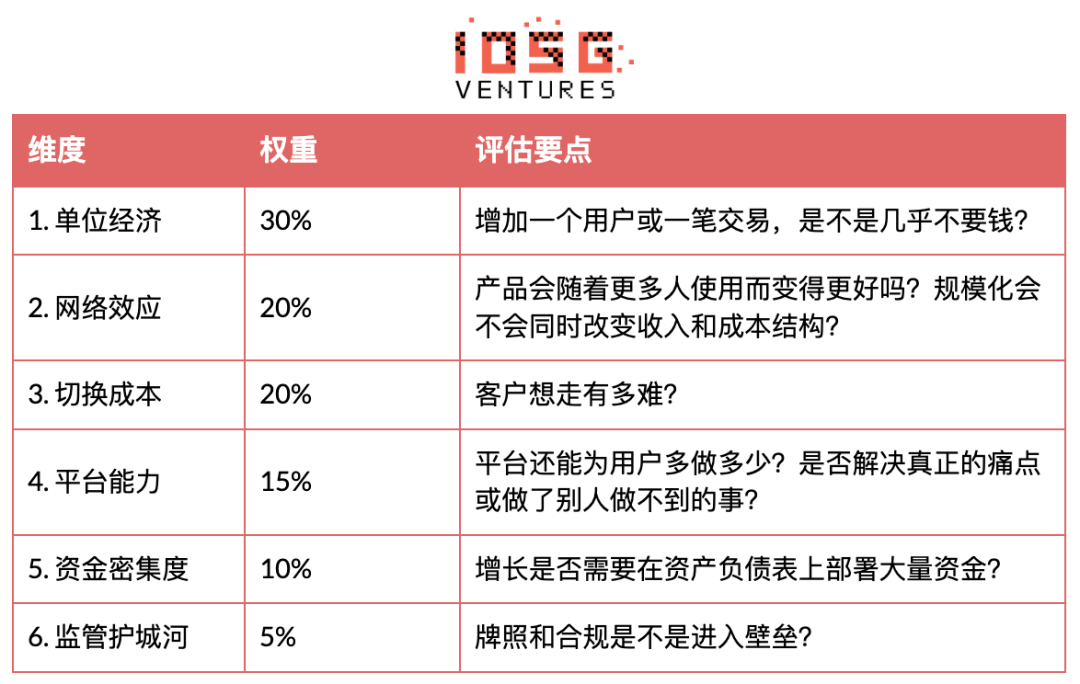
Overview Table
Integration and Alignment of Various Companies in Crypto
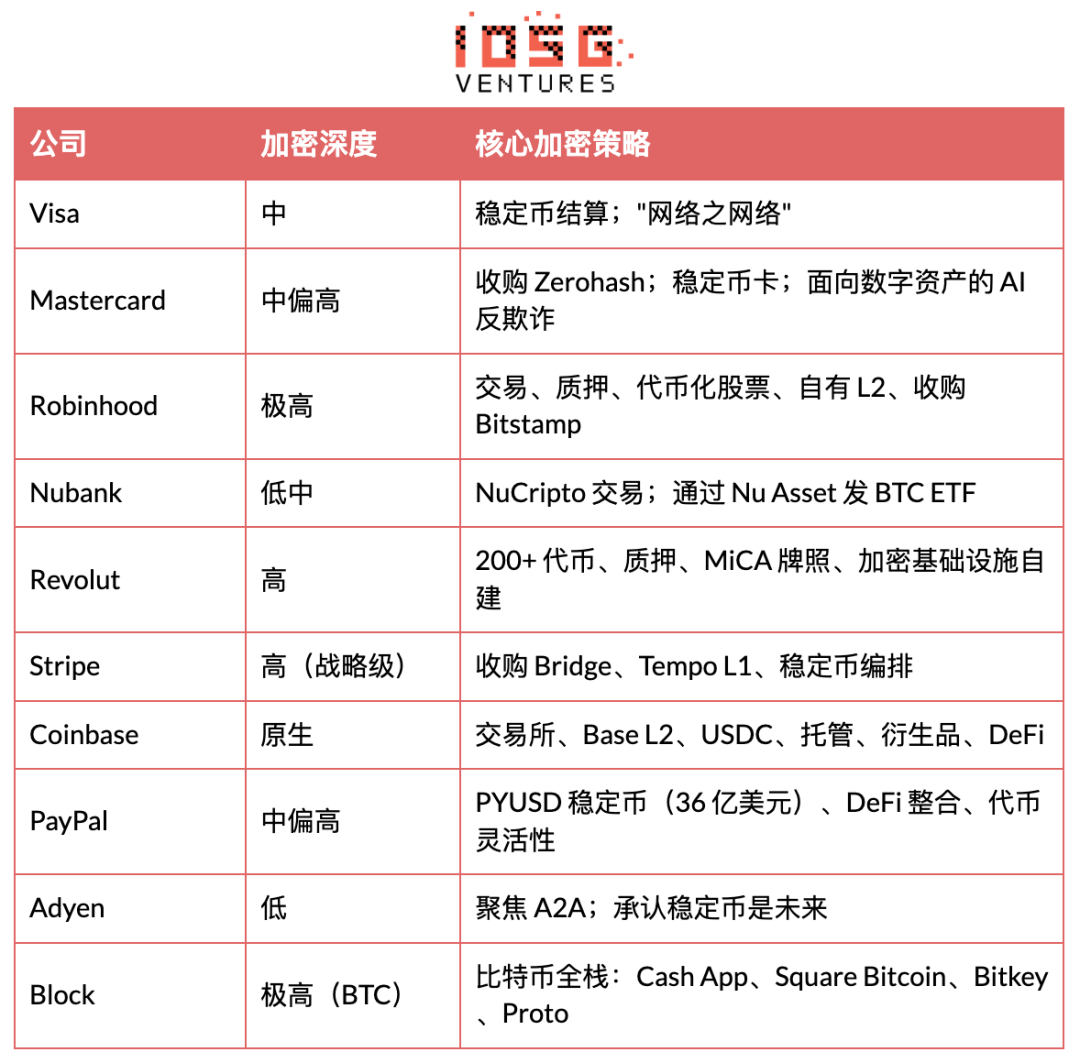
III. Conclusion
The future of fintech lies in the integration of traditional financial platforms with programmable financial infrastructure. Blockchain technology is not replacing existing systems but is increasingly being integrated as a layer operating behind the scenes for settlement and liquidity. Stablecoins, tokenized assets, and on-chain markets bring faster settlements, cheaper cross-border payments, and new financial products, which are largely invisible to end users.
Ultimately, those companies that can capture value in digital finance will be those that possess large-scale distribution, regulatory trust, and control over infrastructure. Whether through payment networks, developer platforms, or consumer finance ecosystems, the winners will be those platforms that abstract financial complexity while orchestrating across multiple payment rails. As programmable money is adopted more widely, fintech companies that successfully integrate traditional finance with blockchain infrastructure will shape the next generation of global financial services.

 Risk warning



Popular articles