Manipulated and divested, Papertrade's thousand-fold leverage experiment got off to a rocky start
 Core Viewpoint

 The two prerequisites on which Papertrade relies, that trader behavior can be predicted and external quotes can be trusted, were challenged on the first day of launch.
Author: Zhou, ChainCatcher
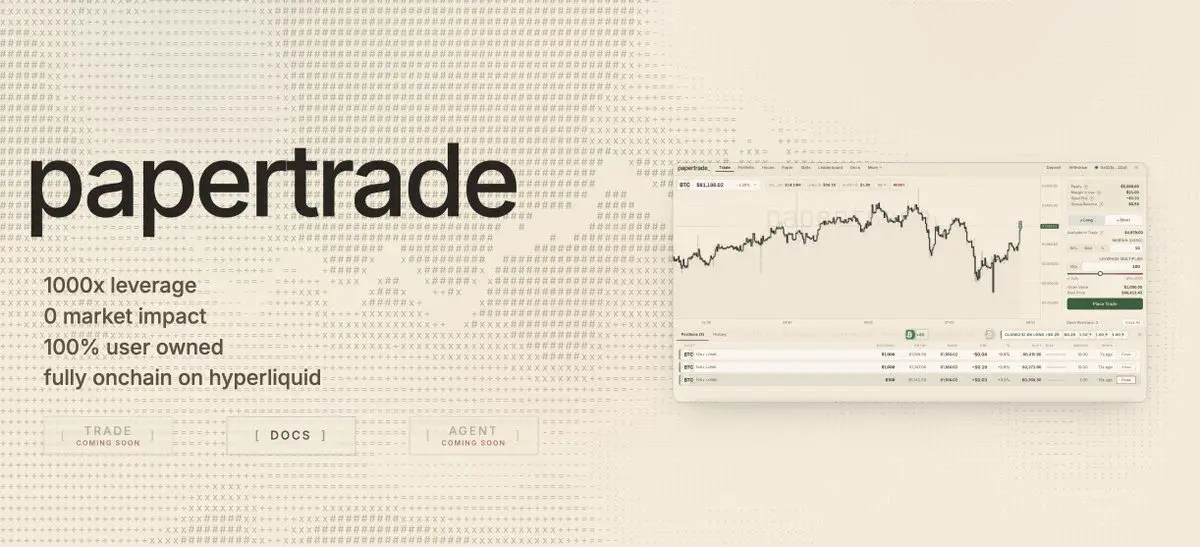
On October 10, the synthetic perpetual protocol Papertrade based on HyperEVM officially launched, featuring a maximum leverage of 1000 times. Users can earn the token PAPER upon incurring losses, attracting approximately $138 million in funds during the pre-deposit phase.
About 8 hours after launch, an on-chain address profited approximately $1.28 million by pulling ETH quotes from Hyperliquid. The official response stated that the risks had been anticipated and began tightening position limits.
Since then, the platform's popularity has noticeably declined. According to official data, as of the time of writing, the platform's TVL has fallen to about $60.6 million, more than halved from the pre-deposit amount; the open positions dropped from a peak of $3.3 billion to less than $400 million.
1. Losses Mean Mining, Significant Volume with Some Flaws
Papertrade was co-founded by traders Jez and Blurr. According to Jez's account on the Taiki Maeda podcast, he was a traditional financial quantitative trader and had engaged in high-frequency options market making. This episode aired a few days before the launch, where Jez candidly stated that most people perhaps should not trade derivatives, as even with correct directional judgment, the expected value with 8 times leverage under random fluctuations is negative.
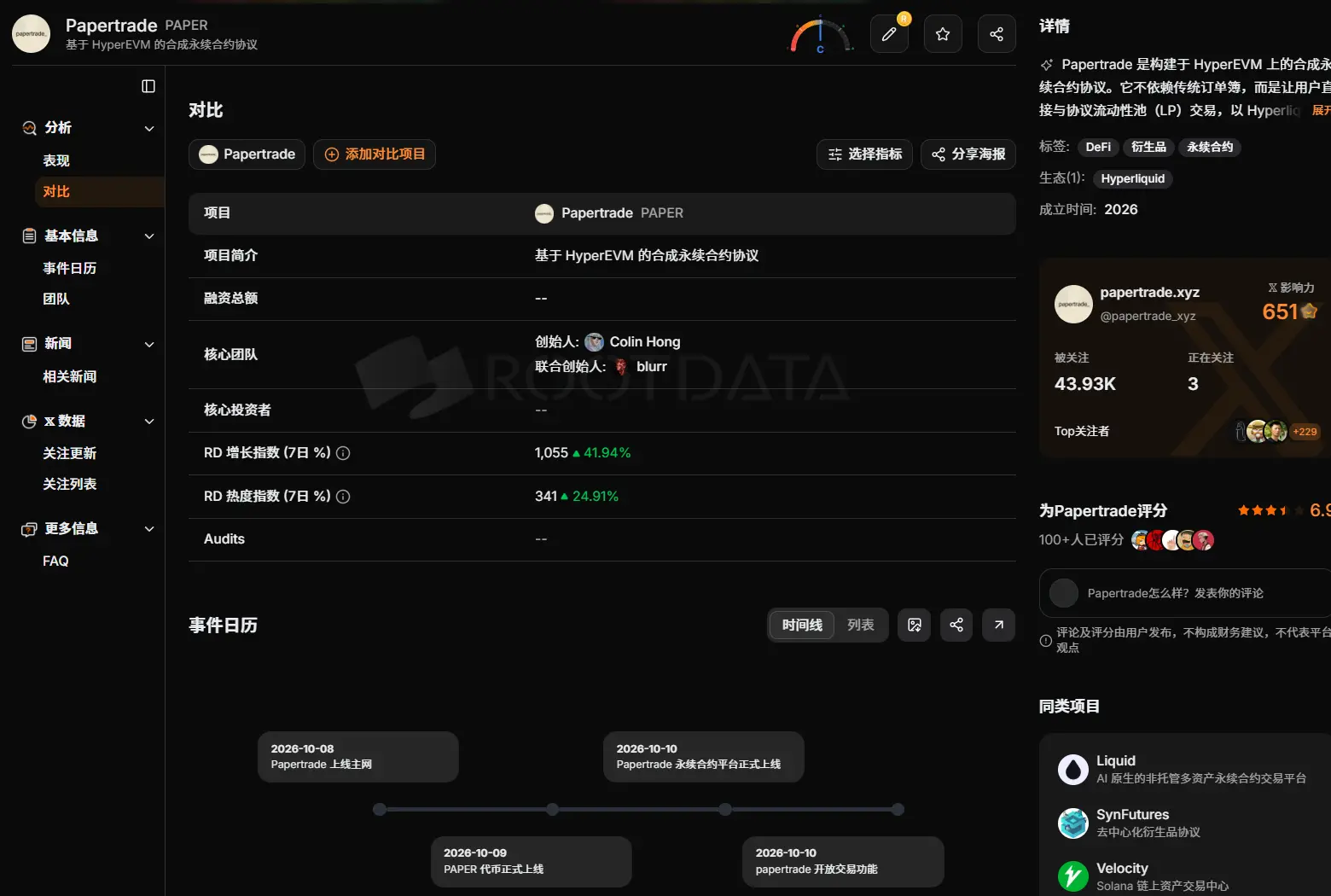
However, he believes that the wave of speculation cannot be reversed, and the real demand in the crypto industry is speculation; rather than advising people against gambling, it is better to own a casino. A few days later, Papertrade officially launched with a maximum leverage of 1000 times.
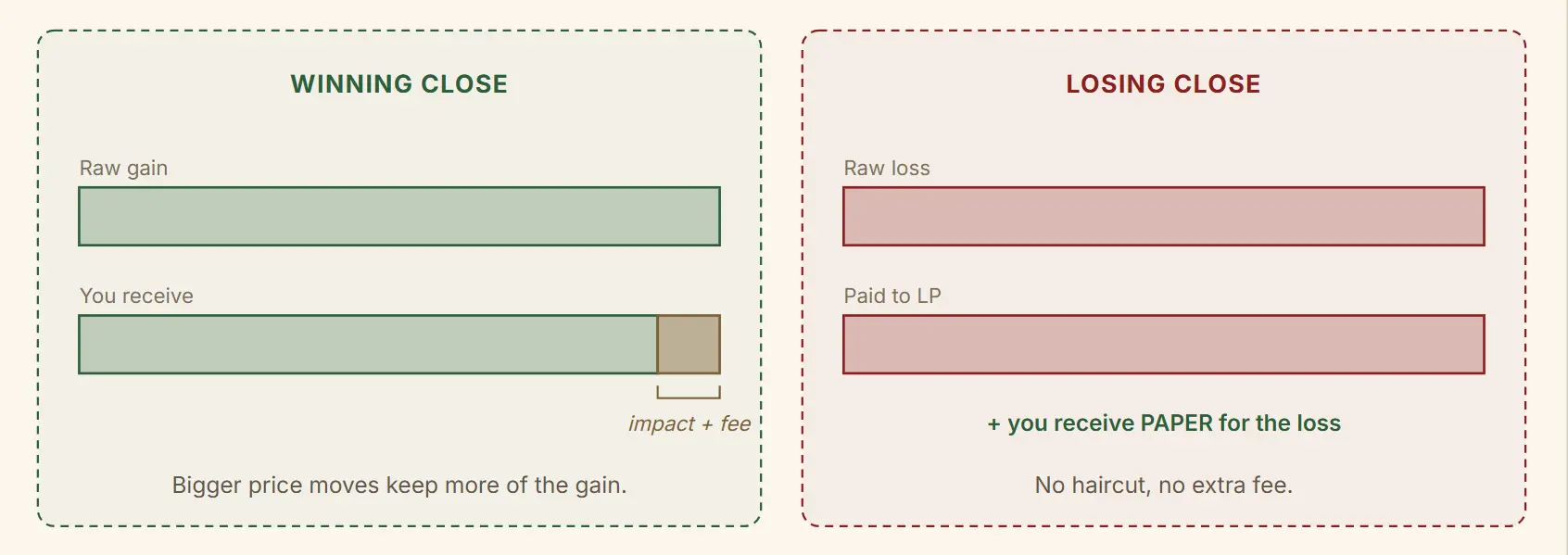
According to the official documentation, Papertrade does not have an order book or market makers. Each trade by users directly faces the protocol's liquidity pool, with prices taken from the midpoint of the best buy and sell prices on the Hyperliquid order book; the platform itself does not place real orders on Hyperliquid.
This liquidity pool starts from zero, does not accept external funding, and the only source of funds is the losses of traders. The profits of the winners are paid by the liquidity pool; when the money in the pool is insufficient, the unpaid profits enter a queue, waiting for the losses of later traders to replenish the pool before being settled in order.
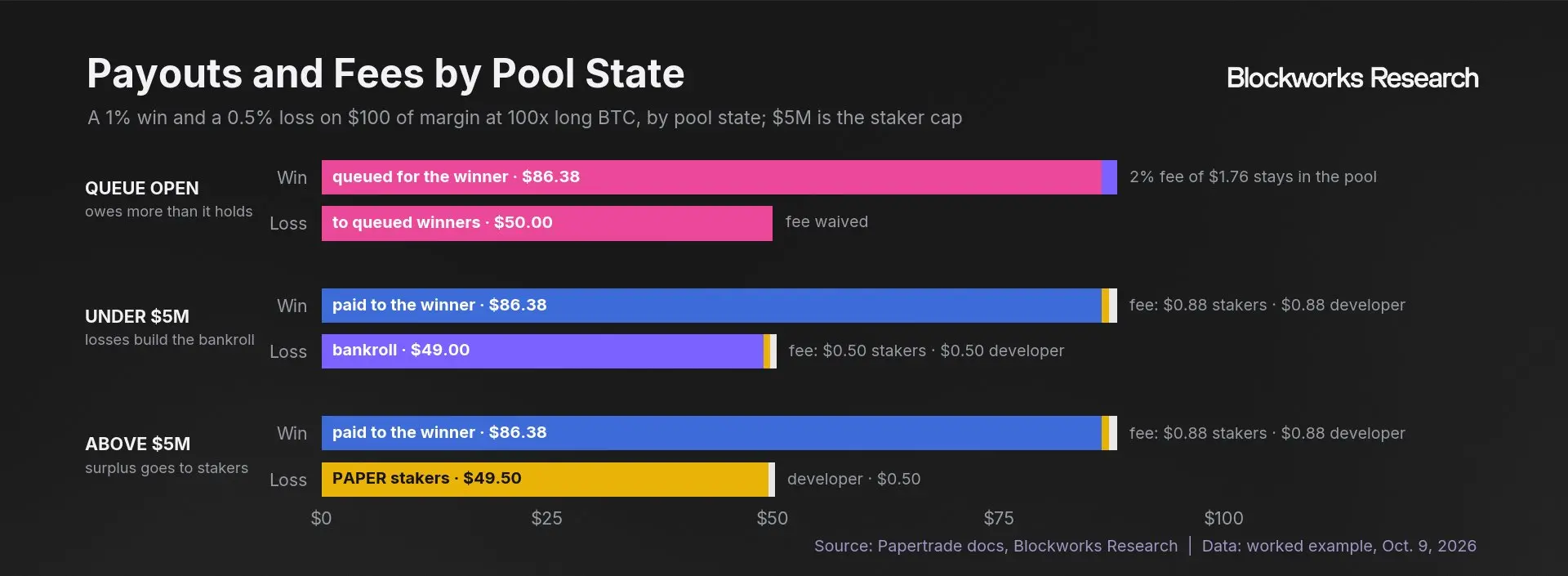
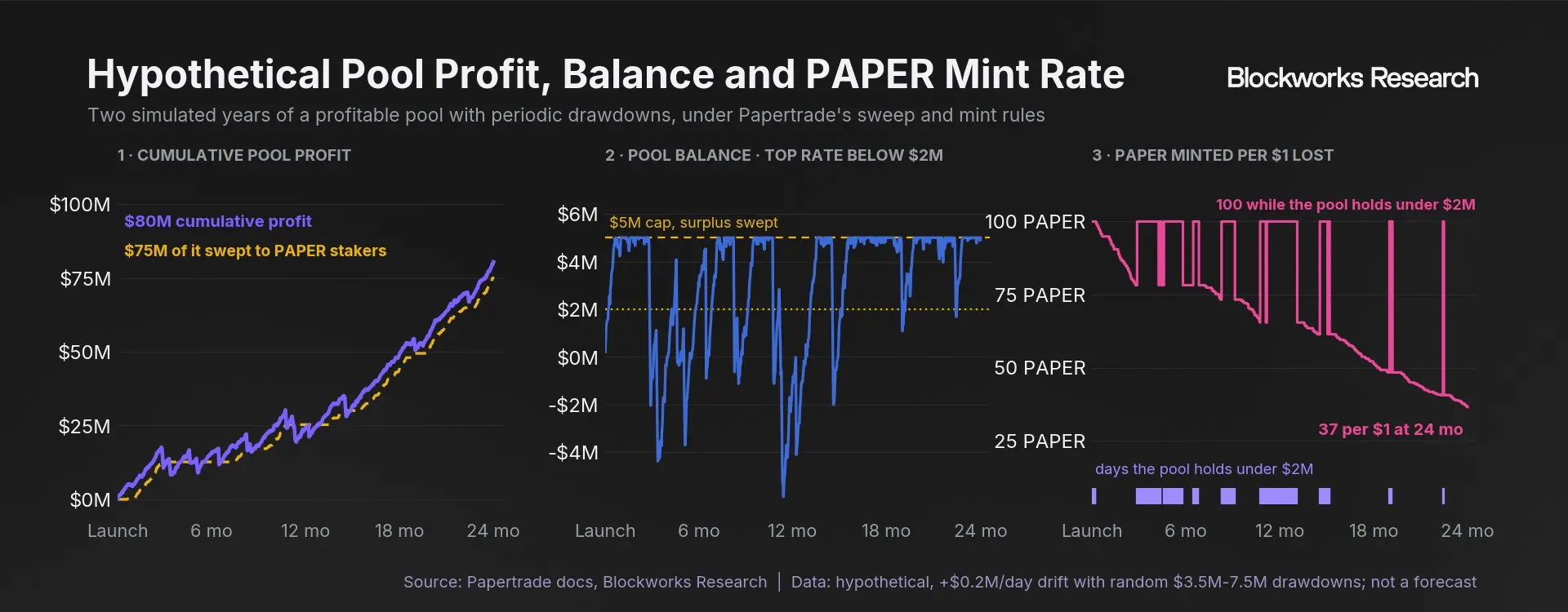
To encourage participation, Papertrade designed the token PAPER. Users can earn PAPER based on their losses or liquidations. When the cumulative profit and loss of the liquidity pool is below $2 million, every $1 lost can mint 100 PAPER; thereafter, the minting rate gradually decreases.
Staking PAPER allows users to share in the protocol's revenue, including 1% of settled profits and all overflow profits once the liquidity pool exceeds $5 million. This means that early losers can share in the profits generated by the platform thereafter.
This design has sparked vastly different interpretations within the community. Crypto KOL Blue Fox believes it transforms the adversarial relationship between the casino and the gamblers, allowing early losers to become future beneficiaries, and it can cold start without external funding.
Others believe it essentially combines mutual assistance and profit-sharing models, where the profits of winners depend on the losses of later participants, and the early high minting rate equates to higher returns for those who enter first.
The project team also earns revenue from this mechanism. Official documentation shows that each position closure incurs a 2% fee, half of which is shared with stakers, and the other half goes to developers. According to PaperDash statistics, developer fees have currently accumulated to about $1.77 million.
After launch, the platform's trading volume quickly surged to hundreds of billions of dollars, but this figure needs to be viewed in conjunction with margin requirements. Official data shows that about 12 hours after launch, the platform's open positions reached $3.322 billion, while the corresponding margin was only about $20.29 million, resulting in an average leverage exceeding 160 times.
A significant portion of the trading volume may stem from wash trading, which the two founders do not shy away from acknowledging. Jez previously mentioned that users can open both long and short positions simultaneously, closing one side at a loss to mine tokens, and he believes this helps keep the liquidity pool healthy. Blurr has also suggested using AI to mine PAPER, stating that the platform is designed for this purpose.
Blockworks Research analyst Shaunda Devens pointed out that such hedging trades bring very little capital to the liquidity pool while continuously minting new tokens. This also means that the nominal trading volume is unlikely to reflect the platform's actual capital scale.
2. Pricing Risks Were Disclosed Early, Exploited on Launch Day
The pricing of Papertrade is entirely derived from the Hyperliquid order book; as long as someone pushes the quotes on Hyperliquid, the profit and loss of positions on Papertrade will change accordingly. Under 1000 times leverage, a 0.1% price movement is enough to double the margin.
Both founders believe that such manipulation is not economically viable. Jez stated that the Hyperliquid order book is deep enough that manipulating the quotes would require deploying eight-figure capital to impact the order book, which is prohibitively expensive. Blurr explained that the liquidity pool limit is set around $5 million to ensure that the pool's scale remains below the cost of pushing the BTC or ETH order books.
However, the morning after launch, community user Boblob discovered that a wallet appeared to push ETH quotes on Hyperliquid with approximately $20 million in trades. Trader Rune subsequently pointed out that the Papertrade official documentation had already disclosed this type of price manipulation risk.
According to the Papertrade official account page, at 6:01 AM Beijing time on the 11th, the address 0x2025 continuously bought about 6060 ETH on Hyperliquid, pushing the price up by about 0.12%, and then sold about 5210 ETH. This address repeatedly established large positions on Papertrade, then pushed the quotes before closing, withdrawing $1.54 million from the platform at 6:06.
More than an hour later, the address attempted a similar operation again. At 7:13, the address opened 30 ETH short positions with 660 times leverage, with a nominal value totaling $297 million, and then sold about 6590 ETH on Hyperliquid, pushing the price down to $2504.40.
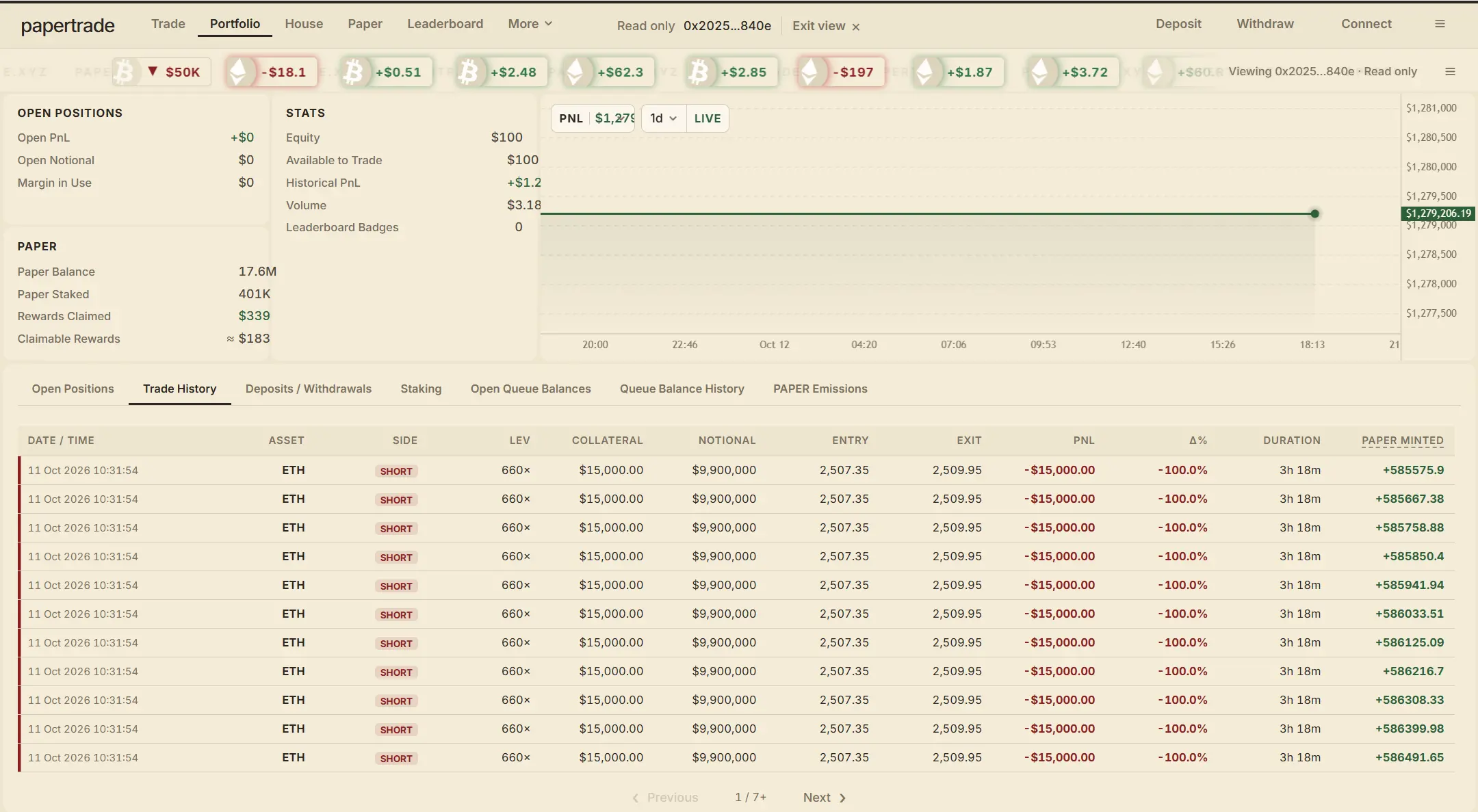
This time it was unsuccessful. The ETH price subsequently rebounded, and this batch of short positions was fully liquidated 3 hours and 18 minutes later at 10:31, incurring a loss of $450,000 while minting about 17.6 million PAPER for that address.
The official account page shows that the address ultimately accumulated about $3.18 billion in trading volume on Papertrade, netting approximately $1.28 million, with only $100 remaining in the account. According to The Block, this wallet has been trading on Hyperliquid since February 2025, accumulating profits of about $13.1 million, indicating it is a seasoned trader familiar with the order book.
This significantly contradicts the founders' earlier assessments. The funds used by that address were indeed at the eight-figure level, but after buying, they immediately sold, almost recovering the funds intact. Statistics show that the fees paid on Hyperliquid were only about $52,000, netting approximately twenty times that cost.
After the incident gained traction, Papertrade responded on X, stating that these manipulation attempts were not due to flaws in the mechanism designed over six months. The occurrence was attributed to the very loose position limits set at the beginning to cope with congestion. The official stated that limits have been tightened on-chain and at the relay level, aiming to make manipulation almost always unprofitable.
The official also claimed that the profit-makers continued to attempt to return almost all profits to the liquidity pool through new accounts. However, this statement cannot currently be verified on-chain, as the official account page shows that the address 0x2025 still has a net profit of about $1.28 million.
The official documentation explains in the risk section that attackers only need to place a small limit order within the buy-sell spread on Hyperliquid that does not require execution to push the midpoint price. Since the pricing process does not have an independent reference price to reject abnormal quotes, the official characterizes it as a real residual risk.
Additionally, the documentation lists three protective measures: profit dead zones, yield discount curves, and directional position limits, but also states that these measures cannot prove that manipulation is impossible or unprofitable. Meanwhile, the position limit is an additional $1 billion space on top of the current positions, not a total cap.
3. Noticeable Decline in Popularity, Limited Repayment Buffer
From the day after launch, the trading activity on Papertrade has noticeably declined. Data shows that the platform's open positions dropped from $3.322 billion 12 hours after launch to $1.3 billion 24 hours later, and by the evening of the 12th, it had fallen to about $400 million. During the same period, the margin decreased from about $20.29 million to about $5 million.
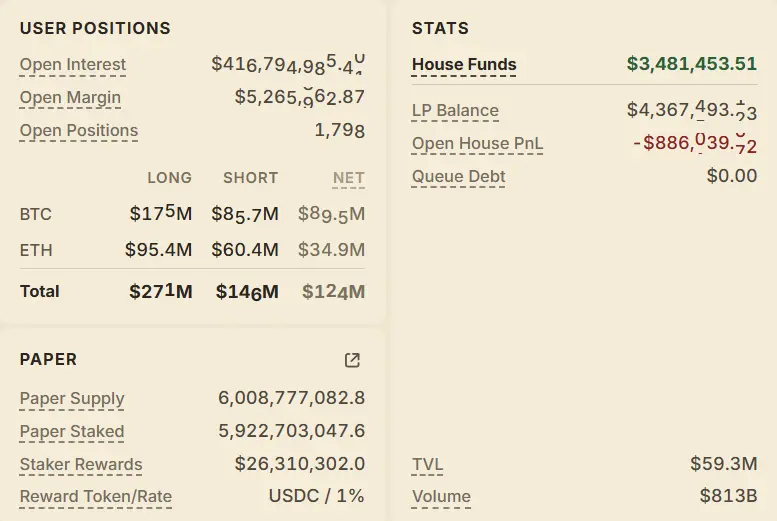
Trading volume has also significantly cooled. On the first day of launch, the platform's nominal trading volume exceeded $678 billion, while according to PaperDash data, the trading volume in the last 24 hours was about $150 billion, less than a quarter of the first day's volume.
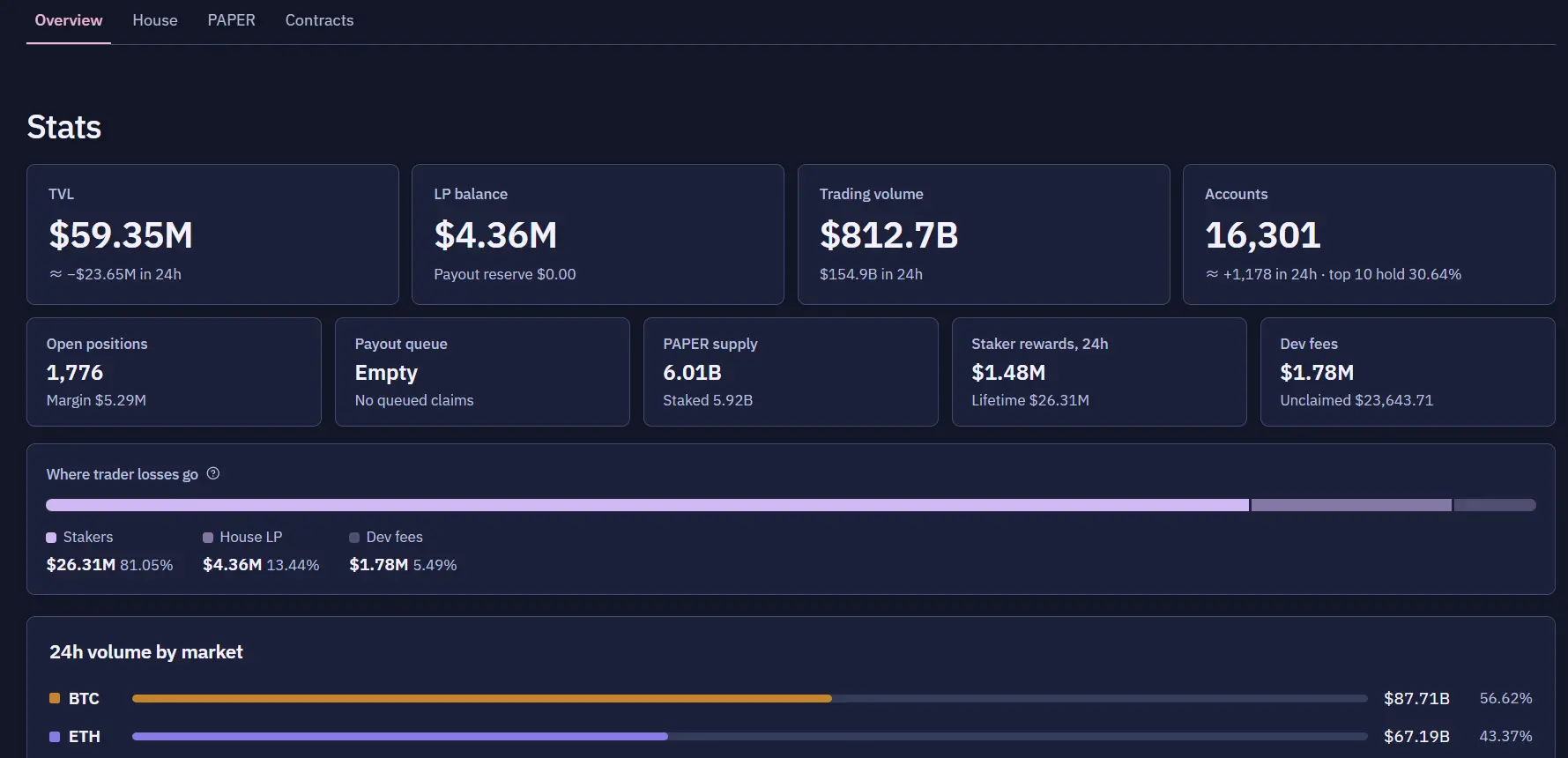
This change is related to the incentive design of PAPER. According to official rules, the minting rate decreases as the cumulative profits of the liquidity pool increase. According to PaperDash data, currently, every $1 lost can only mint about 30.8 PAPER, a decrease of about 70% from the initial 100 PAPER at launch.
The dividends are also highly concentrated at the beginning. Stakers have accumulated approximately $26.3 million in dividends, with only about $1.56 million in the last 24 hours, accounting for less than 6% of the total. Blockworks analyst Shaunda Devens previously pointed out that the PAPER minted at launch can take half of the first year's dividends in the first three months, after which it will be continuously diluted by new supply.
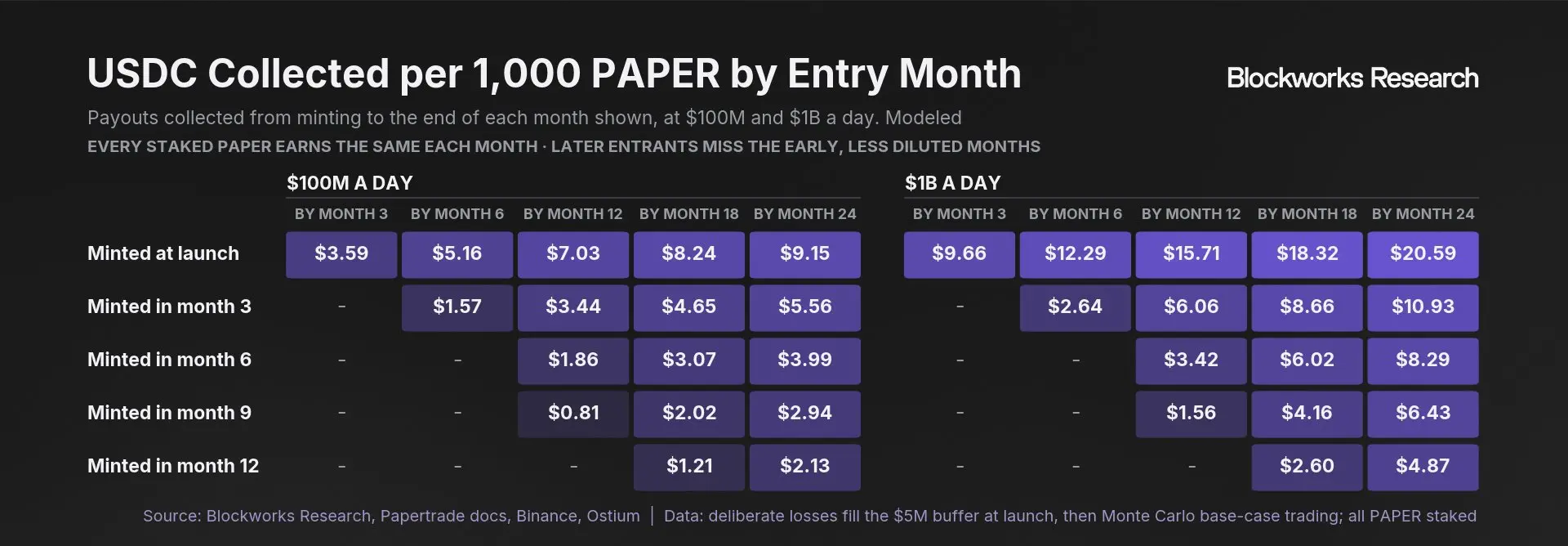
This also means that such designs will gradually eat away at the tail. For latecomers, losing the same amount of money results in receiving fewer tokens and thinner returns.
Fortunately, there have been no issues on the payout side so far. The official website shows that the fund pool balance is approximately $4.44 million, with a net value of about $3.47 million after deducting unrealized losses, and there are zero liabilities queued for payment.
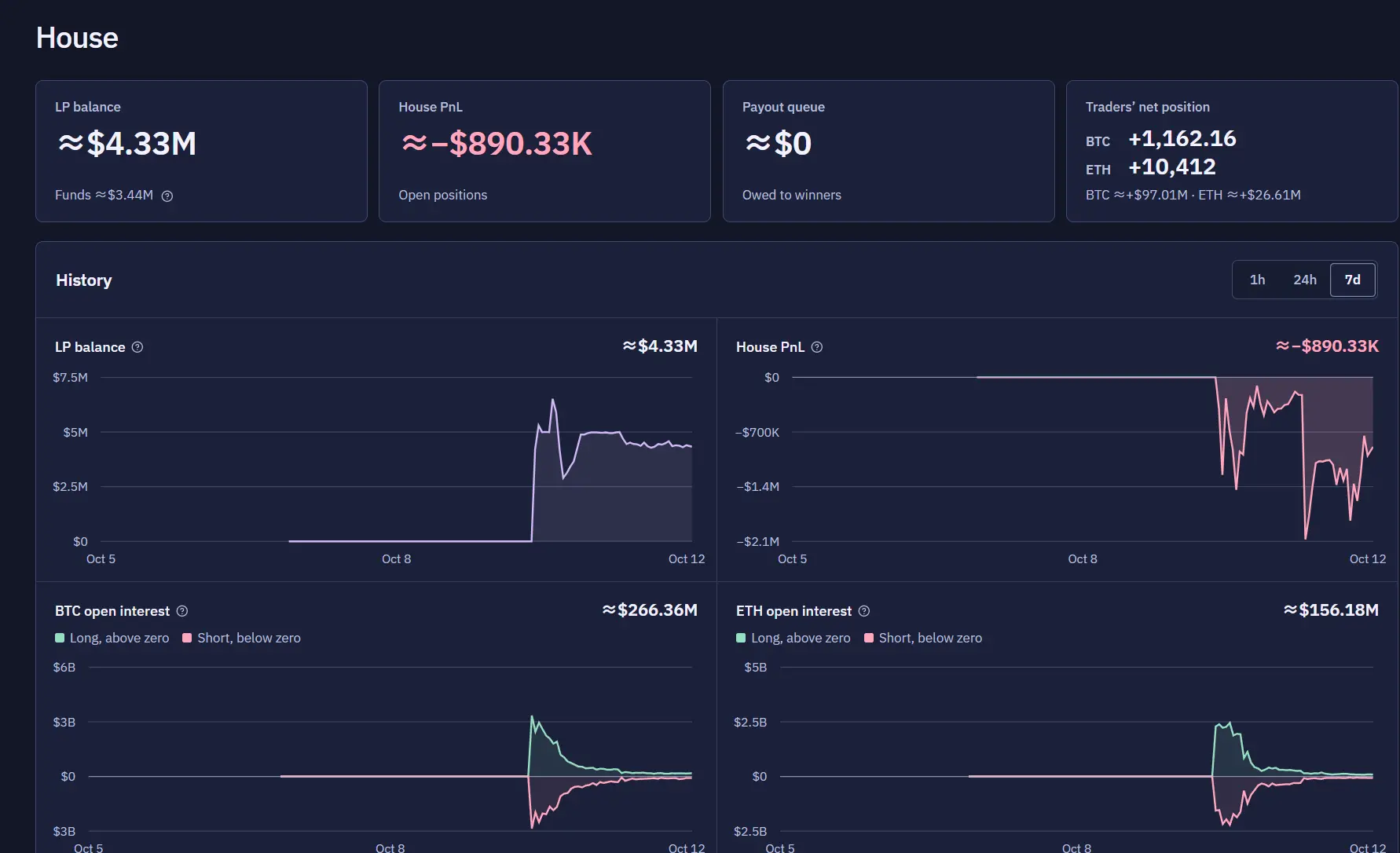
However, the scale of this buffer is limited. According to the design, any amount in the fund pool exceeding $5 million will be entirely distributed to stakers, and the buffer will not exceed this scale. The official website data also shows that users have an overall net long position of about $114 million, making the fund pool more sensitive to one-sided upward trends.
Jez does not shy away from stating that this model can withstand temporary insolvency, provided that everyone believes the casino will repay its debts in the future and that players will continue to play. Conversely, once confidence wavers, this mechanism will face a test.
Blockworks states that if the accumulated liabilities in the queue become sufficient to scare off traders, the mechanism relying on losses to replenish the fund pool will fail, potentially resulting in a situation where winners cannot receive their money.
Some community users have pointed out that when prices gap, the losing side can at most lose their margin, while the winning side settles based on the entire gap. At the same time, opening both long and short positions is equivalent to buying a straddle option with one margin; each major market movement could withdraw a sum from the fund pool. This way, the payout queue lengthens, retail investors flee, and dividends disappear, creating a self-reinforcing cycle.
Moreover, this protocol, which emphasizes being fully on-chain, still has key permissions concentrated in the hands of a few. Jez stated that currently, the project consists only of him and Blurr, with the front end handled by AI. According to the official launch announcement, the administrators consist of Jez, Blurr, and UngusTrade, forming a multi-signature that requires two out of three signatures to pause trading, freeze the market, and modify fee parameters, while contract upgrades require a 7-day time lock.
As it stands, Papertrade has temporarily maintained its payouts, but the two premises it relies on for operation—predictable trader behavior and trustworthy external quotes—were challenged on the first day of launch.

 Risk warning