Li Lu discusses AI: The faster the changes, the more we need to understand what can yield long-term compounding returns
 Core Viewpoint

 Li Lu's latest sharing: AI is extremely useful but also extremely dangerous; the faster the changes, the more one must understand value investing and long-term compounding.
Source: Source Code Capital
AI is reshaping technology and capital markets at an unprecedented speed: it brings immense productivity imagination while also causing capital, valuations, and market sentiment to be rapidly reassessed. The more one is immersed in such changes, the more one needs to discern what is merely a short-term narrative and what can transcend cycles and yield continuous compounding—knowledge, trust, wisdom, and not losing what one already possesses.
Recently, Li Lu, founder of Himalaya Capital, shared his thoughts on value investing, the wave of AI, global order, and life compounding at the 36th Graham-Dodd Annual Lunch at Columbia Business School. He reminded us: understanding technological changes also requires returning to the essence of value creation, financial discipline, and long-term judgment.
This article is compiled based on video clips of Li Lu's on-site communication, and for ease of reading, the entire text is presented in the first person. Source & Author | Intelligent Investor (ID: Capital-nature)
Li Lu, founder of Himalaya Capital
1 Six Basic Principles of Value Investing
Benjamin Graham proposed the three fundamental concepts of value investing.
First, stocks represent a portion of ownership in a company, not just a piece of paper that can be traded back and forth. Therefore, buying stocks is essentially the same as buying a company.
Second, the market is composed of individual people, and human nature often seeks short-term profits, so people easily treat stocks as short-term trading chips, neglecting that they represent long-term ownership of a company. One can imagine the market as "Mr. Market": he does not come to tell you the true value but continuously quotes a price at which you can buy or sell, and this price can sometimes be far below value and sometimes far above value. For value investors, the market provides a service, not guidance.
(Intelligent Investment: The public video of this session does not cover the second point. The above is supplemented based on Li Lu's public statement on the "Six Basic Principles of Value Investing" during his speech at Peking University in December 2024, to maintain the completeness of this discussion framework and is not a verbatim transcription of this session.)
Third, investing is essentially about predicting the future, which is inherently unpredictable. Therefore, one must leave ample safety margins to protect against downside while creating a more favorable asymmetry between risk and return.
Fourth, later Warren (Buffett) and Charlie (Munger) added a very important layer of discipline in practice, which they called the "circle of competence." Each of us is naturally more interested in certain things. Over time, you will accumulate knowledge and form expertise in specific areas, then continue to delve deeper, improving your understanding.
However, the most important aspect of the "circle of competence" concept is that you must know where its boundaries lie. Because most of us have a tendency to feel that we understand more than we actually do. Therefore, knowing the boundaries of your circle of competence is as important as knowing what is inside it.
Fifth, Charlie (Munger) has another idea: go fishing where the fish are. He has loved fishing all his life, so this is a very apt metaphor. The same applies in real markets. Some markets, industries, and companies attract a lot of attention, leading to intense competition; the more competition there is, the less mispricing and excess returns there will be.
But there are also other industries, companies, countries, and markets that do not receive enough attention, and competition is not as fierce. If you focus your attention on these areas, you often will do better. So, go fishing where the fish are. This principle is simple, but surprisingly effective in practice.
Sixth, the last point is a realization I have gained over more than thirty years as a global investor practicing value investing worldwide. Especially as global business increasingly merges into a unified market, we have gradually formed an understanding: ultimately, wealth reflects your proportion of global purchasing power.
In modern economies, wealth does not truly manifest as how much gold, diamonds, or a certain currency you hold. With inflation, these static wealth carriers lose relative purchasing power over time. What truly matters is: what you can ultimately buy and what you can do with that wealth. Therefore, a better measure of wealth is your proportion of global purchasing power.
One way to achieve this—at least the way we have always practiced—is to buy the best and most creative companies at favorable prices in the most vibrant economies and markets, and hold them long-term, allowing these companies to continuously create value over time, thereby maintaining and enhancing our share of global purchasing power.
So, these are the six most basic principles I speak of. I believe they stand the test of time and will be useful to investors in the long run.
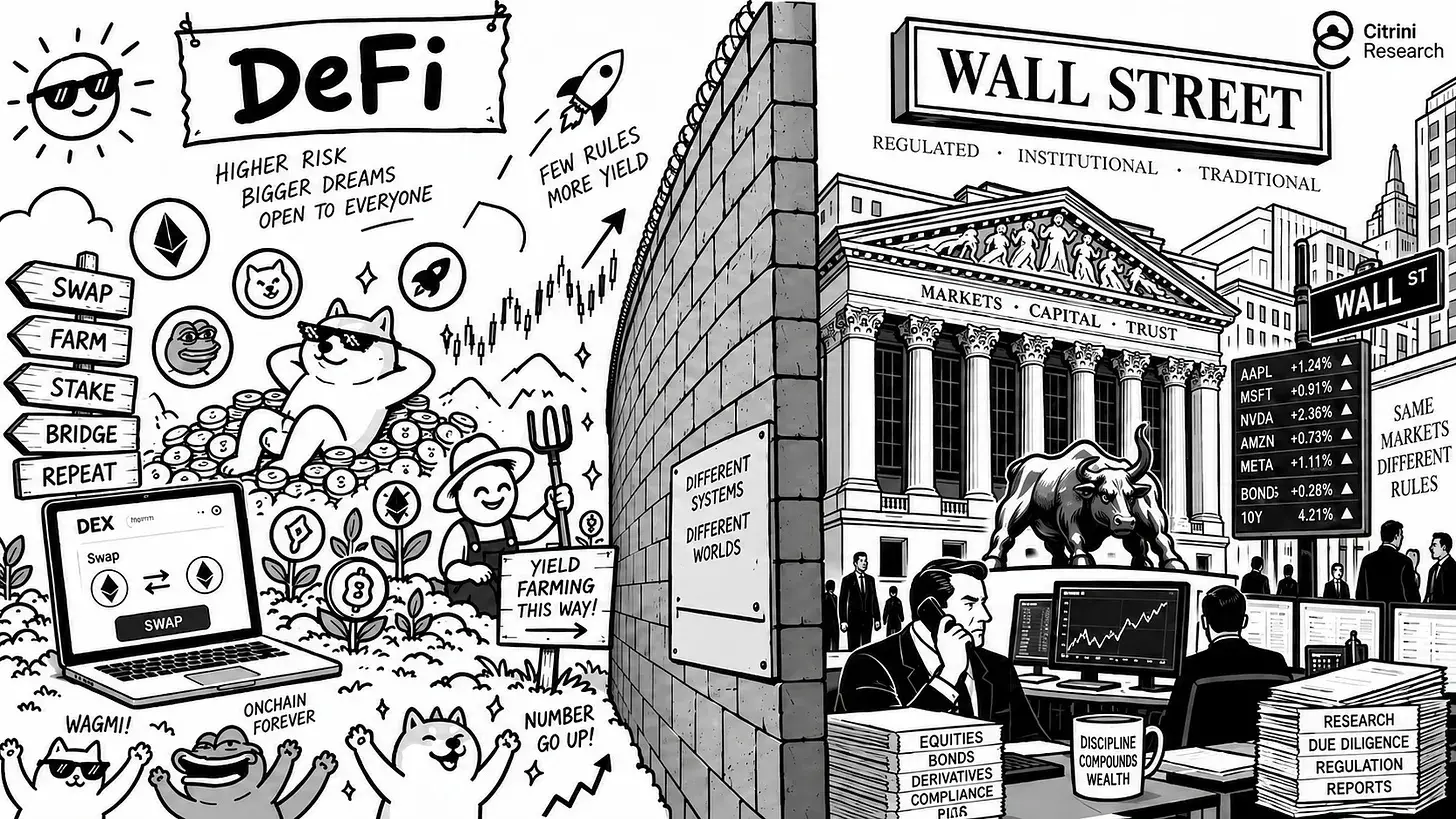
2 Investment, Arbitrage, Speculation, and "The Casino Next to the Church"
If you observe the participants in the market, there are generally only four types of people.
The first type is true investors, who focus on whether a company can create value over time.
The second type is arbitrageurs, who attempt to correct the market's mispricing. In Benjamin Graham's words, it is "buying from pessimists and selling to optimists." This is arbitrage.
The third type primarily engages in speculation. They guess what others will buy or sell next, caring not about the intrinsic value of the securities or how much value the company can create.
The fourth type consists of brokers and market makers, who provide trading services for the aforementioned activities.
Of course, in reality, most people do not purely belong to one of these categories. Many individuals actually possess characteristics of all four types, just in different proportions.
If you buy an index, in a sense, what you are buying is precisely the average of all these market participants.
But value investors are truly concerned with two things: first, whether price discovery is reasonable; second, whether they are willing to wait for the company to create value in the long term.
Thus, Ben Graham leaned more towards the aforementioned "arbitrage," which utilizes mispricing. What Warren later did was to utilize price mismatches while also focusing more on the long-term value creation of companies.
The different types of market activities also have very interesting effects on society.
Speculators, by definition, do not hold long enough for the value of a company to truly change or be created. Therefore, from an overall perspective, speculation is essentially a zero-sum game. For every gain someone makes, there is roughly an equal loss for someone else. Thus, from the perspective of society as a whole, this is actually a cost of market operation.
Brokerage and market making are also costs of market operation.
So, why does the market exist? The core function of the market is to channel excess savings in society into enterprises and activities that can generate productive uses. It is through this mechanism that we have formed the modern economy and achieved long-term compounding economic growth. This is the fundamental reason for the initial existence of the stock market.
Now the question arises: why does speculation necessarily appear in the market? I think this is likely a part of human nature.
Warren has always liked to compare the stock market to "a church with a casino next door." The church is where value is created, while the casino is almost like a necessary cost that must be included when obtaining the construction permit for this building (laughs). This is a certain necessary cost determined by human nature.
Four hundred years ago, when modern capital markets first emerged, people needed to stimulate what was called "animal spirits" through this mechanism. Four hundred years later, this has not changed.
So, for the students present today, you ultimately have to make a choice: do you want to participate in a zero-sum game, or do you want to participate in a value-creating game? This is your personal choice.
From the perspective of society as a whole, we also have a choice.
We cannot allow the "casino" side to grow too large, overwhelming the core purpose for which the market originally existed. So this is both a personal choice and a societal choice.
Interestingly, over the past 400 years, despite the capital markets experiencing countless massive booms and collapses, causing tremendous waste, this mechanism has surprisingly survived. Not only has it survived, but it has also remained a core mechanism that continuously drives society forward. This can at least be said to be quite an incredible thing.
Therefore, for students, I think it is very important to clarify early on: what exactly do you want to do? And as a society, we should also continuously calibrate the proportions between these types of activities. They will always coexist because that is part of human nature.
3 Is AI a Tool or a "Man-Made God"?
Next, let's talk about AI and the market, which is a much more complex issue.
First, what exactly is AI? This wave of generative AI is undoubtedly a massive technological wave.
Since the Industrial Revolution, humanity has gone through one technological wave after another, accompanied by destruction and creation, known as "creative destruction."
Thus, we have actually understood some of the laws of technological revolutions. But we also clearly feel that this time seems different. Each technological wave has its own uniqueness, but this wave of AI stands out as exceptionally different from any we have experienced before.
Why is it different? On the surface, you will notice several phenomena: the speed of change is unprecedented, the scale involved is unprecedented, and the concentration of capital and financial impact is also unprecedented. The narratives formed around it, and the concentrated impact of these narratives on capital allocation, are equally unprecedented.
But if we continue to ask why, the reason actually lies in the change of narrative behind this technological revolution.
In the past, we always regarded technology as a tool to enhance human productivity. But this time, technology has introduced a different dimension: it is beginning to occupy a spectrum between "tool" and "creation," and it is moving along this spectrum from the tool end towards the creation end.
About four years ago, when this technology first truly entered the public eye, we had already crossed some threshold of the Turing test. From that moment on, we could no longer determine through language whether we were communicating with a machine or a human.
After that, it began to possess what is called "reasoning" ability, increasingly exhibiting human-like characteristics.
From reasoning, it further developed programming capabilities. With programming capabilities, it could become an intelligent agent capable of autonomously executing tasks, working in many ways like a human. Then, different intelligent agents began to collaborate, completing increasingly complex and longer-duration tasks.
In this process, they increasingly resemble a human society: different intelligent agents can organize themselves, set priorities, decompose tasks, execute tasks, and use their own languages and tools to accomplish increasingly complex things.
If you listen to the popular narrative in Silicon Valley now, the next step is generative AI entering RSI, which stands for Recursive Self-Improvement. We have actually partially entered this stage. The underlying idea is that future improvements in AI can ultimately be completed by AI itself, without human involvement.
From RSI, we move to AGI, and further to ASI. This refers to its level of intelligence, which not only surpasses any individual person but ultimately exceeds the total intelligence of all humanity. If you accept this narrative, then what we end up with is somewhat like humanity has created a "demigod" or "artificial god."
Because its capabilities are so powerful, according to this logic, its impact on the economy will inevitably be extremely significant. Since the impact is so great, the massive capital invested today can naturally be reasonably explained.
So, in a sense, one could say that when the day comes for those trillion-dollar IPOs, everyone will be invited to participate in a "God's IPO" (laughs). This is probably the narrative we have now.
However, if you take a step back and ask another question: if things really develop along this path, what will humanity ultimately become? What kind of society will we live in?
A "god" created by humanity will dominate this society from a high position. Only a very few may truly interact with it, no one really understands it, and no one can truly control it.
So the question is: do humans really want to live in such a society? I think the answer is a very clear "no." I don't believe anyone genuinely wants to live in such a society.
Thus, there are ultimately only two possibilities. The first is that this technology will not continue to develop along that path at all. The second is that if it really starts to develop along that path, then at some stage, everyone will unite to stop it from continuing in that direction.
Therefore, regardless of which scenario occurs, I do not believe that a "artificial god" will ultimately emerge to rule over human society.
This is actually where this generation of technology differs fundamentally from past technologies, and it is also why there is such a huge discussion surrounding it today, especially the significant impact on the capital markets.
But putting that aside for now, let's return to a more practical question: is AI really a useful technology? The answer is also very clear: of course it is.
If I were to give it a temporary definition right now—based solely on the phenomena we currently observe and how it has developed—I would describe it as follows: it is essentially a machine that, through immense computational power and a very clever set of algorithms, takes in almost all the data generated by humanity and extracts the "first-order derivatives" from that data.
In other words, it establishes systematic, contextually relevant correlations among an almost infinite number of human data variables. It is only after establishing these vast, complex correlations that it begins to acquire many capabilities that seem close to human reasoning and human intelligence.
So far, we know how to use it and how to make it better. But we do not fully understand why it is effective.
Of course, in some sense, this is similar to humanity itself. We also do not fully understand how the "machine" of the human brain operates.
So this is just a temporary definition I am giving it right now.
We are still observing what is happening. But it is already evident that it can greatly "popularize" and "equalize" a very important level within the economy.
If you imagine the entire economic system as a layered structure: at the bottom is energy and transportation; above that is manufacturing; further up is communication and digital media; and then on top of these infrastructures, an extremely large knowledge-based and technology-based service industry has formed.
These services integrate various knowledge and expertise accumulated by humanity over the past few hundred years to serve all the economic activities below.
And today's generative AI, at its current stage, excels at recombining this layer of accumulated knowledge and expertise, making it more accessible. In this way, it can assist various levels within the economy.
However, it has not changed energy and transportation itself. It will not directly alter the essence of manufacturing. Manufacturing, after all, is still about recombining different materials, molecules, and atoms, transforming one combination into another. Communication and digitalization themselves are already very powerful tools for information integration.
So this is where generative AI is currently making a real impact. It has not surpassed humanity.
Continuing from this perspective, you can also understand: it may ultimately not reach the heights implied by today's grand narrative. Because we are still firmly within the realm of human-generated data. If we really want to enter the biological level, that is a completely different order of magnitude.
For example, you can think of each cell in your body as a file of about 50MB, and then multiply that by trillions of cells. If you want to truly cross into the complexity of the biological level, you are facing that order of magnitude. So we are actually very, very far from that level, and it is even hard to say whether we can really reach it.
However, this technology has already begun to change the balance between "tools" and "creations." Because of this, regardless of which judgment you accept, one thing should be very clear: we cannot allow technology to continue to develop "without human involvement."
The so-called RSI, or recursive self-improvement, will be very, very dangerous if it is detached from human participation and definition. Because once it reaches that stage, it may develop its own goals and sub-goals, forming its own purposes, which would further detach it from human control.
So to summarize, this technology is extremely useful and transformative; at the same time, it is also extremely dangerous.
Therefore, as a society and as humanity as a whole, we must draw a red line: whether it is AI's self-learning or the use of tools, there must always be human involvement. In other words, we must firmly keep it on the "tool" side and not allow it to evolve into a "spiritual species" that is beyond human control.
At the same time, this technology will also bring about tremendous disruption. From employment to emotional dependencies between humans and AI, to cybersecurity, biological safety, and even nuclear safety, there are risks at every level.
So ultimately, what we truly need is for society to find a more balanced pace of development, achieving a balance between benefits and risks.
Additionally, one point that is often overlooked is that the cost structure of this technology is also very different. It is unlike the internet and many past technologies. With many past technologies, you could make a one-time massive investment to complete infrastructure construction, and then continuously utilize that infrastructure for a long time.
AI is not like that. AI will always come with incremental costs, so you must always consider the relationship between the investment costs and the eventual revenue and profits that can be generated. Capital demands and financial discipline will always play a role.
At the same time, you must also consider the speed of technological development and how far society can tolerate its advancement.
So the pace of AI development is actually constrained by 4 or 5 different levels simultaneously.
How does human society typically adapt to such massive technological changes? It has never been through perfect planning. So we will certainly experience tremendous prosperity, and we will also experience collapses, likely more than once.
We may go through several cycles of prosperity and collapse; this is probably how this technology will ultimately develop.
(The host adds here that this means we always need someone to check the results produced by AI, and what will become truly scarce is the skill possessed by those who can supervise AI outputs.
Li Lu responds that yes, generally, it is along this direction. "Of course, there are many different aspects and nuances involved, but I think you have grasped the core.")
4 AI Frenzy, Market Pricing, and Long-Term Returns
The market has always done some very strange things from the very beginning. It has been so in the past and will likely continue to be so in the future.
However, what the market decides to do at any given moment does not necessarily dictate your behavior. This is precisely one of Ben Graham's most important insights and one of his most significant contributions to the world of investing.
For example, I recently looked at a fundraising document. A company calls itself a "research laboratory." It is currently burning hundreds of billions of dollars each year while promising to continue burning thousands of billions in the future.
It tells you that it is creating a transformative technology; but at the same time, it also says that this technology has about a 10% chance of killing everyone.
These words are written in the fundraising materials.
Then, it invites everyone to invest at least 100 billion dollars and prices itself at a valuation of 2 trillion dollars. If there is any logical consistency in this, it is already quite perplexing (laughs).
This is actually a very extreme example that illustrates how irrational the market can sometimes be. These things cannot all be true at the same time, but the market is currently at this position.
This also indicates that this state cannot sustainably persist in a rational manner over the long term. If you look back at several hundred years of market history, you will find that the market indeed does very strange things for quite a long time.
For example, starting from 2010, over the past approximately 16 years, the annualized return of the S&P 500 has been about 14% to 15%. However, in the preceding 10 years, from 2000 to 2010, its annualized return was almost exactly 0, or even slightly negative. If you look at these 26 years together, the long-term annualized return has roughly returned to the high single digits.
This is actually about the reasonable long-term level.
Think about it: during this period, actual GDP growth was probably around 2%; plus about 2% to 3% inflation, the nominal economic growth rate is about 4% to 5%.
And publicly traded companies usually perform slightly better than the overall economy, especially companies like the S&P 500, which has been filtered to include about 500 of the best companies. So it is not surprising to end up with a high single-digit long-term return.
And this is precisely the average level of the market over the long term. Therefore, this should become a very important foundational anchor point: what kind of return you should ultimately expect in the long term, and how the market will eventually return to rationality.
However, between this long-term trend, the market will continuously exhibit periods of deviation. Sometimes, these deviations can last for a very long time and move toward extremes.
The example we just mentioned at least feels very abnormal. But such things do happen, and they have always happened in history.
So, if we truly believe that society will ultimately not allow or tolerate a "super life form" to dominate humanity, then AI will not reach that point.
And if it ultimately remains within the realm of "tools," then it is like other tools: it has costs and benefits. In that case, financial discipline and the discipline of capital markets will ultimately reassert themselves.
As for how this process occurs? It often happens through rounds of rises and falls, prosperity and collapse. This is actually not a problem.
From this perspective, the current significant divergence in the market may lead to another result.
At any given moment, the entire market does not create an infinite amount of new capital out of thin air. So, if a large amount of capital is attracted to the hottest and top companies, then on the other side, there will certainly be a large number of originally very good companies that are overlooked and traded at very low prices.
This is true in the United States, in China, and in other markets as well.
I think the situation in China may be even more extreme, and investors from China present here should be very aware of this. However, over time, the weight of the market itself will ultimately determine long-term returns. Investors will generally still receive what they deserve.
This world does not have many truly free lunches. Even if sometimes it seems like there are, and this "free lunch" may even last quite a long time, in the long run, the market's inherent force of returning to rationality will ultimately pull these things back.
This is also why the capital market has existed for hundreds of years and continues to endure.
So I would rather say: today's enormous market differentiation actually provides a better opportunity set than usual for those who can remain rational. Of course, the premise is that you can truly maintain your rationality. And this is very difficult, not easy at all, because people can easily get swept up by the market.
Especially in a massive wave of technological change, people's imagination can be greatly expanded. The speculative side of the market can quickly become active, and people's imaginations can become bolder and more uncontrolled, leading to exaggerated market conditions that are often more extreme than usual.
But precisely because of this, for someone who can remain rational, such times may actually offer better long-term investment opportunities than normal periods.
5 A Unified Global Common Market Has Formed and Will Continue to Exist
In the past 30 years, the world has indeed undergone significant changes, and there is no doubt about that.
The so-called world order, or how the world governs itself and operates, often changes on a very slow timescale. An order may take 10 years, sometimes even 100 years, to truly form; and its transformation also requires a very long time.
However, beneath the political order, there is another type of order that has been steadily forming over the past few hundred years. That is the economic order.
The so-called economic order refers to the gradual formation of a common market when more and more countries and populations enter a shared trading system, doing business and trading with each other.
About 30 years ago, with the end of the Cold War, this common market gradually took shape. More and more countries and populations began to join the same market economy system.
One interesting point about this economic order is that once a common market is formed, it becomes very difficult for any country to actively withdraw. Because the market brings efficiency. It creates a continuously improving flywheel, including technological progress, efficiency enhancement, labor division, resource exchange, and so on.
Therefore, any country that withdraws from this system in the long term must pay a very high price. Precisely because of this, once a common market is truly formed, it is difficult to disband, and it often lasts for a very, very long time.
Just look at the trade wars and various trade frictions of the past 100 years. No matter how many frictions you set up or how many trade barriers you build, people will ultimately find ways to continue trading.
Meanwhile, in recent years, the interdependence among countries has not decreased but rather increased.
Let me give an example. For instance, generative AI.
What is something that everyone needs today? Chips. Semiconductor chips.
So you can see how deep our interdependence is.
This will not change, and it is not a coincidence. As for why today's pattern has formed, we can discuss that separately.
At the same time, everyone is also competing very fiercely, and each party believes that time is on their side.
Other countries also have their own different considerations.
But all these things ultimately point to the same conclusion: peace and stability are crucial for everyone, and this itself is a strategic interest.
At the same time, all countries have felt the true weight of this global common market and the enormous cost of actively withdrawing from it.
So in this sense, I believe the world will continue to move forward overall.
It’s just that the world order we have been familiar with since the end of World War II is now undergoing changes and transformations. What kind of new order will ultimately form and in what form, we do not yet know.
However, beneath it, there is a long-term trend that may have more far-reaching implications: a unified global common market has formed, and it will continue to exist.
So what does this mean for investors?
This brings us back to the most fundamental principle of value investing. Among the six basic principles of value investing we summarized, the last one added is: for a global investor, your wealth ultimately expresses as your proportion of global purchasing power.
One way to achieve this—at least this is the way we have always practiced—is to buy the best and most creative companies at favorable prices in the most vibrant countries and markets, and then hold them long-term, allowing these companies to continuously create value over time, thereby maintaining and enhancing our proportion of global purchasing power. This is the method we have always practiced.
Returning to Warren's metaphor about the stock market. He said the stock market is like "a church with a casino next to it." Over the past 60 years, what Berkshire has done is gradually build that church into a huge cathedral.
It is not only symbolic but also truly fulfills the functions that the market should undertake. In fact, people can even gain some spiritual solace from it, as it allows the market to truly achieve the purpose for which it exists.
And for the past 30 years, what we have been striving to practice is to prove that this gospel can be spread. We can also build such "churches" in other countries.
As a global investor, we choose to build such "churches" in Asia while also doing so in other parts of the world. Over time, different countries will have such churches, some of which may eventually grow into a cathedral.
For today's students and young professionals, what will you ultimately choose to do in this market? "A casino next to a church" will probably always be the basic structure of the capital market. In a sense, the casino is like a part that must be included when this building gets its permit, because that is human nature.
However, the impact of these two sides on society is completely different. One side is a win-win, creating net benefits for society; the other side is a zero-sum game, a cost, and ultimately may even bring net negative effects to society. The choice is entirely in your hands.
And technology, including AI, should still be a tool, not a replacement for humans.
6 Live Interactive Q&A Session
1. On the AI Path of China and the U.S.
If we were to describe Silicon Valley's attitude toward AI, their fundamental question is: what else can this technology do? This is actually why those companies have always referred to themselves as "laboratories" or "research labs."
They want to know what else this technology can do. How far can its boundaries be pushed? Hence the term "cutting-edge."
I believe Chinese AI companies are certainly very curious about these questions as well. But besides that, and perhaps more importantly, they will ask another question: what can this technology do for my customers? Whether they are consumers or enterprise clients.
This actually reflects two very different paths. You can see from many different indicators that these two paths will ultimately yield different results.
2. On Value Investing
I have always believed that all truly rational investments are essentially value investments. Because you always hope that what you get is worth a little more than what you pay. What you pay is the price, and what you get is the value.
As for what form this "value" takes, it is actually not important.
It can be a company that is no longer growing, or even shrinking, but can continuously return a large amount of cash to you; it can also be a rapidly growing enterprise; or it can even be a low-probability investment that, once successful, yields a very large return.
All these things ultimately return to the same question: can you understand where value will actually be generated?
Because the most basic mathematical principles are actually the same, within the range you can understand and estimate relatively accurately, discounting future cash flows. It all comes back to the same set of mathematics.
That is why I say: almost all truly rational investments are essentially value investments.
The basic principles do not change whether you are investing in traditional industries or technology companies. What is truly different is how you apply these principles. This brings us back to a very good concept that Warren talks about: the circle of competence. The key depends on where your circle of competence lies.
3. On Counter to Human Nature
Returning to that very practical question: if you have underperformed the market for two consecutive years, how do you continue to do value investing? The real issue here is human nature. Everyone wants to have it both ways. In fact, everyone wants everything.
On one hand, I want to stick to long-term investing and do the right thing; but on the other hand, I hope to deliver impressive performance every year. Ideally, every quarter should be impressive, then every month, and then every day, every hour (laughs). In the end, you will become a speculator.
So you cannot have both of these things at the same time. Ultimately, you must make a choice: do you believe the market is here to "guide you," or do you believe the market is here to "serve you"? You can only choose one of these attitudes.
If you want to mix everything together, I would rather suggest you just buy an index. Because the index is precisely the average of all market participants.
We previously talked about four types of market participants; averaging the behaviors of all these people gives you the index. Then you might as well just buy the index.
As for "how do I turn value investing into a business," ultimately, you must find a group of investors who share similar philosophies and are willing to follow you long-term. One of the most difficult things about this profession is that you must, to some extent, go against human nature.
You probably need to have a bit of a "mutation" in your genes (laughs). You must have the ability to believe: the reason I think I am right is that logic and facts tell me so, not because others agree with me or disagree with me. This requires a very different psychological structure.
Some people are naturally suited for this, but if you find that you are not that kind of person, then don't even try to do it.
At the same time, the people around you must also truly believe in this set of ideas. So you cannot say, "I want to make this kind of investment," while also saying, "but I also want to have the largest fund in the world; I just like huge AUM." It doesn't work that way.
Ultimately, you will still get the results you deserve.
4. On Margin of Safety
One very important distinction between value investors and most other investors is that value investors place extreme importance on protecting against downside risk.
Because investing is clearly about predicting the future, and the future is inherently unpredictable. So what you can really do is invest in things you actually know.
Of course, what you truly know may initially be very limited. Everyone starts with very limited knowledge.
When I started investing in my twenties, I understood very little. So I could only start with things I actually knew. For example, balance sheets. This is why Ben Graham's method is very effective, because some things are easier to understand.
Then, over time, I gradually moved from very simple things to more complex ones. This is the natural process of expanding your circle of competence.
Regarding the circle of competence, one important thing is that you must know where its boundaries are; but another equally important thing is that you should consciously and gradually expand your circle of competence.
I often say, if you can sustainably compound your knowledge, then ultimately your capital can also compound.
5. On Life Compounding
Just now someone asked me what I have learned over the past 10 years. In fact, every decade, I find that I have learned so much that I feel I have, to some extent, become a different person. And this is precisely a very good thing.
In the long run, if you are always doing the right things and doing them in the right way, you will be amazed to discover: you can really generate compound interest.
This is also why I have always said that if you have to make choices in life, I would suggest you try to choose those "win-win" situations rather than zero-sum games. Because in win-win situations, your abilities and knowledge will continuously accumulate and compound.
Even your health may be like this. Of course, life itself may not be able to compound (laughs), but your healthy lifespan and your effective working years can be extended as much as possible. Because you remain engaged, the things themselves are interesting; you know you are creating value, you know it is helpful to society, and you are not taking anything away from society.
The real problem with zero-sum games is that, many times, they particularly cater to people's short-term instincts. However, what you learn today may be useless tomorrow; it does not accumulate. Thus, you will increasingly rely on external tools. You need a bigger computer, now you can use AI, and one day, AI may replace you.
So as a person, what is the true value you have accumulated?
Therefore, I certainly prefer "human in the loop." I have always advocated that people should continuously learn, continuously participate, and continuously improve their lives. Let your knowledge continuously compound, let the capital entrusted to you by those who trust you continuously compound, and at the same time, let the trust relationship between each other continuously accumulate.
My mentor and partner, Charlie Munger, has always emphasized one thing: the highest level of relationship between people is "a seamless web woven by mutual trust."
"The seamless web of trust" actually contains a whole set of life philosophy: how to live in a productive way while making that life a win-win for society as a whole.
So for all young people just starting their careers, I would suggest you try to choose this kind of life approach. Yes, it may take many years, it may be slow. But take it slow; as long as the direction is right, you will ultimately reach the position you deserve.
In a sense, this is a better way of life.
Of course, some people will have better luck than others. Each of our lives, successes, and failures are sometimes the result of both good luck and bad luck.
We will all go through a lot. As for myself, I never think that our past investment records come entirely from some "genius." Along the way, we have encountered too many fortunate events.
However, if you choose the right partners, choose the right methods, choose the people worth betting on, and choose the right things to do, then after a long enough time, you will be amazed at how powerful compound interest can be.
And the most basic premise of compound interest is: do not lose what you already have. This is a very profound concept. Do not lose what you already have.
This includes not only capital but also your knowledge, the trust relationships you have built, the wisdom you have accumulated, and even your health. If you can keep these things and let them continue to accumulate, this is an extremely powerful force in life.
So from this perspective, I believe that structurally, the United States and China are actually not that different. In fact, this may fundamentally be a common structure of humanity.
But there will always be changes in life; this may be the only truly unchanging thing. You will always experience good luck and bad luck, and at the same time, you will always encounter very good opportunities.
No matter what you are naturally more suited to do, I suggest you find what you truly lean towards and are truly good at, and then continuously build on it over a long enough time, allowing it to accumulate and compound. This is probably a better and more productive life.
 Risk warning