QQQ returns to the annual line: Before the interest rate hike in December, who should we pay attention to in this round of AI rebound?
 The index has completed its repair, and individual stocks are starting their exams.
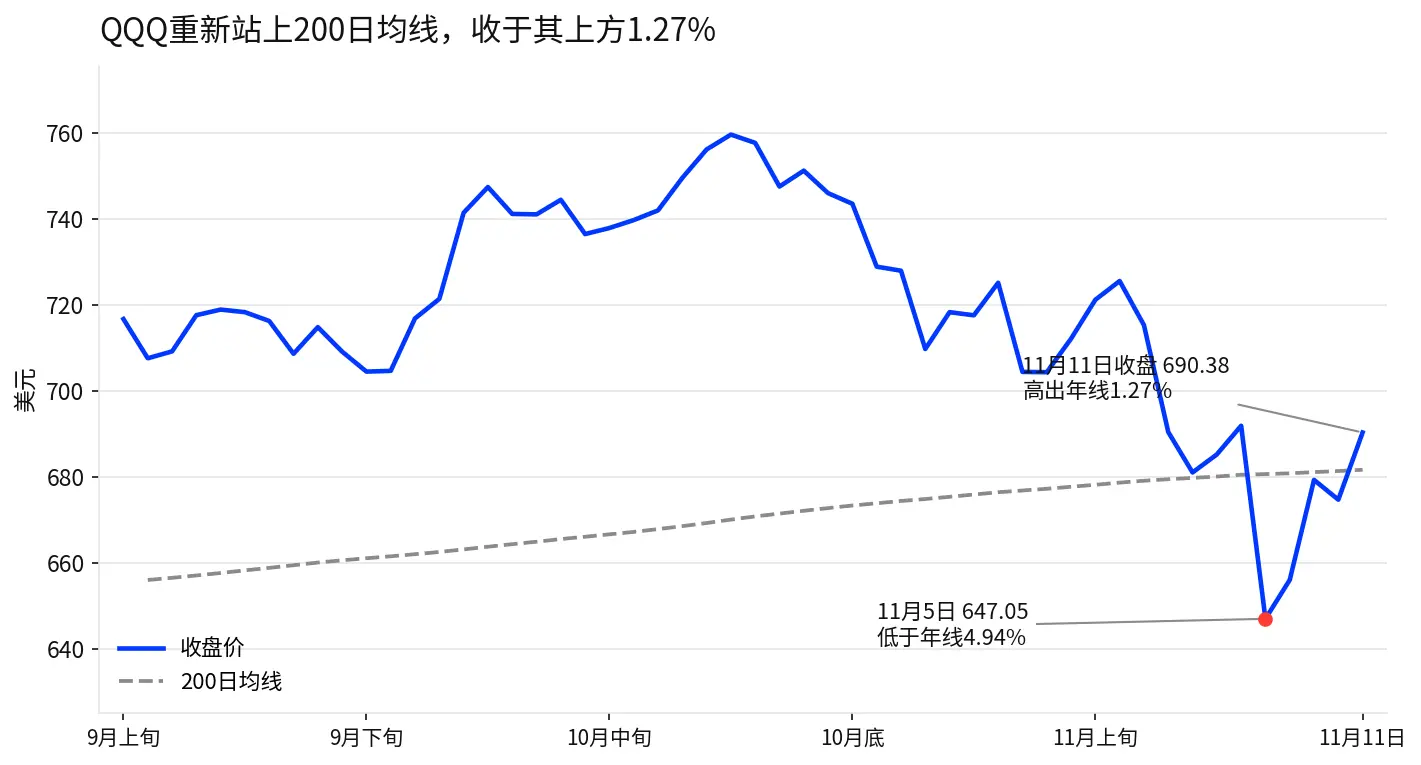
QQQ has reclaimed the annual line, but the real AI market has just entered a stage of differentiation. The index has completed its repair, and individual stocks are beginning their tests. Under the same AI theme, the answers given by the market are already completely different: some have risen above the annual line with cash flow, while others have increased by a quarter but remain 30% below the annual line. This article unfolds along a main line; after the index level repair is completed, who can pass this exam depends on whether the speed of performance realization can outpace valuation pressure.
1. QQQ Reclaims the Annual Line in Four Days, but Real Pressure Still Lies Above the Annual Line
On November 5, QQQ closed at $647.05, 4.94% below the 200-day moving average at that time. It reclaimed most of the loss on November 6 and 9, slightly retreated on November 10, and closed at $690.38 on November 11, 1.27% above the annual line.
Historically, similar trends show significant differentiation after reclaiming the annual line. This statistic only reflects historical cases and does not indicate which path will be superior moving forward, so I won't elaborate here. The real hurdles to overcome are the two immediate ones.
The first hurdle is NVIDIA. This round of QQQ's rebound was ignited by storage, optical communication, and CoreWeave, with NVIDIA, the largest weight, rising 2.87% to $173.73 on November 11, still 15% below the annual line. It will report earnings after the market closes on November 17, and if governance concerns cannot be clarified before then, the structure of the index above the annual line will lack an important confirmation.
The second hurdle is interest rates. The yield on the 10-year U.S. Treasury bond closed at 4.998% on November 10, close to the 5% mark. Long-term interest rates determine the discounting method for high-valuation future cash flows, which is a more fundamental variable than the index level.
2. The Index Has Returned, but AI Has Already Split into Three Tiers
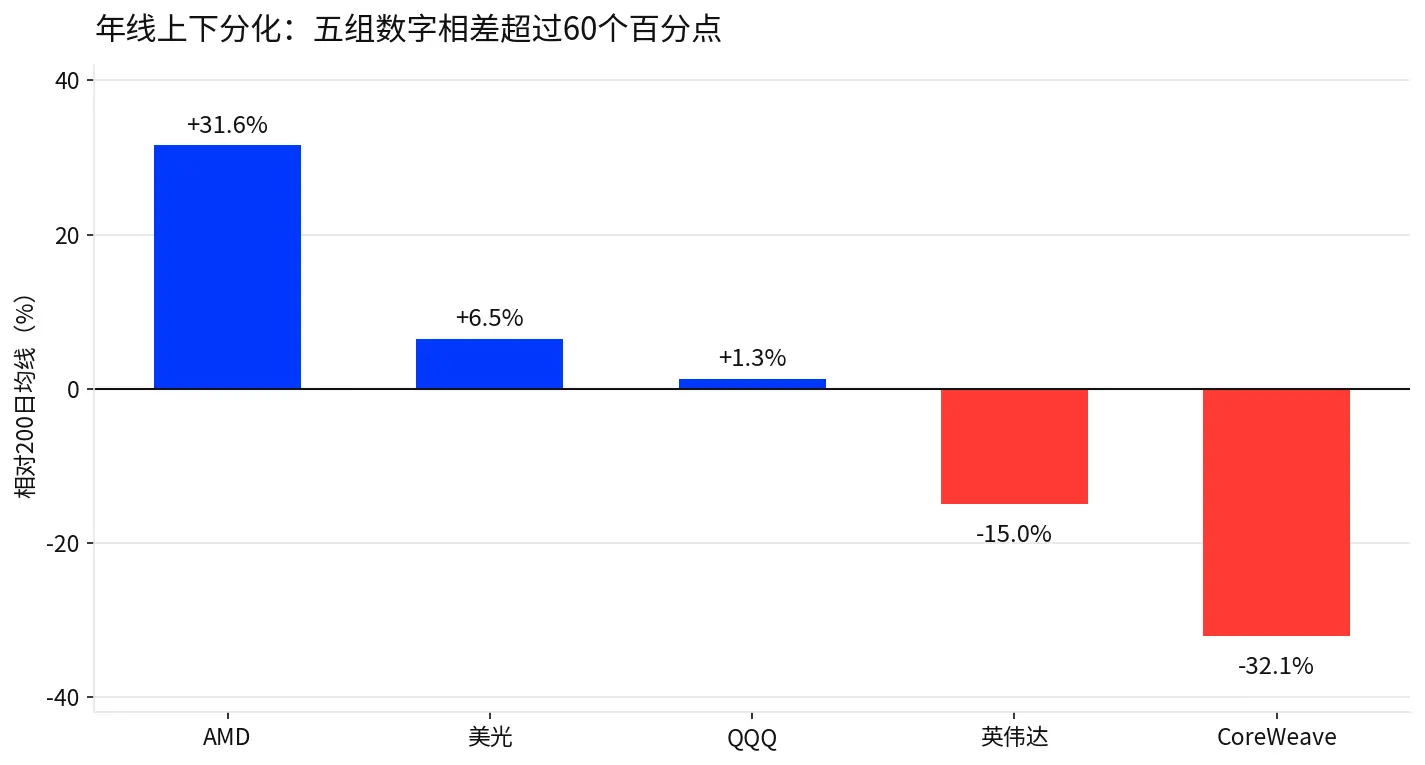
Placing the positions of five main lines relative to the 200-day moving average on one chart reveals three states.
AMD closed at $552.90, 31.6% above the annual line, with high expectations already priced in.
Micron closed at $811.30, 6.5% above the annual line, with fundamentals being realized, rising 11.89% in a single day on November 11.
QQQ itself is 1.27% above the annual line, having just completed its repair.
NVIDIA is 15.0% below the annual line, with core weight yet to be confirmed, down 28.6% from its 52-week high.
CoreWeave closed at $60.77, surging 24.71% on November 11, but still 32.1% below the annual line, with high volatility and high financing risk coexisting.
This set of data leads to an important judgment: the index returning to the annual line may not equal a broad-based rally in AI. Funds may be transitioning from "buying AI" to "buying realization," and the position of the annual line is not random; it reflects the market's scoring of growth quality. The upcoming question is not whether "AI will rise," but whose realization speed can outpace valuation pressure.
3. NVIDIA's Next Hurdle: Uncertainty in Earnings Performance and Board Investigation
NVIDIA closed at $173.73 on November 11, up 2.87%. Looking at a longer timeframe, it has retreated 28.6% from its 52-week high of $243.37, closing below the annual line for several consecutive days in early November.
According to multiple media reports in early November, discussions regarding management arrangements at the board level are fermenting, but the company has not formally confirmed this. The earnings expectations are not low; according to analysts' expectations reported by the media, the market consensus for third-quarter revenue is around $108.8 billion, a year-on-year increase of about 90%. High earnings expectations, yet the stock price is 15% below the annual line; these two numbers together indicate that market concerns extend beyond just performance.
The earnings report on November 17 needs to address two issues simultaneously: the performance numbers and management's statements regarding governance arrangements, guidance for the next quarter, and AI capital expenditures. According to media reports, institutions like Citigroup have lowered their target prices ahead of the earnings report, but ratings have not been downgraded, and the valuation is being discounted, which is a common stance on Wall Street recently.
The observation points after the earnings report also become clear. If governance concerns are clarified and performance is realized, the previous retracement level around $181, as relayed by third-party technical analysis, will be the first verification point for valuation discount recovery. Conversely, if the earnings report exceeds expectations but the stock price cannot reclaim the area around $181, it indicates that governance and valuation discount have not yet been repaired, and the revenue numbers alone do not constitute a sufficient condition for pricing.
4. Micron Returns to the Annual Line: HBM Prices Are More Worth Watching Than Low PE
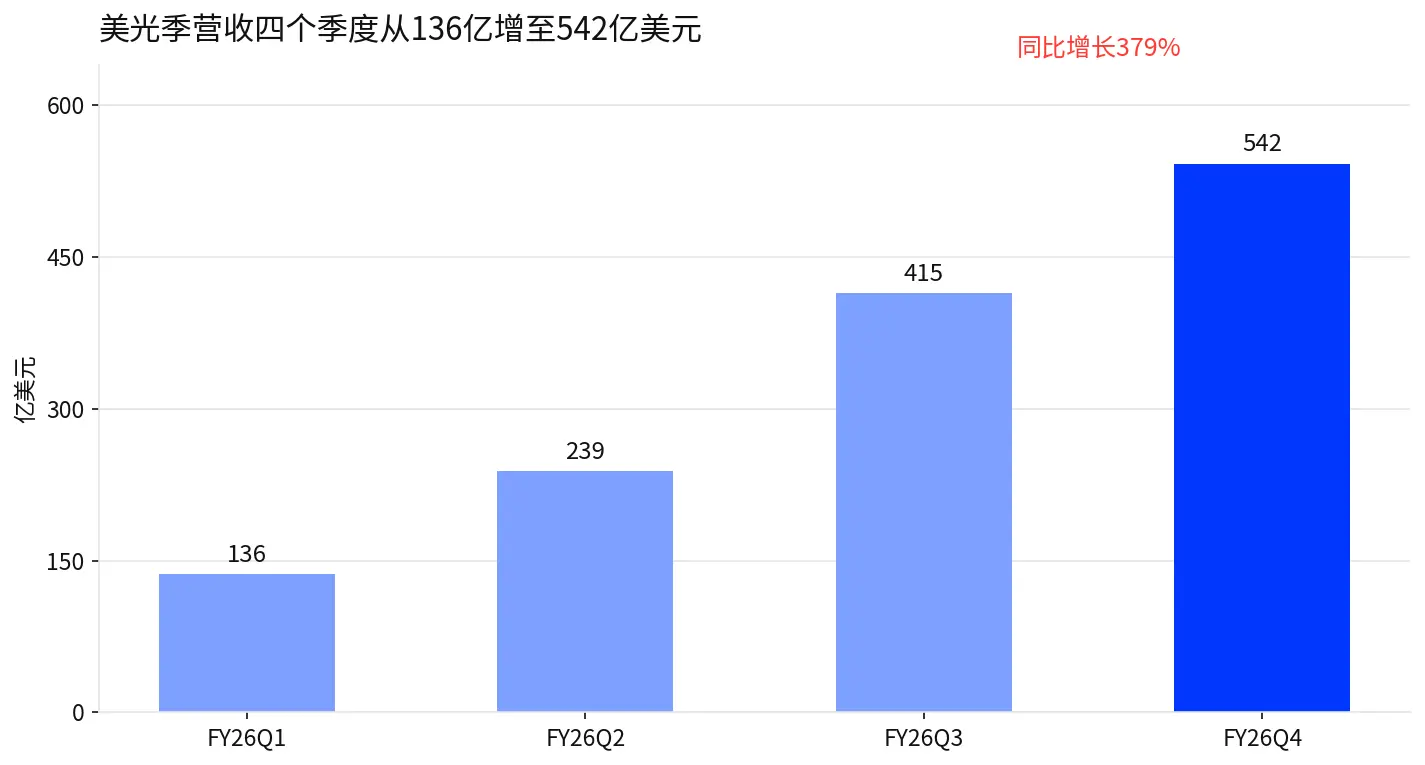
Micron's revenue for the fourth quarter of fiscal year 2026 was $54.229 billion, compared to only $11.315 billion in the same period last year, a year-on-year increase of 379%. Annual revenue was $133.188 billion, with a net profit of $84.969 billion, translating to an earnings per share of $75.38, giving a current price-to-earnings ratio of about 10.8 times.
The question is how to interpret this low P/E ratio. Is the market mistakenly undervaluing it, or is it pricing in an impending peak in the cycle? Micron has retreated 35.4% from its 52-week high of $125.5, and on November 11, it stood 6.5% above the annual line, with the price already providing an answer of "stop falling," but the answer to "turning around" does not lie in past revenues.
The answer lies in HBM prices and supply. According to third-party technical analysis, there is a dense area of previous positions in the $800 to $900 range above $811. If the pricing guidance for HBM in the next quarter continues to rise, and if the supply of HBM4 from Samsung and SK Hynix does not significantly exceed expectations, a P/E ratio around 10 times is more likely to be understood as undervalued. If HBM4 supply increases rapidly and prices begin to loosen, a low P/E ratio is more likely to be an early pricing of a cycle peak. The same valuation data can have two completely opposite meanings, with the dividing line being HBM prices.
5. CoreWeave Rises 25% Yet Still Below the Annual Line: The Rebound is About Payment Concerns, Not Financing Risks
CoreWeave surged 24.71% after its earnings report, but at $60.77, it remains 32.1% below the annual line, down 56% from its 52-week high. After rising a quarter, why is it still 30% below the annual line? The answer is that the earnings report demonstrated strong business growth but did not fully prove that financing costs have decreased. The core of CoreWeave's valuation has never been about quarterly revenue, but whether it can continuously secure financing at acceptable costs. This round of price increase is more about alleviating short-term payment concerns than validating the business model.
Looking at AMD's issues in the same context makes it clearer. Third-quarter revenue was $13.377 billion, with a quarter-on-quarter growth of about 16%, and the data center business reportedly grew nearly doubled to $8.5 billion. Its exam is whether revenue can be converted into cash; according to media reports, its free cash flow dropped from $1.56 billion in the previous quarter to $554 million, and the quality of growth needs to be verified by subsequent quarters' cash flow.
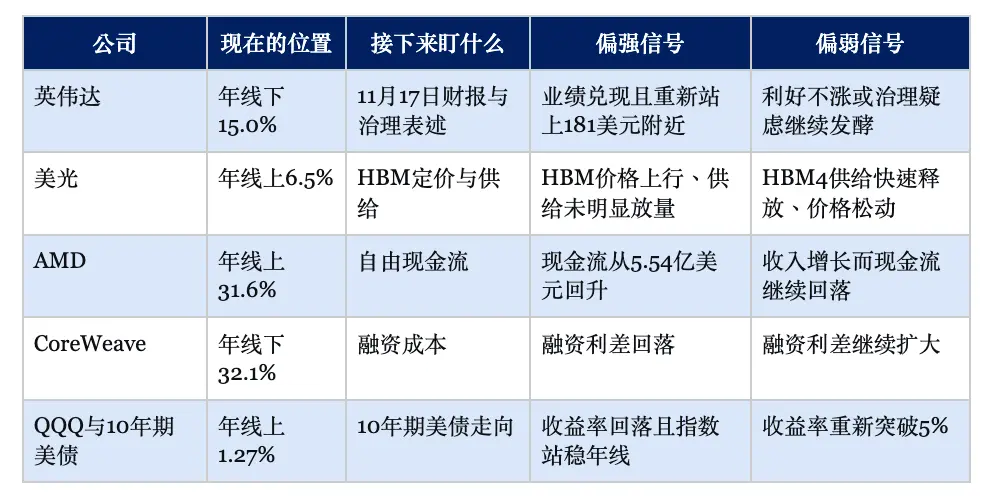
Each of the four targets has its own question. For NVIDIA, it is whether performance can support valuation again; for Micron, it is whether profits can be sustained; for AMD, it is whether revenue can be converted into cash; for CoreWeave, it is whether revenue can cover financing. The internal reordering of AI is about the answers to these four questions.
6. December Rate Hike Has Been Priced in by the Market; the 10-Year U.S. Treasury Bond is the Valuation Switch for AI
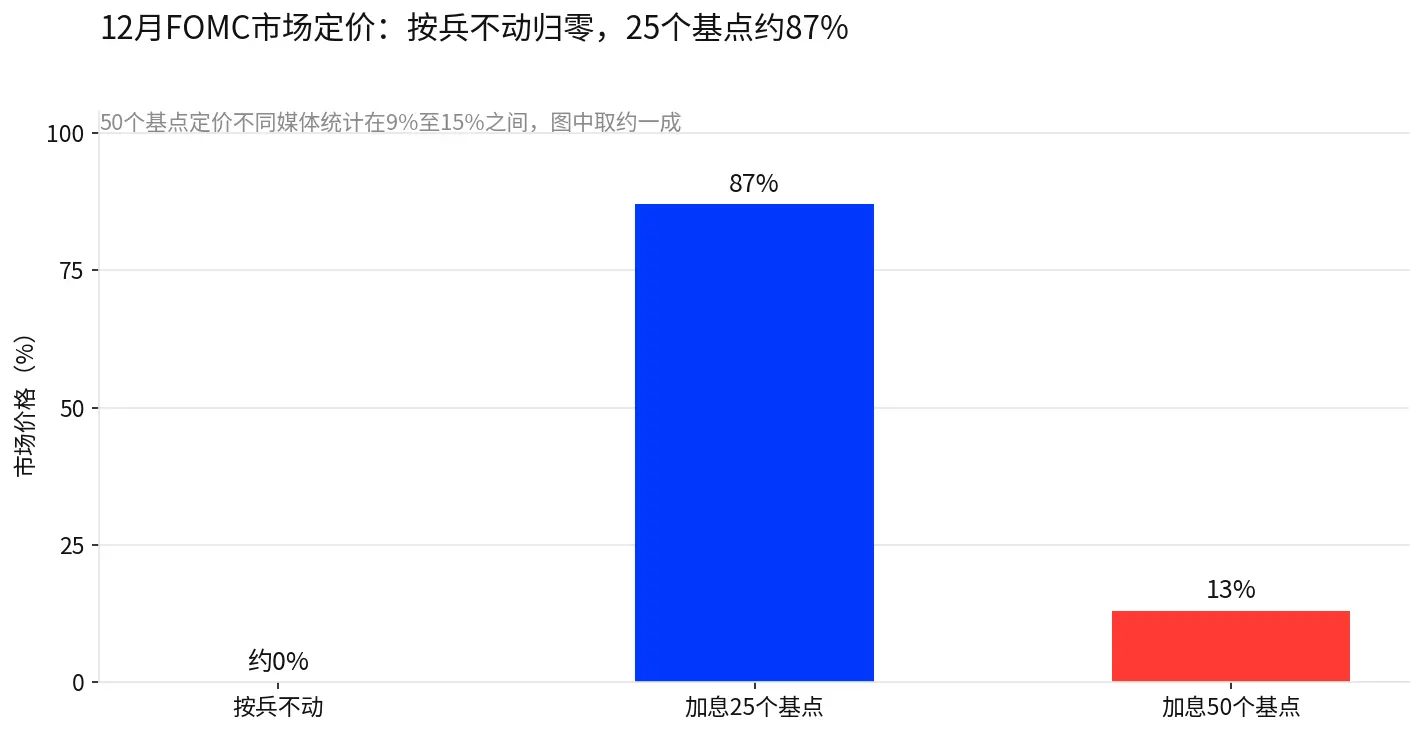
After the October CPI was released, according to market data from CME FedWatch (reported by multiple media outlets from November 10 to 11), the probability of no change on December 9 has dropped to zero, with a probability of a 25 basis point hike at about 87%, and a 50 basis point hike at about 10%, with different media statistics ranging from 9% to 15%. Some institutions have included another rate hike early next year in their forecasts, but media reports indicate that these views only represent the judgments of various institutions. The December rate hike itself has been priced in by the market, and short-term interest rates are not the biggest variable moving forward.
What truly affects AI pricing is the long end. The yield on the 10-year U.S. Treasury bond closed at 4.998% on November 10, close to the 5% mark, serving as the discounting benchmark for growth stock valuations. Therefore, the judgment standard is very specific: if the yield on the 10-year U.S. Treasury bond falls back and QQQ stabilizes above the annual line, AI assets have conditions to recover the discount. If the yield on the 10-year U.S. Treasury bond breaks above 5% again, the pressure of discounting high-valuation future cash flows will increase, and the structure above the annual line will need to be re-examined. Monitoring the 10-year U.S. Treasury bond is more useful than focusing on 25 or 50 basis points.
7. Don’t Just Focus on QQQ: Five Signals Determine Who Continues to Run in AI
In Conclusion: QQQ Returning to the Annual Line Does Not Mean AI is Entering a Broad Rally Again
What is truly noteworthy about this round of rebound is not that QQQ has finally reclaimed the 200-day moving average, but that the internal pricing of AI has already begun anew. AMD stands 31.6% above the annual line, Micron is 6.5% above, while NVIDIA and CoreWeave remain 15.0% and 32.1% below the annual line, respectively. Under the same AI theme, the answers given by funds are already completely different.
Moving forward, do not use "Will AI rise?" as the sole judgment. For NVIDIA, observe whether governance and earnings reports can support valuation again; for Micron, watch if HBM prices can prove that profits are not at the cycle peak; for AMD, see if revenue growth can be converted back into free cash flow; for CoreWeave, check if financing costs can improve alongside business growth. If these signals gradually strengthen, QQQ stabilizing at the annual line may transition from technical repair to trend repair. If the index continues to rise while these fundamental signals do not keep up, be wary of another instance where the index outperforms individual stocks. The index has completed its repair, and individual stocks are beginning their tests; this statement is likely to dominate the AI market before the December interest rate meeting.
Disclaimer: The content of this article is for general information and market commentary only, compiled based on publicly available information as of the time mentioned in the text. Relevant market data, expectations, and probabilities may change with market conditions. The views and investment strategies cited from third-party institutions, analysts, or other individuals represent only the opinions of those third parties at a specific time and do not represent the views or recommendations of BIT. This article does not constitute investment advice, investment research, solicitation, or recommendation for any securities, investment products, or trading strategies, nor should it be used as the basis for any investment decisions. Financial markets carry risks, and securities prices and market performance may fluctuate; past performance and historical market trends do not represent or guarantee future results. Investors should independently assess relevant risks based on their own circumstances and seek professional advice when necessary.
 Risk warning Risk warning



Popular articles