








Dialogue between Aave and Chainlink: What is the imaginative space for leading DeFi projects?

 DeFi greatly reduces the operational costs, asset issuance, distribution difficulties, and improves efficiency compared to CeFi.
Recently, the 21st session of the Catcher Academy, hosted by Chain Catcher, invited Leslie, the Lead for Aave in China, and Yu Wenqing, the head of the Chainlink China technical community, to share insights on "The New Cycle of DeFi and the Imagination Space of Leading Projects."
During the session, Leslie and Yu Wenqing shared with community users how the composability of DeFi will change, how to view relatively centralized exchange public chains like BSC and Heco, what problems in traditional finance can be better solved through DeFi, and what more exciting application expansions we can expect in the future among many other valuable insights. The full text is organized as follows, hoping to inspire readers.
Chain Catcher: The heat of DeFi has continued for almost a year, and the ecological infrastructure has gradually improved. How do you view DeFi's performance in 2020? What potential directions and spaces for explosion might exist in the new year? Is there a possibility of a significant correction in the secondary market like last September?
Leslie: The rise of DeFi in 2020 was exceptionally rapid, starting with the liquidity mining of Compound, which ignited the DeFi mining craze. Liquidity mining, as an effective, transparent, and fair token distribution method, allows every user participating in the ecosystem and providing liquidity to gain project-related benefits. We then saw a large number of projects grow in lending, DEX, derivatives, and other sectors.
DEXs represented by Uniswap and Sushiswap are gradually capturing user traffic and assets from centralized exchanges. DeFi significantly reduces the operational costs and difficulties of asset issuance and distribution in CeFi, improving efficiency.
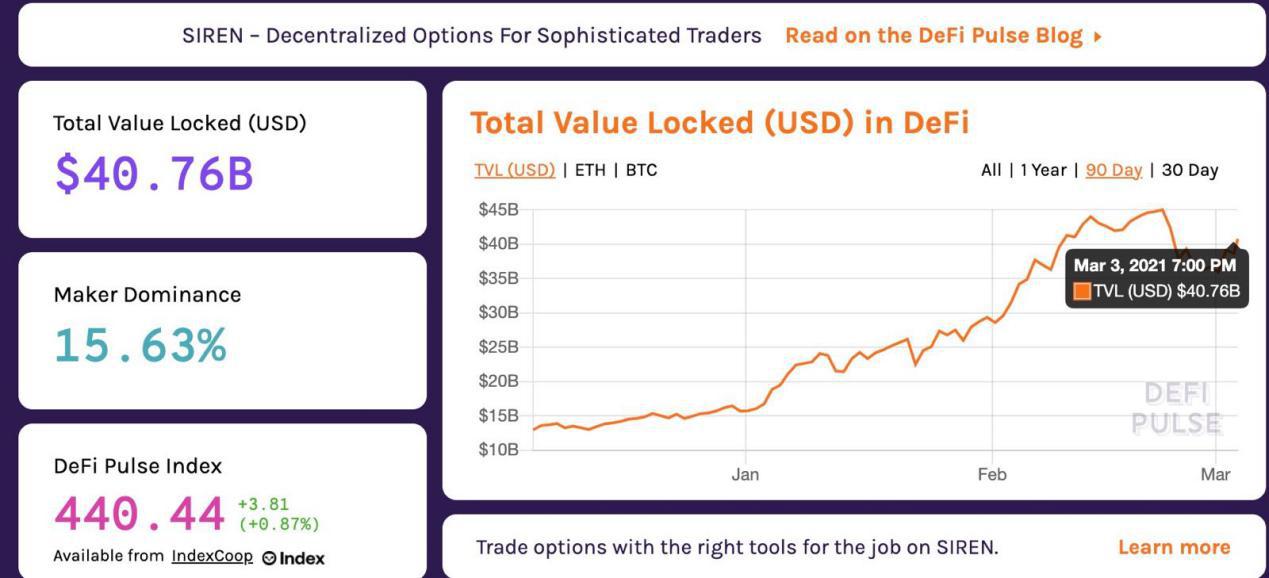
According to the latest data from DeFipulse, the total TVL of all DeFi projects is currently $40.76 billion, while the total market capitalization of the entire cryptocurrency market is $1.6 trillion, but there are still a large number of crypto assets that have not entered DeFi. In 2021, DeFi will further explode.
Regarding the development direction for the coming year, the combination of DeFi and NFT, the custody of DeFi assets, and the entry of traditional institutional assets into DeFi are relatively clear directions.
Additionally, there is the derivatives sector, from swaps, forwards to futures and options. The underlying assets include interest rates, equities, foreign exchange, commodities, and other asset products. There is a need for balancing position risks, liquidity, hedging, leverage, and other investment portfolios and liquidity management. In traditional finance, the trading volume of derivatives is more considerable than that of spot trading.
Yu Wenqing: The speed of DeFi's development in 2020 was very fast. The first intuitive manifestation was a significant increase in TVL, and the number and variety of DeFi projects experienced explosive growth; Leslie just showed some data. However, during this process, many new phenomena emerged, such as the interactivity of high-density contracts, high-frequency on-chain and off-chain, cross-chain interactions, and issues related to performance and costs.
Therefore, some common problems that emerged last year naturally became the competitive themes of various DeFi sectors in 2021, such as performance and costs, leading to expectations for ETH 2.0, Layer 2, and high-performance public chains; the demand for oracles combining on-chain and off-chain data, and so on.
I am not very good at the secondary market, so I won't express too many opinions, but regardless of the sector, the leaders will definitely have great potential.
Chain Catcher: We know that the original intention of DeFi is to lower financial thresholds and achieve inclusive finance. In the recently hot market, due to the congested Ethereum network and high Gas fees, inclusive finance has turned into finance for the wealthy. How do you view this phenomenon? Can the controversial EIP-1559 effectively solve this problem?
Leslie: EIP-1559 is something everyone is already aware of; it is a transaction pricing mechanism that includes a fixed network fee for blocks, which will be consumed to dynamically expand or contract block sizes to cope with transient congestion. The implementation result is that transaction fees become more predictable for users on the Ethereum network.
The recent Gas fees are indeed a headache. When chatting with some community users about DeFi mining and decentralized exchanges, I found that apart from a small number of DeFi users, there are still many users willing to use CeFi, partly due to concerns about asset security and partly due to the high Gas fees.
When we hope to attract a large number of users, especially ordinary users outside the circle, the interest rates of DeFi attract them, but the Gas fees of dozens or hundreds of dollars per transaction deter the vast majority of ordinary users.
The Aave team supports the implementation of EIP-1559 to improve the user experience of transactions on the Ethereum network. The implementation of EIP-1559 is what DeFi projects and Ethereum developers hope to see. In the long run, it can solve the underlying problems of user experience and make transaction fees more predictable. Burning transaction fees will correspondingly reduce the total amount of ETH, which also improves the economic model.
For miners, it does reduce their income to some extent; reforms will always involve the interests of one party.
Yu Wenqing: The issue of Ethereum Gas fees is a result of competitive games; faster speeds and lower costs are the trends for the future development of public chains.
Currently, there is significant community controversy caused by EIP-1559, mainly because miners believe that EIP-1559 will affect their mining income, while other community members believe that EIP-1559 can solve some of the Gas cost issues.
I think this controversy is precisely a normal reaction of the blockchain game mechanism. The goals of high performance and low costs are certainly important, but how to approach these goals is even more crucial for blockchain.
For Chainlink, we welcome anything that is beneficial to the development of the industry. If a series of community games like EIP-1559 can guide Ethereum towards a decentralized financial platform that can support larger scales and security, it would be a good thing for the entire DeFi ecosystem.
At the same time, I personally hope that this controversy can become an opportunity for ETH to break historical limitations. After all, in the long run, if this controversy can be resolved well, it will be very beneficial for the Ethereum ecosystem; if the controversy leads to more significant problems, then this controversy will also be very valuable for the development of the entire blockchain.
This view may lean towards Darwinism, but at any time, the breakthrough development of blockchain is not achieved through unilateral human intervention, but through the power of trends.
Chain Catcher: Recently, there have been reports that the Optimistic mainnet will launch in March, but even after Layer 2 solutions are implemented, how DeFi protocols attract liquidity migration is still a question. Starkware has adopted a liquidity incentive model, and users are also curious whether Layer 2 will bring a new wave of liquidity mining. What do both of you think about this issue?
Yu Wenqing: I personally have high expectations for Layer 2. I believe Layer 2 (and some high-performance public chains) can provide a larger platform for existing DeFi.
In terms of Layer 2, Chainlink has also made a lot of efforts. First, Chainlink is currently integrating a large number of Layer 2 and various high-performance public chains, such as Matic, xDai, BSC, Near, Polkadot, Optimistic, Starkware, and Arbitrum, etc. In the future, Chainlink will integrate into all Layer 2.
Regarding the issue of liquidity migration to Layer 2, this is indeed a problem that DeFi applications will face now; liquidity is the lifeblood of DeFi. Chainlink has also made various efforts to support various DeFi, such as providing high-performance price feeds for Layer 2 derivatives projects; achieving cross-chain assets through Proof-of-Reserve; and even implementing cross-chain computational tasks through deep integration with Layer 2, etc.
As for mining, it has become a popular and effective incentive tool for helping DeFi cold start and growth since 2020. In a future with better performance and lower costs, the form of mining may also change.
For example, is it possible in the future to stake on Layer 1 and participate in DeFi application interactions on various Layer 2? Is it possible that my stake in Aave is an abstract concept, and you can use it across multiple chains through a cross-chain certificate? These are all things we can imagine.
Leslie: We are already seeing projects like Aavegotchi migrating to Layer 2 Matic, and Aave is also referencing other Layer 2 solutions. The community will soon see some of our solutions on Layer 2.
The migration of Layer 2 implementation will become a main theme for DeFi projects this year. For example, Optimistic has implemented EVM in its contracts, using a built-in virtual machine to run contracts step by step. The migration further reduces the cost of user participation in DeFi and has a certain usage threshold.
Additionally, Optimistic is still in the mainnet testing phase and cannot fully guarantee its security and system stability. The Layer 2 version of Synthetix previously encountered technical failures with Optimistic, but fortunately, there was an upgrade network for repairs. The migration to Layer 2 still has certain uncertainties.
Moreover, whether Layer 2 supports interactions with smart contracts, asset migrations, and nested structures remains unknown. It is not ruled out that before Layer 2 is fully developed, some communities may call for liquidity mining to encourage employees to use the Layer 2 version when urging projects to migrate to Layer 2.
Liquidity mining itself can be an effective means of supplementing liquidity and is also a fairer and more effective token distribution mechanism. Personally, I am optimistic about Layer 2 in the long term, but I want to observe more in the short term.
Chain Catcher: DeFi is known as financial Lego, and composability is the most fundamental characteristic of DeFi. With the development of Layer 2, more and more DeFi are adopting Layer 2 solutions. How will the composability of DeFi change? How will protocols achieve interoperability if they adopt different Layer 2 solutions? (Liquidity dispersion)
Yu Wenqing: Interoperability between Layer 2 is somewhat similar to cross-chain interoperability. The underlying infrastructure for interaction poses a significant challenge. For oracles, in the past on a single chain, many price oracles that formed price convergence through two-way collateral arbitrage will face significant challenges in a "multi-chain" state.
Conversely, for Chainlink, we not only deploy customized Chainlink nodes based on various high-performance public chains of Layer 2 but also provide verifiable secure data services from different dimensions based on DeFi application scenarios. In short, the pattern of the underlying infrastructure layer will be very different in the future.
Leslie: Currently, there are still some issues with composability and interactivity of DeFi on Layer 2. Some Layer 2 solutions do not yet support smart contract interactions, such as ZkSync. Assets on Layer 2 and Layer 1 cannot migrate and nest between DeFi.
The interoperable solutions at the protocol level (like Aave, Uniswap, etc.) and the L2 technology layer (like Optimism, Starkware, etc.) are currently being researched. The operability of Layer 2 is not the biggest issue at present. The composability within a single transaction, like flash loans, will become less frequent in the future, with more solutions through cross-chain bridges, state channels, etc.
Each Layer 2 has its own solution and may only have activities occurring there. For example, the interest rate of a certain protocol on Layer 2 may differ from the interest rate of another Layer 2, and the interest rate of another Layer 2 may differ from that of Layer 1. We are still looking forward to more complete solutions.
Chain Catcher: The congestion of Ethereum has led to the overflow of DeFi and has also caused the popularity of some exchange public chains. The daily trading volume of Mdex on the Heco chain and Pancake on BSC has surpassed that of Uniswap. Recently, 1inch also announced that it will migrate to Binance Smart Chain. Does Aave have plans to migrate to other public chains in the future? What layouts does Chainlink have on exchange public chains? How do you view relatively centralized exchange public chains like BSC and Heco?
Leslie: Currently, Aave is still on Ethereum, and we also support the implementation of EIP-1559 to improve user experience, etc. We will continue to observe other public chains, such as BSC and Heco.
There are significant changes happening on exchange public chains and other public chains, with superior performance and accumulated capital flow. Especially BSC and Heco, leveraging their traffic and capital, quickly built an exchange public chain ecosystem. We look forward to seeing more efforts towards decentralization from exchange public chains in the future.
Yu Wenqing: BSC has already completed the integration of Chainlink, and Heco is also in the process of integration, which should be on the mainnet soon.
In the short term, exchange public chains do have certain advantages in performance and cost, especially during the recent ETH congestion when costs were extraordinarily high, while Layer 2 high-performance public chains were still in their infancy, leveraging their superior user base to attract a lot of speculative capital and attention;
But in the long run, Layer 2 high-performance public chains still need to invest more energy in security and decentralization. Whether exchange public chains can achieve true decentralization will be a key measure of long-term success.
Chain Catcher: Aave's pioneering flash loans not only make liquidations more efficient but also greatly enrich the use cases of funds. However, several significant thefts last year were primarily due to flash loan attacks that manipulated oracle prices. Could you both discuss how DeFi protocols can better safeguard user assets? Will flash loan attacks be effectively prevented and avoided in the future?
Leslie: Flash loan attacks can largely be avoided, and this is related to excellent oracles. In this regard, protocols and oracles should first learn to defend against flash loan attacks.
Flash loans are an innovative tool that allows people to borrow without collateral. Currently, flash loans are still a borrowing tool for developers. The various data of the Aave protocol can be viewed at https://aavewatch.com/, and the data has been verified by The Graph and Fetch. The flash loan volume of V1 is $2.076 billion, and the total volume of flash loans in V2 after three months of launch is $2.1 billion.
The reasons for flash loan attacks: some projects that were attacked used price feed systems from a single node or directly used the price of a single exchange for pricing. Aave uses Chainlink, which brings more nodes and resources for asset pricing.
There are indeed some methods to avoid flash loan attacks, such as comparing blocks to ensure that transactions are not executed within the same block.
Yu Wenqing: Flash loan attacks have been one of the main attack methods since the DeFi boom last year. First, let's talk about flash loans themselves; the original intention of flash loans is not bad. To some extent, flash loans have high on-chain liquidity value.
For example, many users use flash loans to arbitrage between multiple DeFi, allowing asset prices in various DeFi applications to converge to "market fair" prices. By arbitraging with flash loans, financing costs and operational errors can be reduced.
Aave's flash loans were implemented relatively early and have always maintained high quality, but when the mechanism design of DeFi applications or the underlying infrastructure's flaws are exploited, flash loan attacks become amplifiers for hackers to conduct targeted explosions.
However, this is not an issue with flash loans themselves. For example, the pricing mechanism has been exploited for a long time, with some price oracles that converge prices through collateral arbitrage frequently being attacked by flash loans, causing price decoupling and subsequently attacking the liquidity pools of the DeFi applications associated with those trading pairs, repeatedly succeeding. This is why Chainlink oracles, with their relatively independent mechanism, can better ensure the safety of funds.
Chain Catcher: Chainlink and Aave are now both projects within the top 20 by market capitalization, becoming the most important infrastructure in the DeFi ecosystem. What plans do you have to further enhance the ceiling or imagination space of your ecosystem? Are you considering vertical integration like AC?
Leslie: Integrating Aave with more DeFi projects, CeFi projects, and institutions has always been an effort of the Aave team. Currently, Aave has been integrated into over a hundred applications, and this month Aave just integrated with Hex Trust. Hex Trust has integrated AAVE, stkAAVE, and aToken into its institutional-grade custody platform, Hex Safe.
Through this integration, institutional investors can safely hold tokens in the Hex Trust market. Hex Trust is fully compliant and protected, making it one of the safest platforms in the market.
Hex Trust has also integrated the Aave protocol into its new DeFi module, allowing institutional clients to borrow a range of digital assets directly from within Hex Safe. This is a way to bring institutional-level applications into the fold.
Aave is collaborating with Balancer to build a fund manager within Balancer, allowing funds in Balancer to earn passive income using Aave. Matrixport has also integrated with Aave, enabling their users to directly use the Aave protocol for deposits, loans, etc. Moving forward, connecting CeFi to bring in institutional partners and allowing more users to seamlessly use DeFi products will be one of our directions.
It is particularly worth mentioning that Aave is funding various developers, providing support for DeFi, NFT, and other projects in terms of technology and funding, and is also promoting more integrations of Aave to form a vast Aave ecosystem.
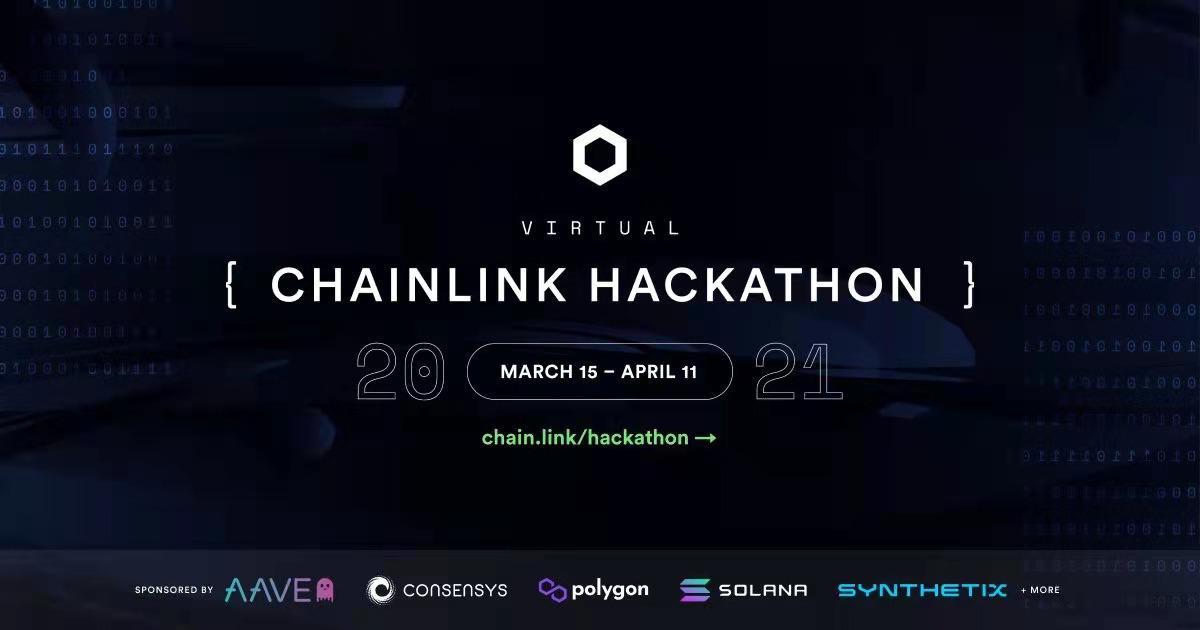
We also sponsored Chainlink's Spring Hackathon, where developers can receive funding and guidance from the Aave and Chainlink teams, hoping to turn more excellent developers' brilliant ideas into reality.
Yu Wenqing: Chainlink is doing a lot of things, such as integrating various Layer 2 high-performance public chains, ensuring that DeFi can use secure oracle services wherever it goes.
Secondly, Chainlink is also expanding the definition of "oracles," from basic price feeds, verifiable randomness, collateral proofs for cross-chain asset transfers, to computing execution across chains. The integration of assets is also increasing, not only including crypto but also traditional assets like US stocks, crude oil futures, gold and silver, commodity futures, weather data, and enterprise-level payments, etc. Chainlink aims to provide more possibilities for DeFi.
Recently, Chainlink released a very significant feature worth everyone's attention: Off-Chain Reporting technology. With the massive integration of DeFi, Chainlink's Gas consumption is enormous.
To ensure the security and reliability of price feeds, Chainlink's prices are usually generated by aggregating data submitted by several nodes simultaneously on-chain to prevent errors and malicious actions. However, each node's pricing incurs considerable Gas costs.
Since the beginning of this year, Chainlink has been consuming an average of over a thousand ETH per day, with peak days consuming over ten thousand ETH.
The launch of Off-Chain Reporting will allow data aggregation between nodes to be achieved through threshold signatures off-chain, ensuring aggregation security while significantly reducing aggregation costs. Currently, it is expected that cost reductions will exceed 90%.
Chainlink is also doing a lot of ecological integration work. For example, as everyone knows, Keep3r announced last year that the guardian nodes would be executed by Chainlink. This year, Chainlink will expand the related business as part of the standard services of Chainlink oracles for other DeFi projects. We look forward to it.
Chain Catcher: Teacher Yu, you mentioned at an event that oracles can be a bridge between traditional finance and DeFi, as well as between Layer 1 and Layer 2. Coincidentally, Aave's "Credit Delegation" feature launched last year is about bringing DeFi into traditional finance and the real world. Could you both discuss what problems in traditional finance can be better solved through DeFi? What more exciting application expansions can we expect in the future?
Yu Wenqing: This topic is very broad. Let me provide two application scenarios that I believe can be further improved through DeFi in traditional finance.
First is NFTs. We know that NFTs have been very popular recently, but I believe the real explosion period for NFTs has not yet arrived. If in the future we can bridge physical assets to the blockchain through various methods of value anchoring in NFTs, then the market that NFTs can carry will be enormous.
Another issue is privacy. Due to the "institutional dependency" nature of traditional finance, we face an asymmetry in information disclosure, meaning that institutions know, but the public may not, and even you may not know. If blockchain can decouple the financial attributes of data from ownership attributes, then privacy can be truly resolved.
Leslie: I think all the problems of CeFi are the value of DeFi. First, CeFi is just too expensive. If you want to issue an asset, you need to apply to Nasdaq, the Shanghai Stock Exchange, or the Shenzhen Stock Exchange, which takes a lot of time to check various materials.
In centralized exchanges, any asset token's listing requires enormous operational costs. DeFi does not require this at all; anyone can issue assets on Ethereum and trade on DEXs like Uniswap, significantly reducing operational costs.
Secondly, DeFi is permissionless; anyone can operate. In the real world, if we need to borrow, we must provide various guarantees and certificates to the bank, which also requires extensive scrutiny and background checks.
With DeFi, for example, on Aave, we can quickly interact with our wallet and the Aave platform, deposit collateral, and borrow assets conveniently and quickly; anyone can operate.
Thirdly, regarding the utilization of funds, traditional financial institutions, like Yu'ebao, are also combinations, but the degree of combination is insufficient, and the depth is not enough. The interest generated by Yu'ebao comes from Tianhong Fund.
In DeFi, protocols can interact with each other, and LP tokens can circulate between DeFi projects, greatly improving the utilization and liquidity of funds, which is also one reason for DeFi's high interest rates. Improving composability and doing a good job in the mutual penetration between DeFi and CeFi protocols can lead to more profound progress in DeFi.
 Risk warning
 Risk warning



Popular articles





