








Under the trend of multi-chain, how does Paradigm view the development of cross-chain bridges?

 Connext is an interoperability protocol that enables fast, non-custodial cross-chain transfers and contract calls between EVM-compatible blockchains.
As the public chain market enters the "multi-chain era" with many contenders, the demand for cross-chain solutions has become increasingly clear. Whether it's new public chains or Ethereum Layer 2, asset bridges for cross-chain functionality seem to have become indispensable, and the once "cross-chain duopoly" of Polkadot and Cosmos has recently returned to the public eye.
So how has their ecosystem developed? Has the logic changed? What do investors think?
There have been many articles introducing Polkadot and Cosmos, and interested readers can check the historical footprints on 8btc. This article will first summarize the similarities and differences between the two, then briefly compare the development of their ecosystems, and finally present insights from the leading crypto investment firm Paradigm.
First, a brief introduction to these two projects:
Cosmos Network is a decentralized network that connects independently operating blockchains. It is a scalable blockchain ecosystem where the blockchains within its ecosystem can interact with each other, and the digital assets used for transfers in the Cosmos network are called Atom.
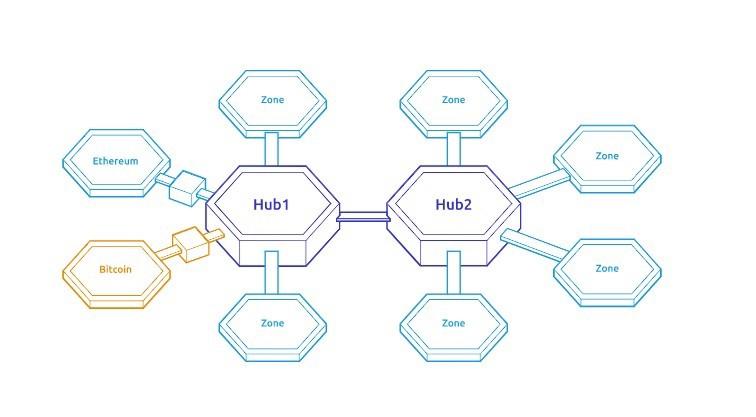
Cosmos uses a main chain called Hub, while other chains referred to as Zones interact with this Hub main chain, but each Zone chain has its own validators.
Cosmos operates a coordination and validation center called Cosmos Hub to ensure the entire system works in harmony. Transactions on the Cosmos network use the Tendermint algorithm for validation through a proof-of-stake (PoS) mechanism. Applications using the Tendermint core communicate with the Cosmos Hub via the Application BlockChain Interface (ABCI), and the Inter-Blockchain Communication (IBC) protocol mediates the transfer transactions between blockchains by connecting the zones and the network center (hub) linked to the Cosmos Hub.

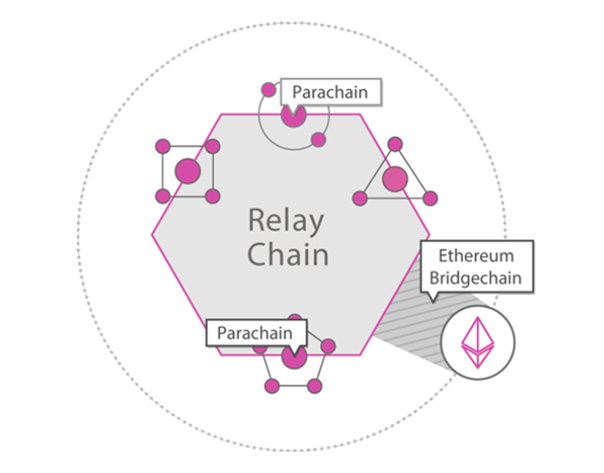
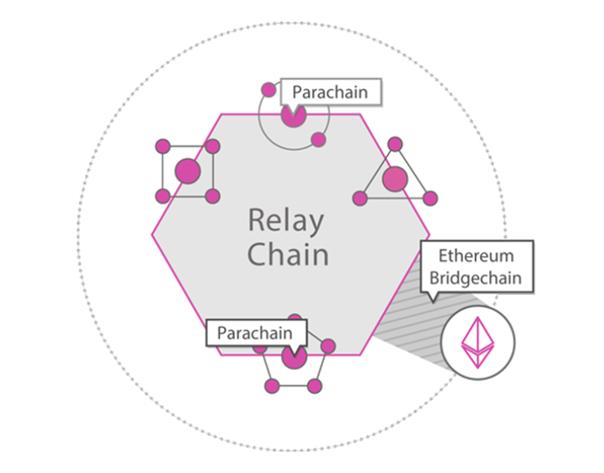
Polkadot, on the other hand, is built on a relay chain, where all validators operate on this main chain, and parachains work on the main chain. Additionally, data and assets can be transferred between bridge chains and blockchains like Bitcoin.
To understand the basic working structure of Polkadot, one must first grasp a few concepts. The first is the Relay Chain, which is the relay blockchain connecting all independent chains. This allows them to organically address interoperability issues between these blockchains. The second concept is Parachain, which refers to the parallel blockchains running on the Polkadot network. These help scale the system by parallelizing transactions. The last concept is Bridge Chain, which is used to connect different blockchains that do not use the Polkadot governance protocol. The following diagram illustrates the workings of Polkadot.
Design Differences Between Polkadot and Cosmos
Next, let's briefly discuss the differences between Polkadot and Cosmos. Note that this refers to past situations, and changes may occur in the future.
Polkadot focuses on shared security, while Cosmos prioritizes interoperability.
Membership in the Cosmos network has no fixed rules; anyone can establish a Zone or Hub.
Polkadot blockchains can be updated without hard forks, whereas enhancements and improvements to Cosmos blockchains require forks.
Although both Polkadot and Cosmos have designs for staking tokens to earn rewards, their token economics are entirely different.
The native token ATOM of the Cosmos ecosystem is staked to secure the Cosmos Hub, and stakers receive transaction fees as rewards. Besides governance and collecting transaction fees, ATOM has not yet been assigned other functions, and independent blockchains within the ATOM ecosystem can use their own tokens (like Terra's Luna) without needing ATOM. This initially made it seem that ATOM captured little value, leading to its early token performance lagging behind DOT.
In contrast, all transactions on the Polkadot network are paid in DOT, creating a demand for token fee payments. Another distinction is that Polkadot requires parachains to stake DOT, so if you want a parachain to connect to the relay chain in Polkadot, you essentially need to lock up DOT tokens, creating market demand for DOT tokens and locking in supply.
From the design perspective above, it seems there is a reason why Polkadot temporarily leads Cosmos in market capitalization.
So, how have the developments of these two ecosystems fared?
Comparison of Ecosystem Development Between Polkadot and Cosmos
The following diagram is from a recent popular article about cross-chain bridge projects:

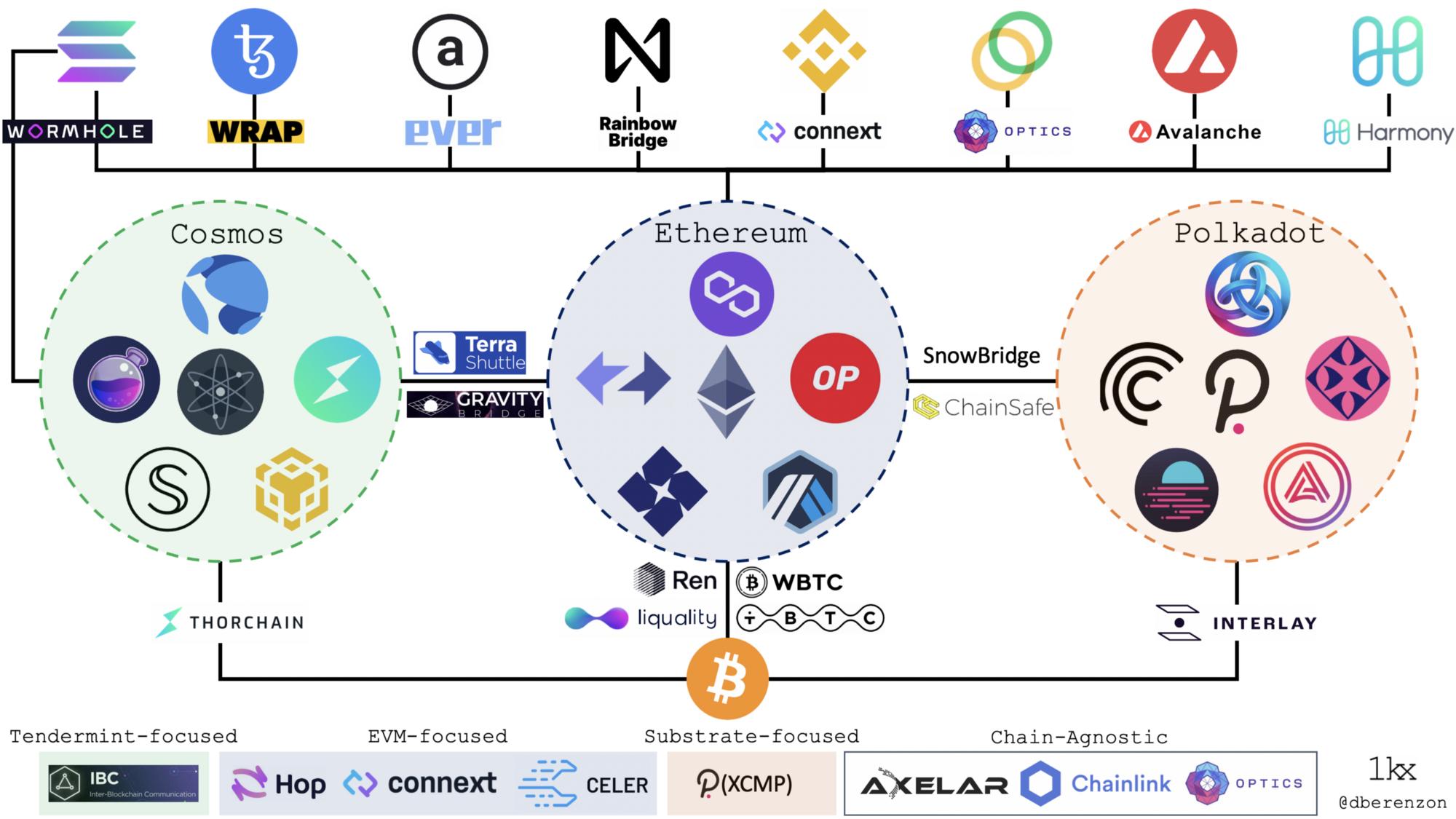
As shown in the diagram, the three ecosystems from left to right are the Cosmos ecosystem, Ethereum ecosystem, and Polkadot ecosystem, with the listed projects representing key projects within each ecosystem.
Here are several representative projects from the Cosmos and Polkadot ecosystems.
Cosmos ecosystem:
- Terra (Luna, circulating market cap of $15.5 billion);
- Thorchain (RUNE, circulating market cap of $2.66 billion);
- Osmosis (OSMO, circulating market cap of $1.19 billion);
- Secret Network (SCRT, circulating market cap of $300 million);
- Binance Chain (Note: There is significant debate over whether Binance Chain should be included in the Cosmos ecosystem. Although Binance Chain is built on the Cosmos SDK and Tendermint fork, Binance's current focus is on Binance Smart Chain, i.e., BSC.)
Polkadot ecosystem:
- Moonbeam Network (divided into two projects: Glimmer (GLMR) and Moonriver (MOVR), with Moonriver (MOVR) currently having a market cap of $588 million);
- Centrifuge (CFG, circulating market cap of $104 million);
- Hydradx (XHDX, circulating market cap of $51 million);
- Acala (token not yet released);
- Astar Network (formerly Plasm, token not yet released).
Of course, this comparison has some issues because the Cosmos ecosystem mentioned here is actually composed of multiple independent public chain ecosystems.
Insights from Investment Firm Paradigm
Many readers are likely very familiar with Polkadot. Now let's take a look at the views of the leading foreign investment firm Paradigm on the cross-chain battle, with the original text coming from a dialogue podcast featuring Hasu and Paradigm investment partner Charlie Noyes and research partner Georgios Konstantopoulos.
Hasu: As we know, Paradigm is a strong supporter of Ethereum. Overall, besides Bitcoin, Ethereum is the only "other" blockchain you have supported. But there is one exception, which is Cosmos. So, Charlie, can you talk to us about your investment thesis on Cosmos and what you see? How does it compare to Bitcoin and ETH?
Hasu: So, what would you do with Cosmos? I would love to hear one or two examples of applications that are particularly suited for use on Cosmos rather than built on Ethereum.
Charlie Noyes: Yes, so maybe there are a few different examples. I think, for instance, Cosmos Hub and some other Cosmos zones, these blockchains have DEXs that operate like batch trading, where transactions are enforced in batches for every block. This is essentially a transaction ordering constraint that is application-specific and affects front-running transactions. And this dynamic cannot be achieved on Ethereum, at least not today, without VDFs and some other fancy tricks. I think this will be an obvious example that Cosmos makes possible.
Hasu: Okay, but you are indeed giving up a lot in return, right? So, suppose you built a DEX on a Cosmos application chain. Is there a simple way to explain how you might use assets from other application chains on Cosmos, like the Cosmos Hub?
Charlie Noyes: Yes, so Cosmos provides us with the first general interoperability protocol we see in the crypto space, essentially called IBC (Inter-Blockchain Communication protocol), which can be applied to any blockchain with finality and efficient light client proofs. Therefore, most PoS blockchains in Cosmos, Ethereum-based blockchains, etc., can adopt IBC and use it to achieve various interoperability patterns. One of them is that cross-blockchain asset transfers already exist today, so you can think of it as a universal bridge. For example, if I want to build a lending market within Cosmos, I could deploy that application on my own blockchain. Maybe I am the only validator, or maybe I pay some people to help me do this. In any case, any user wanting to send Atom from the Cosmos Hub or Luna from a Cosmos zone like Terra to my lending market can do so by default.
Hasu: You say it is essentially like a universal bridge. How does it work compared to trusted asset bridges (like WBTC)? We all know how trusted asset bridges work.
Charlie Noyes: I have some thoughts on this. First, I think it is best to view IBC as a universal bridge rather than a special implementation, whether they are custodial or not. So, like WBTC, or cross-chain bridges from Solana to Ethereum, or any Ethereum L2 to the main chain, or to BSC, or anything else, they are a bit like special protocols. They have different trust assumptions, some of which are more decentralized than others, while some are more custodial and centralized. But broadly speaking, they are not universal or shared, which makes it difficult to achieve efficient interoperability across various platforms. You often have to route through something like a hub. You end up with multiple versions of the same asset on different platforms, depending on the route you take. In contrast, IBC provides a universal way to establish paired bridges with minimal trust assumptions.
Hasu: Cosmos has its native token ATOM, but building your own application chain using the Cosmos SDK does not require using ATOM, and there is no need to adopt IBC when communicating with another blockchain in the Cosmos ecosystem. So one thing I often hear is that the value proposition of ATOM essentially comes from the Cosmos Hub, which is a special zone within the ecosystem. Can you talk about what the basic investment thesis for Cosmos Hub is?
Charlie Noyes: The Cosmos Hub itself is not particularly special, but perhaps that is what makes it special. Unlike any other project, the Cosmos Hub does not enjoy special rights to the protocol; it shares equal status with any other zone. It does have some natural centrality or natural selling point for protocol development. So today, I would say that in the medium to short term, the Cosmos Hub plans to provide certain functions that require a high degree of trust and credible neutrality. Some of these examples will become bridges like Ethereum and Bitcoin. Then in the future, one can imagine that the Cosmos Hub will adopt a shared security model and move towards a final state that may look similar to ETH2.0-based rollups or Polkadot's main chain, but the mechanism has yet to be determined. They decided to build the rest of the protocol on interoperability specifications first rather than starting like a main chain. So it is just a different approach.
Hasu: What do you mean by shared security?
Charlie Noyes: Well, in the literal sense of shared security, like many blockchain protocols, it starts from a general execution environment where anyone can deploy applications, or in the case of Polkadot, sorry, in this case, they share the same security to some extent. The security of all applications on Ethereum is unified across the platform. There are other examples of blockchains, like Polkadot, which, although it does not directly provide a general execution environment or smart contract capabilities on the main chain, does provide a built-in auction mechanism that allows different applications to essentially bid to share security with that main chain. You know, this is theoretically a bit like the most trusted validator set and the highest level of security. In contrast to these approaches, Cosmos starts from interoperability rather than from a shared platform or architecture. Then, you know, it will evolve towards a long-term vision like network security topology. So I think they are both working towards possibly the same final state from opposite sides of the problem.
Hasu: Okay, so we establish that applications can use the Cosmos SDK to build their own blockchains, but they are typically PoS blockchains, right? So they need validators to generate security and finality. How will they acquire these validators? I take it your suggestion is that they can essentially buy validators from, say, the Cosmos Hub, but they might also be able to acquire validators from elsewhere?
Charlie Noyes: Yes, I mean, I think it is like a simple and reasonable shared security model. It is like a kind of depth cryptography or incentive design work that does not require life in the medium to short term. I think in the long run, the shared security layer for all cryptocurrency applications or different application ecosystems is an open question of what kind of ideal it would like. You know, there may be different niches depending on their use cases. It looks like whether this is a general execution environment, whether it is a sharded execution environment, whether it is something like ETH2.0 centered around rollups, or whether it is like Polkadot, you know, its parachain slot auctions, and things like that, these people may experiment with multiple different models. The first might be leasing validator sets rather than something similar, around which more direct incentive engineering could be built.
Hasu: So what does that mean? I have my application chain, I need validators, and I am looking to the Cosmos Hub. Essentially, they have staked their ATOM, and then I say, please validate my blockchain, and essentially ATOM would face the risk of double staking, right?
Charlie Noyes: Yes, it is essentially shared slashing risk. I mean, there are various different models, like you can imagine, one is purely social, meaning if a validator on the Cosmos Hub, or a group of validators on the Cosmos Hub validates your blockchain, or you pay them to do so, they could become malicious. This would have social consequences, and honestly, I think this is not much different from assumptions like weak subjectivity, etc. But you can go further; you can actually tie their slashing conditions together. If those validators, you know, violate or like perform invalid state transitions on your blockchain, then they would also be slashed on the hub. You can directly link the incentives. And there are very broad potential protocols. In this case, I think many of them may make sense in many different environments. And the Cosmos Hub is like an interesting tool they use for exploration.
Hasu: Yes, it is interesting to consider such a blockchain, you know, validators are not getting paid… they are not staking the native tokens of the blockchain. So it feels like their motivation to keep the blockchain healthy might diminish if they do not hold the relevant tokens, meaning they are not betting on the blockchain.
Charlie Noyes: I am not sure I fully agree with that. But in this regard, it is an incentive security issue, and any shared security layer, whether it is a general execution environment or a directly rented environment, is so. I think this might be more like a general comment on non-application-specific security layers.
Hasu: Perhaps a more important point is, you know, this is just the application layer idea, does this not force application developers to also become protocol developers?
Charlie Noyes: Well, I think they have been forced to become protocol developers, I mean, in practice.
Hasu: Is that because they have to understand all the properties of the blockchain they are building, or why is that?
Charlie Noyes: Well, they have to understand all the properties of the blockchain they are building, like building on Ethereum does not exclude MEV, or you have to do something to prevent your application from being exposed to MEV, or other things like communication layers. Just like we have all the infura stuff, you know, we now have various different private storage pools and things like that. So application developers might have to consider them, and if they choose not to, it would be harmful to users. Therefore, I think they have been somewhat forced to become protocol developers, and many of them might want more control over their environment.
Georgios Konstantopoulos: I agree with what Charlie said. I think one underestimated aspect of the Cosmos ecosystem is the SDK, which allows you to build these blockchains very easily. You can use all the community-made modules to provide the very common functionalities needed when building a blockchain without having to rebuild them yourself.
Charlie Noyes: Yes, and you know, I might get in trouble for saying this, but even if you do not like this Cosmos investment thesis, and you do not want to build a Cosmos-based blockchain, there are still many parts of the protocol that could be added to everything in crypto, like IBC as a universal communication layer. It is an interoperability protocol that should essentially be adopted by everyone. Just like every blockchain, so I think when you reconstruct the conversation in this way, you might start from some small programs, some applications wanting to build their own blockchain or have their own blockchain and protocol design, and if your answer is "yes," then Cosmos might be your best choice right now.
Georgios Konstantopoulos: Likewise, I think ultimately having a Solidity contract or Ethereum precompiled to accept IBC-type messages would be valuable for us.
Charlie Noyes: Yes.
Hasu: Oh? What would be your way of using IBC on Ethereum? Right now?
Charlie Noyes: Right now, every L2 and every non-Ethereum platform has its own cross-chain bridge. If you adopt IBC, then it does not need to be that way. Any protocol can use IBC, so these are likely to be replaced by IBC as a universal standard.
Hasu: Is this really feasible, Georgios?
Georgios Konstantopoulos: I think for all existing rollup systems, they either do not have interoperability protocols or are currently planning to communicate with each other. They either have to roll out their own custom products or follow some message format. Or they can try to leverage one of the existing standards. I think using IBC would be a good choice. Likewise, I think it would be valuable to adopt IBC on the XCMP protocol currently used for interoperability with the Polkadot ecosystem.
Hasu: Would this be a case of "there are 20 different standards? This is unsustainable, so let me create the 21st standard"?
Georgios Konstantopoulos: I think not. This is the first or second interoperability standard. My point is that this should be the sole goal of chain communication?
Hasu: Then why have none of the Ethereum L2 projects adopted IBC now? What are their thoughts?
Charlie Noyes: I mean, it is just relatively new.
Georgios Konstantopoulos: Because there is too much to do and too little time. As Charlie said, as a protocol, it is still very new.
Hasu: How difficult would it be for existing L2 projects to tear down their protocols and adopt IBC?
Georgios Konstantopoulos: I think it would be trivial because you would implement it as a smart contract. That is the beauty of using smart contracts. They do not need to change the protocol; you just need to define it in your smart contract to achieve whatever functionality you want. Well, for IBC, it is more or less just a message format and some validation rules about that message format, that’s it. Then you might need to adjust your client code based on how they interpret those messages. But I do not think this is a big overhead, assuming you have a clear semantics for the protocol.
Hasu: If we accept this idea and think that IBC will be adopted by more blockchains in the future, what impact will this have on the Cosmos ecosystem? Will the boundaries just disappear? Or what will happen?
Charlie Noyes: I think there is a high likelihood that the boundaries will disappear. I mean, some people joke that everything is a Cosmos chain. This is not really a joke. Because Cosmos does not grant any chain privileges, as we said, there is nothing special at the center. Ethereum is the same way; if Ethereum or any application developers on it decide to support IBC and interoperate in this way. I think, once again, philosophically speaking, if Cosmos is effective, yes, it will not have boundaries, and it will interoperate between different blockchains in a reasonable and practical way for the first time without needing a bunch of special middleware. And I think this is not a matter of dissolving the boundaries of Cosmos but rather dissolving the boundaries between all blockchains.
Hasu: So investing in Cosmos is like betting on the globalization of blockchains?
Charlie Noyes: Yes, certainly.
Hasu: I guess this does not grant any blockchain privileges, but what about Bitcoin? I mean, can Bitcoin adopt IBC? Or will it never?
Charlie Noyes: No, no, I naturally hope Bitcoin can choose to adopt IBC through something like precompiles. But Bitcoin will almost certainly never choose to do so. I guess there is close to a 0% probability, you know, Bitcoin is unlikely to support smart contract functionality. You know, the uniqueness of Bitcoin is that it does not have finality and cannot understand the consensus mechanism and messages of remote blockchains, so it cannot adopt any interoperability protocol. That is why every Bitcoin cross-chain bridge you see basically needs to be built like crypto, either custodial or needs to build crypto-economic incentives to protect interoperability patterns, just like in remote blockchains. For example, in the case of WBTC, it is clearly custodial, while KEEP's model uses collateral. But it is worth noting that none of them really involve Bitcoin. All of this is scaffolding built around Bitcoin because the Bitcoin protocol is blind to the world around it.
 Risk warning
 Risk warning




Popular articles





