








A Detailed Account of BUSD's Four-Year Ups and Downs: The Ambitions and Regrets of a $15 Billion Stablecoin Empire

 Backed by the world's largest exchange, the "Libra heir" has gone from zero to a billion and then to tens of billions in just four years, and has hurriedly launched a stablecoin in response to rumors, entering the competitive arena.
Written by: Jack, Blockbeats
On the 14th of this month, the New York State Department of Financial Services ordered the crypto financial institution Paxos Trust Co. to stop issuing more BUSD Tokens, marking the end of the reign of a stablecoin giant that once ranked among the top three by market capitalization. This "heir to Libra," backed by the world's largest exchange, went from zero to billions in just four years, and with a single rumor, hastily entered the competitive stablecoin arena. Let’s take a moment to review the rise and fall of this "prosperous crypto world."
Morning Star
On the afternoon of August 19, 2019, Binance released an important announcement, declaring the launch of the "Morning Star Project" (Project Venus). The aim of this project was to create a "regionally autonomous version of Libra," referring to Facebook's once-large stablecoin payment plan.
Venus is the guardian star of Libra, and the straightforward name of the project reflects Binance's evident ambition. In the announcement, Binance pointed out that although Libra ultimately failed, its concept was rapidly spreading worldwide, and governments should establish the strategic position of blockchain and digital stablecoins as soon as possible, creating sandbox mechanisms and allowing private enterprises to issue digital stablecoins.
The announcement did not mention the operational details of the stablecoin plan but repeatedly encouraged partners from various fields to join its camp. To attract more partners, Binance also announced that it would not use the BSC chain as the ecological foundation for this stablecoin. It is clear that the Morning Star Project was not a technological innovation like Libra; Binance had already learned from it and shifted its focus to regulation and compliance.
In the same year that the Morning Star Project was announced, Binance found its ideal compliance shell—Paxos. Paxos is a financial institution and technology company based in New York that had previously issued stablecoin assets such as USDP and GUSD, all of which received regulatory approval from the New York State Department of Financial Services (NYDFS), demonstrating impressive compliance performance.
In its collaboration with Binance, Paxos acted as the issuing entity for BUSD on Ethereum, with BUSD being an ERC-20 Token issued on Ethereum, and its reserves stored in Paxos's U.S. bank accounts. After BUSD was launched, the NYDFS quickly approved it, making BUSD another stablecoin project approved by Paxos after GUSD and PAX.
Having broken through regulatory hurdles, Binance wasted no time and accelerated the Morning Star Project to new heights:
- On March 10, 2020, in less than a year, BUSD's market capitalization reached $100 million. On August 6 of the same year, BUSD was again included in the NYDFS-approved green list.
- In January 2021, in less than two years, BUSD's market capitalization surpassed $1 billion, overtaking competitors like USDP and TUSD.
- In September 2022, despite the crypto market having turned bearish, BUSD remained unaffected, with its market capitalization once reaching $20 billion, a 20-fold increase in two years.
From then on, BUSD, along with USDT and USDC, became one of the three pillars in the stablecoin space. However, despite BUSD's remarkable achievements, Binance's ambitions for it were far from over. After all, reaching the moon is merely a starting point compared to Venus.
Crypto SS
Shortly after BUSD's market capitalization hit $20 billion, Binance announced on September 5 that it would stop using three competing stablecoins: USDC, USDP, and TUSD, officially declaring war on the stablecoin giant USDC.
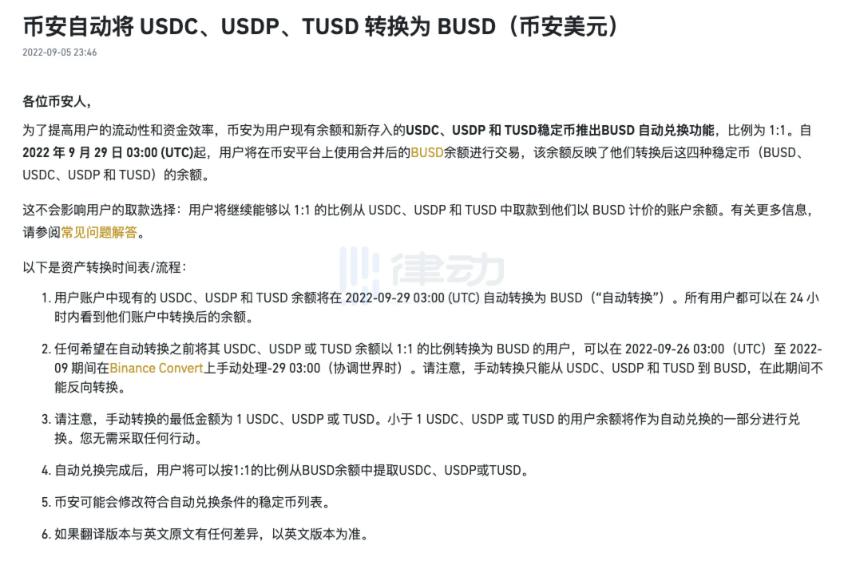
In a subsequent official blog post titled "Setting the Record Straight: BUSD Autoconversion," Binance provided its response:
"The answer is simple: this move is to benefit and protect our users.
…… With a large and growing number of stablecoin options, exchanges have no choice but to split liquidity across too many trading pairs. Let's take BTC as an example. Before the conversion, there were five stablecoin trading pairs for BTC on Binance. Imagine each trading pair as a drinking cup, with the water in each cup representing liquidity. Essentially, the BUSD autoconversion will pour all existing liquidity from USDC, USDP, and TUSD into one cup—BUSD.
This is a logical next step; all BUSD trading pairs will enjoy faster order matching, better pricing, and less slippage, saving users money and time while creating a more stable trading environment. Importantly, users can still use their preferred stablecoins (including USDC, USDP, and TUSD) to enter and exit the Binance platform."
Although Binance's autoconversion included three targets, TUSD's market capitalization was only around $10 billion, and USDP was closely related to BUSD, making USDC the real target of Binance's conversion plan. At that time, USDC's market capitalization was about $52 billion, and as part of the conversion, Binance also had to close its savings accounts, DeFi staking, and lending services denominated in USDC.
The next day, Circle CEO Jeremy Allaire responded on Twitter: "The unified dollar ledger on Binance, FTX, and Coinbase is a good thing for USDC." There was a hint of tension in the air.

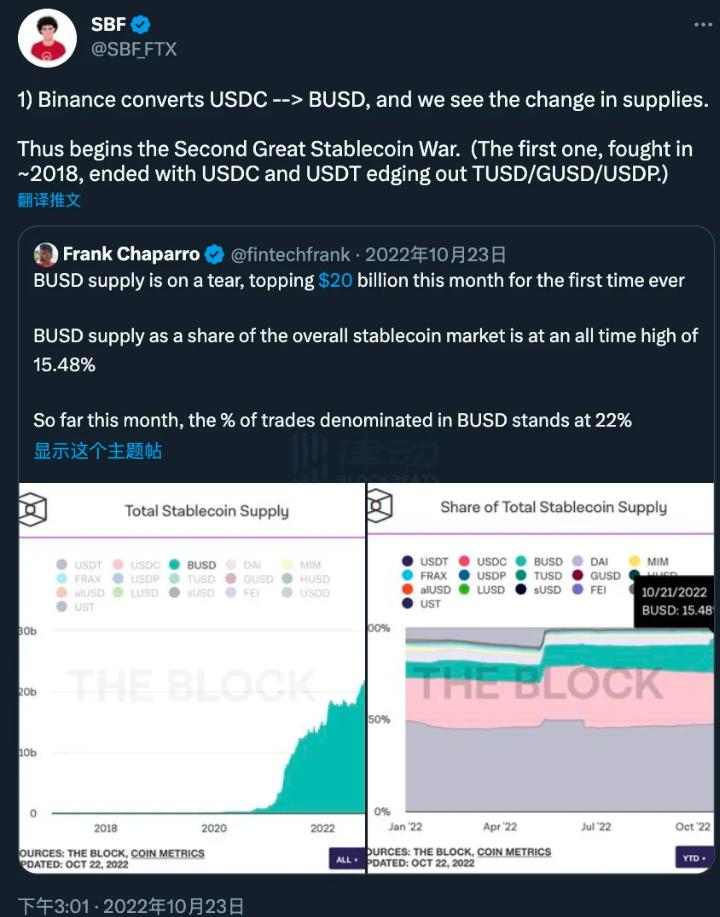
Meanwhile, BUSD's trading volume soared despite the market downturn, reaching a historic high market share of 15.48%, with its market capitalization touching $22 billion. After seeing BUSD's impressive data, SBF, then CEO of FTX, responded: "Binance is converting USDC to BUSD, and then we see the change in its supply. The second stablecoin war has begun."
The successful issuance of BUSD paved the way for Binance to ascend to the "throne of minting rights." After BUSD's success, Binance also minted numerous "B-Tokens" (or Binance-peg) linked to crypto assets like BTC, ETH, and USDC, allowing them to be used on the BNB chain, valued at billions of dollars. These assets are theoretically backed 1:1 by their pegged tokens and are not subject to any regulatory oversight, providing significant operational flexibility. Thus, Binance is gradually building its own crypto SS with its platform advantages.
Just a month after Binance announced its conversion plan, on October 28, Huobi Global issued an announcement stating that HUSD triggered Article 11 of Huobi Global's token management rules and would stop trading HUSD that day, with users' HUSD directly converted to USDT.
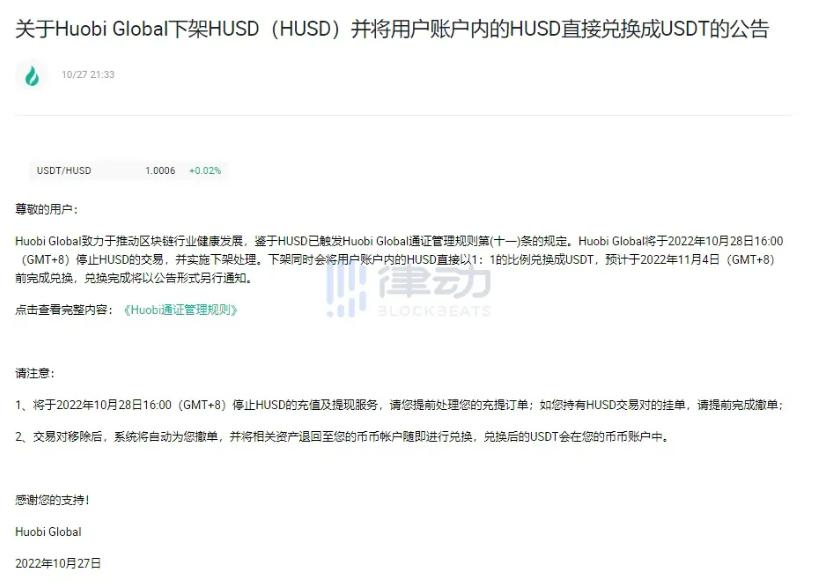
Observant users would notice that HUSD was also a stablecoin project launched in collaboration between Huobi and Paxos, with an issuance exceeding $1.6 billion within a year. In a blog post commemorating HUSD's first anniversary in July 2022, the Paxos team wrote: "Paxos now supports three of the top six stablecoins in the world, and we are proud of that. As the first regulated trust company and qualified digital asset custodian, Paxos has unique expertise in this market."
A month after the commemorative blog post was published, Paxos co-founder Rich Teo was seen dining with Binance CEO CZ at a high-end restaurant overseas, stirring up quite a bit of gossip in the crypto circle. Two months later, HUSD announced its termination, and Paxos became the "full-time steward" of BUSD.

Seeing BUSD's momentum, Circle, backed by Goldman Sachs, also refused to back down. Circle and Paxos "share" a regulatory body, and according to a recent Bloomberg report, Circle had already complained to the NYDFS about Binance's mismanagement of its own crypto asset reserves at the end of last year, implying that Binance did not have enough crypto reserves to back its issued B-Tokens.
A few months later, Binance admitted that BUSD had previously faced insufficient collateral due to periodic over-issuance. Reports indicated that this issue also spread to the B-Token version of USDC, and for a time, Binance had only $100 million in storage collateral to support $1.7 billion of B-peg USDC. Subsequently, Binance also acknowledged its improper practice of mixing pegged assets with user assets in management.
Despite having its own compliance shell, BUSD was quickly hit hard under Circle's strong regulatory advantage.
Hard Landing
On the morning of February 14, The Wall Street Journal cited informed sources revealing that the New York State Department of Financial Services (NYDFS) was investigating Pax Dollar (USDP) and Binance USD (BUSD) issuer Paxos, though the specific scope of the investigation was unclear. Following this, it was reported that the SEC had issued a "Wells notice" to Paxos. Later that afternoon, news broke that the NYDFS had ordered Paxos Trust Co. to stop issuing more BUSD Tokens.
In an email, the NYDFS provided its reasoning: Paxos could not operate BUSD safely and soundly on a fully regulated basis and timely remedy significant issues related to the issuance of BUSD.
Subsequently, Binance issued a statement confirming the news, stating that Paxos Trust Co. had informed Binance that it had been instructed to stop minting new stablecoin BUSD. A Binance spokesperson stated: "BUSD is a stablecoin fully owned and managed by Paxos, so BUSD's market capitalization will only decline over time. Paxos will continue to service this product, manage redemptions, and provide additional information as needed." Paxos also assured that these funds are safe and fully backed by bank reserves.
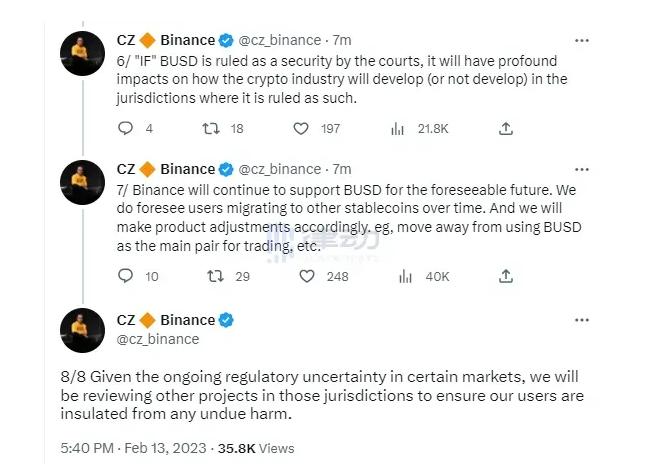
CZ's response was straightforward: "We do foresee that users will migrate to other stablecoins over time. We will also make corresponding product adjustments, such as abandoning the use of BUSD as the primary trading currency," essentially admitting that BUSD's current trajectory was beyond saving.
Market funds reacted swiftly, leading to a chaotic scene where BNB plummeted nearly 10%, and decentralized stablecoin targets like MKR and CRV showed varying degrees of performance, with even UST riding the wave. Meanwhile, the TVL on the BSC chain dropped over 5% in a single day, and the busd v2 pool on Curve experienced imbalances, with large funds betting on arbitrage opportunities tied to the return of the peg.
Event Impact
From a macro perspective, stablecoins are the "invisible hand" in the chaotic world of crypto, wielding hidden power as Layer 0. If the crypto market is likened to "fields," and financial instruments to "canals," then the right to issue stablecoins is the "water source." In a bullish market, market confidence is high, and the water flows smoothly into the fields; in a bearish cycle, liquidity contracts, and the "crypto central bank" also plays a regulatory role.
Whether stablecoin regulation is in place or not appears to be a struggle between compliance and interests, but in reality, it is a power struggle, with the core contention being the market's "root power," namely the right to mint. Given Binance's current industry position, stablecoins are a key component in perfecting its industry ecosystem, and with Binance's influence in the current market, no sovereign financial regulatory body would want to see the emergence of such an uncontrollable ecosystem giant. In comparison, the FUD surrounding BUSD's repayment issues seems somewhat trivial. (Paxos's compliant BUSD is a native Ethereum Token, directly supported by a 1:1 reserve of fiat currency, while all BUSD on the other 31 chains achieve fiat reserve support indirectly through the cross-chain chain of "fiat currency ------ native Ethereum BUSD ------ Binance-Peg BUSD.")
Will decentralized stablecoins like MKR benefit from this? I believe this is merely a short-term manifestation of market sentiment. Due to cost and efficiency issues in the current stablecoin design, they fundamentally cannot support large-scale adoption, as has been evidenced by the market over the years. Users who lose confidence in BUSD will inevitably turn to its competitors. After the news broke on February 14, trading volume for the BUSD-USDT pair surged dozens of times, a trend that will gradually slow down and continue in the near future.
Will USDT and USDC face similar regulatory issues? In any case, speculating on regulatory intentions requires a comprehensive understanding of the actual considerations before and after their decisions. Outside parties often grasp at straws, and sometimes being right does not indicate a true understanding; being correct now does not guarantee it will remain so in the future. It is certain that the first shot was fired at BUSD, not the latter two, which itself indicates a problem; while USDT and USDC are relatively pure issuers of stablecoins, Tether and Circle have very limited influence in terms of market adoption beyond issuance, but BUSD is a part of the overall trading ecosystem, and the three cannot be generalized.
Whether from a regulatory perspective or in terms of user aftermath, BUSD still has enough time to change direction. The experience of growing through regulatory challenges gives us reason to believe that Binance will not abandon stablecoins. As spectators, we just need to wait quietly—perhaps a new BUSD is already in preparation.
 Risk warning
 Risk warning



Popular articles





