








Sequoia and IDG lead the investment, how will dappOS achieve the transition from account abstraction to chain abstraction?

 The dappOS V2 version roadmap includes new features such as unified accounts, task-related order execution, and a brand new bidding system.
Written by: angelilu, Foresight News
The Web3 operating protocol dappOS recently announced the completion of its seed round financing with a valuation of $50 million, led by IDG Capital and Sequoia China, with participation from OKX Ventures, HashKey Capital, KuCoin Ventures, TronDao Ventures, Gate Labs, Taihill Ventures, Symbolic Capital, Foresight Ventures, BlueRun Ventures, Mirana Ventures, Leland Ventures, and others.
dappOS first came to public attention when it was selected for the fifth season of the Binance Incubator in November 2022 and received Pre-Seed investment from Binance Labs in June 2023.
dappOS: An Operating Protocol to Enhance User Usability
Why has dappOS stood out among numerous protocols and attracted the favor of crypto venture capitalists like Binance Labs and Sequoia? Let's first look at what problems it aims to solve.
In the development of the traditional internet, the release of the operating system "Windows 1.0" allowed users to interact with computers through a graphical user interface, ushering in the era of "usability" and laying a certain technological and user foundation for the popularization and vigorous development of the internet. So, what is the key to solving the problem of large-scale adoption of Web3?
There are many possible solutions to the challenges of large-scale adoption of Web3, but from the perspective of the user growth funnel model, the number of users aware of a certain field and the number of users who ultimately enter this field and use its products resembles a funnel, with significant attrition. The user conversion rate, which plays a crucial role, is determined by the size of the "funnel neck." Most people stuck at the "funnel neck" during the expansion of Web3 are deterred by obscure terms like public chains, wallets, and private key assistance. If users can interact without needing to understand or even ignore these concepts, new users will find it easier to get started.
This is precisely what dappOS is doing: establishing a more user-friendly operating protocol that reduces the barriers for users to interact with crypto infrastructure (such as public chains and cross-chain bridges).
dappOS V2 Will Integrate Top DeFi Projects Like Curve
Recent important developments for dappOS include the release of the V2 version roadmap on July 7, which previewed new features such as unified accounts, task-related order execution, and a new bidding system.
The first batch of supported projects in the V2 version includes top DeFi projects such as Benqi, Cheems, Curve, DeFi Kingdom, Frax Finance, GMX, KyberSwap, Lido, Perpetual, QuickSwap, StarryNift, SyncSwap, and SynFutures. After the official release of V2, dappOS is expected to attract more users from these projects, further enriching and expanding the application scenarios of dappOS.
Unified Account Function Based on "Account Abstraction"
Web3 natives already have so many "accounts"; is it still necessary to use a dappOS account? Vitalik Buterin recently proposed that Ethereum must undergo three transformations for broader adoption, including L2 scaling transformation, wallet security transformation, and privacy transformation. Vitalik pointed out that these three transformations will weaken the psychological model of "one user ~= one address" in different ways, meaning that users will have more accounts, accompanied by issues like crypto information transmission and privacy protection, making it increasingly difficult for users to manage their accounts.
The unified account function in dappOS V2 allows users to manage all their assets across all chains with a single account and interact with different applications on different chains, improving the efficiency of fund usage and aiming to achieve "overall consistency in Web3."
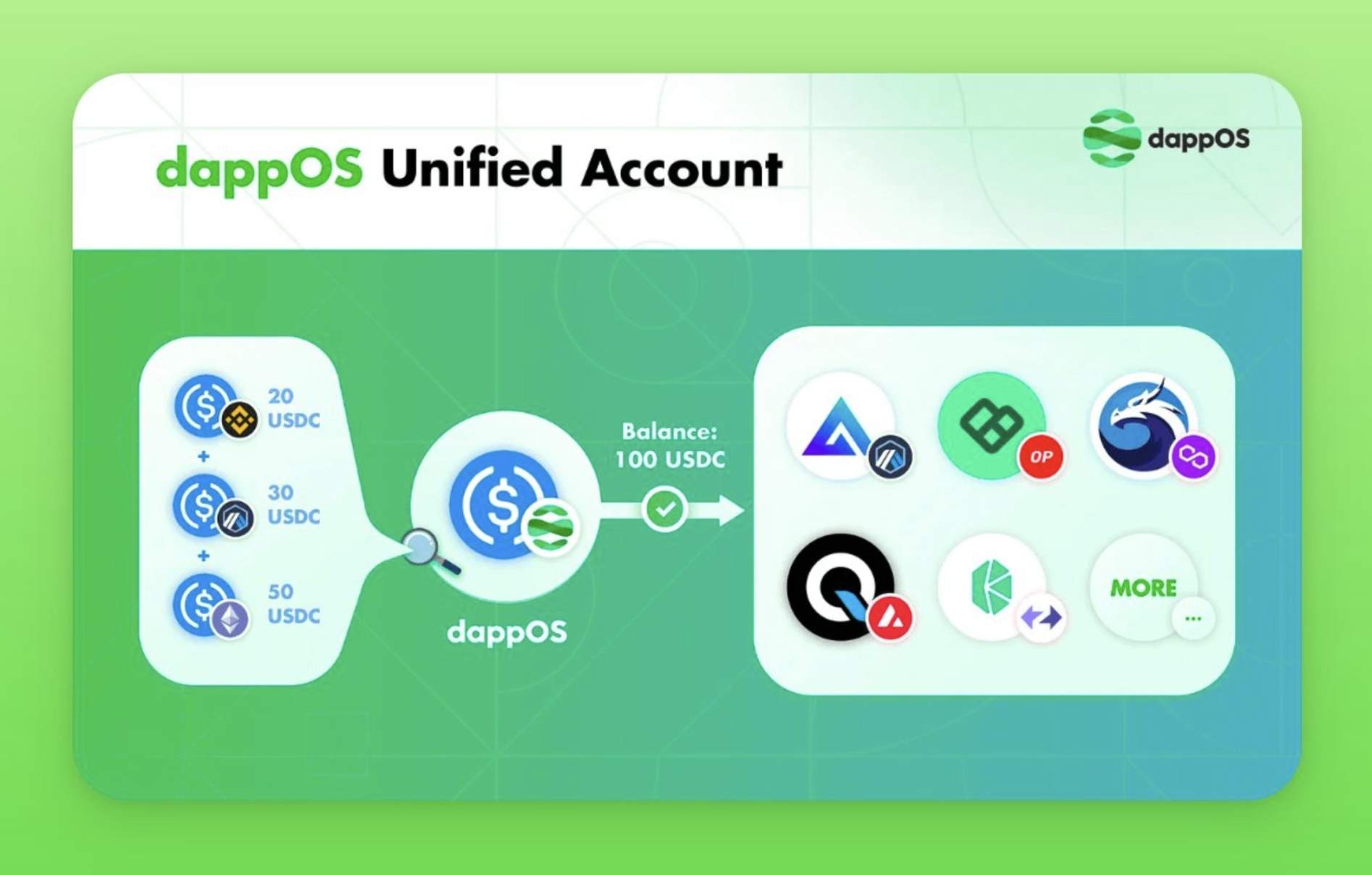
The unified account function of dappOS is based on "account abstraction" technology. At the recent EthCC conference opening ceremony, Vitalik Buterin again mentioned that "account abstraction" is "very elegant" and believes it is the future of smart contract wallets, stating that everyone will switch from current EOA wallets to smart contract-based wallets. If successful, managing a crypto wallet will become as simple as managing an email account. While most people are still trying to understand the intricacies of "account abstraction," dappOS has already built practical applications based on it, allowing users to avoid mnemonic phrases while laying the groundwork for features like gas payment and automated task-related order execution.
From Account Abstraction to Chain Abstraction
"Abstraction" is the core of dappOS's design and the key to its usability. Account abstraction refers to hiding the complex information within blockchain accounts, allowing users to operate without directly encountering addresses, private keys, mnemonics, and other complex concepts. Similarly, the architectural design of dappOS is based on further expansion of account abstraction, achieving "chain abstraction," enabling users to use applications on different chains without perceiving complex operations like which chain they are using, how to cross chains, or how to pay gas, ultimately achieving transaction goals. This provides a smoother interactive experience for both users and protocols.
Unlike the complicated processes in the mobile interactions of most mainstream wallets, users only need to focus on the total amount of assets and can make combined payments on any asset's chain. When interacting with dApps, client users do not need to bear the steps of gas payment, asset bridging, and approval for auxiliary contract interactions; they only need to confirm the total fee and click once to confirm.
At the protocol level, the dApp SDK allows users on chain A to use dApps on chain B without configuring a new wallet and manually operating asset cross-chain, providing a shortcut for multi-chain development for project parties. Additionally, multi-chain decentralized applications integrated with dappOS can weaken user boundaries between chains, forming a more unified liquidity.
Service Node Bidding System
When operating across the entire chain, cross-chain operations are often a concern for users. How does dappOS help users perform operations on different chains? The core logic of transactions in the dappOS Network is to allow service nodes to package and execute user-initiated interaction orders. There are two types of nodes in the dappOS network: super nodes and server nodes. Super nodes receive user orders and delegate them to appropriate server nodes, as well as punish server nodes for improper behavior. Server nodes accept commands from super nodes and earn profits by executing them.
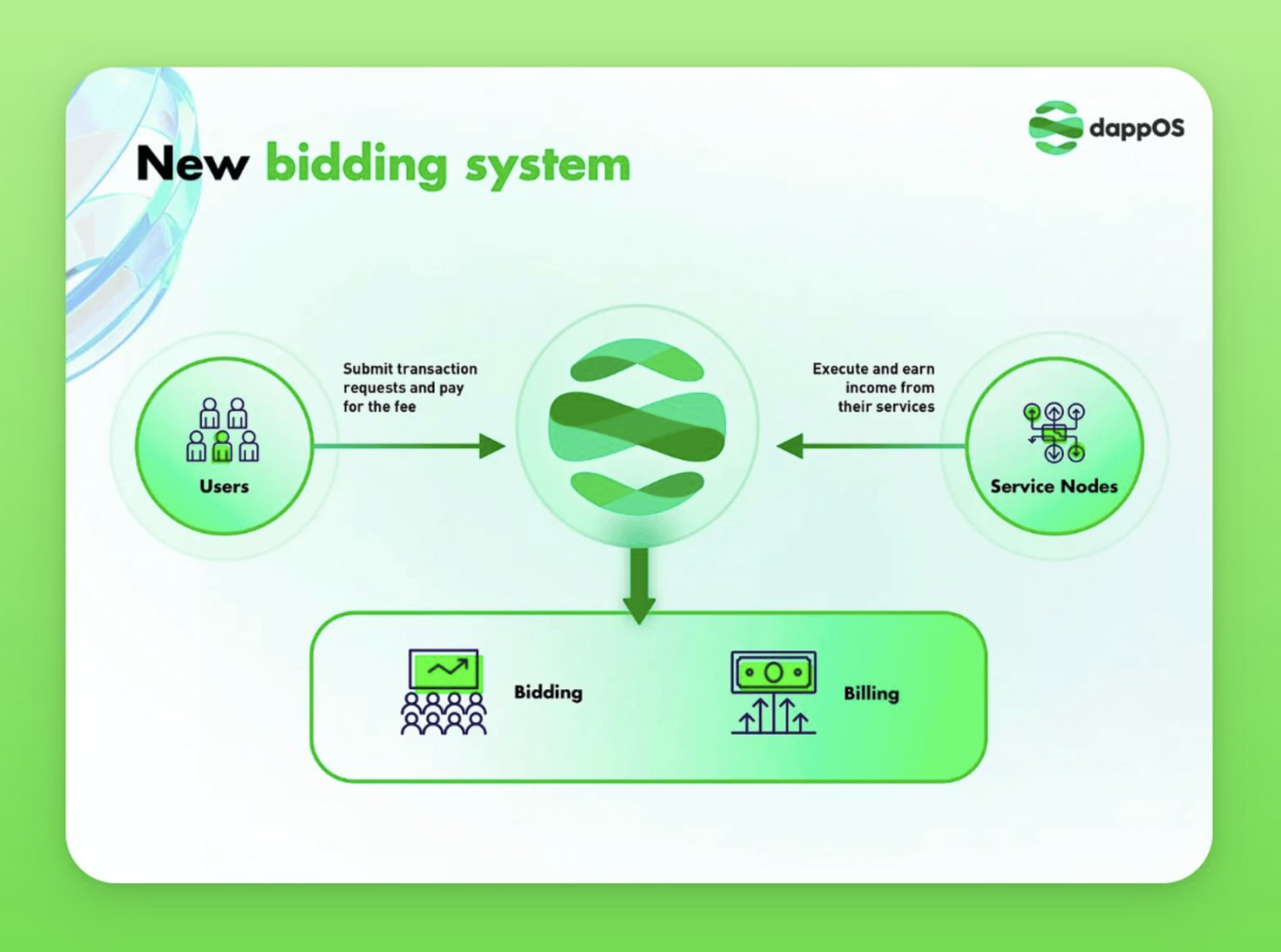
One issue to consider when using nodes to compete for transactions is whether some nodes will earn excessive transaction fees, thereby undermining decentralization. How does dappOS ensure user usability without sacrificing decentralization? One key point is that the selection of its server nodes is similar to dPoS chains, where the chain with the most staking will become the active super node.
Furthermore, the upgraded V2 version of dappOS will introduce a new node bidding system that allows users to see a list of service nodes for a target transaction, displaying the costs and time required for all service nodes to complete that transaction. Users can make optimal choices among different service nodes to enhance transaction efficiency and reduce transaction costs.
Conclusion
Since its debut, dappOS has made significant progress, completing several important developments. Investments from well-known institutions like Binance Labs and Sequoia endorse its growth potential. dappOS is also diligently preparing to launch its new V2 version, which will collaborate with more projects to enrich and expand its application scenarios while contributing to the development of Web3.
 Risk warning
 Risk warning


Popular articles





