








Stop support, each for themselves, the desperate struggle of NFT exchanges

 The rise of low-threshold NFTs, which have relatively small individual values, can attract a broader audience and thus influence overall market indicators.
Written by: Jessica, Odaily Planet Daily
Edited by: Hao Fangzhou
On August 19, after weighing the pros and cons, OpenSea announced it would stop supporting BNB Chain, as the support costs had exceeded the returns.
This decision came as OpenSea increased support for L2s like Base and Zora, leading some to speculate whether BNB Chain was on the decline. However, it is not BNB Chain that is struggling, but rather OpenSea, which relies on NFTs for its revenue.
From a data perspective, the cryptocurrency market is currently in a deep bear phase, with NFTs experiencing an even broader decline.
According to DappRader data, in August, NFT trading volume dropped by 16% to $559 million, and the number of transactions fell by 13% to 3.2 million.
Next, let's take a look at OpenSea's revenue situation, which mainly comes from a 2.5% transaction fee. In January 2022, it reached its peak with a monthly trading volume of $4.8 billion, bringing OpenSea a monthly gross profit of $120 million. By February 2023, the monthly trading volume shrank to $657 million, with gross profit dropping to just $16.43 million per month. However, in August 2023, the monthly trading volume was only $105 million, with gross profit falling to $2.63 million per month.
The significant drop in NFT trading volume, compounded by a decrease in OpenSea's market share, makes it indeed difficult to support more ecological NFTs. Additionally, the decline in OpenSea's share of the BNB Chain market is also a factor.
From the statistics between 2022 and July 2023, Ethereum accounted for almost all of the trading volume on OpenSea, while BNB Chain peaked at only 0.8% (in November 2022).
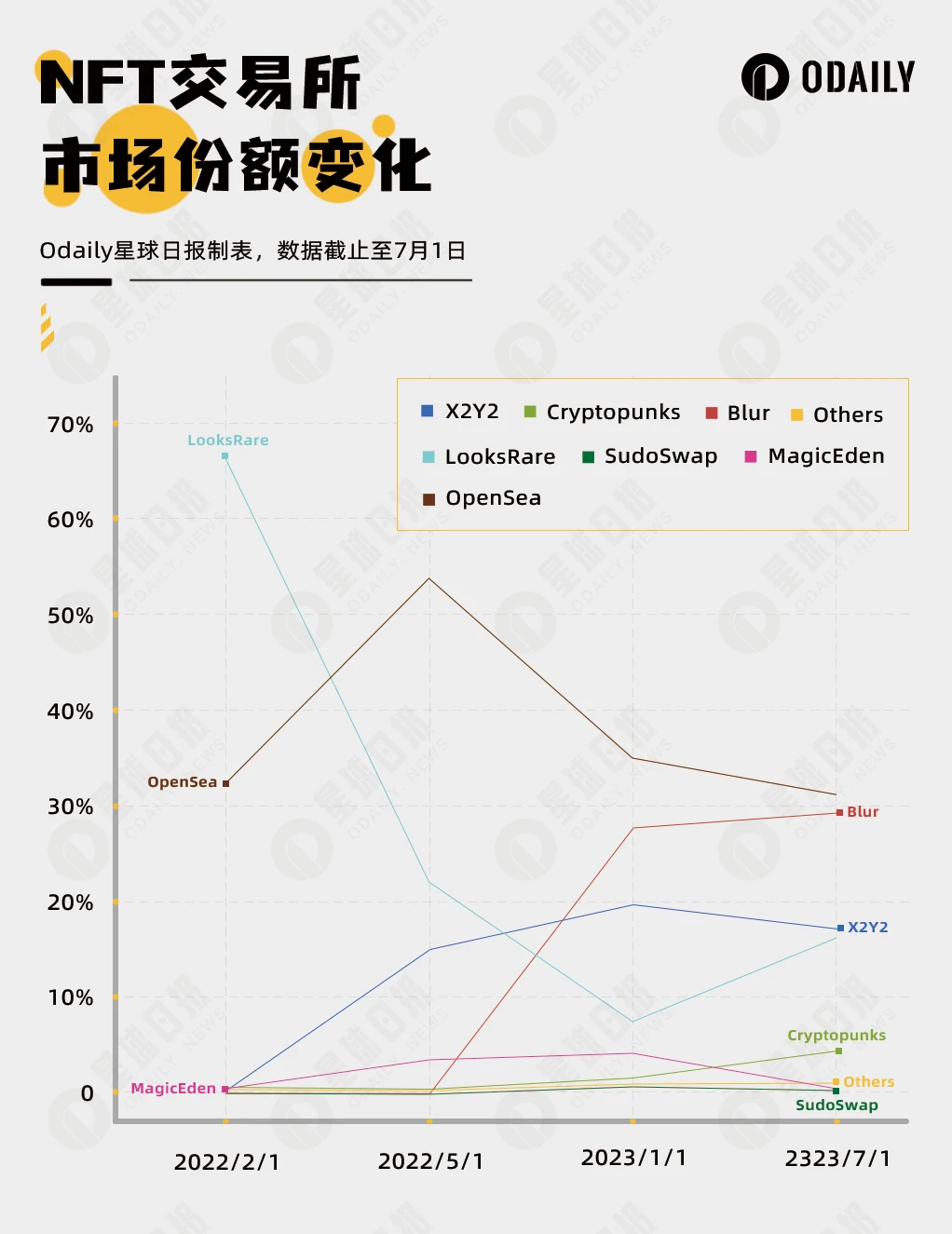
With a significant decline in revenue and market share, it is indeed challenging to support more ecological NFTs, and this is also related to the decrease in OpenSea's share of the BNB Chain market.
On August 18, OpenSea announced changes to creator royalties, eliminating permanent royalties, adding optional royalties of 2.5% -10% for secondary sales. Some community users believe this move undermines artists' ongoing income. Yuga Labs announced that, in light of OpenSea's announcement to discontinue mandatory royalties, it will implement an optional creator royalty program for all NFT secondary sales after February 2024. Yuga Labs will gradually cease support for all upgradable contracts and new collections on OpenSea SeaPort, aiming to complete this by February 2024 alongside OpenSea.
The cancellation of royalties also reflects OpenSea's predicament, as Blur is replacing it as the leader, prompting OpenSea to reduce royalty protections to remain competitive.
On the other hand, OpenSea CEO Devin Finzer stated that this change is a step towards enhancing innovation and adaptability. Additionally, he acknowledged the limitations of the previous model and encouraged creators to explore alternative strategies. This perspective aims to foster diverse revenue sources and creative possibilities.
Moreover, this initiative has stimulated the emergence of creator-centric platforms and ecosystems that establish their own markets to protect creators' rights.
A typical example is Art Blocks, the cornerstone of NFT generative art, which launched its own secondary market back in March this year. After OpenSea announced this news, Art Blocks reiterated its commitment to protecting creators' rights through its own NFT marketplace.
Unlike Yuga Labs' collections, which primarily trade on Blur, most collectors of Art Blocks continue to trade on OpenSea. As of August 21, Art Blocks' 30-day trading volume reached $5.32 million, with a significant portion occurring on OpenSea. Therefore, the possibility of Art Blocks exiting OpenSea would indeed impact the platform's revenue. Given the increasing popularity of NFT generative art, this effect becomes particularly pronounced.
OpenSea's decision to eliminate mandatory royalties means losing another major NFT market that advocates for creators. This change could trigger a trend where more projects choose to create their own markets. After Yuga Labs announced its exit, it is not hard to imagine that they might soon initiate the process of launching their own marketplace.
This also indicates subtle changes in the NFT market, with the rise of "low-barrier" NFTs, which have lower individual values but can attract a broader audience, potentially affecting overall market metrics.
OpenSea does not support BNB Chain, yet BNB Chain remains active, with 500,456 dUAW (daily unique active wallets) in the past month, accounting for 24% of the market share.
Among the DApps active on BNB Chain, the top three in the past month are TinyTap, LifeForm, and PancakeSwap, with the first two being social-related, indicating that assets related to social and games are growing in the NFT market.
Additionally, BNB Chain has its own native NFT exchanges, such as Binance NFT Marketplace. Binance Labs has also strategically invested in NFTrade, Tabi (formerly TreasurLand), and Tofu, which held the top spot among BNB Chain's NFT exchanges for a period, making it difficult for OpenSea to compete.
Another small detail is that Binance NFT will no longer support the Polygon network starting September 26, focusing instead on BNB Chain, Ethereum, and Bitcoin.
This move will provide opportunities for native NFT exchanges within the Polygon ecosystem.
Some believe that the current "stop supporting" situation in the NFT market indicates that the NFT market is "dying," especially since the cryptocurrency market itself is quite small. While the underlying efforts are towards interoperability, NFTs are creating barriers that complicate trading. However, others hold a different view, suggesting that the NFT market is gradually segmenting, as NFTs on different chains do not have a "cross-chain" demand or significance.
 Risk warning
 Risk warning



Popular articles





