








Binance Loses Illusions: Started from the Grassroots, Achieved through Compliance

 This is the biggest test in Binance's history since its establishment, as well as the most important opportunity related to its long-term fate, and it is also the "calamity" that Binance must face in order to become a "great" company.
Author: Gu Yu, ChainCatcher
$4.3 billion, this is the fine amount that Binance needs to pay for its long-term violations, which also means that the U.S. regulators' accusations against Binance over the years will come to an end.
Undoubtedly, this is a huge benefit for Binance, as the sword of Damocles that has long hung over its head has finally fallen, resolving the heavy burdens accumulated throughout history. As the most profitable exchange in the industry, almost no one believes that a $4.3 billion fine will have a substantial impact on Binance's operating cash flow.
In the past, the SEC has repeatedly publicly accused Binance of non-compliance, including issuing securities and violating anti-money laundering laws. This not only affected the trust of many large capital users in Binance but also directly impacted Binance's partnerships in areas such as stablecoins and payments. For example, many banks no longer provide USD withdrawal services for Binance, and the BUSD stablecoin, which Binance strongly supported, was forced to stop issuing.
According to the settlement agreement, all historical trading records of Binance will be available to law enforcement agencies, and multiple law enforcement agencies will be allowed to supervise its operations for the next five years. A highly transparent management and operational system will help gain the trust of regulatory authorities and the public worldwide, thus allowing for more freedom in market expansion and compliance.
At the same time, this also marks Binance's formal farewell to the CZ era. CZ has led Binance through a glorious and legendary seven-year entrepreneurial journey, relying on his strong capabilities and broad vision, but also benefiting from a grassroots environment lacking regulation. In the new industry cycle, Binance needs new methodologies and strategies.
However, with the major roadblock—regulatory pressure—now removed, Binance still faces multiple difficulties and challenges ahead, including management transition, competition, and product strategy, which can be considered the biggest "calamity" since Binance's establishment.
Starting with the management transition, it is not easy for any company to transition from founder-led management to professional manager-led management. This often requires a long adjustment period accompanied by growing pains, and successors will rotate through several key positions in advance. Binance's new CEO Richard Teng was only the head of Binance's operations in Europe, the Middle East, and North Africa six months ago, making his appointment seem somewhat rushed. Although this is a forced concession to regulators, it will objectively impact Richard Teng's ability to perform his duties.
In addition to the CEO position, there have also been changes in many senior positions at Binance, including Chief Marketing Officer, Chief Strategy Officer, Head of Products, Vice President of Custody Business, and Vice President of Compliance Business.
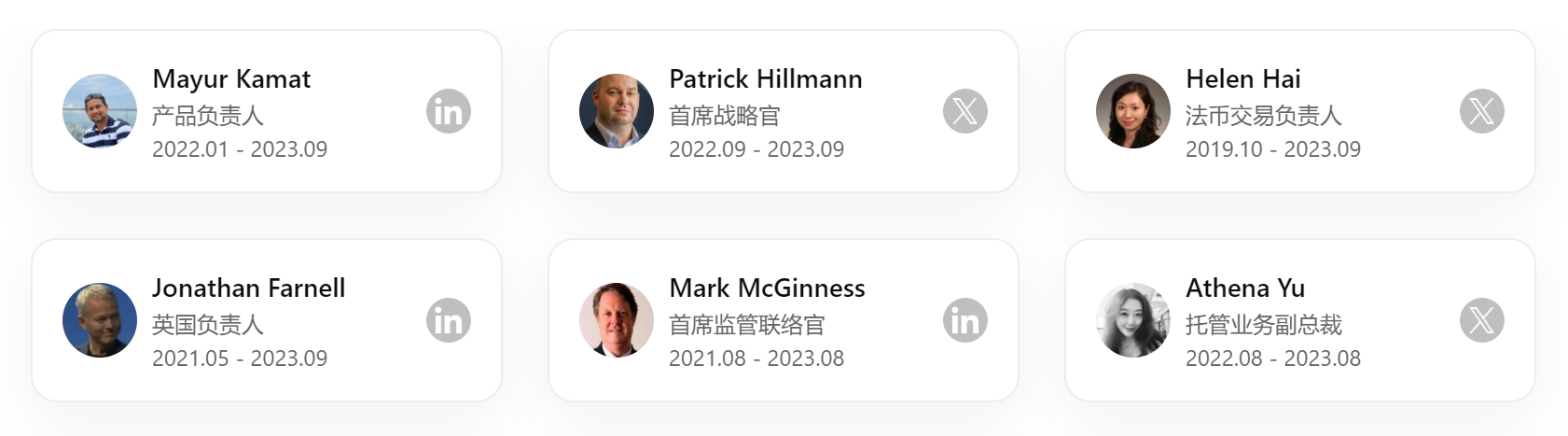
Recent departures from Binance Source: RootData
Looking at the product and innovation aspect, Binance has been exploring new business directions based on its solid trading business, such as the previous BNB Chain, payments, fan tokens, NFT markets, and live streaming. However, in the past year, Binance has seen almost no product functionality innovations, only recently launching an integrated Web3 wallet feature, lagging behind competitors. This indirectly reflects the difficulties Binance faces in its product strategy direction.
Finally, regarding competitors, during the past year or two when Binance has been severely constrained by regulations, established exchanges like OKX and Bitget have been catching up, while exchanges like Coinbase, Bitpanda, Bakkt, Upbit, and HashKey Exchange have made significant progress in compliance. Although Binance's user base remains relatively stable, the intensifying competition puts considerable pressure on Binance in expanding into new markets.
Additionally, beyond the impact on the business level, CZ has long been the most important bridge for Binance's interaction with the public. Whether through mainstream media interviews or social media like Twitter, CZ has maintained an active and friendly presence in front of the public as the founder, which is a significant difference between Binance and most other exchanges. This has played a crucial role in helping Binance gain public trust. How this role will be filled in the future remains to be seen.
From a funding perspective, Binance is still the most trusted cryptocurrency exchange among crypto users. The hefty penalties from U.S. regulators have not affected this, as the vast majority of users still stand by Binance and CZ, which is enough to prove Binance's unshakeable position in products and markets.
However, past achievements are ultimately in the past, and the aforementioned hidden dangers objectively exist. Resolving historical issues does not necessarily mean that Binance has made significant progress in compliance. Binance still needs to put more effort into its management structure and trading monitoring mechanisms, especially regarding how to handle contract products, which are the most closely watched by regulatory authorities but have strong revenue-generating capabilities. This is an unavoidable and important issue on the path to compliance.
This is the biggest test in Binance's history and the most important opportunity concerning its long-term fate. It is also the "calamity" that Binance must face to become a "great" enterprise. Whether it will be reborn or fall into mediocrity is now in the hands of the new management team.
Currently, there are two potential scenarios for Binance: one is BitMEX, and the other is ByteDance. Both became leaders in their respective industries during their early development and faced strong pressure from U.S. regulators. The difference is that BitMEX faded into obscurity after its founder faced hefty fines and handed over management to professional managers, while ByteDance continued to thrive under Liang Rubo, who took over after founder Zhang Yiming stepped down as CEO in the first half of 2021, with revenues approaching Meta.
For Binance, most users would hope for the latter scenario.
 Risk warning Risk warning


Popular articles





