Interview with the former Binance listing team manager: After reviewing 2,000 projects, the real cryptocurrency world in the eyes of a power player
 Core Viewpoint

 The cryptocurrency market is a financial battlefield where "no acting" takes place, filled with liquidity games and market maker manipulation.
Organizer: Deep Tide TechFlow
Guest: Chase, former listing manager at Binance
Podcast source: Class Representative Stand Up
Original title: Is Bitcoin Manipulated? Former Exchange Executive Reveals: How Market Makers "Proclaim Sovereignty" to the World
Broadcast date: February 10, 2026
Guest Identity: Chase, former listing manager at Binance. During his tenure, he handled about 1,000-2,000 projects and was directly responsible for the token launch of about 100 projects, with data quality that is extremely high, representing a top-level perspective in the industry.
Core Understanding: He believes that the crypto space (especially the exchange environment) is a "non-theatrical" financial battlefield. Unlike the stock market, which still wears the cloak of financial reports, this space is filled with liquidity games and market maker manipulation. He observed that Bitcoin's candlestick charts can be manipulated by market makers to create perfect "artificial patterns" to proclaim sovereignty. In this market, information, traffic, attention, and even insider information itself are assets; as long as there is liquidity, they can be priced.
Highlights of Key Points
Macroeconomics and Crypto Valuation Logic
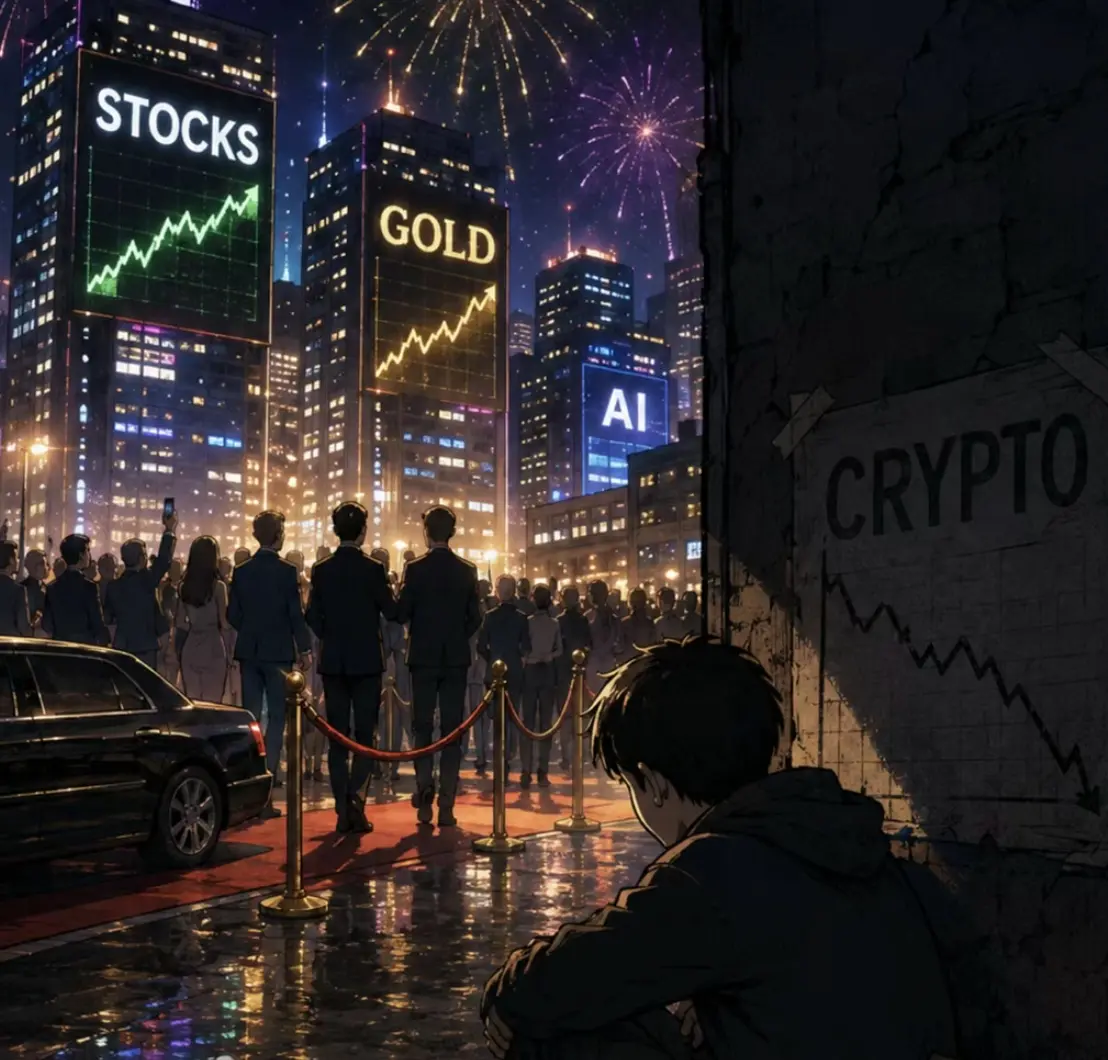
• The Truth Behind the Bull Market in US Stocks: Since the dot-com bubble, the S&P 500 has been in a long-term bull market, but when compared to gold, it may not be so. The core reason for this phenomenon is the continuous expansion of money supply.
• Support for Asset Prices: Newly created money must find assets to support it. The growth of goods and services (GDP) cannot keep up with the speed of money issuance and credit growth; excess money must flow into new asset classes, leading to cryptocurrencies (Crypto) becoming an excellent container for global overflow liquidity due to their low-cost issuance and lack of need for centralized verification.
• Crypto Valuation System: Unlike traditional finance, which looks at cash flow, the short-term performance of crypto assets is determined by three factors:
Liquidity
Traffic/Attention
Tokenomics
Market Manipulation and "Market Maker" Thinking
• Can Bitcoin be manipulated?: Yes. Chase observed that Bitcoin rose for seven consecutive days in a week with almost identical amplitude and trading volume, followed by a sharp drop. This is not natural fluctuation but a signal released by large capital groups (market makers) to the market—"I control the rhythm; those who understand will follow, and those who don't will be eliminated."
• Everything can be priced: In the Crypto world, information, traffic, and even insider information (like Polymarket prediction markets) can be assetized. When most people form a "consensus," it is often the moment for reverse harvesting.
• A market without theatrics: Exchanges like Binance vividly demonstrate what naked trading is. There are value investors, but more are market makers who see through liquidity and short-term interests; this is a "no theatrics" financial battlefield.
- Cutting-edge Trends: The Combination of AI Agents and Crypto
• The Measurement Dilemma of AI: The economic volume generated by AI agents will surpass that of humans in the future, but the existing GDP system cannot measure the microtransactions (API calls, data exchanges) of AI.
• Crypto as Infrastructure: Crypto is a natural financial infrastructure suitable for AI. It can provide precise measurement and settlement for every tiny transaction without the cumbersome trust processes of the banking system. Crypto may be designed for AI use, rather than for humans.
Industry Insider Information and Wealth Opportunities
• The Huge Profits of Stablecoins: Tron carries a large amount of USDT. Tether's (USDT issuer) annual profit (about $15 billion) exceeds the total losses of OpenAI and Anthropic combined. This is a risk-free arbitrage model relying on the spread of US Treasury bonds, making it the industry's true "cash cow."
• Capital Equality: The biggest change in production relations brought by Crypto is "capital equality." No matter who you are, as long as you meet the standards, funds can earn equal returns (like DeFi yields), breaking the traditional banks' differential treatment of retail and high-net-worth clients.
• Advice for Practitioners:
◦ On Getting Rich: There are indeed "abundant" dividends in this industry; ordinary people who work a bit harder (like participating in airdrops) may earn more than in traditional manufacturing, but ultimately, big money still flows to "top players" or gets redistributed.
◦ Advice for Newcomers: First, understand two things—Bitcoin (as an asset allocation) and stablecoins (as a payment revolution). Don't just focus on speculation; see the opportunities brought by the payment system revolution.
◦ 2026 Prediction: Bitcoin will rise, but possibly in ways you wouldn't expect (by pricing all information and liquidity games).
Opening and Guest Introduction: The Power of Binance's Listing Manager
Class Representative: Hello everyone, welcome Chase, a very mysterious figure in the crypto space, to our show. Chase, please introduce yourself.
Chase: Hello everyone, I used to be a powerful figure, but now I'm a bit down and out, haha. I'm leaving to pursue my dreams, giving up a huge amount of power. I'm Chase, as the class representative mentioned, my most recent job was as a Listing Manager at Binance, the largest cryptocurrency exchange in the crypto space. This job mainly involved helping founders mint their tokens. During the time I was at Binance, we reached an annual trading volume on par with Nasdaq, so the scale is significant.
Class Representative: Let me interpret your work for everyone. These people issue a coin, but if they want to trade it on Binance, which has a trading volume comparable to Nasdaq, it has to go through your team. My understanding is that you might not be able to say this, but it's somewhat similar to a position where the SEC decides whether a company can go public. So all the founders are very…
Chase: There are similar functions, but legally it can't be defined that way.
Class Representative: Okay, please continue. How big is your team, and what role do you play in it?
Chase: Our team has about a dozen people. My official title is Listing Building Manager. We had four people, and now there are even fewer. Four of us were the ones who could truly approach and communicate with everyone, interpret their doubts, guide them, and tell them how things should be done, A, B, C, D, and so on.
Class Representative: Wow, I think your background provides several important insights. First, you must have seen many projects; you are probably one of the people who has seen the most crypto projects in the world because that's your job. And since you truly have power, we won't shy away from it, especially since you're about to leave, so there is no conflict of interest. Therefore, those founders value you highly, and the core resources and information you can access are very firsthand and very real. You have also formed your own judgment. Thirdly, one of your jobs is to communicate with the industry, so you must have formed your own views or insights. I think these aspects uniquely position you. What do you think you can share with everyone today?
Chase: I think the most I can share with everyone is what the entire model has become after inputting so much data. Moreover, I believe my data is of relatively high quality, so it shouldn't be garbage. I can honestly share with everyone the highest quality data. From the time I joined the company until last year, I spent about two and a half years looking at roughly 1,000 to 2,000 projects. Last year, about 100 of the projects I supported successfully launched their tokens.
Class Representative: Tell us what this number represents, whether it's looking at projects or launching projects.
Chase: You can understand looking at projects as being similar to how VCs look at projects. You have to look at the deck, the team, talk to them, call them, and then make some judgments; that's the basics. I think a VC looking at about 200 projects a year is pretty good, quite impressive. You also have to keep communicating with the founders. But in my two-plus years, I looked at over 1,000 projects, and last year alone, I launched about 100. What does 100 mean? When I first joined Binance, they were only launching about 20 projects a year, the whole company. Then in the second year, they launched about 50 or 60, and by the third year, in 2025, I launched 100 by myself last year. In total, how many were launched? It should be around 250 to 300.
Class Representative: Anyway, you accounted for almost half of it.
Chase: One-third. No, no, about one-third. Because there were only four of us in total. The success rate for screening is about 5% to 10%.
The Worldview of Crypto: The Tertiary Industry and AI Infrastructure
Chase: I want you to help everyone interpret this world. Many people who may not understand Crypto might see it this way. First, you can think of it as a virtual world. This world has its own set of economic circulation mechanisms. If you consider it a country, it needs the US dollar as liquidity support. However, its output, its exports, are its services. It only has services; it is purely a tertiary industry. What is its primary industry? It needs computing power and electricity.
Class Representative: How should this be understood? What does it mean that the output is the tertiary industry? Because we often say, can we use Bitcoin to buy pizza, right? That's not the case.
Chase: The reason I say it is a tertiary industry is that although Bitcoin has a large market share, 50% to 60%, it is not the core of this industry. We can talk about where bubbles can be blown; it can serve as a store of value, but it cannot provide many services. The store of value is what we call liquidity support. Why is it a tertiary industry? For example, after Ethereum came out, many smart contracts can enable functions like DeFi, which can significantly impact the traditional financial industry. I remember a few weeks ago, someone mentioned that in the next two years, almost all mainstream institutions on Wall Street will go on-chain.
Class Representative: Regarding DeFi, we previously invited Richard Youzhong (founder of Huma Finance) to our channel to talk about his project. Essentially, it helps companies already engaged in trade reduce friction in finance, whether it's exchanging currency or lending, improving their efficiency. It's a service that brings value to traditional or non-Crypto entities.
Chase: Right.
Class Representative: Can you list some of the main points you see?
Chase: What you just mentioned is the industry’s external output of services and value, which is not a problem. But besides that, this industry has its unique aspects. For example, flash loans. Most people may not have heard of it. What does it mean? For instance, if you go to a bank to borrow money, you either need collateral or a very high credit score; you need something for the bank to lend you money. The ability of flash loans is that you can complete borrowing and receiving funds without any collateral, and the bank has no risk. Almost everything related to payments in Crypto can enable this.
Chase: The most important thing, and something I might write a paper on soon, is related to AI. Let's say that five years from now, if AI continues to develop according to our current scaling laws, the number of AI agents will definitely exceed the human population, right? Based on this assumption, how do you measure the economic behaviors generated between AI agents? You call its API, fine, you are now in a subscription model. But many times, I might only need a lot of long-tail data, like data that only you have or only I have; how do we settle after one call? Right? The amount of data obtained is very, very small, and the existing banking system cannot help settle it. All these economic behaviors need to be measured first and must be trusted by everyone to succeed. This is also where Crypto can enable or collaborate with AI. This is why many people in the circle think that Crypto itself may not be designed for human use; we designed it this way, and it may be for AI use in the future.
Class Representative: When interviewing Youzhong, he also mentioned something I still remember: he believes AI is productivity, while Crypto is the relationship of production.
Chase: Actually, Crypto also has productivity and production relationships. But what really can change the production relationship in Crypto is the ideology of capital equality. If you think about it, if you live in the mainland now, you are used to Alipay and Yu'ebao, right? Your money is there, and it automatically earns interest, which seems very reasonable. But in North America or Europe, you may have to go to a bank separately, which has a threshold, and the interest rate they give you is very low. But Crypto completely equalizes the world. Money is just money; I don't care whose money it is. As long as you deposit it and meet my standards, you can earn the same returns.
Macroeconomic Perspective: US Stocks, Gold, and Monetary Illusion
Class Representative: We just mentioned that payments themselves are a huge system, and Crypto can provide a lot of value in this. Changing the production relationship is another value. Are there any other significant value points of Crypto in your view?
Chase: To be more realistic, it can help all countries with excessive liquidity carry more liquidity without affecting inflation.
Class Representative: I understand, it's about store of value. Do you think there is a significant difference between this and gold?
Chase: That's a very good question. You see, in the link I shared with you, there is a chart. What does this chart show? First, let me ask you a question: do you think the US stock market has been in a bear or bull market since the dot-com bubble?
Class Representative: It's a bull market.
Chase: Yes, if you take the S&P 500, it is indeed a bull market. But for gold, it is a bear market. The chart I showed you illustrates this point.
Class Representative: Right. Interesting. It suggests that the money you printed has driven the growth of the S&P 500, but it still hasn't surpassed gold's anti-inflation growth rate. Wow. So the S&P is higher than gold…
Chase: This is a very famous research piece by Lyn Alden; I can send you the link later.
Class Representative: Interesting, interesting, interesting. This is a significant shift in my understanding of investing. Previously, I was misled by economic theories that taught me to think of stock prices as discounted future earnings. That makes sense, but later I realized that everyone says the US stock market is a bubble that will burst every ten years, yet it hasn't happened. Why? I later thought it was because there was nowhere for the excess money to go. Previously, people couldn't generate that much money, but now that so much money has been created, it has to go somewhere.
Chase: Yes, exactly. You think about our growth in goods and services, maybe around 5% a year, right? Your money issuance and credit growth far exceed that speed. Therefore, the excess money, aside from becoming a bubble, has to find new services or assets to price. Why are there new assets to price? Because in the crypto space, Crypto can continuously issue assets at a very low cost. Moreover, you don't need to verify with a central institution. As long as everyone believes your asset has value, new liquidity will come in to absorb that liquidity.
Class Representative: You just need to verify it yourself.
Chase: Yes, you just need to make your own judgment.
Class Representative: Not just you! You!
Chase: Oh~ Me personally? You! No, no, I'm just an employee, just an employee.
Pricing Everything: Polymarket and Information Assetization
Chase: A project that has been quite popular recently is called Polymarket; I believe you've heard of it.
Class Representative: I'm not familiar; can you explain it to everyone? I've heard of it, but I'm not very familiar. I always thought it sounded like a scam, so I didn't look into it.
Chase: OK, it first gained popularity during the Trump election year. Basically, it's a prediction market; it claims to be a prediction market, but it's actually a binary option. It knows the election results a few hours in advance. Its logic is based on the belief that there are always people in the world who have inside information about something.
Class Representative: I agree.
Chase: So, this inside information should be priced; it should be valued.
Class Representative: Right.
Chase: This is a market for pricing it.
Class Representative: Okay, it's not a scam. That makes sense. Haha, you convinced me with one sentence.
Chase: Haha, that's exactly what happened. I have a good relationship with the founder; we often have meals and drinks together. Now, you can understand that in the context of de-globalization, Crypto is a very strong sector that maintains globalization. And this sector puts all information on the same network, where all information can be priced. Information can become an asset, traffic can become an asset, and any transaction or idea can become an asset. As long as this asset has liquidity, it can be absorbed.
Measurement and the Ineffectiveness of GDP in the AI Economy
Chase: Just like I mentioned earlier, the reason I want to write this AI paper is that I believe the GDP or economic volume generated by agents in the future will definitely exceed that of humans. At that time, without a measurement, you won't be able to do it without a certain infrastructure. The existing infrastructure is Crypto. However, in economics or academia, there is no index that says what these agents are like. Currently, we can only estimate what AI might look like in the future based on Google’s reports, OpenAI’s financing data, and Oracle’s data center construction CapEx.
Class Representative: I understand.
Chase: If you think from first principles, it should be that every agent and every transaction should be measured, and it should be very precise.
Class Representative: Let me explain this to my channel's audience. My understanding is that there are two core issues. The first is how valuable AI is; is AI worth money? This is actually very hard to price. Because if we only look at OpenAI's revenue now, it's not much, just a few billion, right? But Dai Yusen raised an idea; I was at an event where I did a survey. If I were to buy out your future usage rights for ChatGPT, you wouldn't be allowed to use ChatGPT or any new AI services. How much would you be willing to pay to be bought out? I asked the audience, and when I reached $100,000, only one person raised their hand. Out of about 100 people, only one raised their hand. When I asked about $1 million, many still didn't raise their hands. $1 million, so the value of this thing is enormous, but I can't measure it. The second is how much productivity AI generates; GDP is actually very hard to measure.
Chase: Yes, GDP is particularly flawed. G is gross, right? But it's actually not gross. Every time you make an API call, you can measure it precisely. Secondly, it is domestic. AI is not domestic; it is global. Thirdly, it is not a product; it is not a formed product; it is many intermediate states. So every word in GDP is wrong. If you use this to measure AI, that's why we need a new index, at least a micro measurement. And on top of that, whether a macro index can emerge is also very important. We are already writing some, and there is already a framework.
Class Representative: What I mean is that the link between macro and micro can write a framework, but whether OpenAI allows you to measure is another matter.
Chase: Hmm, you are right. It may be said that when the number of agents develops to a certain extent, and when one or two killer apps emerge, you may not need OpenAI to manage your data, care about your data, or collect your data 100%. You can locally host your own agent. Then, when your agent helps you with complex tasks, you can rely on cloud agents for daily tasks. Right? For example, I have two MacBooks at home, one MacBook and one Mac mini; I can connect them to run a 31B model at home, and all my data is local, which is very, very useful.
Bitcoin 2026 and Market Manipulation: "No More Theatrics" Market Makers
Class Representative: Hmm, we return to value creation. Let's quickly talk about money, haha, let's talk about the most concerning issue: will Bitcoin rise or fall in 2026? Make a prediction.
Chase: It will rise. It will definitely rise; it will definitely reach an all-time high. But in what way, it will probably be in a way you never expected.
Class Representative: Why?
Chase: Returning to my previous topic, all information can be priced. Now, in the crypto space, anyone can be priced in this network. When everyone forms a consensus, your consensus will be priced, and there will be people with reverse consensus to cash out you. OK, this might be a bit deep. If you've ever been a market maker or know about quantitative trading, you will find that it is always a big fish eating a small fish. However, when the majority forms a large consensus, it is likely to become a target. Others will price you as that target.
Class Representative: So when everyone thinks this thing will fall, it will rise instead. It won't fall. Why? Because when you know it will fall, you will be convinced, and when you are convinced it will fall, you have already been socially engineered. I'm talking about the general public, not you personally. But this feeling is not new; it's just the logic of market manipulation in the stock market.
Chase: Right.
Class Representative: Can someone manipulate Bitcoin? Is it that large? Or is it really that big?
Chase: Bitcoin's market cap is now around two to three trillion US dollars, so the scale is not small. It's about 1/10th of gold. Last year, around February and April, there was a week when Bitcoin's candlestick chart, if you looked at the daily candlestick, rose continuously for seven days with the same amplitude and volume, then suddenly fell. What does this mean? Generally, such a pattern appears when a strong market maker can control the entire chip situation. In other words, certain people or a group wanted to announce to the world that they have control over this thing, just that simple.
Class Representative: OK, not only did they control it, but they also directly told everyone; they sent a clear signal.
Chase: Right. What do they hope for? They hope you join; they hope those who understand will join them and eat up those who don't understand.
Class Representative: I need to quickly check what day that was; let me find it for you.
Chase: I'll find it for you, haha. This industry is very, very interesting.
Class Representative: Who is this person?
Chase: There is no specific person; you will never know who it is. There are many market makers involved, and many traditional financial market makers overlap with crypto market makers. These market makers do not look at fundamentals; they only look at market liquidity and the signals they believe in. Once these signals come out, they will trigger. The trading methods I just described belong to what? Either the market liquidity at that time was controlled by these few people with the same algorithm, and everyone confirmed each other, OK guys, we are all in this together, right? Or they believe that other people with chips or money will not participate in my game during this time. About a year ago, I will find that day for you.
Class Representative: Okay~ I'll find the screenshot for you. Continue. Bitcoin has shown such a trend that insiders know about, where experts manipulate the market. If that's the case, then as you said, they can already cut, and they will do it this way. As long as everyone understands.
Valuation System: Liquidity, Attention, and Chip Structure
Class Representative: Next, you just mentioned Bitcoin, which aligns with my understanding: Bitcoin is a store of value in the blockchain, essentially a trading base we all rely on gold, and it feels like a vault. To really make big money or lose big money here, it is actually all about things outside of Bitcoin. The value of gold, no matter how much it rises or falls, is relatively stable. Even if it rises to an all-time high, it may only be a 30-40% increase compared to now. Besides leveraging for trading, what else do you see?
Chase: This may go back to some of your previous studies in traditional economics. One is valuation-driven, right? The other is liquidity or fundamental-driven. The valuation system in the crypto space is different from traditional finance. It mainly consists of three parts. One is liquidity. The other is traffic, which is attention. Finally, the entire chip structure, which we call Tokenomics. These three components almost determine what the asset will look like in the short to medium term. No one looks at the long term; no one looks at the long term.
Class Representative: How short is the short term?
Chase: Generally, it’s about 7 days to 3 months; you can almost see the general direction of an asset. However, for example, the project Richard is working on is actually a very, very good project, but because they didn't have experience in launching tokens before, it wasn't launched particularly well. But from a long-term perspective, this project is very, very worth paying attention to. For instance, they recently released a new feature called Defensive Loopring, which indirectly helps you leverage assets they consider to be very low risk, without causing you to incur losses, almost at the smart contract level. The result is that you can achieve an annualized return of about 16-17%. This is very, very considerable, and it has no significant upper limit on the amount of funds; you can put a few million in and just relax.
Chase: This is a good case illustrating why their token price hasn't risen. The underlying has been done so well; what causes the price of the token or the gap in between? Once your token, this asset, circulates, to be honest, first, you can no longer control it; it’s all market behavior.
Class Representative: Yes.
Chase: However, because the market participants pricing this market are either retail investors who don't understand or market makers who have very strong capital but don't care about value; they only care about short-term profits. This leads to everyone choosing short-term without long-term considerations. So when to enter the market? Especially for someone like you or traditional finance practitioners, even my current situation, wanting to make long-term choices, is usually after the first wave is over, and everyone realizes it still has value, and its token is no longer influenced by liquidity and attention; only then is the valuation relatively fair. For example, if you look at Richard's project Huma, its current valuation is probably around $300 million. But from my perspective, it is worth around $2 billion without a doubt; it’s just waiting for the wind. Basically, the speculation has already been played out.
Class Representative: Right.
Chase: Exactly, the speculative wave has already finished.
Class Representative: I think looking at Crypto trading, especially on exchanges like Binance, vividly reflects that the stock market has its so-called value part, its trading part, and its speculative part or the part controlled by market makers, making it hard to see clearly. But in Crypto, it is particularly obvious and clear.
Chase: So it is vividly displayed; everyone is not acting, everyone is not acting.
Class Representative: Right. No theatrics.
Chase: No theatrics. Because it has not yet been defined as a security, the regulations governing it are very few. Many people start to engage in wrongdoing, which is hard to avoid.
Industry Figures: Sun Yuchen, Tether, and the Truth Behind Huge Profits
Class Representative: Speaking of this, let's introduce a person who is completely not acting. Or rather, he may be all acting; I recently watched "A Mortal's Journey to Immortality," and this Nanlong Marquis is someone who acts like himself, a person with deep schemes. Sun Ge, Sun Yuchen, you should know quite a bit about his stories, right? I think he is a good case to discuss the portraits of people in this field and their underlying motives. It's actually quite mysterious; he seems to be everywhere, so it's hard to tell whether he has cut money or if he is genuinely wealthy or just pretending to be wealthy. How should we view this? Share some insider information.
Chase: Insider information… Let's first talk about Nanlong Marquis; after all, he is a descendant of Cang Kun. He must be secretive. In the world of immortality in the environment created by Wang Yu (the author of "A Mortal's Journey to Immortality"), there are intrigues, which is unavoidable; this is his protection. Even so, he was still betrayed, right? So it's hard to say. As for Sun Ge, I don't have personal interactions with him, so I can't comment much. But he is indeed wealthy; this is well-known in the industry. It is known that he is very rich, which may be a question mark for outsiders, but it is a certainty of 100% in the industry.
Class Representative: What is known in the industry? It should also be public information, right? He has a public address?
Chase: There is a public chain called Tron, right? You know USDT; in fact, the largest parking space for USDT is on Tron. This means Tron and USDT have a symbiotic relationship, at least in the past. Moreover, you think about how much currency USDT has printed; I forgot if it's 60% or what percentage, but I can check. It's better to share real data with everyone. Tron currently has about $4.7 billion in total value locked (TVL). USDT on Tron has $80 billion. What does this mean? Its largest competitor, Ethereum, has 46.77%, and the second is Tron at 43.07%, which is over 80%.
Chase: And Tether's annual revenue is $15 billion. Its pure profit is almost… you think about it, OpenAI loses tens of billions a year, Anthropic loses tens of billions a year; the two combined don't earn as much as Tether.
Class Representative: How does Tether make its money? Is it from transaction fees?
Chase: No, Tether is the issuer of USDT. Its underlying logic is that if you give me $1, I buy T-bills (US Treasury bonds) with that dollar. After buying the T-bills, I give you this USDT token. So for you, you exchanged $1 for a USDT token, right? It's one dollar for one dollar, so you can go have fun. But for me, every time a dollar comes in, I can earn the interest from the T-bills given to me by the Federal Reserve. As long as my scale is large enough, I can keep earning this interest spread of 3.5%. That's how much interest there is now, about $15 billion a year.
Class Representative: Haha. Sun Ge is indeed wealthy. So what next?
Chase: He is indeed wealthy. Haha, I am not familiar with Sun Ge, but I can give you some links for gossip; it's not good to talk about people in public.
Wealth Distribution and the "Journey to Immortality" Metaphor
Class Representative: Hmm… indeed. How about we talk about the stories of getting rich quickly in the crypto space? What kind of people are these? We just talked about the essence or value of this place, and we discussed its current state, right? For example, everyone is not acting. It is actually a very clear trading space. I think its underlying logic is quite clear. What kind of people are in it?
Chase: From what I've seen, the ratio of beautiful women at all crypto gatherings is particularly high.
Class Representative: Yes, it's quite strange.
Chase: The proportion of women seeking wealth is particularly high. This can be verified. (Of course) there are also many excellent women; more than half of my former colleagues are women, and they are all outstanding. The entire crypto industry is actually a separate world, a separate country. It has everything. The entire spectrum, from the far left to the far right, has everything. You think about it; on the far right, there are the highest power figures, like the President of the United States, and their families are involved in many things in the crypto space. On the far left, there are people who have been imprisoned for defrauding others of tens or hundreds of billions. There are all kinds of people.
Class Representative: From my perspective, I am someone who understands technology and have produced several videos about Web3, so I have some understanding. But I feel like I am completely outside this circle; apart from buying a Bitcoin, I have no connection to this circle. I occasionally see some people around me saying they are working in Web3. It feels like the ones making money are a minority, but it seems that some people, after understanding the rules of the game, can quickly amplify their wealth, so-called getting rich quickly. Among the practitioners, what do you think is the proportion of those who understand this game?
Chase: First of all, the threshold is not high. As long as you are diligent enough, even a high school student, not to mention in the mainland, if you understand how to circumvent the Great Firewall, can earn several thousand RMB a month without much problem.
Class Representative: Through what means? Trading or…?
Chase: By participating in new projects, like airdrops and such. It is actually a part of monetizing traffic. Because this industry has enough liquidity or enough bubbles. Therefore, the economic returns you get from spending the same amount of time will definitely be higher than doing manufacturing or traditional primary and secondary industries.
Class Representative: This sounds like there is a lot of abundance here. The top players are fighting, or when they are working on projects, they are past the Qi refining stage, and now they are seeking some elixirs. Hahaha!
Chase: That's about the idea. Because it’s not that competitive. It seems like there is so much money, but there are really not many people. Binance now has about 300 million registered users, KYC verified and KYB included. But I think the truly active people in this industry may be less than a million, around a million.
Class Representative: Besides seeking elixirs, what else can they do?
Chase: Seeking elixirs and many other abstract things. For example, the NFT craze in the last cycle, right? It’s just small pictures. But it follows the model of the Dutch tulip. Many people play it, and it leads to many people becoming rich overnight. How do these rich people get their money, and how does it flow? It means that all newcomers can easily earn the same average income as those with similar understanding, as long as they are diligent. Even if someone becomes rich overnight, if they do not continue to change or improve their understanding, their money will slowly be redistributed to others in the circle. It is a dynamic process. As long as this money is not spent, it remains in that place. This is fake, right? It doesn't count as money.
Chase: This is also why I say this industry can capture a lot of excess liquidity without affecting inflation in the real economy. The money is all there; everyone can play.
Class Representative: Just like joy beans. It is indeed similar to the tulip, but it has many variations.
Chase: Yes, many variations. Moreover, everyone can create their own tulip. There is still an idea of equality in there.
Class Representative: So what are the top players doing?
Chase: The top players are also divided into factions, many factions. Some are value investors, like Richard, or cash flow types, like our boss. They already have a lot of money, and they may not care about cash flow; instead, they care more about their industry status. Others are so-called hacker builders, providing new technologies, like FHE, ZK, and these things, which are also very interesting.
Class Representative: Hahaha, alchemists.
Chase: And it is very useful. Why? Because without Crypto, technologies like ZK or FHE find it hard to have large-scale applications in the real world. First, it requires a long-term investment in infrastructure, and it may not even be good. However, in the crypto circle, as long as it is something that everyone recognizes as having public good or value, it can be priced. This is also what makes this circle attractive, I think.
Class Representative: But it sounds like the people making big money are still those manipulating the market, not those doing the technology. Especially for these stories to hold, the biggest problem is that the story is very beautiful. For this story to hold, the technical investment required is actually very, very large. But it seems…
Chase: Yes, that's right.
Class Representative: It is very hard to motivate those who really have the technology to invest. There are two thresholds: the first is that there may not be enough money, and the second is that they are too close to money, which can become a problem. For example, I think these things sound great, and I want to invest, but I know the temptations, challenges, noise, and the scythes are very, very many. I don't think I can survive well in this.
Chase: Yes, you have expressed the voice of most people. Many people want to enter the circle or want to do something; there are definitely various risks. Because it is still a somewhat wild era, it has not been fully formalized. But it is getting there quickly; Binance has already obtained a global license in Abu Dhabi, and compliance will continue to improve.
Advice for Newcomers: Bitcoin and Stablecoins
Chase: For individuals, I think everyone should first eliminate their distractions. First, understand what this industry is all about. What is it doing? Why is there so much money? Why are so many talented people entering this industry? It is still a high-density talent and capital industry. If you don't understand, it shouldn't be a problem with the industry; it should be your problem. This is also why I convinced myself to spend eight years doing nothing but diving into this matter. Moreover, it is particularly friendly to young people; it doesn't care about your identity or status; it only cares about whether you have put in the effort and whether you have seriously studied and learned. You can earn your living expenses or some initial income, which will definitely be better than working.
Class Representative: Finally, let me ask you a question. For our channel's typical audience, for example, someone in the tech industry who may have accumulated some wealth through working and wants to make money in the crypto space, not to mention participating in building the crypto space, but just wants to make money from it, what advice do you have for them in 2026?
Chase: My advice is that they should at least first understand the two mainstream things in the crypto space. One is BTC, as a capital allocation, as gold or whatever; they should first consider buying a base position. But this is not investment advice. The second thing is stablecoins. This stablecoin thing has almost been shared within my team since the year before last, and there will be a big explosion. Last year, this wave of explosion was almost confirmed, and this year it will be realized. Because almost all banking systems, traditional old financial systems, will be challenged by the payment of stablecoins. Whether it is C2C / B2B / B2C, there will be.
Class Representative: My understanding is that stablecoins are a good trading tool, but they don't have particularly good investment opportunities to make money. Is that right?
Chase: If you look at it, of course, you can look at US stocks, look at Circle, look at Robinhood, look at Coinbase; these three targets can all be looked at. I think there are still undervalued ones. For example… of course, I can't mention names, haha, but there are undervalued ones. But you have to first experience why this will challenge. Because besides being bullish, you can also be bearish. If the challenged side does not react quickly enough, can you short them? Right? There are many strategies based on information and a fixed trend that you can deploy.
About AI Courses and Learning Methods
Class Representative: I suddenly have an idea here; I can invite you to Superlinear to hold a paid closed-door sharing session. This is not investment advice, but I think you have done a lot of research, right? These things should be shared with everyone.
Chase: Of course, of course, let me finish my AI course first, haha. I haven't had time to talk about the AI course yet, sigh~ Hehehe.
Class Representative: A great opportunity to sell courses. You have actually been paying attention to AI courses. Previously, you were particularly busy with work, spending more than ten hours a day on over 1,000 projects; it was all about time. But now that you are starting to exit, you can look at this course. I heard you have some insights; can you briefly share a bit with everyone?
Chase: This course is particularly suitable for me, especially after the term "vibe coding" came out. For me, I may not focus on the details; I may first look at the framework, see what things cannot be used, and what things cannot be done. For example, I just watched a video by Duck Brother today, where he mentioned that after importing your API key, you should put it in the .env file, right? Instead of being passively uploaded. These are things that I think beginners who are not engineers do not know; this should be emphasized. Even an initial list, a not-to-do list.
Class Representative: Let me tell Duck Brother about this list and summarize it. Hey~ Have you watched the course on the basics of programming in the AI era?
Chase: I watched it; it should be very useful. Because when I replied to your message that day, I happened to be halfway through that course, and I was deploying my own agent locally to help me check various transaction data. It exists on my phone, allowing it to call different APIs to check this information for me. For me, this is also very useful. In the future, we might even do a separate MCP to focus on Crypto-related APIs.
Class Representative: I think these courses have a significant role for you; the specific points they teach are useful, and the mindset and habits are also useful. But I think a very unique value is that Duck Brother understands enough and has deep first-principle thinking, so he dares to say what things are no longer useful and what learning methods are wrong. Many people are afraid to say this because they fear being wrong. They lack confidence in their ideas. Duck Brother has completely figured out why things were like this before and are like that now. For example, he can say that learning AI through a framework is wrong. Most people are afraid to say this; they only dare to muddle through.
Chase: You might need to be someone with ten years of experience to perceive this. For me, Duck Brother has guided me through it. However, when he guided me, there were many details I had to explore and figure out myself, not knowing how many pitfalls I would encounter.
Class Representative: Right, right.
Chase: The reason I mention this is that I wrote an article in the community today. Someone said, "There are so many free resources online; why pay for such expensive courses?" I said this course, compared to the pitfalls it saves you, helps you save a day of time, makes the money worthwhile. You can learn something online in ten minutes and waste a day. That's basically how it is. Online resources are just a drop in the bucket. When you two release a course, I will be the first to buy it. After buying it, I will look at it when I have time. I have never hesitated because I know it is very cheap, a few hundred dollars. Especially for people in the crypto space, a few hundred dollars is like nothing. That few hundred dollars can help me open up a new field of direct understanding in the most efficient way. This is very, very efficient for investors, especially for someone with my mindset. I highly recognize your value.
Future Plans: From Power Player to Building Influence
Class Representative: Thank you, thank you. Now let's answer your question. Hmm… How do you think I should maximize my domain knowledge? In terms of your overall value, when you had power, what was the ratio of power to your domain knowledge?
Chase: 2:8, meaning power is 2.
Class Representative: In others' eyes?
Chase: In others' eyes, it might be reversed.
Class Representative: In others' eyes, I think it might be 99:1.
Chase: That could also be the case. I think we need to think about this matter; it's very normal. In any large company, a VP of that level can easily find themselves in a position where nobody cares. To be honest, I have always maintained an empty cup mentality. You think about it; when I transitioned from investment to Crypto, my first job was also a very basic entry-level job, so I don't care. What I care about is that first, my vision and value need to be reflected. My value, this data has already been input into my model; I want to output it. But first, someone needs to ask the right questions, and second, I need a suitable platform for everyone to understand.
Class Representative: What do you think the maximized leverage outcome is? Is it monetary income, influence, or something else? Actually, the second question is similar; we can ask them together. The second question is how to prioritize building IP and cash-rich businesses. Most people have neither money nor influence, so since you are still here, have you already accumulated enough money?
Chase: I can't say it's enough, but I won't worry too much about family or children.
Class Representative: What do you think the maximized leverage outcome is?
Chase: My vision is that I believe this industry has another 20-30 years; I hope to keep eating the industry's beta. Occasionally, there will be some alpha that comes out. That's my goal. Money? In general, fame and profit are the same for me. If you have fame, you will naturally have profit.
Class Representative: Your situation is very special. Let me first give a relatively generic suggestion for someone who is not in such a situation, and then I will see if I can customize something. A generic suggestion is that I think the first step in entrepreneurship, doing knowledge monetization, is very reasonable. Because it is non-standard and high unit price, and if you now do a standard product, it cannot justify your time investment. Because the profit margin of standard products is very low. And you already have so much knowledge, and there is so much demand for this knowledge in the market. So I think this is a reasonable path. If you are interested, we can also discuss whether there is a way to help you with this. The key is to accumulate a basic business, I think, and a basic income. Then see if you can exchange chips on top of that. That's roughly the idea.
Class Representative: Additionally, I think it is very important for you to build your own assets in this. And this asset should ideally be one that can generate cash. For example, this community is such an asset. In the crypto space, I don't know what kind of assets there are. It sounds like launching such a project is possible, or how?
Chase: If you want to enter the crypto space, I can help you play it well. Haha, but under the current conditions, it may not be good for your reputation. However, in the crypto space, when it is about to reach maturity, that is the best time to cash out. I don't think my reputation is that important. Just yesterday, I was in a snow circle, and someone said, "Hey, we caught a YouTube god." I said, "Don't call me a YouTube god; call me a course-selling little demon." But indeed, this is not my current focus; I am still focused on completing that course. So we can think and discuss this in the second half of the year.
Class Representative: Anyway, you need to build an asset that belongs to you. And this asset, if you want to capture the industry's growth, must be able to appreciate along with the industry's growth. I just don't know what kind of asset is most suitable in this regard. But I believe you can have better ideas. My feeling is that it is already very difficult to build such an asset in the ordinary world in five years; it may be faster in the crypto space. And you have already started working on your agent and have the AI advantage, plus your knowledge advantage. My suggestion is to try to find a partner; you have such a large network in the industry, and everyone trusts you so much. Most people should see your power, but there should be some who recognize you personally.
Chase: Yes, you are very right.
Class Representative: Then find someone, whether it's a big brother who can share a piece of business with you or a new project, giving you certain resources and endorsements to do it, or find someone similar to you but complementary to you to do it. I think both can help you establish a more influential asset faster. And your vision, the reason I hesitate is that I think your vision is a particularly attractive vision. But it easily leads to a purely influential route, which may not be what you want.
Chase: I understand.
Class Representative: A purely influential route is actually very difficult to build. Influence depreciates very quickly. So today you released something, and the best result is that everyone shares it, and everyone thinks what you said is great. But what about three months later? If you can't land it, what use is it? You still need a big brother like CZ to call the industry and say, "We need to land this as an industry standard, and I want to promote actual collaborations at the level of top players," for it to be possible.
Chase: That would be at the transformation level.
Class Representative: The alliance of top players should also be possible. But it may be difficult for individuals to achieve.
Chase: You are very right. The two points you gave me are actually what I have divined; these are the two points. Either I find a very good platform, or I find a very good partner.
Class Representative: Yes, it depends on your personality. I think finding a platform is definitely a particularly good method. Because you can always find partners, but opportunities like platforms are hard to seize.
Chase: It depends on fate. In this circle, is there any platform larger than Binance? There is a position, right? You jumped from this position at Binance to another place to do something else. The size of the platform and your role in it are both very important.
Class Representative: In terms of positions in this industry, you have reached the top. But it is not what you want to do.
Chase: Yeah~ In terms of fame and fortune, especially regarding power, you have reached the top. But it cannot realize your ideals. This power cannot be transformed into your ideals.
Class Representative: What I mean is to find someone who believes in you, a platform that believes in you, giving you corresponding resources, and then you can realize your ideals. And this realization of ideals is definitely not a one-step process.
Chase: In my view, you need to do a project that can be presented. I must continue to work hard every day; this has already become a habit. We can schedule another time to discuss other topics.
Class Representative: Great! Thank you very much for this content today, haha.
Chase: No problem, no problem. Thank you, thank you.
 Risk warning