








"Trapped in the crypto world: Don't let the anxiety of missing out force you onto the most dangerous last train."
 Core Viewpoint

 When global assets are at new highs, cryptocurrency has become the only guest that wasn't invited.
Author: David|Shenchao TechFlow
There is a kind of poverty where you haven't done anything wrong; yet one day you wake up and find yourself poorer than everyone around you.
The Koreans have coined a term for this kind of poverty, called 벼락거지. Literally translated, it means "thunderstruck poor person." Struck by a bolt of lightning from the sky, you instantly go from being an ordinary person to being poor.
This term became popular during the surge in South Korean housing prices in 2020, referring to those who did not buy homes, who saw their income unchanged but felt poorer compared to the skyrocketing housing prices.
Recently, it has made a comeback. Because the South Korean stock market is currently producing a large number of thunderstruck poor people.
In the past six months, the KOSPI index in South Korea has surged from around 4000 points to over 8000 points, and today the South Korean stock market also triggered a circuit breaker due to a significant rise. Stocks like Samsung Electronics and SK Hynix, which are AI memory chip stocks, have lifted the entire country's stock market to new heights.
As a result, online forums in Seoul are filled with self-deprecating remarks: the person sitting across from me at the same company has earned ten years' worth of salary from semiconductors, while I did nothing and became a thunderstruck poor person.

The most painful part of this is actually for people in the crypto space.
The feeling of "everyone is rising, but I'm stuck in place" is more deeply felt, experienced earlier, and less willing to be acknowledged by those holding coins. The best asset, BTC, which was repeatedly mentioned a few years ago, has been in a slump since the significant drop last October.
Now, if you are still waiting in the crypto space for opportunities, it feels more like a consolation for those who are not good at stock trading, adding more suffering for the thunderstruck poor.
Structural Missed Opportunities, Thunderstruck Poor
The experience of missing out can actually be divided into two types, with vastly different levels of discomfort.
The first type is a collective missed opportunity during a bear market. Everyone loses; your account is in the red, your friends' accounts are even more in the red, and no one in the entire market is making money. This type of missed opportunity is not too painful because there is no point of reference.
You didn’t get on the bus, and missing out feels like you dodged a bullet. This is how everyone in the crypto space has endured the bear markets of the past few years; they have gotten used to it.
This year is a different story. The crypto space is in a state of structural missed opportunities.
Money hasn’t disappeared; it has just relocated. Gold has moved in, U.S. stocks have moved in, and even the retirement funds of South Korean grandpas have moved into semiconductors. Global liquidity is like a powerful pump, drawing money from all directions and sending it into one new high after another.
Only crypto has been bypassed.
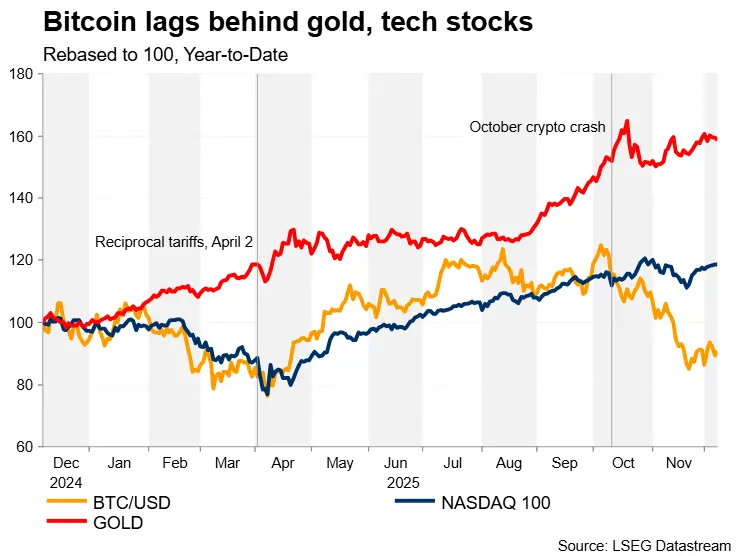
This is different from "everyone is out of money." Everyone has found a way out, while you stand still, watching money flow past your door without a single cent coming in. This type of missed opportunity is much more painful than a bear market.
BTC lacks the safe-haven status of gold, and tech stocks are hitting new highs without it. When the market panics, it is the first to be sold off alongside risk assets. It doesn't get included when prices rise, nor does it get left behind when they fall; it misses out on both ends.
Those holding coins want to hedge, but it doesn’t provide that; they want to speculate on rebounds, but it doesn’t bounce. The two things they initially bought it for have not materialized this year.
Losing money at least has a clear reason: you misjudged the direction. But missing out is different; you haven’t done anything wrong, the money just flows around you, and you can’t even find a specific target to blame.
Thus, the entire crypto space has become the popular term in the South Korean stock market: thunderstruck poor people.
However, people in the crypto space have a keen sense and a drive to hustle; the real response of more thunderstruck poor people is not to lie flat but to migrate with the trend.
On social media and community forums, discussions that used to revolve around which altcoin could double have now shifted to Nvidia's earnings report and Tesla's support levels, while still listing crypto tickers in their bios.
Everyone has transferred the skills they honed from trading crypto to this new arena, analyzing K-lines, chasing trending narratives, and enduring volatility, only the targets have changed from altcoins to U.S. stock codes. Some even repurpose the scripts they used for trading crypto to create monitoring tools for U.S. stocks, keeping an eye on the market, setting alerts, and automating orders.
The skills haven't gone to waste; they have just been applied elsewhere.
On the other hand, crypto exchanges are also actively saving themselves and adjusting, launching various on-chain U.S. stock trading products in response to the trend, as Hyperliquid has already set an example for the entire crypto market.
So when exchanges sell stocks, it is a subtle attempt to retain users. Users want assets that are hitting new highs, so they bring in those assets to keep people around. From retail investors monitoring the market to exchanges listing coins, the entire industry is doing the same thing:
Finding ways to ride the wave of a market they missed out on, ultimately it is still a form of trend-following FOMO.
Whether actively or passively, everyone is clear about one fact: if they don’t adjust their mindset, what is truly rising will never be what they hold.
Don’t let missing out force you to jump on the last bus
Those who don’t want to leave may still have some bullets left, whether through dollar-cost averaging into BTC or finding localized narratives; it doesn’t matter if the coins haven’t risen, my U hasn’t decreased. Sitting still in a bear market, waiting for the next wave to rise.
The principal is still there; can you treat missing out as if it never happened?
At the beginning of 2025, the RMB to USD exchange rate was still around 7.2 to 7.3, but entering 2026, it strengthened all the way, breaking through 6.8 in May for both onshore and offshore rates, entering the 6.7 range, reaching a three-year high.
What does this mean? Assuming you remained disciplined, didn’t chase highs or cut losses. As a result, holding U is also a loss. Missing out is at least when others earn and you don’t; now you are standing still while the ground beneath you is sinking.
Waiting isn’t a zero-cost endeavor; the wait itself is burning money.
Thus, a very natural thought arises: since crypto isn’t working, why not clear out and FOMO into what’s rising? This thought may be far more dangerous than missing out itself.
The feeling of missing out needs to be resolved, but perhaps not by chasing after it.
Let’s be honest, crypto really isn’t doing well this round, and you can’t comfort yourself with "it will come back later." The past logic was a four-year cycle: halving, bull market, new highs, and if you missed out, wait for the next round.
Now the game has changed; ETFs have turned Bitcoin into a position on institutional balance sheets, money on-chain is busy buying U.S. stocks, and even exchanges have switched to selling stocks… this round of crypto is no longer the same as the one you remember that could multiply tenfold overnight.
Hoping it will follow the old script again is itself a form of wishful thinking. But acknowledging that crypto is on a downward path doesn’t mean that the stock market is a safe haven.
If you rush in to chase gold, U.S. stocks, or South Korean chips, what you earn is not your insight but the money from the rising tide. Right now, global liquidity has lifted all boats together; the water level is high, and everyone seems to know how to swim. The problem is, the tide will eventually recede.
The real test is not whether you got on the bus back then. It’s whether you have the ability to switch your chips back to shore before the water goes down.
And this is precisely what ordinary people are least good at. We have proven time and again in NFTs and altcoins that we can catch the rise, but the successful profit-takers are rare, always thinking there’s another wave to ride until it goes to zero.
Changing markets won’t automatically erase these weaknesses. Transferring the skills from trading crypto to trading U.S. stocks will likely also bring along the mindset of "reluctance to sell."
So whether you missed out or not may be a false dilemma. The ultimate goal is to take profits before leaving the table.
The term "thunderstruck poor person" coined by Koreans was originally used for self-deprecation for not catching up. The English term FOMO probably carries a similar meaning. But if you are forced to measure yourself against someone else's balance sheet, pushing you to jump into a pool you can’t navigate at the highest water level, it is actually very dangerous.
The real thunder is never the bus you missed.
It’s that you finally squeezed onto the next bus but once again forgot at which stop you should get off.
 Risk warning




Popular articles





