








Why do I still have confidence in ETH?
 Core Viewpoint

 As stablecoins and RWAs accelerate on-chain, Ethereum's role as a global value settlement layer has just begun, and the market will eventually reprice ETH.
Author: Lucas
Compiled by: Jiahua, ChainCatcher
Ethereum is Dead
The sentiment towards Ethereum on Crypto Twitter is at a historical low.
Many of my peers have given up on Ethereum over the years, with some even leaving the broader crypto industry. Most of them hardly hold any ETH anymore, largely because they believe it no longer has investment value. This is not directed at any individual or group, but rather a genuine observation among my peers across the industry.
While the larger outflow of funds seems to be because cryptocurrencies are no longer at the forefront of technology (with AI, robotics, and biotech taking their place), the pessimism surrounding ETH largely stems from its price performance over the past five years.
The experience of holding ETH has been terrible. No need to beat around the bush.
But I remain optimistic about Ethereum and ETH, in fact, more resolute than ever. You should be too.
In fact, Ethereum is on the brink of its most exciting phase of growth and adoption. Let me explain.
About Price Performance
Let’s start with an obvious question: over the past five years, ETH's price performance has been an absolute disaster.
For those who have held since 2021, the best-case scenario is breaking even, while the worst-case scenario is significant losses. Even after the recent downturn, BTC is still above the historical peak of the 2021 cycle and reached twice the previous peak at its 2025 high.
In contrast, ETH is currently about 60% lower than the historical peak of the last cycle and is barely set to reach a new high in 2025, not even breaking $5000.
Meanwhile, the S&P 500 index is hitting historical highs almost daily, and any hot concept favored by Wall Street (such as AI, semiconductors, energy, etc.) is skyrocketing.
The good news is that if you extend the timeline, the chart actually looks like just a multi-year consolidation period. Ethereum still has a market cap of over $200 billion and has basically held the $2000 mark, firmly remaining among the top 100 assets globally.
The better news is that historically, high-growth assets often experience years of consolidation and volatility before embarking on epic price surges.
Ignore the percentage fluctuations. What matters here is the time spent at this price range.
In fact, all of the largest companies in the world have gone through this phase.
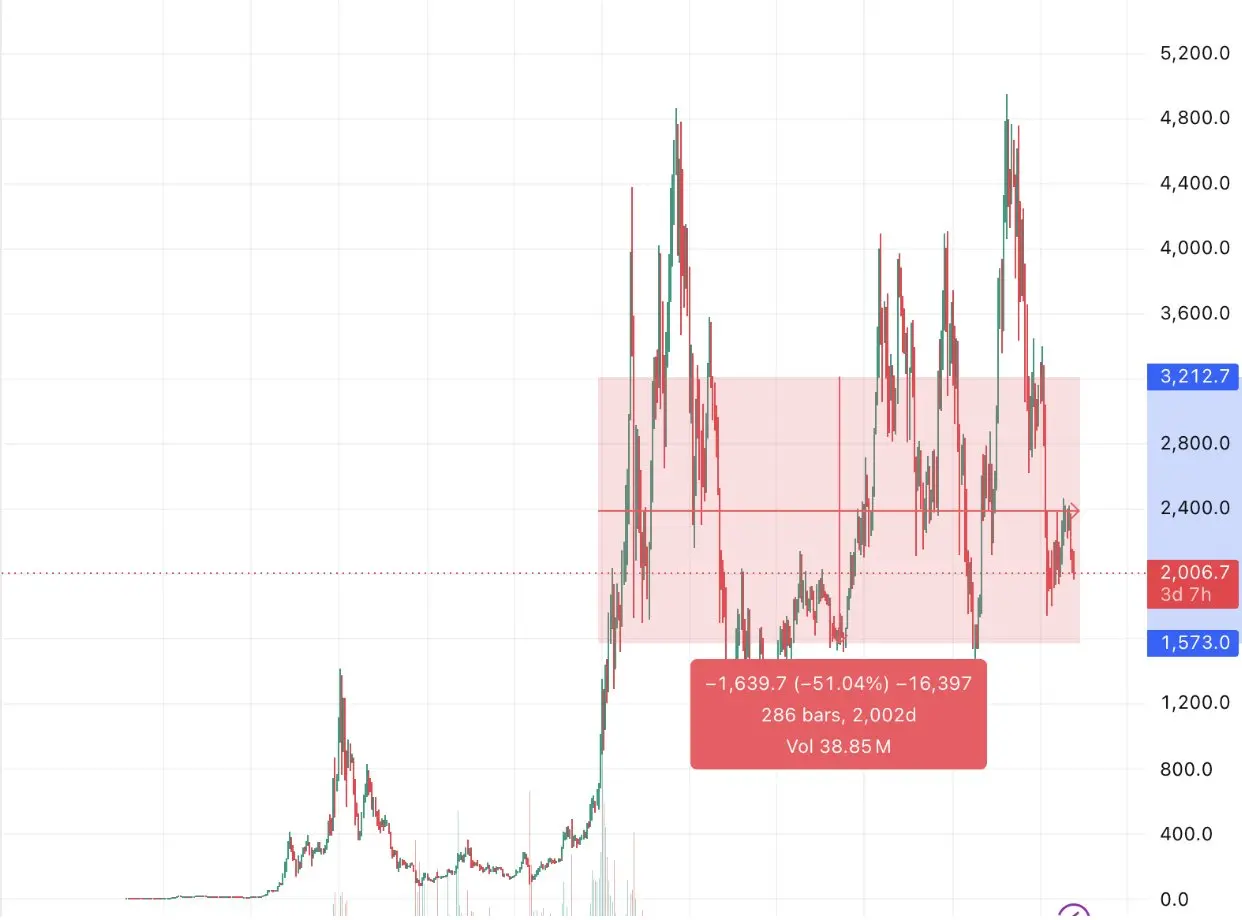
The first example is Amazon ($AMZN). Bezos led the company through nearly a decade of consolidation throughout the 2000s, surviving the downturn after the internet bubble burst, ultimately becoming one of the most valuable companies in the world.
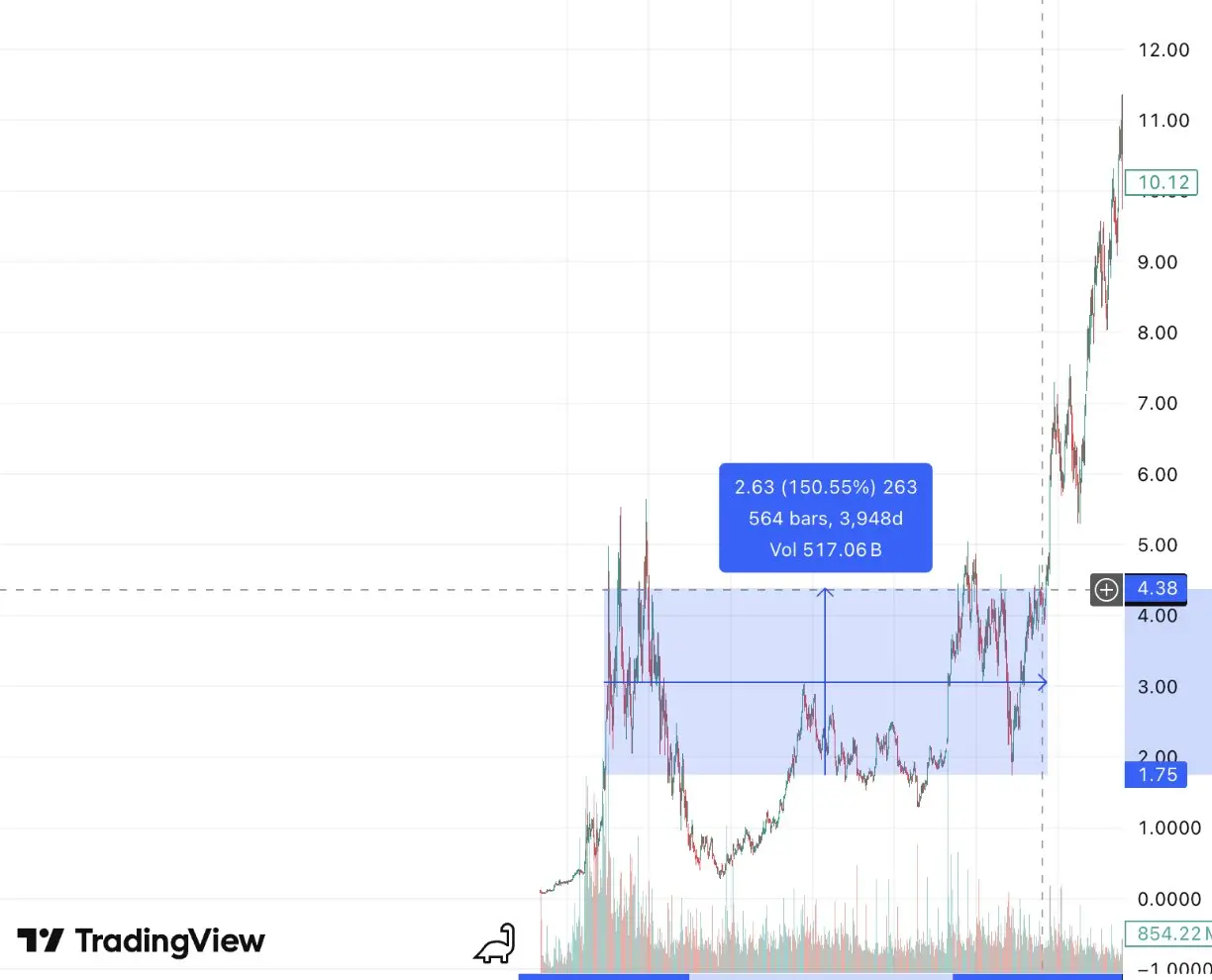
Wall Street darling Nvidia ($NVDA) also experienced a seven-year consolidation in the 2010s. Riding the wave of AI, it has now become one of the most valuable companies globally.
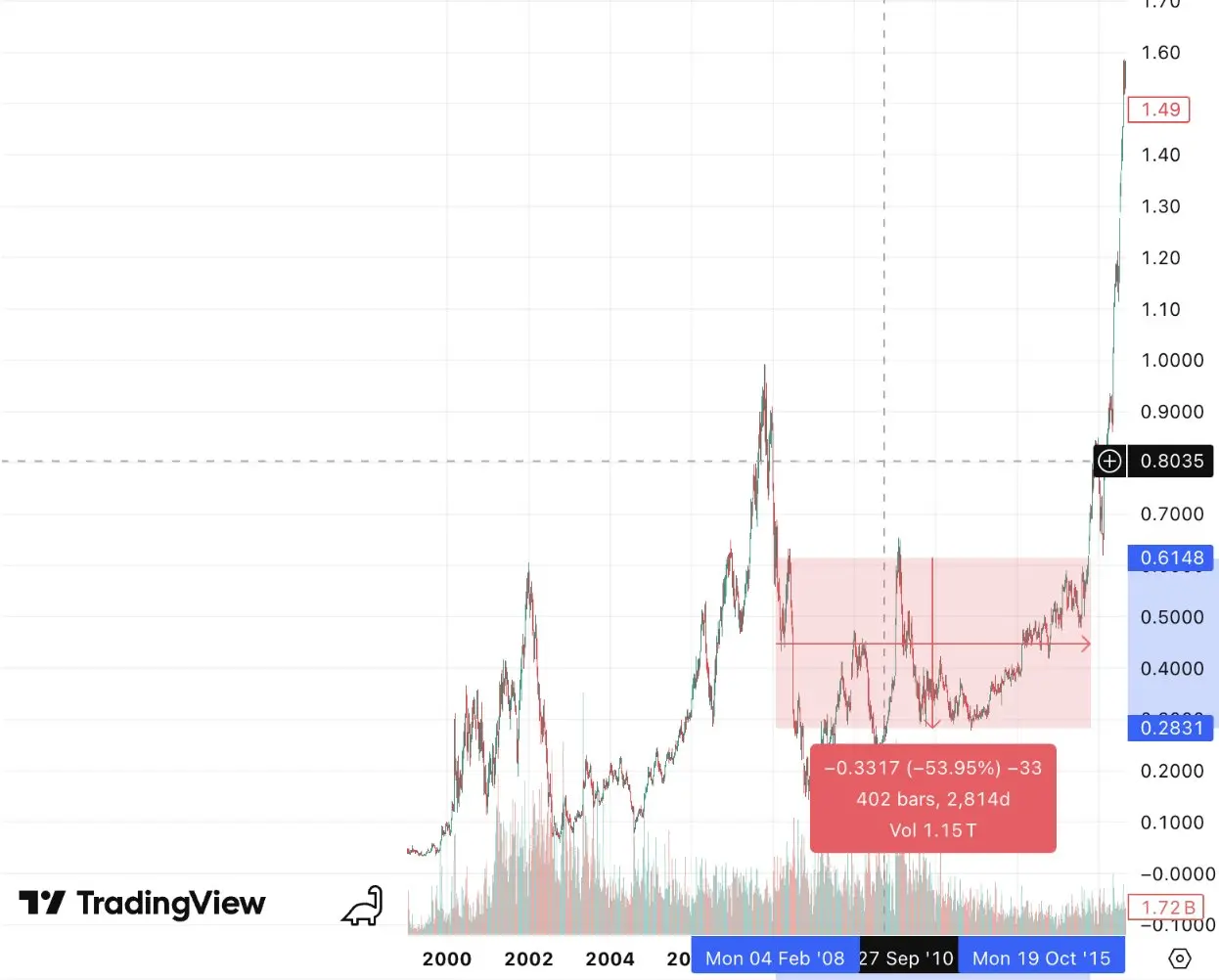
Apple ($AAPL) faced similar struggles in the 80s and 90s, trying to find its footing until Steve Jobs returned to the company in 1997.
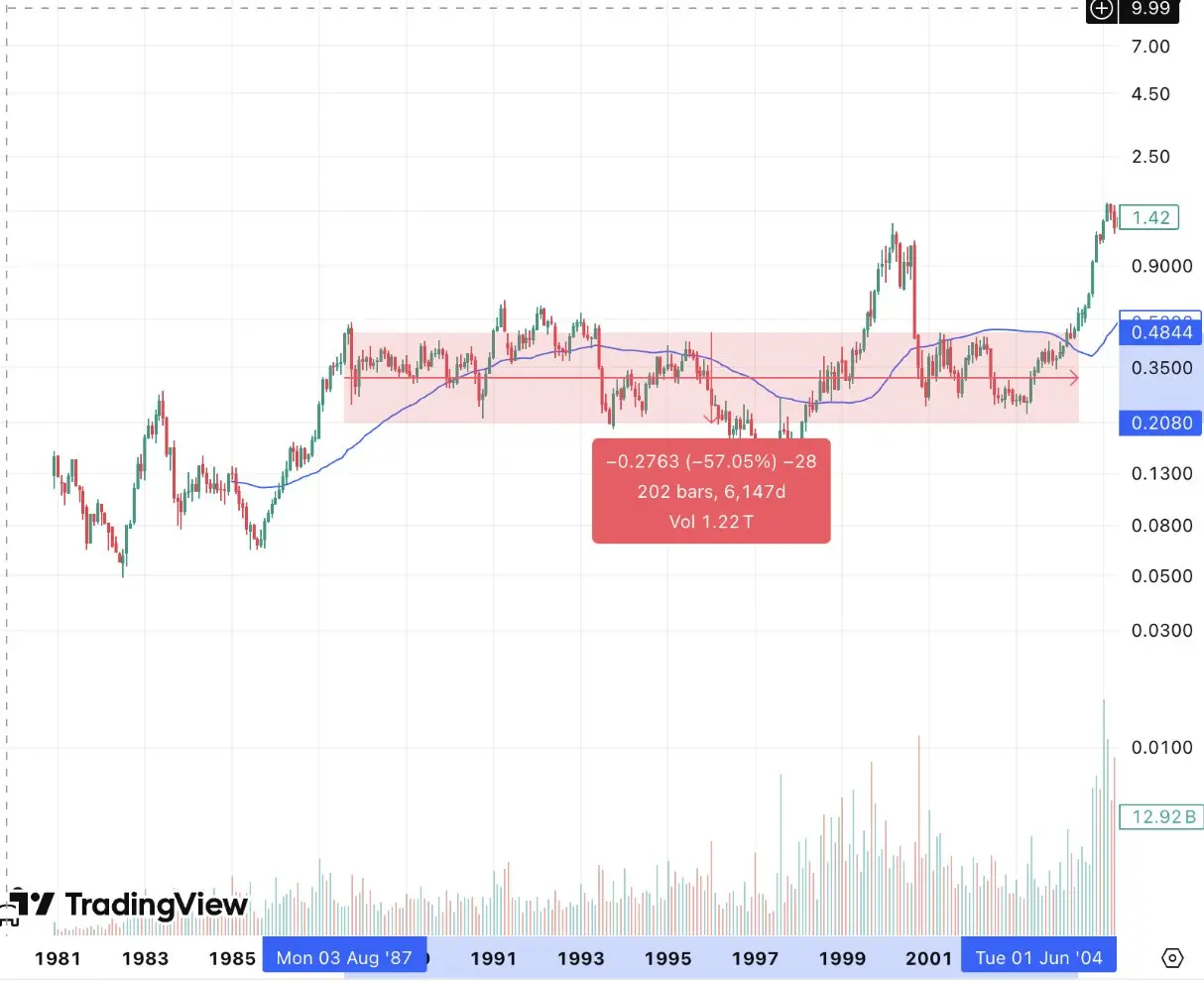
Finally, Microsoft ($MSFT) underwent about 15 years of consolidation before breaking through its historical highs. If you bought MSFT in 2000, you wouldn't have truly broken even until 2015. It is now the second most valuable company in the world and one of the best-performing companies over the past five years.
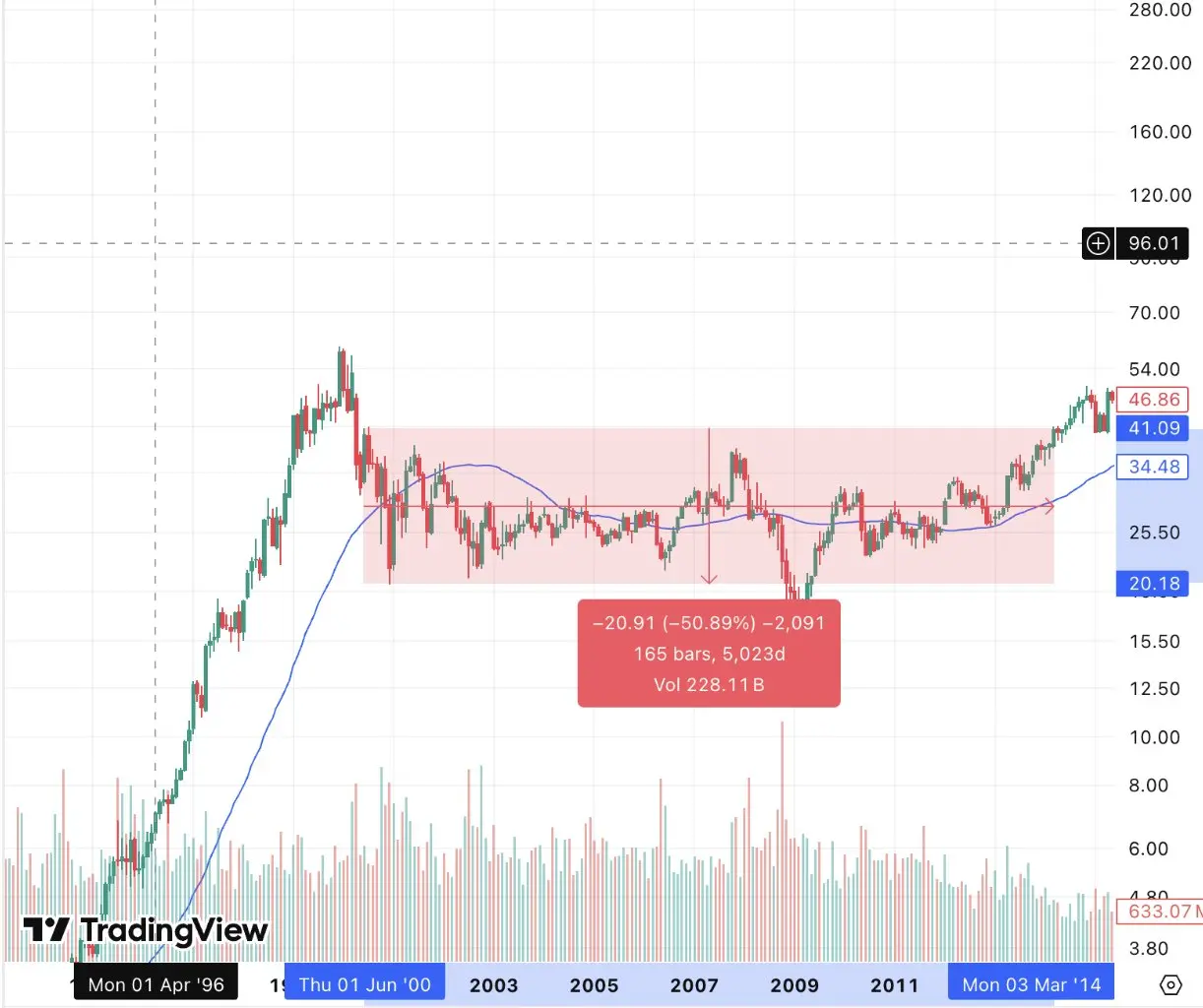
I believe you understand. Almost all of the most valuable companies in the world have gone through these extremely long and tedious consolidation periods (if lucky, they briefly retest historical highs before dropping again), only to eventually encounter the catalysts that drive their next growth phase.
It is also worth noting that during these periods, the S&P 500 index frequently set historical highs, while the performance of the aforementioned assets lagged behind the market.
Therefore, in terms of ETH's price performance, looking through the lens of financial history, the past five years is not unusual.
The most reassuring thing is that when you set aside price performance and examine its fundamentals, you will find that Ethereum's fundamentals have never been stronger.
About Network Activity
You might think that with the poor sentiment and price trends, Ethereum's network activity would also be sluggish.
Transaction volumes should be declining, fees would be so high that no one would want to use it, and there would be virtually no adoption.
The reality, however, is quite the opposite.
Transaction volumes on Ethereum are surging. Fees are cheaper than ever. And the pace of tokenization is accelerating (which will be detailed below).
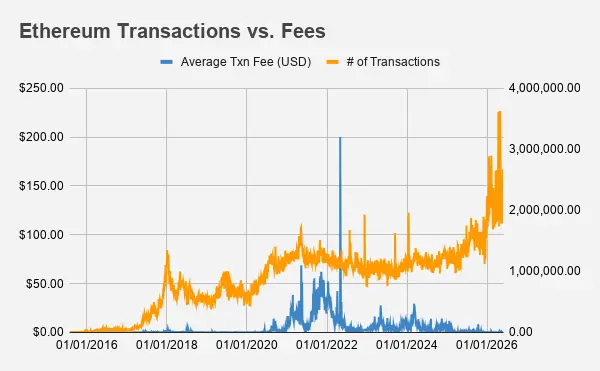
Data Source: Etherscan.
As of May 2026, Ethereum is processing an average of 2.27 million transactions per day. This is a historical high for the network. Meanwhile, the average fee during this period is only $0.27. This starkly contrasts with the $50 to $100 or more that people paid during the 2021 frenzy (even though the current transaction volume is higher).
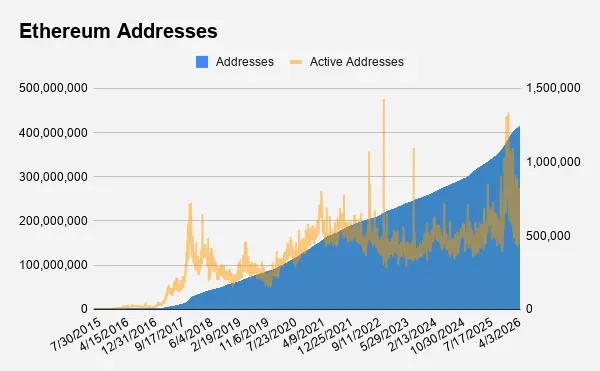
Additionally, the number of addresses continues to grow. The network has surpassed 400 million addresses and is growing at a stable rate of about 0.08% per day, with daily active "users" exceeding 1 million in recent months.
At this rate, assuming no significant growth catalysts during this period, Ethereum will surpass 1 billion addresses sometime in mid-2029.
Finally, the amount of ETH staked on the network continues to reach new highs. Currently, over 32% of the supply is used to secure the network.
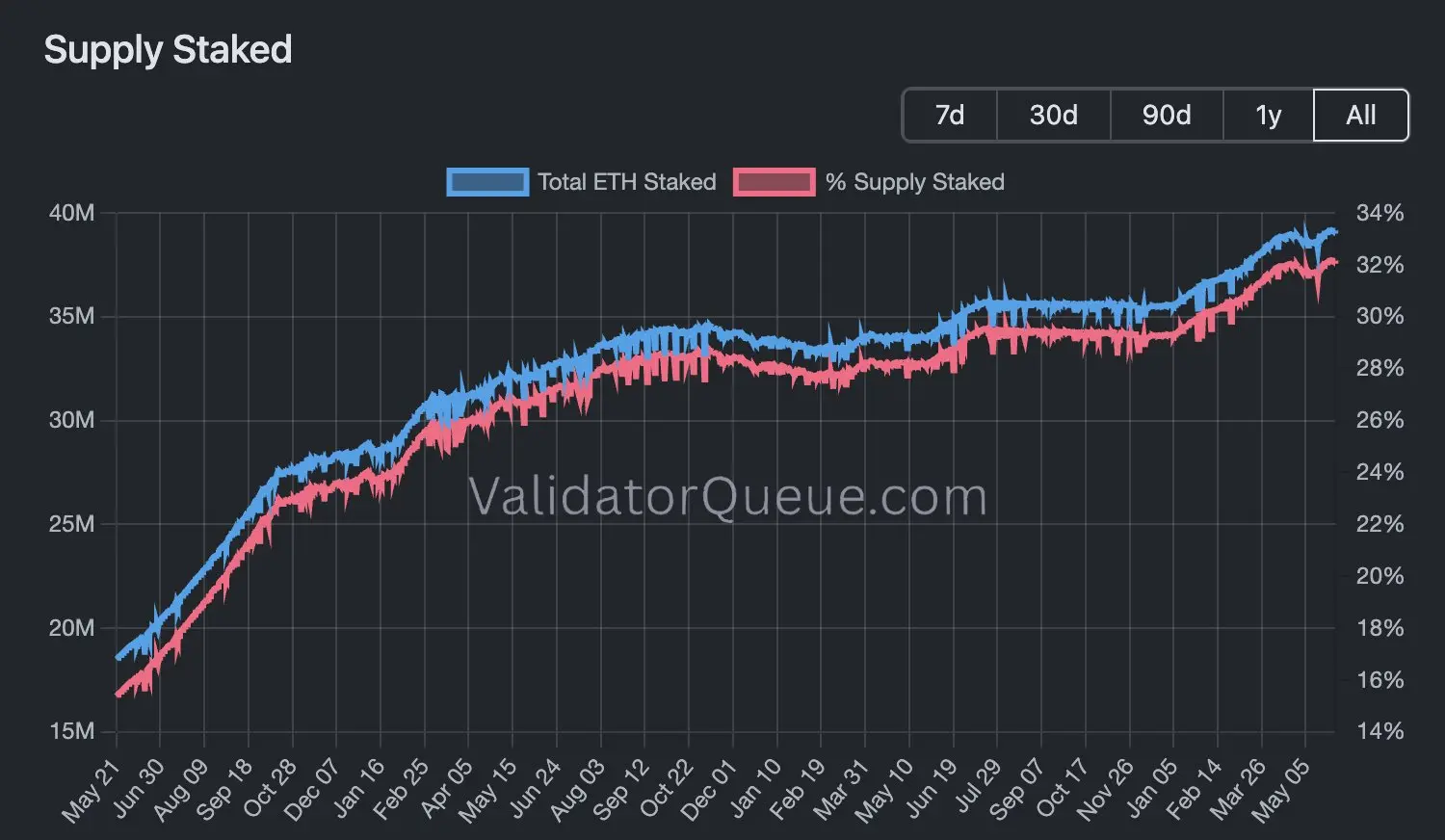
All of this indicates that Ethereum has achieved significant scalability while maintaining its security and decentralization.
Moreover, Ethereum has maintained 100% uptime throughout its existence of over a decade, giving the network an unfair advantage: it is the most trusted, neutral, secure, and programmable block space in the world.
This is a prerequisite for Ethereum to become the infrastructure of the global financial system.
Infrastructure of the Global Financial System
Since entering this field in 2017, my assertion about Ethereum has always been:
- All value will be tokenized
- Ethereum is the settlement layer for tokenized value
- ETH will capture the value generated by settlement layer activity.
In its first decade of existence, Ethereum has been the experimental ground for crypto-native tokenization (such as DeFi, NFTs, meme coins, etc.). This is a crucial foundational step, and while this experimentation will continue, the network is opening a new chapter that pushes itself to trillion-dollar levels.
For hardcore crypto natives and cypherpunks, this chapter may seem more "boring," but it undoubtedly plays an extremely valuable and important role in the world. This is something we should all support.
Ethereum will become the primary stronghold for the $700 trillion worth of traditional assets that are destined to be tokenized.
Many readers at this point may respond, "Ethereum can't scale to support this," or "other competitors will eat up market share."
But for these critics, the harsh reality is that early data shows the exact opposite result: the financial system is gravitating towards Ethereum.
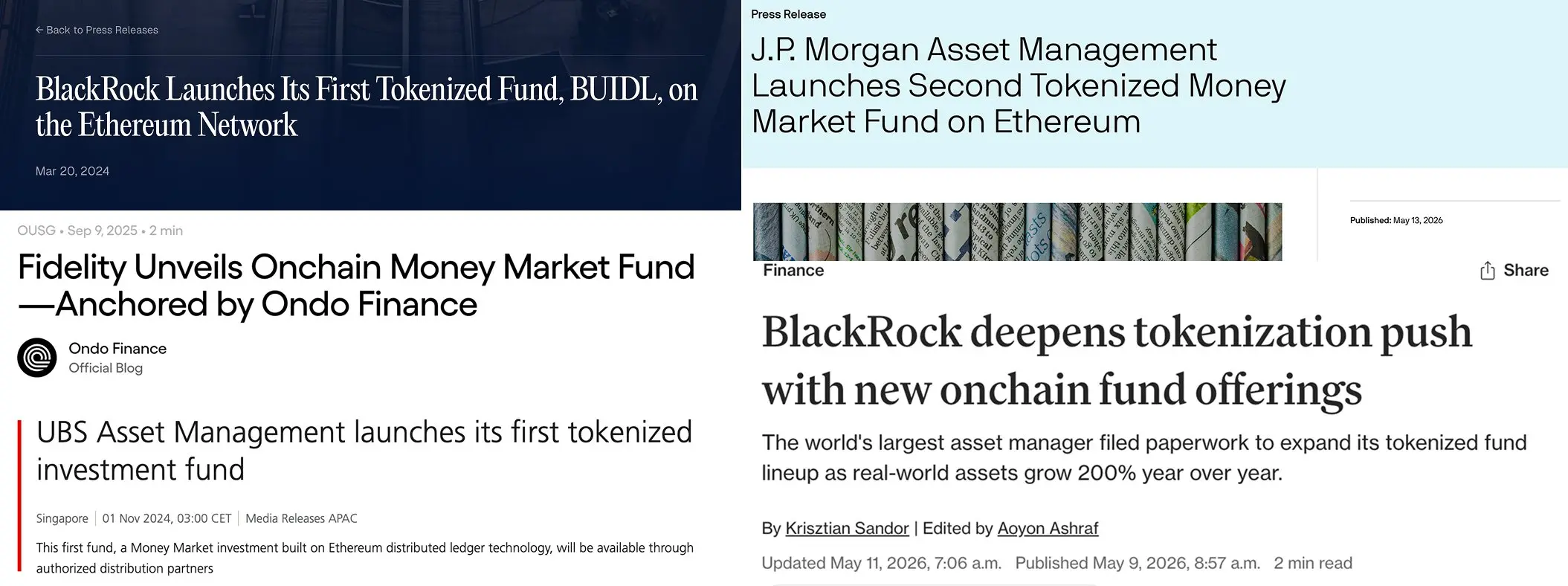
A series of headlines over the past two years. Notice they all have one thing in common.
Today's financial institutions need certainty. Banks, asset management firms, and clearinghouses are deciding to trust blockchain to secure their valuable assets, which is a huge and significant decision.
They need to seize the tremendous opportunity at hand, but they also do not want to be fired.
This does not mean that projects like Hyperliquid and Solana cannot succeed or cannot take a piece of the pie, as the cake is big enough. In fact, I firmly believe that there will be multiple beneficiaries of this wave.
However, in the process of institutions moving towards tokenization, Ethereum will be the preferred choice.
If you don't believe the headlines, don't worry. I have evidence.
Stablecoins are the first tokenized real-world assets to find product-market fit. Their circulation has surpassed $300 billion, and Tom Lee referred to it as the "ChatGPT" moment for the cryptocurrency space.
Where is the main stronghold of stablecoins?
Ethereum, which occupies about 54% of the total market share.
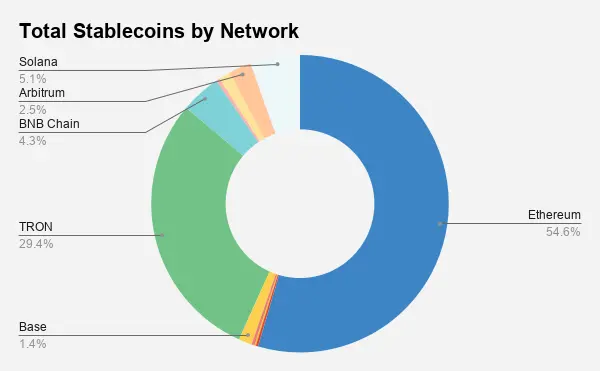
It clearly illustrates my expectations for the development of RWA tokenization: Ethereum will win, while many other networks will also capture their share.
The data so far supports this claim.
According to @RWA_xyz data as of June 1, 2026, the total value of real-world assets (RWA) is currently experiencing parabolic growth, exceeding approximately $30 billion.
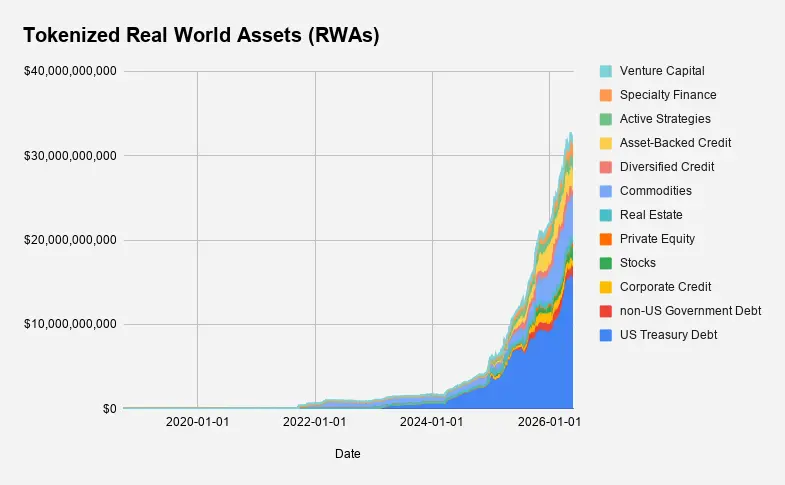
Not surprisingly, over 53% of existing RWAs are located on Ethereum. Despite fierce competition among various Layer 1s, and any network having the opportunity to compete for the non-stablecoin RWA pie, Ethereum remains the dominant winner.
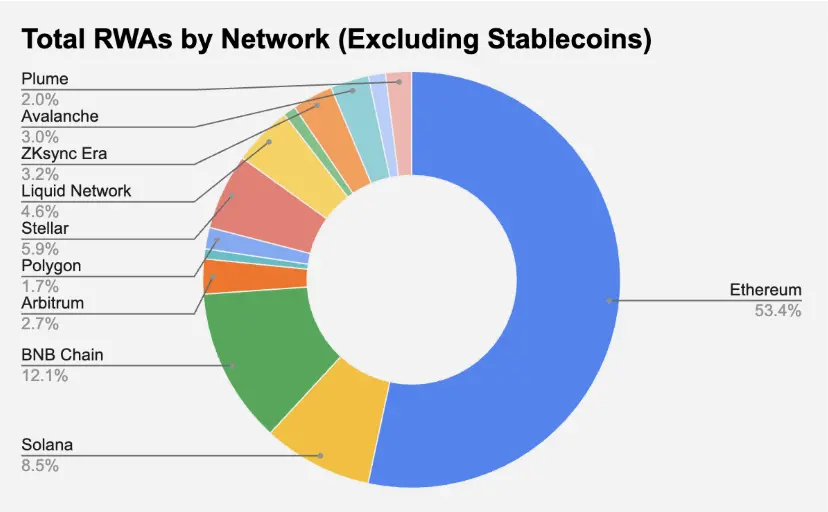
Today's RWAs remind me of DeFi in 2019/2020. A brand new and rapidly emerging field with a clear path to becoming the next "big trend," supported by early growth data.
This is a snippet from @DefiLlama showing the exponential growth of DeFi TVL at the beginning of 2020. If you look closely, this chart should look very familiar.
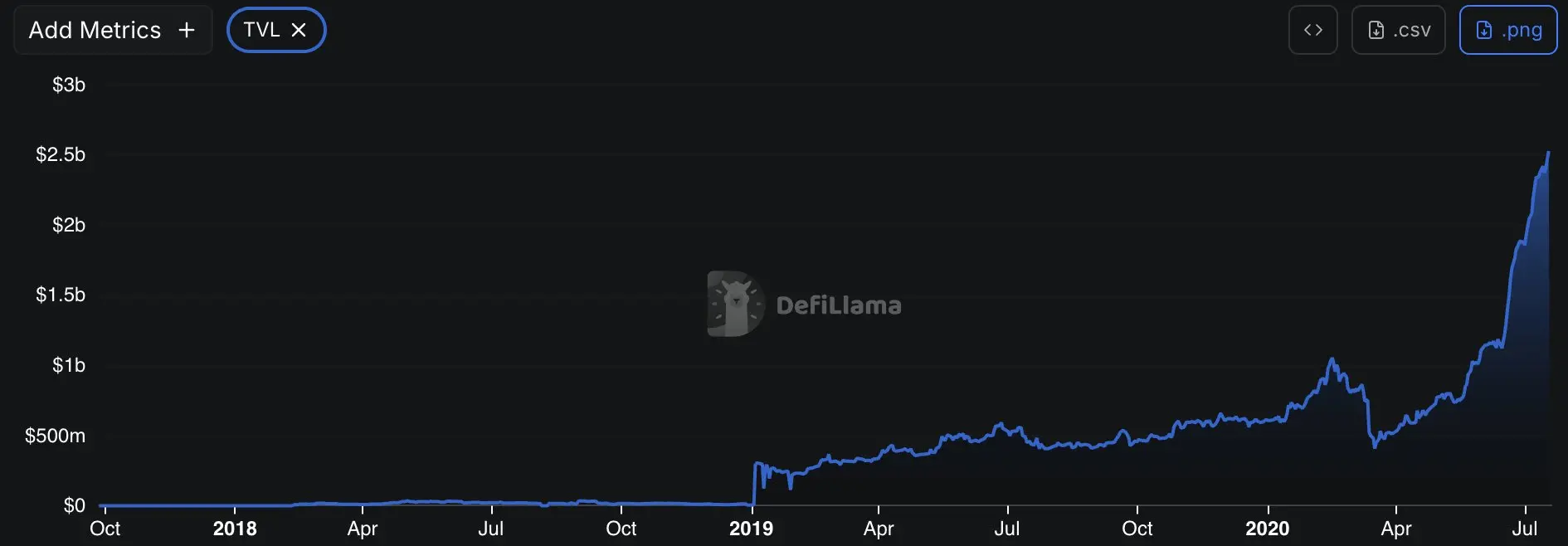
Coincidentally, when DeFi's TVL reached billions of dollars, it was precisely during the period when ETH was stagnating.
The summer of DeFi was in full swing, liquidity mining was all the rage, yet ETH was still recovering from the crash triggered by the pandemic, hovering between a valuation of $2 billion to $2.5 billion (only a tenth of today's valuation).
Meanwhile, the newly launched BNB Chain was threatening Ethereum's throne as a scalable and cheap alternative.
It wasn't until DeFi began to occupy a significant portion of the network (around 20% of the network's market cap at the beginning of 2021) that ETH began its epic rise, soaring from around $300 to about $4000 by the end of that year.
For background reference, the current value of all RWAs on Ethereum (excluding stablecoins) is $16 billion, which is about 7% of ETH's $230 billion market cap. We are now at the same crossroads, only with all the numbers magnified by 10 times. Not $3 billion in DeFi, but $30 billion in RWA; ETH is no longer stagnating at $200, but firmly sits at $2000.
Replacing BNB Chain is Hyperliquid (by the way, BNB's performance is still outstanding).
✍️ Note: It is undeniable that DeFi at that time generated more demand for ETH as collateral, and the NFT narrative enhanced the "ETH as currency" story.
On the other hand, Ethereum at that time did not have a proof-of-stake (PoS) mechanism, and EIP 1559 was only implemented towards the end of the cycle. Now both mechanisms are live, so there is a clear path indicating that any activity on Ethereum will return value to ETH.
If this "10x expansion" assumption is accurate, it means that the total value of RWA in this cycle could exceed $1 trillion (the peak of DeFi TVL was about $150 billion). This is without including stablecoins.
With the advancement of The Clarity Act, this assumption becomes even more reasonable, as the act paves the way for the tokenization of everything and the on-chain migration of the financial system in the U.S. (and globally).
According to @Polymarket data, as of the time of writing, the probability of this act being signed into law by the end of the year is about 55%.
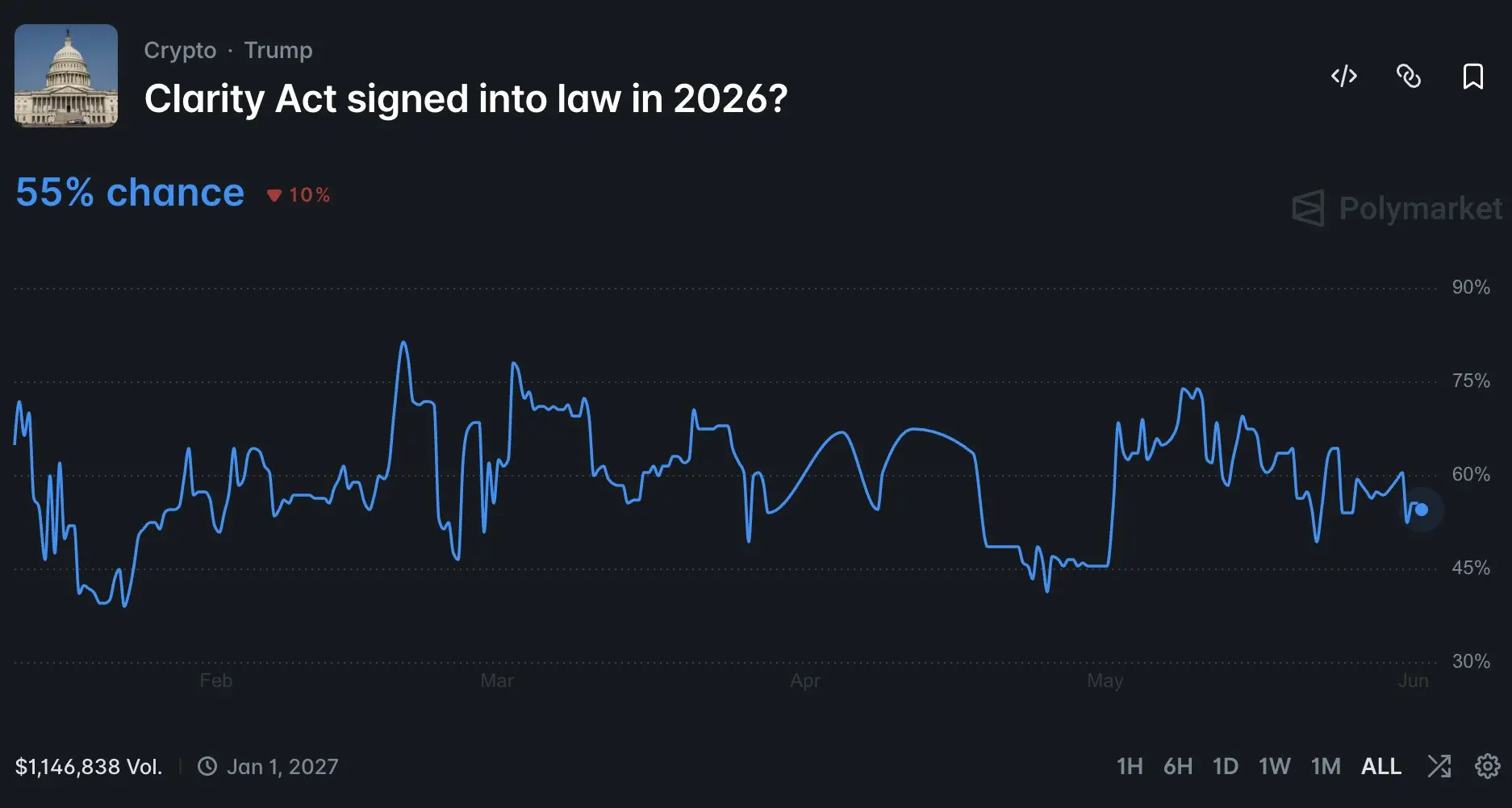
If it is signed into law in 2026 or later, it will be a significant catalyst for Ethereum and the entire crypto space.
Ethereum is Still Thriving
All stocks, bonds, commodities, currencies, real estate, art, intellectual property, and anything of value will be tokenized.
This is the next great financial innovation of the world. The crypto industry is finally ready for it. The industry has spent its first 20 years focused on tokenizing unique and quirky crypto-native values (protocols, applications, etc.).
The next 20 years will be dedicated to bringing everything else in the world on-chain.
Despite the continued poor sentiment on Crypto Twitter, I firmly believe that Ethereum will become the home for most of the tokenized value in the world.
Why? Because it has excelled in the areas where it must rely on strength: security, reliability, and liquidity.
If Ethereum carries most of the world's value, the market will ultimately have to reprice ETH (just like in the past).
But I think I will save this analysis for the next discussion.
Thank you for reading. Hang in there, ETH holders.
 Risk warning



Popular articles





