








Tokenized US stocks are not the "liquidity killer" of the crypto market
 Core Viewpoint

 "As garbage coins are gradually eliminated, the protocols, infrastructure, and financial products that can truly create value will have the opportunity to obtain a more reasonable valuation."
Author: Hu Tao, ChainCatcher
I. The Unestablished Liquidity Controversy
In the past few months, tokenized US stocks have rapidly become one of the most discussed topics in the crypto industry.
From the emergence of platforms supporting on-chain stock trading to an increasing number of exchanges and DeFi protocols starting to lay out related businesses, and as the regulatory environment gradually clarifies, the tokenization of US stocks has evolved from a fringe concept to the most explosive direction in the entire RWA (Real World Assets) track.
However, alongside the rapid rise in interest, there is also a concern in the market: when high-quality stock assets like Nvidia, Tesla, Apple, and Coinbase are moved on-chain, will the funds that originally belonged to the crypto market be siphoned off by these traditional assets? Will Bitcoin, Ethereum, and even altcoins face greater liquidity pressure as a result?
This concern is not unfounded. For many ordinary investors, when trading can be done through on-chain accounts, one side features volatile and cash flow-deficient crypto assets, while the other side consists of stocks from leading global tech companies with real businesses, profits, and valuation systems, the latter seems more likely to gain recognition from traditional funds.
But if we extend the time dimension, people may find that this wave of US stock tokenization does not pose a direct threat to the crypto industry; rather, it is likely the most significant expansion for the crypto industry since DeFi Summer—of course, it could also be the most important event in crypto history.
Essentially, US stock assets and the vast majority of crypto-native assets belong to different categories of assets. Historical data and on-chain capital flows indicate that when on-chain asset categories expand, there may be short-term capital reallocation frictions, but in the medium to long term, capital with different risk appetites will form a complementary rather than substitutive relationship on-chain.
More critically, the prosperity of tokenized US stocks heavily relies on stablecoins and the settlement layer of native public chains. Without USDC and USDT, there would be no payment tools for buying stock tokens; without Ethereum, Solana, or Base, there would be no vehicles for issuance, trading, and clearing; without DeFi protocols, stock token holders would not be able to unlock their capital efficiency.
Investors may enter the on-chain world to purchase stock tokens, but a significant portion will gradually engage with stablecoin payments, on-chain lending, yield products, and even crypto-native assets.
"Stablecoins, tokenized US stocks, etc., once on-chain, will not simply lie dormant on the chain; they must become liquid, and the composability of crypto will be fully utilized. Once there is a good narrative and good projects, not only will funds from the crypto circle come in, but funds from outside the circle will also flow in; this is merely a competition in the same arena," said renowned crypto researcher Blue Fox.
According to DeFillama, the total TVL of tokenized stocks and ETFs has now exceeded $1.7 billion, making it the fastest-growing vertical in DeFi.
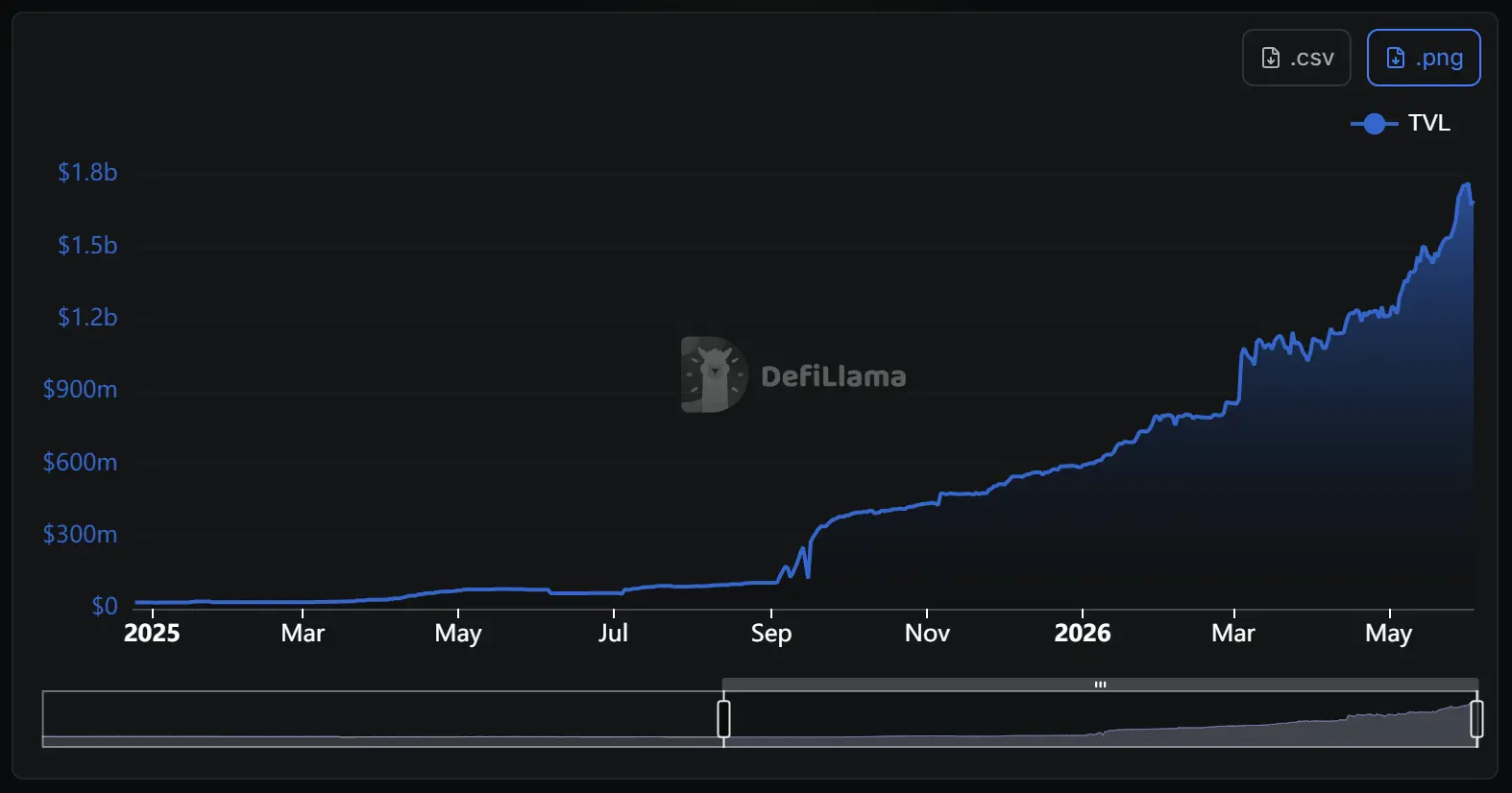
Recently, exchanges such as Binance, Bitget, and Gate have announced the launch of real-time US stock trading functions and support for tokenization on-chain, indicating that the market size for US stocks will continue to expand rapidly, and its market demand has been fully validated.
More significantly, an increasing number of traditional financial giants are also accelerating their layouts. In mid-May, the US Securities Depository Trust & Clearing Corporation, a global securities clearing giant, announced the integration of Chainlink to build the data and orchestration layer for its tokenized collateral platform, and later at the end of the month announced that it would launch DTC custodial asset tokenization services on the Stellar network. These developments have directly stimulated the rise in related token prices, bringing direct benefits to the adoption rates of crypto market infrastructure service providers.
Such dynamics convey an extremely clear signal: the traditional financial world not only does not view blockchain as a "competitor," but is actively embracing public chains as the infrastructure for asset clearing and settlement. The choice of DTCC is not an isolated case—JPMorgan's Onyx platform, Citibank's tokenization services, BlackRock's BUIDL fund, and the tokenized stock plans approved by Nasdaq and the New York Stock Exchange are all pointing in the same direction: the underlying architecture of global finance is undergoing a system-level "on-chain" migration.
This has dual value for the crypto industry. On one hand, it provides the strongest endorsement for the regulatory legitimacy and market credibility of tokenized assets—when institutions like DTCC choose public chains, it effectively announces to thousands of financial institutions worldwide that "on-chain assets are trustworthy." On the other hand, the entry of these institutions directly drives the adoption rates of existing crypto infrastructure service providers, with Chainlink's data oracles, Stellar's asset issuance standards, and Ethereum's smart contract capabilities all gaining actual demand validation in this process.
II. Driving a System-Level Upgrade of Global Financial Infrastructure
From a more macro perspective, the greatest significance of the US stock tokenization craze for the crypto circle may not lie in how much "new money" it can bring, but in the fact that it has, for the first time, irrefutably demonstrated the practical value of blockchain technology to the traditional financial world.
For over a decade, the crypto industry has been trying to prove the importance of blockchain to the outside world, but many narratives have remained at the level of technical vision. In contrast, US stock tokenization directly corresponds to the core demands of the global capital market—more efficient issuance, lower-cost circulation, more transparent settlement, and broader global accessibility. When Wall Street begins to actively embrace these capabilities, blockchain finally ceases to be just a story of the crypto industry and starts to become an infrastructure upgrade that the entire financial industry participates in.
Today, tokenization is shifting from early fringe experiments driven by DeFi projects to a mainstream financial track led by large asset management institutions, custodians, exchanges, and financial market infrastructure providers. The change in leadership itself signifies that this "on-chain movement" is not a "downgrade" of a financial game, but a system-level upgrade of the underlying architecture of global finance.
As global investors begin to get accustomed to holding stocks, bonds, funds, and various real assets through blockchain, what the crypto industry gains will not just be a hot speculation, but a fundamental expansion of value-bearing capacity.
"Every market maturation is essentially a process of funds flowing from low-efficiency assets to high-efficiency assets. As junk coins are gradually eliminated, protocols, infrastructures, and financial products that can truly create value will have the opportunity to obtain more reasonable valuations. Tokenized US stocks may not be the endpoint of the crypto market, but they are likely to be an important turning point for the crypto market's transition from a 'speculative market' to a 'capital market,'" said crypto trader @WinWinBro.
Therefore, rather than viewing US stock tokenization as a threat to the crypto industry, it is better to see it as one of the most important milestones in the process of blockchain moving towards the mainstream financial system.
The moment the $75 trillion US stock market connects with crypto infrastructure—even if only achieving a 2% penetration rate—will also mean an additional $1.5 trillion of on-chain value. By then, no one will argue whether tokenized US stocks have drained liquidity or injected unprecedented value anchoring into blockchain.
 Risk warning

Popular articles





