








BTC ETF through the legal regulatory logic behind it

 Everything is attributed to the victory in the court's gray area.
Author: Will Awang, Web3 Xiaolu
After a decade-long arduous approval process, the BTC ETF has finally seen the light of victory. At 4 AM on January 11, 2024, the U.S. Securities and Exchange Commission (SEC) simultaneously approved 11 spot BTC ETFs, including: Bitwise, Grayscale, Hashdex, BlackRock, Valkyrie, Invesco, Ark, VanEck, WisdomTree, Fidelity, and Franklin.
All of this should be credited to Grayscale's victory. On August 29, 2023, a ruling by a U.S. federal court allowed Grayscale to win its lawsuit against the SEC for rejecting its application for a spot BTC ETF. This move accelerated the process for traditional financial giants like BlackRock and Fidelity to apply for BTC ETFs in the past few months.
This article will examine the SEC's change in attitude following Grayscale's victory from a regulatory perspective (actively identifying market manipulation risks), the logic behind approving BTC ETFs, and the SEC's continued stance that other crypto assets are securities, indicating a cautious approach to market risks.
1. Court Ruling Accelerates SEC Approval Process
The SEC previously did not approve BTC ETFs due to concerns about fraud and manipulation in the market. All rejected ETF applications cited the securities law's rationale regarding "protecting investors from market fraud and manipulation" (the products were not designed to prevent fraudulent and manipulative acts and practices).
The SEC first allowed trading of futures BTC ETFs in 2021, stating that futures products are harder to manipulate because the market is based on futures prices from the Chicago Mercantile Exchange (CME), which is regulated by the Commodity Futures Trading Commission (CFTC).
In the case, Grayscale argued that the logic for approving futures BTC ETFs should be equivalent to that for approving spot BTC ETFs; otherwise, all futures BTC ETF applications should be revoked. The judge agreed, stating that the SEC's rejection of Grayscale's application was arbitrary and without basis (acting arbitrarily and capriciously), as the SEC failed to explain how it treated similar ETF products differently. The court found that this discriminatory administrative action violated administrative law, agreeing with Grayscale's request and overturning the SEC's rejection of the application.
It was only after the Grayscale case that the SEC's attitude completely changed, shifting from passively not approving to actively reviewing, and stating in a 22-page approval document: This order approves the Proposals on an accelerated basis.
2. What Risks Does the SEC Identify for BTC ETFs?
As a long-established compliant financial product, there are no legal barriers for ETFs, and BTC is the only asset defined by U.S. regulators (especially the SEC) as a "non-security." So where does the risk of BTC ETFs lie?
In the 22-page approval document, the SEC tells us: The risk comes from the uncontrollable trading market of the ETF's underlying assets — specifically, the manipulation risk of the BTC spot market.
Although each ETF has signed surveillance sharing agreements with compliant trading exchanges (such as CME) to monitor the risks in the BTC futures market, the BTC spot itself is not traded on CME, making it impossible to cover the BTC spot market with monitoring.
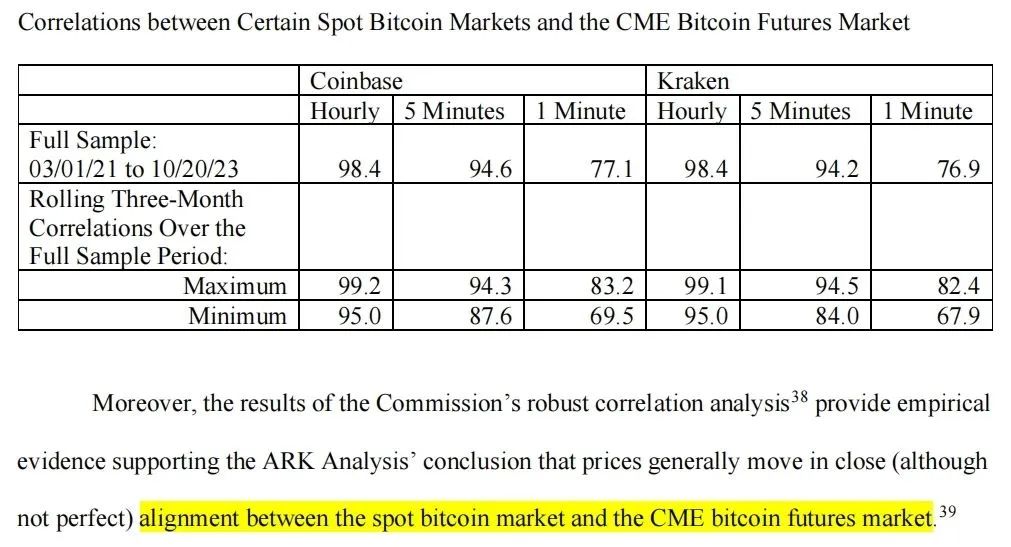
BTC futures on CME are already compliant products. Therefore, demonstrating the price correlation between BTC spot and BTC futures in CME is the best option. Consequently, the SEC compared the BTC prices from two crypto exchanges, Coinbase and Kraken, with CME futures prices since 2021 and found a high correlation between the two. This means that if fraudulent or manipulative behavior occurs in the BTC spot market, it is likely to also affect the futures market, which would be detected by CME's monitoring system, allowing regulators to control the risks.
3. Market Manipulation in the BTC Spot Market
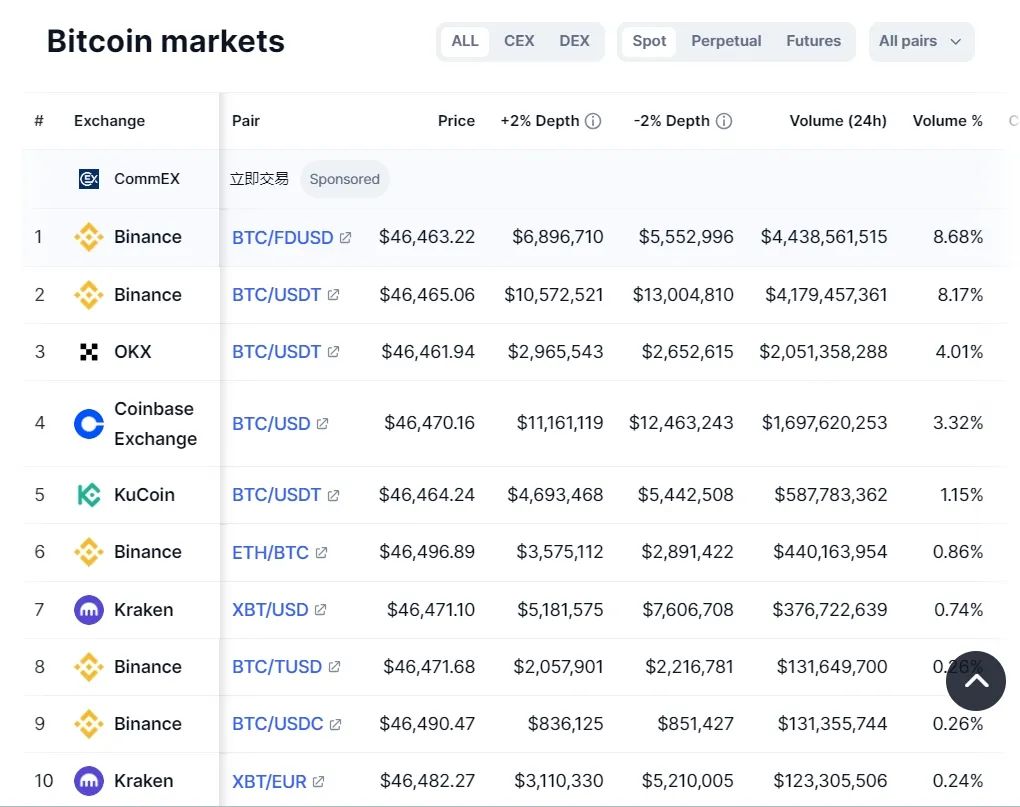
The risk of market manipulation in the BTC spot market mainly comes from market makers or participants trading on centralized exchanges (CEX). If U.S. regulators can cover the regulation of CEX, they can achieve relative control over the risks.
To this end, U.S. regulators have opted to implement compliance oversight over the two crypto exchanges, Coinbase and Kraken, while simultaneously "targeting" the largest trading volume exchange, Binance, and successfully establishing compliance control.
4. Neutral SEC and Cautious Gary Gensler
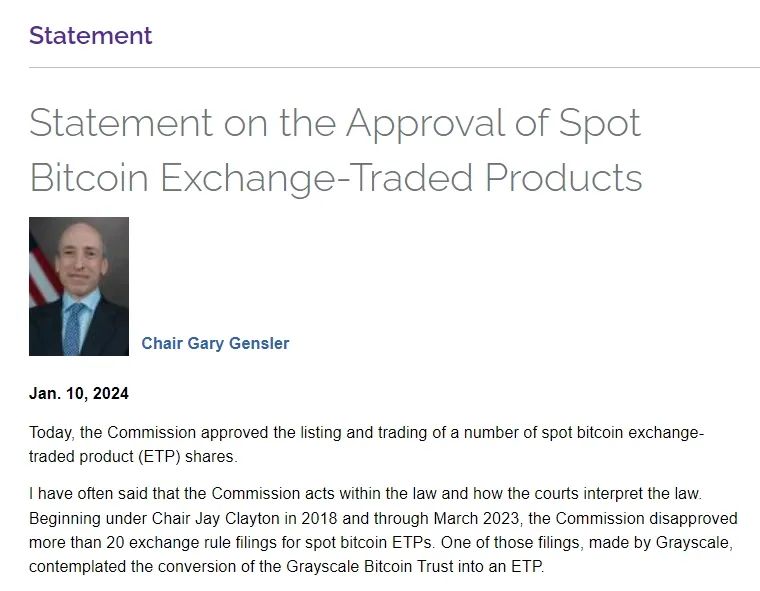
Thus, the neutral SEC evaluates whether the rules submitted by national securities exchanges comply with the Securities Exchange Act and its provisions, including whether they aim to protect investors and the public interest. At 4 AM on January 11, 2024, the SEC simultaneously approved 11 spot BTC ETFs, including: Bitwise, Grayscale, Hashdex, BlackRock, Valkyrie, Invesco, Ark, VanEck, WisdomTree, Fidelity, and Franklin.
(https://www.sec.gov/news/statement/gensler-statement-spot-bitcoin-011023)
More importantly, the SEC stated in its press release:
"This SEC ETF approval is limited to ETFs holding one 'non-security' commodity (BTC). It should not indicate that the SEC is willing to approve any other crypto asset securities' listing standards. The approval does not indicate the SEC's view on the status of other crypto assets under securities law or the current situation of certain crypto asset market participants not complying with securities law.
As I have said before, the vast majority of crypto assets are investment contracts and thus fall under the jurisdiction of securities law.
While the SEC is neutral, I must point out that the underlying assets in precious metals ETFs have consumption and industrial uses, whereas BTC is primarily a speculative, volatile asset that is also used in numerous illegal activities, including ransomware, money laundering, evading sanctions, and financing terrorism.
Although the SEC approved the listing and trading of spot BTC ETFs today, we have not approved or recognized BTC. Investors should remain cautious about BTC and products related to crypto assets."
5. Pressure on Coinbase — Defining Crypto Assets
Gary Gensler's remarks are very clear: BTC is not a security, and market risks can be controlled, thus it can be approved. Other crypto assets are securities, which is another story and has no relation to whether BTC ETFs are approved or not.
This still circles back to Gary Gensler's ongoing avoidance of directly answering the question of "what types of crypto assets are securities." This is a regulatory compliance issue for the SEC concerning the three largest exchanges, Kraken, Coinbase, and Binance, and also a political game that the SEC is asking U.S. judicial and legislative bodies to respond to.

Coinbase has been at the forefront of the fight against the SEC, shouldering this heavy burden. Judge Katherine Polk Failla previously referred to ETH as a commodity in the Uniswap case. Considering that this judge is also presiding over the SEC v. Coinbase case, her response to whether crypto assets are "securities" was: "This situation is not decided by the court, but by Congress," throwing this ultimate question back to the U.S. legislative body — Congress.
However, the legislative process in Congress will be very lengthy, and the 2024 election year will be worth watching.
6. GM BTC ETF
Regardless of how the SEC performs, the approval of the BTC ETF is historically significant, allowing those of us who harbor the ideals of crypto punks or dreams of overnight wealth to be part of it, adding a vivid splash of color to the rolling tide of history.
As Wang Chuan said: "January 10, 2024, in the context of world monetary history, looking back in the future, it may be comparable to August 13, 1971 (when Nixon announced the decoupling from gold) and January 18, 1871 (when Germany unified and led European countries and the U.S. to join the gold standard system in the following years)."

 Risk warning
 Risk warning




Popular articles





