








Will the Gas fees of Ethereum L2 really decrease by more than 90% after the Cancun upgrade?

 After the Cancun upgrade, the Gas fees for Ethereum L2 will decrease, but the reduction will be less than the market expectations.
Written by: NingNing
There is a consensus in today's market: after the Cancun upgrade, the average Gas fee for Ethereum L2 will decrease by 10 times or even more.
After the deployment of the core protocol EIP4844 of the Cancun upgrade, the Ethereum mainnet will add 3 dedicated Blob spaces to store L2 transaction and state data, and these Blobs will have independent Gas Fee markets. It is expected that the maximum scale of state data stored in one Blob space is approximately equal to one mainnet block, which is about ~1.77M.
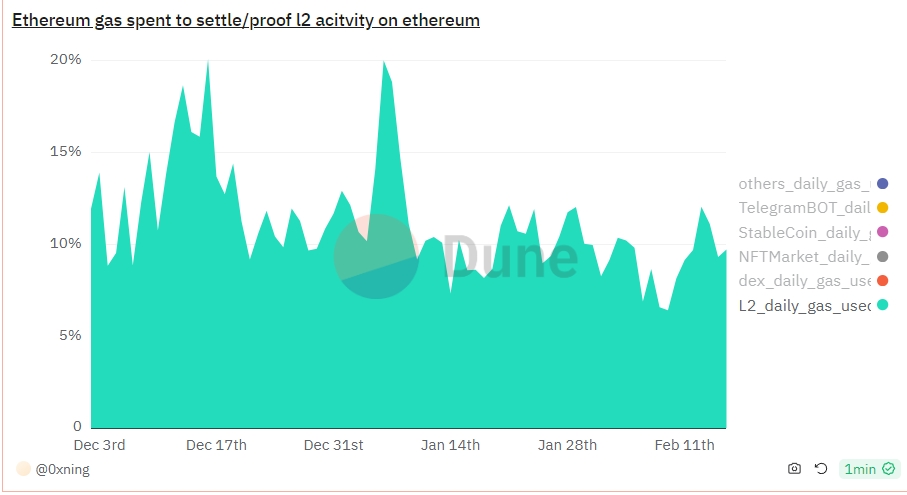
Currently, the daily Gas consumption of the Ethereum mainnet is 107.9b, with the Gas consumption of Rollup L2s accounting for about ~10%.
According to the economic supply and demand curve:
Price = Total Demand / Total Supply,
Assuming that the total Gas demand of Rollup L2s remains unchanged after the Cancun upgrade, and the block space that Ethereum can sell to L2s increases from the current ~10% of one block to three complete Blob blocks, this means that the total supply of block space expands by 30 times, then the price of Gas will decrease to 1/30 of the original.
However, this conclusion is not reliable, as it makes too many assumptions of linear relationships and abstracts away too many details that should be included in the calculations and considerations, especially the competition and game strategies among Rollup L2s regarding Blob space and their impact on Gas prices.
The Gas fee consumption of Rollup L2s mainly consists of two parts: data availability storage costs (state data storage fees) + data availability verification costs. Currently, data availability storage costs account for as much as ~90%.
After the Cancun upgrade, for Rollup L2s, the addition of 3 Blob blocks is equivalent to adding 3 pieces of common land. According to Coase's theory of common land, in a fully competitive market environment for Ethereum Blob space, it is highly likely that the leading Rollup L2s will abuse Blob space. This can ensure their market position while squeezing the survival space of competitors.
The following chart shows the profit statistics of 5 Rollup L2s over a year, revealing that their monthly profit scale exhibits significant seasonal variation without a clear overall growth trend.
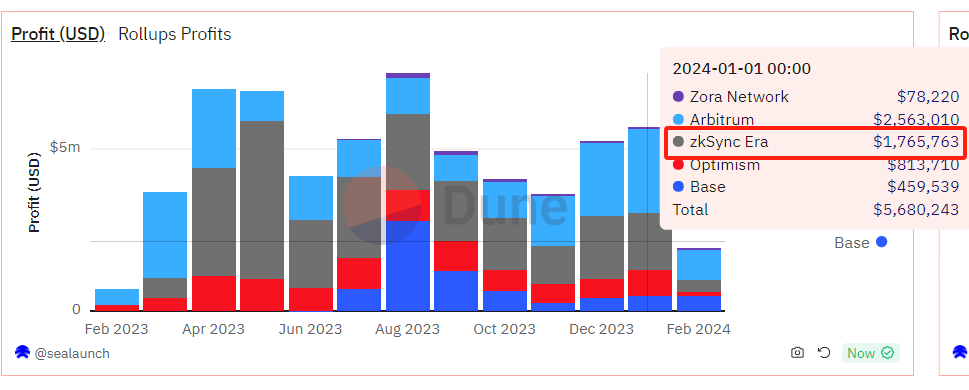
In such a market with a ceiling limit, Rollup L2s are in a state of constant high tension in a zero-sum game, competing fiercely for developers, funds, users, and Dapps. After the Cancun upgrade, they will have 3 additional Blob spaces to compete for.
In a market situation where "there's only so much meat, if others eat more, you eat less," it is difficult for Rollup L2s to achieve a Pareto optimal ideal.
So how will the leading Rollup L2s abuse Blob space?
Personally, I speculate that the leading Rollup L2s will modify the Batch frequency of the sequencer, shortening the current batch interval from a few minutes to about 12 seconds, keeping pace with the Ethereum mainnet block generation speed. This will not only enhance the quick confirmation of transactions on their own L2 but also occupy more Blob space to suppress competitors.
Under this competitive strategy, the structure of Gas fee consumption for Rollup L2s will see a surge in verification fees and batch fees. This will limit the positive impact of the newly added Blob space on reducing L2 Gas fees.
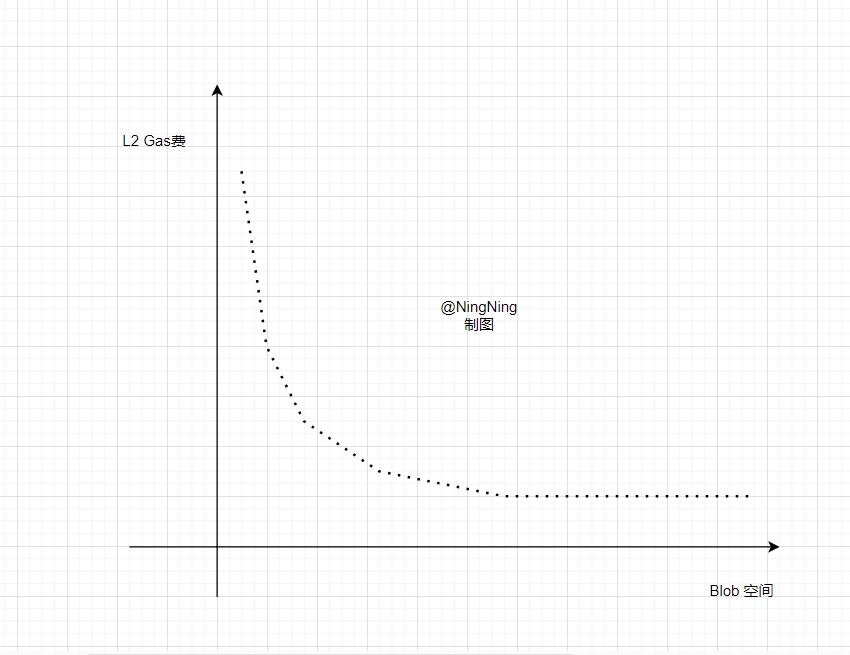
As shown in the above chart, the positive impact of increased Blob space on reducing L2 Gas fees will diminish marginally. Moreover, after reaching a certain threshold, it will almost become ineffective.
Based on the above analysis, I personally judge that the Gas fees for Ethereum L2 will decrease after the Cancun upgrade, but the extent of the decrease will be less than market expectations.
 Risk warning
 Risk warning


Popular articles





