








Bitcoin was born 15 years ago, and its price reached a historic high, returning to $69,000 per coin. What happened in the 800 days leading up to this?

 Unlike the high leverage of the previous bull market, this round of Bitcoin's price is supported by the "real money" net inflow from Wall Street after the ETF approval.
Author: Rhythm BlockBeats
Bitcoin is writing a new chapter in crypto history.
On March 5th at 23:05, the price of Bitcoin briefly reached $69,005. After crossing the $69,000 threshold, Bitcoin's market capitalization hit $1.35 trillion, surpassing Meta Platforms to rise to the 9th position among global mainstream asset market values. This marks the latest historical high since the creation of Bitcoin's first block in January 2009. This indicates that in this round of the crypto bull market, Bitcoin's rising price has been unleashed, paving the way for more new history.
$69,000 Three Years Ago
Looking back at the last crypto bull market, it was a bull market fueled by the dollar's liquidity.
In early 2020, the COVID-19 pandemic struck, causing the U.S. economy to plummet and unemployment rates to soar. Against this backdrop, the Federal Reserve launched a combination of "zero interest rates + quantitative easing" monetary policy tools, significantly lowering the federal funds rate from 1.5% to zero in two consecutive moves, and announced unlimited purchases of government bonds and MBS (mortgage-backed securities). This was the Federal Reserve's second large-scale monetary easing process since the 2008 subprime mortgage crisis.
As a result of this monetary "liquidity injection," the Federal Reserve's balance sheet expanded by 1.1 times in 26 months, growing from $4.2 trillion at the end of January 2020 to $9 trillion at the end of March 2022, an increase of $4.8 trillion. The absolute scale of this "liquidity injection" far exceeded that during the 2008 subprime mortgage crisis. More importantly, there was a significant difference in the trend of prices, a key macroeconomic indicator, after these two rounds of monetary "liquidity injection." In the same year, the Russia-Ukraine conflict triggered a rapid rise in global energy and food prices, further exacerbating the situation.
With more dollar liquidity, it inevitably flowed into various global markets, including Bitcoin.
In 2020, Bitcoin surged over 300%, with nearly a 50% increase in December alone. Subsequently, starting in early 2021, Bitcoin skyrocketed over 120%, reaching nearly $65,000 in mid-April, marking the beginning of a rollercoaster ride.
The U.S. cryptocurrency exchange Coinbase went public in April, achieving a valuation of $86 billion on its first day, making it the largest cryptocurrency company to go public to date. By May, Bitcoin's price experienced a 35% decline, only to soar to a historic high of $69,000 in November.
LUNA Collapse Triggers Market Liquidation
In May 2022, the Nasdaq index continued to decline, and the market's reaction to the macro situation was extremely pessimistic, with Bitcoin's price dropping nearly 10% for several consecutive days. Panic spread rapidly throughout the crypto market, and the collapse of Luna unfolded as an epic disaster in the crypto space.
To build its powerful 4Crv pool, the core team of the Terra ecosystem, LFG (Luna Foundation Guard), withdrew $150 million in UST liquidity from the UST-3Crv pool on May 8. However, just 10 minutes later, a new address suddenly dumped $84 million worth of UST, severely impacting the balance of the 3crv pool. To maintain the liquidity balance of the UST-3Crv pool, LFG withdrew another $100 million in UST from the liquidity pool.
As a result, several whale accounts began to continuously sell UST on Binance, with each transaction amounting to millions of dollars. UST began to decouple, and from that day on, a large amount of UST locked in Anchor flowed into the market, further increasing the selling pressure on UST. Due to UST's prolonged inability to return to its peg, it began to be sold off on a large scale, dropping below the $0.95 threshold.
On May 10, Jump Trading and LFG stopped selling Bitcoin reserves to protect the peg, allowing the situation to worsen, and UST plummeted to $0.6. This death spiral triggered by $300 million ultimately led to the collapse of Luna.

Luna founder Do Kwon was arrested in Montenegro
VCs and market makers like Three Arrows Capital, Galaxy Digital, and Jump Trading selectively ignored Luna's strong financial attributes, placing the Terra ecosystem, dominated by Anchor, into the public chain narrative, alongside ecosystems like Solana and Avalanche, continuously promoting "Solunavax."
After the collapse of Luna, individuals and institutions in the crypto space were on edge, and on-chain activities became more frequent. After stETH decoupled, Celsius was the first to encounter problems. This well-known CeFi lending platform in Europe and the U.S., with 1.7 million users and over $30 billion in assets under management, was ultimately forced to suspend all withdrawals due to a liquidity crisis, becoming another "martyr" in the crypto space after LFG.
In just a month, Luna's $40 billion financial empire collapsed overnight, ETH 2.0's largest decentralized node Lido's derivatives decoupled, and the largest crypto bank in the U.S., Celsius, suspended withdrawals, followed by the liquidation of Three Arrows Capital, which reportedly once held $18 billion in crypto assets.
Undoubtedly, the crypto market at that time was experiencing its own Lehman moment. To prevent further deterioration of the liquidation, external capital was often needed to save the situation. Unfortunately, we were caught in a historically rare wave of interest rate hikes: the Federal Reserve raised the benchmark interest rate by 75 basis points to the range of 1.50% to 1.75%; in Europe, Italian government bond yields continued to rise, and the European Central Bank held an emergency special meeting to discuss response strategies and early rate hikes.
As a highly volatile market, crypto was undoubtedly one of the areas where liquidity tightened the fastest. The liquidation of mainstream ecosystems and institutions caused the overall credit scale of the market to shrink rapidly, further reducing the capital flowing in the market, leading to a further depletion of liquidity, and thus the market situation deteriorated exponentially.
The Climax of FTX's Collapse
A few months after the $40 billion financial empire of LUNA collapsed, in November 2022, the jittery market faced the largest black swan in cryptocurrency history: the $32 billion valuation of FTX, the world's second-largest exchange, also collapsed.
The most direct cause of the collapse was a bank run. A journalist revealed a balance sheet from Alameda Research (another company of FTX founder SBF), and the market discovered that the assets of this market-making investment firm were primarily SBF's own tokens, with a significant portion being FTX's platform token FTT, which meant they were extremely unstable and could become worthless at any time.
Due to the well-known relationship between FTX and Alameda Research, the already frightened market no longer dared to trust anyone, and users immediately began to withdraw funds. Overnight, FTX processed $6 billion in withdrawal requests. Unfortunately, SBF's FTX indeed had no money left. According to SBF, Alameda had borrowed against FTX, and FTX had lent assets to Alameda. Regardless, the users' funds in FTX were no longer in the accounts, and this super unicorn, backed by Washington and supported by the world's top VCs, went from a $32 billion valuation to an $8 billion funding hole in less than a week.
In the entire year following Bitcoin's historic high, market confidence plummeted to rock bottom with FTX's collapse. When both LUNA, ranked in the top 5 by market capitalization, and FTX, the second largest globally, could collapse, cryptocurrency players could only wait in despair for confidence to be rebuilt, but no one knew how long it would take.

Recently, a crypto KOL exposed the latest prison photo of SBF (second from the right), showing a drastically changed physique
Binance Reaches $4.3 Billion Settlement with SEC
BlockBeats reported that on November 22, Binance announced a resolution with the U.S. Department of Justice (DOJ), the Commodity Futures Trading Commission (CFTC), the Office of Foreign Assets Control (OFAC), and the Financial Crimes Enforcement Network (FinCEN) regarding historical registration, compliance, and sanctions issues. This resolution marks the company's acknowledgment of past criminal compliance violations and indicates that it will use this as a foundation for future development over the next 50 years. Subsequently, Binance founder CZ announced his resignation as CEO. The new CEO will be Richard Teng, the company's former global market head.

Binance founder CZ appeared in Seattle court
The $4.3 billion fine is the largest in the history of Chinese entrepreneurship, without exception. The only comparable amount is the 18.2 billion RMB fine imposed on Alibaba three years ago, which is "only" 65% of the fine against Binance, the world's largest cryptocurrency exchange. Even when looking at global internet giants, the $4.3 billion fine ranks among the highest in history.
CZ stated in a tweet that this decision, while emotionally difficult, was necessary for the community, Binance, and personal interests, and he must take responsibility for past mistakes. He believes that Binance has a strong team and will continue to grow and optimize.
With Binance's settlement with regulators and the $4.3 billion penalty, the market's largest uncertainty has "landed," and Bitcoin hovered around $40,000, with the crypto community slowly regaining confidence, believing that this round of the bull market would no longer face black swan events.
"Breaking the Ceiling" Bitcoin Spot ETF
If the biggest catalyst for this round of the bull market was the approval of the Bitcoin spot ETF, then the biggest contributor to Bitcoin's historic high is Wall Street.
The role of the Bitcoin spot ETF is to bring a large amount of off-exchange capital into the crypto market, providing Wall Street with a legitimate channel to allocate crypto assets. Although many institutions participated in the previous cycle, with increasing acceptance from major companies like Tesla and Mastercard, and growing favor from Wall Street banks, which drove Bitcoin's price upward, the amount of capital flowing in after the approval of this round of ETFs is still relatively small.
Let's rewind to August 2023 and review Bitcoin's performance over the past six months. From $25,000 to now, the key points of Bitcoin's rise have almost all been driven by ETFs, whether it was litigation victories or fake news, the stimulation from news has continuously influenced the market. On August 30, 2023, Grayscale won its lawsuit against the SEC, overturning the SEC's decision to block the Grayscale ETF. With the fake news about the approval of the Bitcoin spot ETF in October, Bitcoin stabilized at $34,000.
On January 11, the long-awaited news about the ETF finally arrived, with the SEC approving 11 Bitcoin spot ETFs simultaneously, six of which would be listed on the Chicago Board Options Exchange (CBOE), three on the New York Stock Exchange (NYSE), and two on Nasdaq. On that day, Bitcoin's price surged to $48,590.
Data shows that from January 21 to 26, the total assets under management of Bitcoin ETFs dropped from $29.16 billion to $26.06 billion in just five days, losing over $3 billion. However, starting in February, the total assets under management of Bitcoin ETFs began to rise steadily from $28.3 billion, surpassing $40 billion in less than a month.
With a massive influx of capital, Bitcoin's price experienced a significant surge. Throughout February, Bitcoin's price saw the largest volatility ever, with each Bitcoin's price increasing by $18,615, which is higher than Bitcoin's value 15 months ago.
Historic High is Just the Beginning
Unlike the high leverage of the previous bull market, this round of Bitcoin's price is supported little by little by the "real money" net inflow from Wall Street after the approval of the ETF.
According to data from February 28, the total trading volume of 9 Bitcoin spot ETFs was approximately $2.4 billion, marking the highest record since their listing, slightly higher than the trading volume on the first day of listing, and about twice the recent daily average trading volume.
Among them, the trading volume of BlackRock's iShares Bitcoin spot ETF IBIT reached an astonishing $1.3 billion, ranking 11th among all ETFs (top 0.3%) and 25th among stocks. Bloomberg ETF analyst Eric Balchunas stated on social media, "This is an absolutely crazy number for a newly listed ETF."
Since January 10, the Bitcoin holdings of BlackRock's IBIT have been continuously increasing, from 228 Bitcoins to now 126,900 Bitcoins. As the world's largest asset management company, it manages approximately $8.9 trillion globally. In terms of both client resources and brand effect, it is one of the most competitive among numerous ETF products. Currently, the Bitcoin holdings of BlackRock and Fidelity's ETFs have surpassed MicroStrategy's 190,000 Bitcoins.
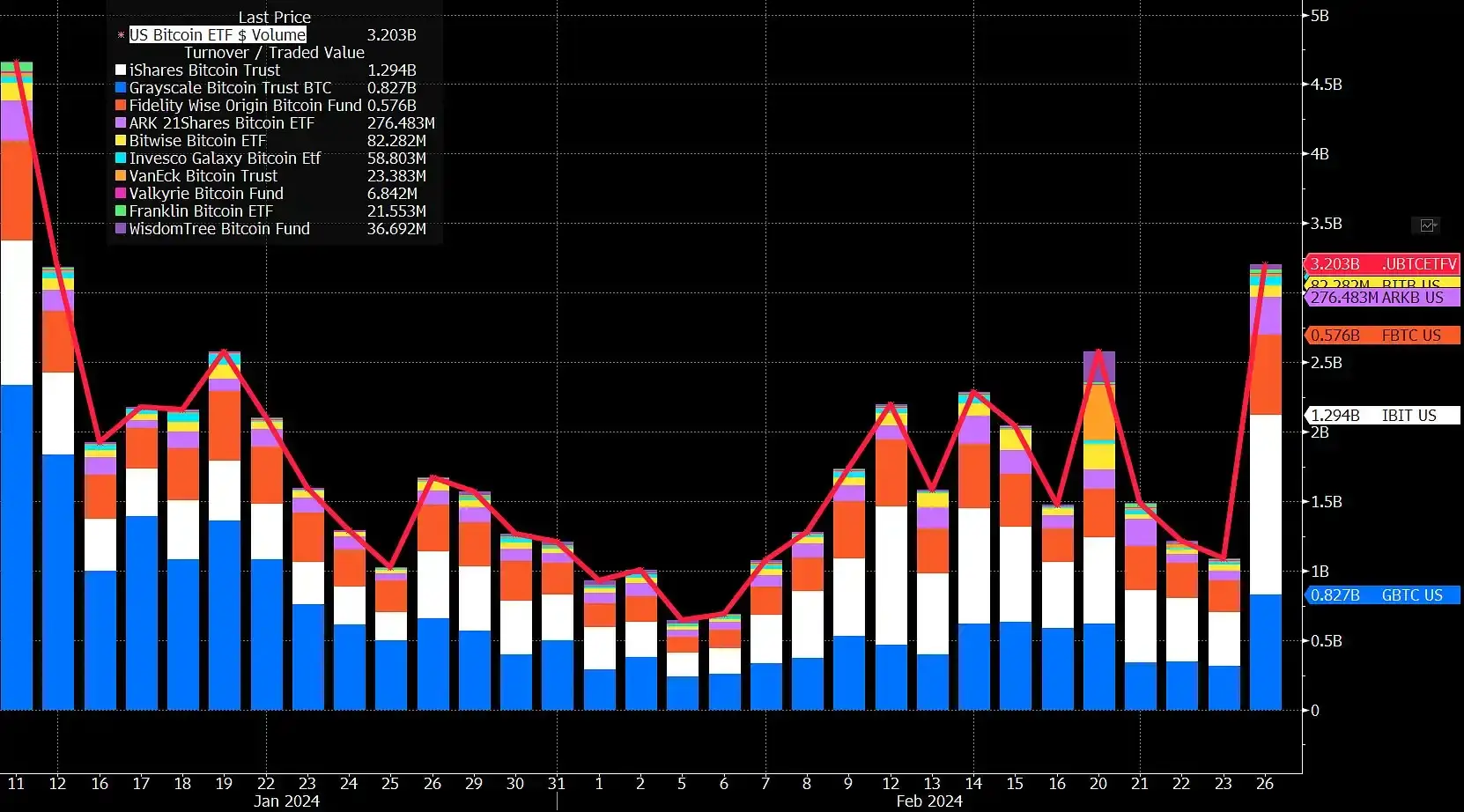
As for the question that everyone in the crypto space is most concerned about: "Where will Bitcoin go in this round of the bull market?"
Markus, a crypto analyst from Matrixport, the hottest firm in the crypto space, analyzed in an exclusive interview with BlockBeats that many people underestimate the impact of the spot ETF. He predicts that this bull market may last until February to September next year, with Bitcoin potentially reaching $125,000 in this cycle, and we are currently halfway up the bull market.
Regarding potential black swan events that could occur in this round of the bull market, Markus stated that the only possibility is if someone can access Satoshi Nakamoto's wallet. "The inflow of funds from gold ETFs has entered Bitcoin ETFs, and Bitcoin is becoming a better macro asset than gold." Markus concluded the interview with these words.
 Risk warning Risk warning




Popular articles





