








Bitcoin ecosystem vs Ethereum ecosystem, who will be the next leader?

 The Ethereum ecosystem in 2024, under the multiple benefits of the Cancun upgrade, expectations of spot ETFs, ongoing deflation, and soaring staking numbers, is bound to make a significant mark.
Written by: Joyce
Source: Baihua Blockchain
Recently, Ethereum has seen a very strong rise. After breaking through 3500 USD a few days ago and reaching a new high since May 2022, it has now surpassed 4000 USD. Looking at the increase over the past 30 days, Ethereum has outperformed Bitcoin with a 62% increase, which indeed caught many by surprise.
However, when we examine the development of the Ethereum ecosystem, from the continuously growing deflationary data, the successful testing of the upcoming Cancun upgrade on the mainnet, to the soaring amount of staked and restaked ETH, along with the anticipated approval of the ETH spot ETF in May, it is clear that multiple positive factors are converging, making the rise in ETH prices quite reasonable.
So, will these positive factors really come to fruition? What is the current state of Ethereum's ecosystem development? Let's look at the data.
Ethereum Deflationary Situation
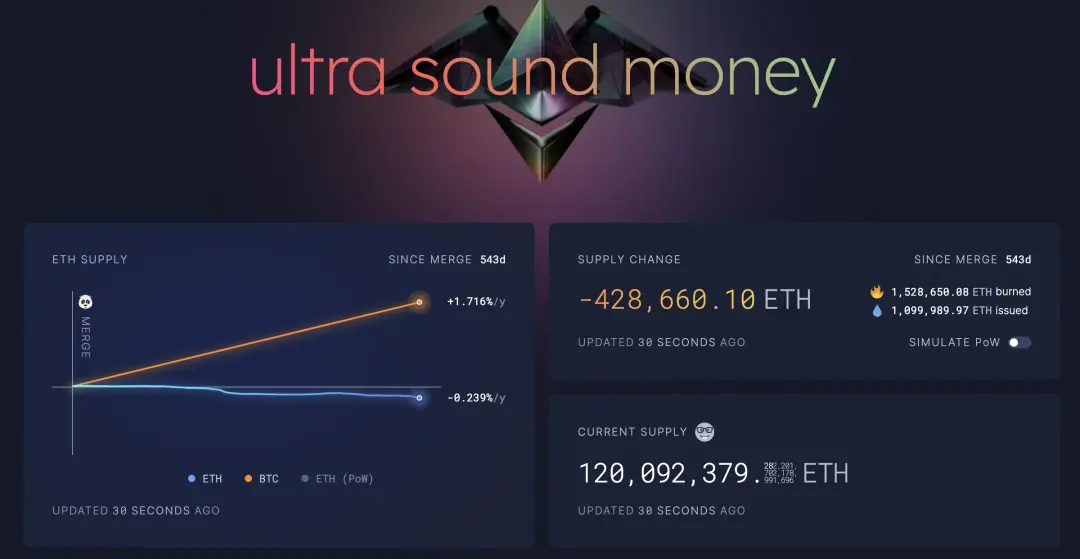
Trend chart of Bitcoin and Ethereum inflation/deflation data over the past 532 days, source: ultrasound.money
Ethereum officially entered a deflationary phase on January 16, 2023, meaning that the daily new issuance of ETH is less than the amount of ETH being burned. Specifically, the current annual deflation rate of ETH is 0.239%.
In comparison to the industry leader Bitcoin, the annual inflation rate is 1.716%, and although the total supply is limited, new bitcoins are continuously produced every day. Therefore, when we say "the total supply of Bitcoin is limited, so each Bitcoin is very precious," it further highlights the value of ETH in its current deflationary state.
As the Ethereum ecosystem flourishes, the total amount of ETH burned continues to increase, leading to a higher deflation rate for Ethereum, which in turn reduces the circulating supply of ETH in the market.
Rapid Development of Restaking
Not only has the increase in Ethereum's deflation rate reduced the circulating supply of ETH, but the development of liquid staking and restaking on Ethereum has also locked a large amount of ETH on-chain, further drastically decreasing the number of ETH in circulation.
According to OKLink's Ethereum staking contract data, the total amount of staked Ethereum has now exceeded 40 million ETH, accounting for over 34% of Ethereum's circulating market value, with the total number of validators surpassing 1.26 million. Although most validators are attracted by the appreciation of Ethereum and staking yields, it is still a significant positive for the overall security of the Ethereum network.

Number of Ethereum staking contracts, data source: OKLink
Moreover, according to data from Stakingrewards, as the leading public chain in terms of staking volume, Ethereum has maintained a net inflow of staking traffic over the past 7 days, which is clearly evident when compared to other lower-ranked public chains. At this stage, the attractiveness of Ethereum staking to investors is apparent.

Top five public chains by staking market value, data source: stakingrewards
Of course, the recent surge in Ethereum staking volume is closely related to the development of the restaking sector.
Restaking was first proposed by the founder of Eigenlayer, and its core idea is to allow ETH that has already been staked on the Ethereum main chain to be restaked on other protocols, enabling those protocols to share Ethereum's security, thus reducing their own security costs. Investors participating in restaking can not only earn staking rewards from Ethereum but also gain additional rewards from restaking.
Thus, restaking creates a win-win-win situation:
- For protocols using restaking, they can enjoy security almost on par with Ethereum while reducing security costs, and attract a large number of ETH holders to enter the ecosystem and participate in its development;
- For ETH stakers, they can enjoy both Ethereum staking and restaking rewards, along with the expectation of numerous airdrops;
- Additionally, for the Ethereum main chain, the restaking mechanism provides more empowering scenarios for its assets and encourages holders to lock ETH, bringing greater appreciation potential.
Therefore, the restaking sector, led by Eigenlayer, has rapidly developed in recent months, attracting more and more institutional capital. Taking Eigenlayer as an example, from May 2022 to now, it has completed four rounds of financing, with the latest round led by a16z, reaching a single financing amount of 100 million USD, and the total financing has exceeded 160 million USD in four rounds. As an emerging sector, restaking has indeed entered a favorable period.
Currently, Eigenlayer's total TVL has exceeded 11 billion USD, ranking third among all DeFi projects, only behind Lido and AAVE. Related projects in the liquid restaking sector have also seen significant growth in TVL, with a 7-day increase of over 10%.
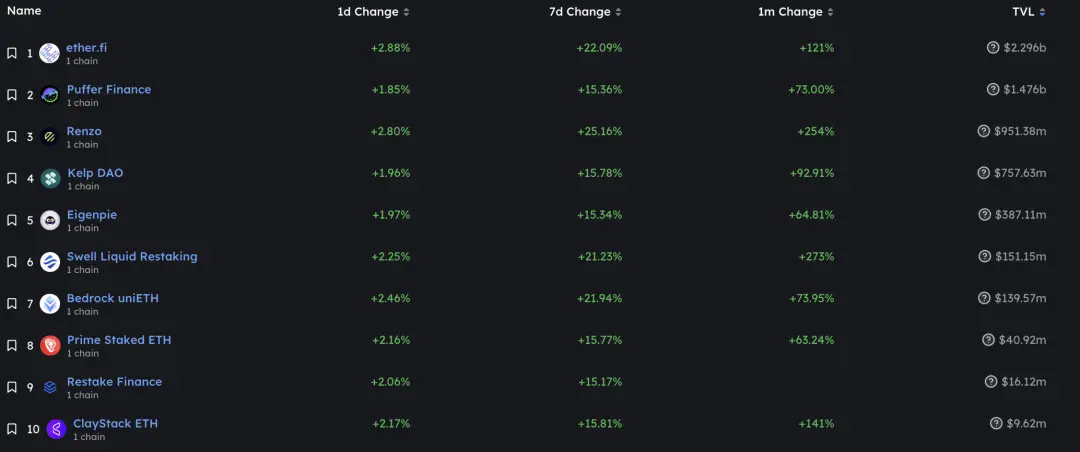
Growth of TVL in related projects of the liquid restaking sector, data source: defillama
The rapid development of restaking protocols and the expectation of ecosystem airdrops have stimulated more ETH holders to participate in ETH staking and restaking, as evidenced by the rapid growth of ETH staking ratios and the TVL of restaking protocols. All of this further reduces the circulating supply of ETH, providing new upward potential for ETH.
Cancun Upgrade
Of course, the Cancun upgrade is also a significant positive factor for Ethereum.
Many articles have already been written about the Cancun upgrade; friends interested in exploring in detail can read our historical article “What Substantial Benefits Will the Legendary Ethereum Cancun Upgrade Bring?.** For the Ethereum mainnet, the Cancun upgrade is an important hardware upgrade that mainly enhances the scalability, security, and usability of the Ethereum mainnet.
Of course, the biggest perception for users is that after the Cancun upgrade, the fees on Ethereum's Layer 2 will be significantly reduced, potentially by more than 14 times compared to the current levels, roughly equivalent to the gas fee levels of public chains like Solana, and it will also greatly enhance the throughput of Layer 2. This is mainly due to EIP-4844 in the Cancun upgrade, which significantly reduces the cost of data on the ETH main chain in Layer 2 protocols and advances the Ethereum sharding plan.
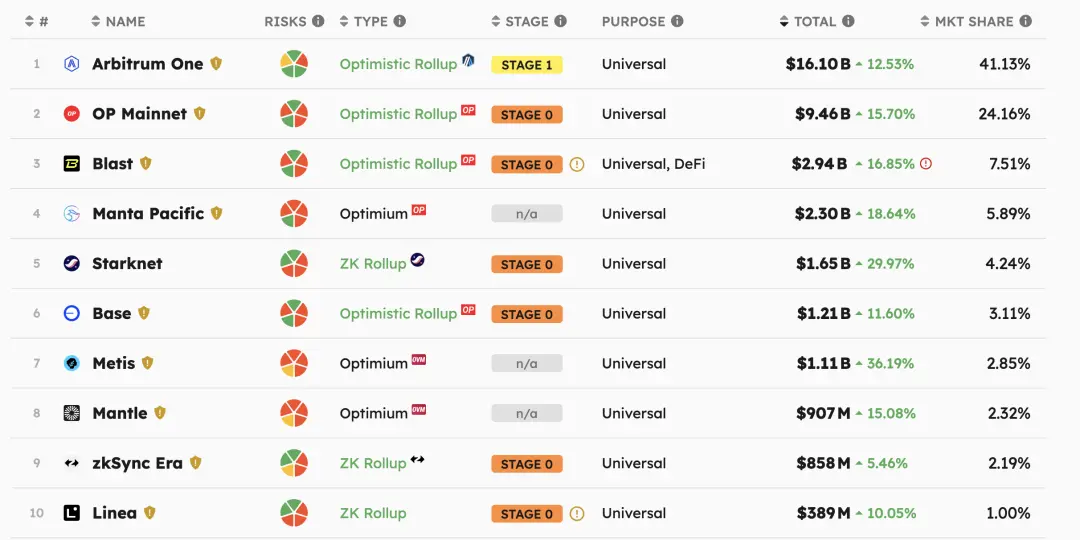
Overview of TVL growth in various Layer 2 projects on Ethereum, data source: L2BEAT
In addition, another important upgrade in this Cancun upgrade is EIP-4788, which optimizes the communication of information between Ethereum's consensus layer and execution layer. This improvement is very beneficial for liquid staking, restaking sectors, and cross-chain bridge-related projects, enhancing their security and operational efficiency.
Therefore, overall, the Cancun upgrade not only significantly reduces Layer 2 fees and enhances throughput, benefiting the development of Layer 2 on Ethereum and facilitating the influx of new capital into Layer 2 for ecosystem construction, but it is also a major positive for the liquid staking and restaking sectors. The success of the Cancun upgrade will bring another breakthrough for the Ethereum ecosystem.
Currently, the Cancun upgrade has been successfully deployed on all of Ethereum's testnets (including Georli, Sepolia, and Holesky) and is scheduled to go live on the mainnet on March 13 of this year. The imminent launch date has already been reflected to some extent in the prices of Ethereum and related ecosystem projects.
Probability of Ethereum Spot ETF Approval
Since the SEC approved 10 Bitcoin spot ETFs on January 10 of this year, attention has turned to Ethereum spot ETFs.
After all, the approval of Bitcoin spot ETFs is a huge positive for Bitcoin and its ecosystem, as evidenced by Bitcoin's price surge in the short term.
But will the Ethereum ETF be approved as scheduled?
Currently, seven institutions, including BlackRock, Hashdex, ARK 21Shares, and VanEck, have applied for Ethereum spot ETFs. After several delays in approval by the SEC, a decision on whether to approve the related institutions' applications for Ethereum spot ETFs will be made by May of this year at the latest (see the chart below).

Tracking chart of Ethereum spot/futures ETF applications, source: blockworks
Of course, the key to whether the Ethereum spot ETF will be approved lies in whether the SEC classifies Ethereum as a commodity or a security. The current divergence is that Ethereum's entire mechanism is quite different from Bitcoin; Ethereum does not have a fixed total supply, and its holders can stake it for rewards.
This has led many to believe that there is a risk of Ethereum being classified as a security.
However, in the SEC's lawsuit against Ripple last June, the SEC listed 67 tokens classified as securities, and ETH was not among them. Moreover, the SEC has sued several CEXs for listing tokens that it classified as securities, and ETH was not included. In other words, the SEC has not publicly and explicitly stated that ETH is a security.
More importantly, last year, U.S. securities regulators approved Ethereum futures ETFs, which implies that ETH is a commodity rather than a security. Therefore, the approval of ETH spot ETFs is likely just a matter of time.
The future approval of ETH spot ETFs is expected to bring substantial funds and resources to Ethereum and its ecosystem, similar to the Bitcoin spot ETFs, opening up the entire ecosystem's development landscape and ceiling.
Conclusion
If last year was the year when Bitcoin and its ecosystem occupied the spotlight of the entire crypto industry, then in 2024, the Ethereum ecosystem, under the multiple positive factors of the Cancun upgrade, spot ETF expectations, and continuous deflation and soaring staking numbers, will undoubtedly write a significant chapter.
Will the main players in this bull market be the inscriptions and infrastructure of the Bitcoin ecosystem, or the staking and restaking sectors of the Ethereum ecosystem? We shall wait and see.
 Risk warning
 Risk warning

Popular articles





