








Web3 Project Detailed Explanation No. 19: How UXLINK Solves the "People, Goods, and Market" in Web3 Before Issuing Tokens

 The launch of UXlink's token is imminent, and approximately 1-2 million people will receive the first batch of airdrops. After the token launch, should the airdrop be held or sold? Is there any value in participating in the subsequent airdrops?
Today we will share: #UXlink is building the "people, goods, and market" for the industry in Web3. Is it possible for SocialFi to become a hundred billion market?
The launch of UXlink's token is imminent, and approximately 1-2 million people will receive the first batch of airdrops. After the token launch, should the airdrop be held or sold? Is there any value in participating in the subsequent airdrops?
Today we will share: #UXlink is building the "people, goods, and market" for the industry in Web3. Is it possible for SocialFi to become a hundred billion market?
As more developers enter the space, the Web3 landscape is now flooded with various projects. According to incomplete statistics, 1 million new projects were added in 2024, which is 2.5 times the number during the bull market in 2021.
A common issue among these new projects is "low circulation and high market value." These 1 million projects release a bit of sell pressure to the market every day, causing the market to bear nearly $300 million in selling pressure daily.
With a limited user base, millions of new projects are gnawing away at the already fragile liquidity, which is a significant reason for the insufficient liquidity in this bull market, the stagnation of altcoins, and the losses experienced by users during the bull market.
https://x.com/jconorgrogan/status/1790385292446400623
Every Web3 project tells users a beautiful story, which ultimately serves trading. Trading is like fast-moving consumer goods; traffic is everything. Without traffic, the flywheel cannot spin; without users, traffic cannot operate; without enough users, how can you have L2? Without enough users, how can you have LST? Without enough users, how can you ensure blockchain security…
Thus, most of the demand in the crypto space is pseudo-demand in the face of the industry's demand for users. Only by addressing the narrative at the user level can other narratives follow.
Web2 has already formed a trillion-dollar market in the "people, goods, and venue" model. How to convert Web2 users into Web3 users and create Web3's own "people, goods, and venue" has always been a challenge for the industry. The consensus among industry developers is that building Web3's "people, goods, and venue" through SocialFi is the most convenient and stable approach.
Today, we will introduce various aspects of SocialFi.
1. Web3 Social Has No Endgame, Is It Peak from the Start?
The market generally believes that SocialFi can produce several unicorns and has conducted very professional theoretical reasoning, matching SocialFi with impeccable market and technology. Developers have already created hundreds of solutions on-chain:
However, "reality" seems to have always been at odds with "theory," leading to a disconnect between "theory" and "reality." This has resulted in SocialFi, which comes with its own traffic, feeling like it peaks right from the start.
Here, we will analyze some key projects to see if they indeed peaked from the start, such as Lens Protocol, CyberConnect, Farcaster, Debox, and friend.tech.
(1) First Generation SocialFi
Lens Protocol is regarded as the first generation of SocialFi, founded by Aave in 2022. It is a grand narrative on-chain social data layer. There are already 200 Dapps built on it, with a total ecosystem user count of 1,482,795 and around 1,000 daily active users.
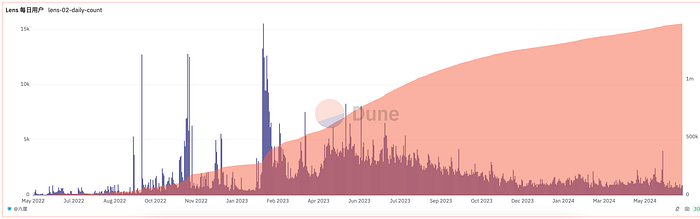 https://dune.com/queries/1534604/2573852
Based on the Lens protocol, several interesting Dapps have emerged, such as Lenster and Phaver:
- Lenster, a decentralized version of X
- Phaver's model rewards users for likes
Due to Lens Protocol's poor integration of assets during product design, users could not generate strong profit expectations within the protocol before the SocialFi scenario was validated, leading to user attrition due to the weak "Fi" attributes.
The first generation of SocialFi platforms also includes CyberConnect, Farcaster, Nostr, Mast Network…
The Web3 market pursues "faster, cheaper, and more innovative." Although many other SocialFi projects have emerged after Lens Protocol, none have been disruptive until Friend.tech appeared.
(2) Second Generation SocialFi
Friend.tech is considered the second generation of SocialFi. It is not a protocol but chooses a one-to-many network social form in its scenario.
It overly emphasizes the "Fi" attributes on the "goods" in the "people, goods, and venue," realizing the monetization of KOL's influence value. The more reputable the KOL, the more users come to purchase their shares, increasing their value, and consequently, the purchase price rises, as does the selling price.
Although it is sufficiently novel, it has significant bubbles, a closed system, and insufficient externality, leading to rapid user attrition after the wealth effect diminishes (with 100 daily active users).

Despite the downward trend after its peak, Friend.tech's innovative attempts in fan economy and value feedback to users have inspired many practitioners and project teams.
The second generation of SocialFi that has gone further is DeBox, which also follows the "one-to-many" model. The core issue DeBox addresses is "holding and chatting." DeBox's group chat feature can be set to allow members with specific NFTs or tokens and a certain amount to enter the community, using holdings as consensus to unite community members with similar views and ideas, thus better forming a spontaneous community governance mechanism and reducing information noise. Since content storage and logic are off-chain, the user experience is relatively good, resembling that of Web2 social products.
Summary
From the solutions of the first and second generations of SocialFi, it can be seen that many current market solutions are merely replicating Web2 models. Therefore, the commonly seen Web3 social products fall into these categories:
- Underlying Infrastructure: such as Lens Protocol, CyberConnect, Farcaster, Nostr, Mast Network…
- Task Platforms: such as Galxe, Zealy, Layer3, etc.
- X to Earn Types: such as CARV, SwapChat,
- Creator Economy: such as Friend.tech, Bodhi
- Web2 Social Applications Transitioned to Web3: such as Satellite IM, Debox, etc.
It can be observed that the first and second generations of SocialFi are either platform models or one-to-many community models. A powerful "people, goods, and venue" solution that combines "platform to user" and "one-to-many" models has yet to emerge.
Only when UXLINK surpasses 10 million users do we slowly realize that the third generation of SocialFi has begun to sprout.
2. Third Generation SocialFi - UXLink
UXLink is regarded as the third generation of SocialFi. From the outset, UXLink targeted the niche of familiar social interactions and designed a dual-token model on the asset side.
The product architecture is more complex, divided into basic application layer, protocol service layer, and infrastructure layer, which support and complement each other while leaving enough interfaces for external protocol access.
In the familiar social scenario, UXLink has created a social ecosystem that integrates traffic entry, social asset trading, and infrastructure. Let's break down UXLink's product framework from top to bottom.
In simpler terms: UXLink takes the strengths of previous SocialFi projects, combines its understanding of SocialFi, and designs its own public chain and community model. The UXLink community does not need to be built on its own application; like Toncoin, it is compatible with Telegram, allowing seamless conversion of Web2 users on Telegram into Web3 users through invitation rewards, solving the commercial closed loop of "people, goods, and venue."
How UXLink Solves the "People, Goods, and Venue" of Web3
UXLink positions itself to build a familiar social relationship map through Link To Earn and provides data services to third parties. In other words, UXLink is not just a social Dapp but aims to be an L1 social protocol solution.
Its structure is divided into three layers. To help readers better understand, I will minimize technical jargon:
- First Layer, Basic Application Layer - Solving "Where Do the People Come From?" in the "People, Goods, and Venue"
This is the basic application layer of UXLink, providing "to C" services and is the layer users frequently interact with. Interaction rewards occur at this layer. It is compatible with Telegram group scenarios, seamlessly converting Web2 users into Web3 users through the invitation reward model in "familiar social."
Toncoin quickly gained traction by leveraging Telegram's 800 million user base. UXLink uses a technical solution compatible with Telegram, allowing both third-party developers and users to seamlessly enter Web3, effectively addressing the "Where Do the People Come From?" issue.
Here, UXLink has already achieved significant results:
🔸 10 million+ registered users
🔸 5 million+ holders
🔸 1.6 million+ NFT holders
We can imagine that with so many real users, developers will likely find ways to enter the market.
- Second Layer, Protocol Layer - Solving "Where Do the Goods Come From?" in the "People, Goods, and Venue"
Users converted from the application layer's social rewards need a place to reside; there must be "goods." Without goods, converted users will quickly churn.
Thus, this layer primarily targets developers, providing a protocol layer that offers data through APIs and a mixed scalable technical architecture of EVM + IPFS + Cloud, allowing developers to create high-quality growth and personalized user services, such as AI algorithms, recommendations, and group formations, just like developing mini-programs in WeChat or Facebook Marketplace, forming a complete ecosystem.
Users interact with different entities in the UXLink ecosystem, which can be referred to as "interaction" or "contribution." Users continuously contribute their social relationships, attention, trust, and data. The core scenario of UXLink is to financialize contributions, allowing users to be the actual beneficiaries of their contribution behaviors rather than the platform itself.
Currently, over 100 projects have been launched on UXLink, allowing users to participate in these projects through their UXLink identity, effectively solving the "Where Do the Goods Come From?" issue in the "People, Goods, and Venue."
- Third Layer, Infrastructure Layer - Building the "Venue" in the "People, Goods, and Venue"
This is a mixed scalable architecture (EVM + IPFS + Clouds), a more fundamental infrastructure that allows social relationships and data to be assetized and flow. By using a multi-chain approach, users can circulate their social assets across various public chains and applications.
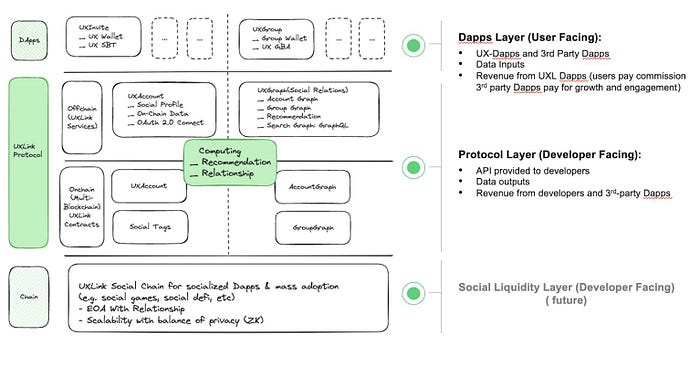
From the above "people, goods, and venue" closed loop, we can see that UXLink acts as a super linker, playing the role of a Hub in the blockchain.
- The first closed loop is a small closed loop, which is user - product - developer (narrow sense of "people, goods, and venue"). Through the technical stack provided by UXLink's first and second layers - a complete set of tools (such as UX Growth) and its transformation of the native TG scenario (such as Social DEX), effective links have been established between users, products, and developers, meeting the real needs of users and developers, gradually forming a complete user product group.
- The second closed loop is a large closed loop, which is infrastructure - traffic - application (broad sense of "people, goods, and venue"). UXLink addresses blockchain trust issues through Layer - Protocol - Dapp at three levels, achieving a large closed loop through brand traffic.
In today's Web3, where projects do not trust each other and users are skeptical of project parties, the industry needs a linker that can connect users and projects, a "people, goods, and venue" with tens of millions of real users to ignite the market.
3. UXLink Token Model and Airdrop
Recently, UXLink released the "Token Airdrop Rules and Further Community Feedback," which is akin to a witch hunt announcement, indicating that the project will soon distribute airdrops.
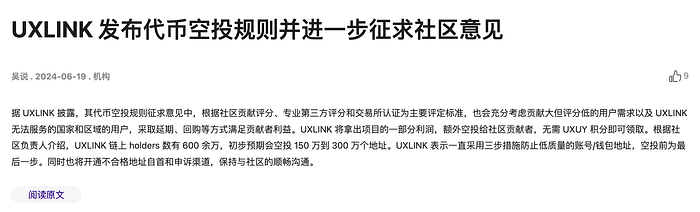 https://wublock123.com/index.php?m=content\&c=index\&a=show\&catid=42\&id=28444
Before the airdrop, let's estimate the value of the tokens.
(1) Token Economic Model
UXLink adopts a dual-token model, including utility token $UXUY and governance token $UXLINK.
1. Utility Token $UXUY: Mainly used to incentivize community growth and interaction for $UXUY.
- Earning Method: Users can earn $UXUY by inviting friends and contributing to the ecosystem. As the user base of UXLINK grows, the speed at which users earn $UXUY will decrease exponentially. Once the network reaches 30 million users, no new UXUY tokens will be generated. At that point, the value formed by network effects can support the continuous expansion of users and nodes. UXLINK refers to this mechanism as PoL (Proof of Link).
- Destruction Mechanism: $UXUY can be used to pay service fees (costs of interactions within the ecosystem; UXLINK can also help users pay commissions with $UXUY). Of these fees, 3% - 15% will be destroyed, with the specific value depending on the governance decisions of the UXLINK community.
2. Governance Token $UXLINK: Mainly used for governance and capturing the value generated by UXLINK products.
- Supply: $UXLINK has a fixed supply of 1 billion tokens.
- Release: $UXLINK will be released after the launch.
- Community: Airdropped to active high-quality users, with no lock-up period.
- Investors: 6-month lock-up period + 12.5% released quarterly over 8 quarters.
- Team: 6-month lock-up period + 12.5% released quarterly over 8 quarters.
(2) About the Airdrop
65% of the tokens are allocated to the community, with the top 10% of community users eligible for the airdrop. Based on the data of 1.6 million NFT holders, each user can mint 5 tokens. Considering that many have not minted yet, the first batch will likely have around 50 million UXLINK tokens airdropped, with an estimated 1 million participants in the distribution.
(3) Token Value Estimation
The total supply of UXLINK tokens is 1 billion. Based on the release chart, there will likely be 5%-10% initial circulation. Projects already listed in the same track include CyberConnect, coincidentally, both UXLINK and CyberConnect have secured $15 million in funding. Although their valuation models differ, there is still some reference value.
Referring to CYBER, FDV is 547 million, MC is 127 million.
Assuming UXLINK has an FDV of 200 million, then the price of UXLINK would be around $0.2;
The market has high expectations for UXLINK, and the FDV may rise. If it reaches 350 million, then the price of UXLINK would be around $0.35;
If your tokens are obtained through airdrop, you can observe the market sentiment and buy/sell orders after listing to make decisions. If there are many buy orders, you might hold for a while and sell at a new high.
 Risk warning Risk warning



Popular articles





