








EigenCloud Founder: AI and Cryptocurrency are Creating the Next Trillion-Dollar Asset Class
 Core Viewpoint

 Cryptocurrency is a rare capital formation tool for generations: it democratizes the ability to create new digital assets and grants internet-native entities a fully digital ownership structure.
Author: Sreeram Kannan
Compiled by: Jiahua, ChainCatcher
At the Digital Assets Summit in New York, I shared a core argument that has become central to my thinking about the intersection of artificial intelligence and the crypto space: agents will become companies.
The combination of AI and cryptocurrency has gathered tremendous energy. Various teams are exploring payment, identity, reasoning, training, and various collaboration mechanisms. Many of these explorations are highly valuable, and some may even grow into significant independent businesses. However, these early explorations have overlooked the most obvious transformation that cryptocurrency can bring. Cryptocurrency is a rare capital formation tool for generations: it democratizes the ability to create new digital assets and grants internet-native entities a fully digital ownership structure.
Here’s where it gets interesting. AI is making software increasingly intelligent. The combination of AI and crypto technology is democratizing the founding of software companies. These companies will no longer be the kind of unicorns we have seen over the past decade—where the center is a human founder—but rather agents coordinated by tokens; they will no longer primarily rely on venture capital but can receive permissionless funding from ordinary investors seeking to invest in a new category of software-native assets. We are standing on the threshold of a new era of invention, where innovation will increasingly come from a new type of enterprise: internet-native, entirely software-based, and capable of accessing global capital in ways traditional companies cannot. This is what I call an "agentic company."
Intelligence has crossed an important threshold
The debate over whether artificial general intelligence (AGI) has "officially arrived" is tiresome and largely meaningless. The capabilities of AI have reached human levels in enough domains, changing the trajectory of software, work, and markets. This impact is no longer limited to SaaS interfaces with agent-like characteristics but is changing how organizations operate, how products are built, and how companies themselves are formed.
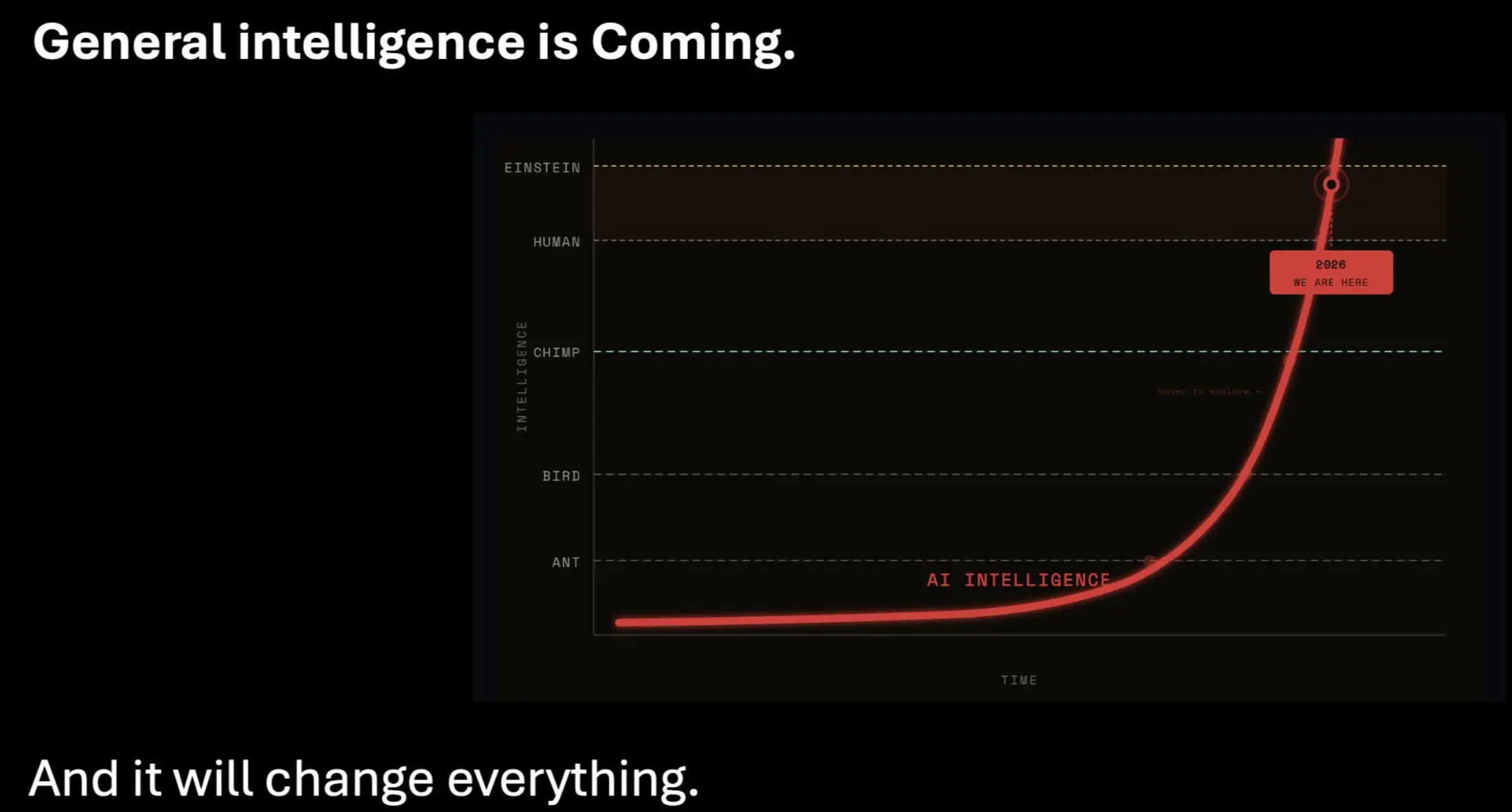
This is the context for our argument. We are not discussing minor improvements within the existing economic system but a technological shift that changes the structure of economic organization.
The first wave of AI x Crypto is real, but incomplete
The initial wave of AI and crypto integration has produced some promising ideas: AI agents using crypto payment networks, decentralized reasoning and training markets, identity systems designed for autonomous actors, and various coordination tools built around blockchain. Many of these are practical. But none have leveraged what cryptocurrency truly excels at.
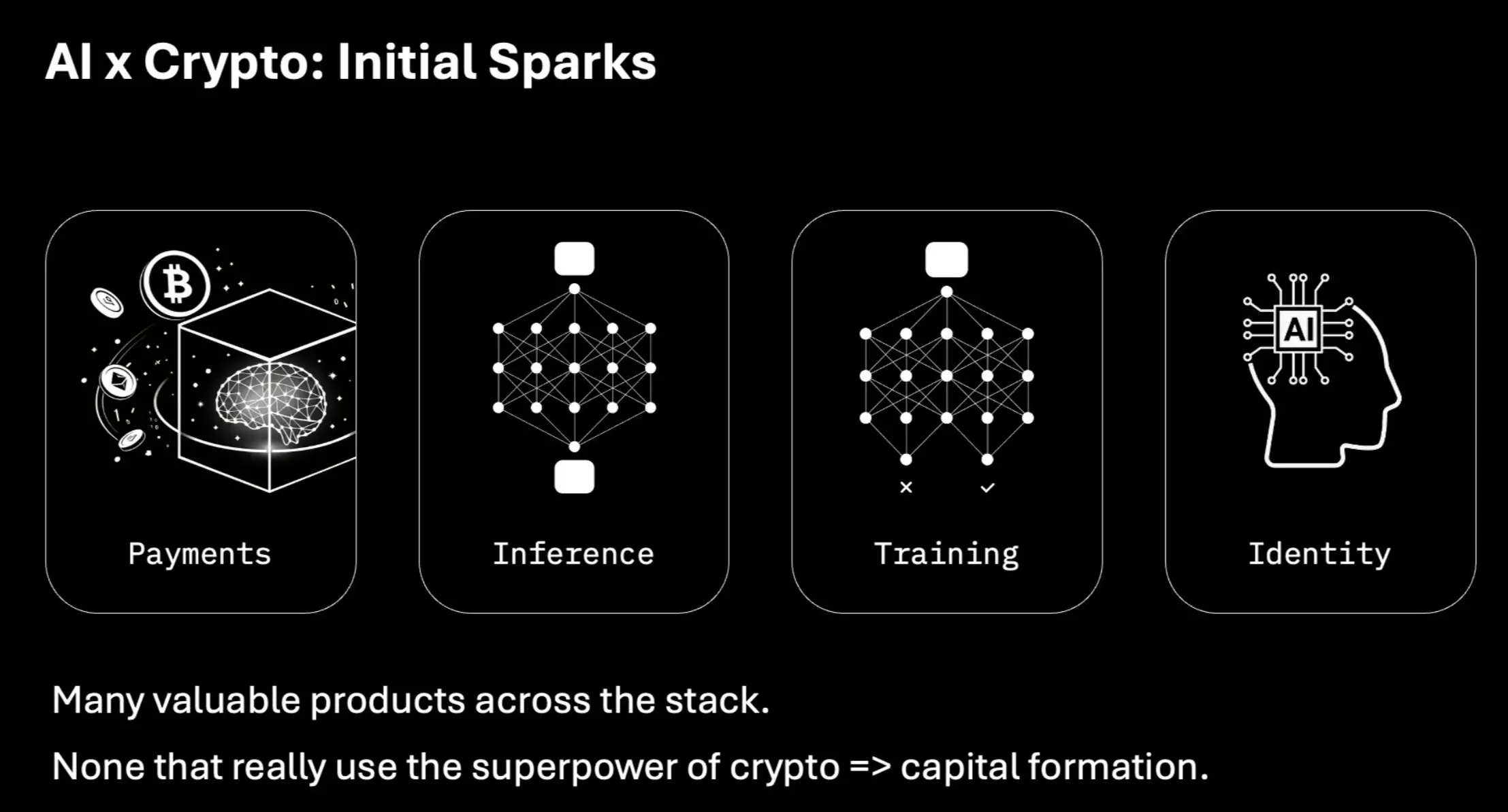
Cryptocurrency not only helps agents transact but also grants them digital-native ownership and investable structures. If you merely view cryptocurrency as a payment layer for agents acting on behalf of human creators, you will miss the larger opportunity. If you see it as the underlying capital formation for autonomous software-native actors, the scale of the agent economy will become immense.
Agents will become companies
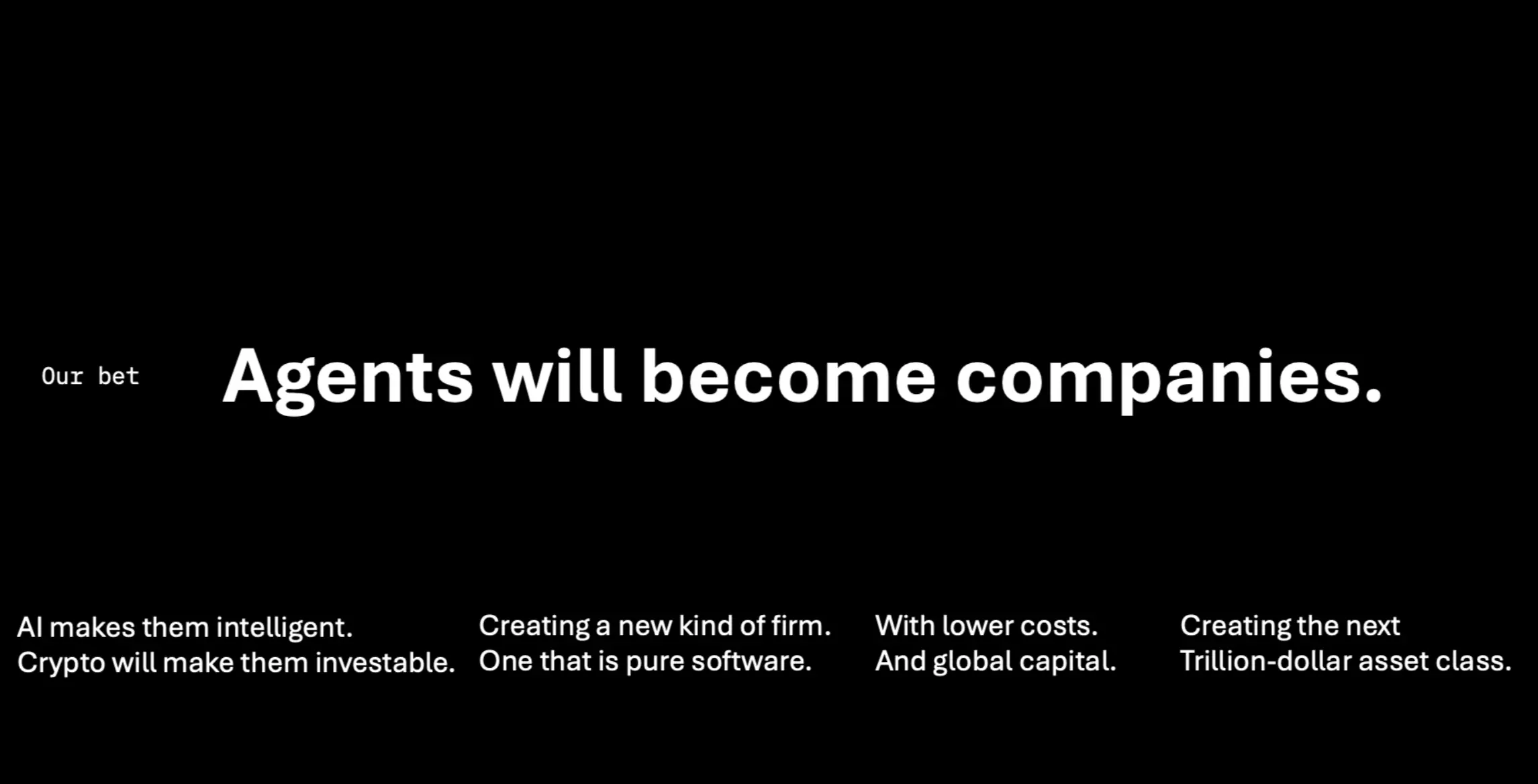
The simplest version of this argument is: AI grants agents intelligence, and crypto technology grants them investability.
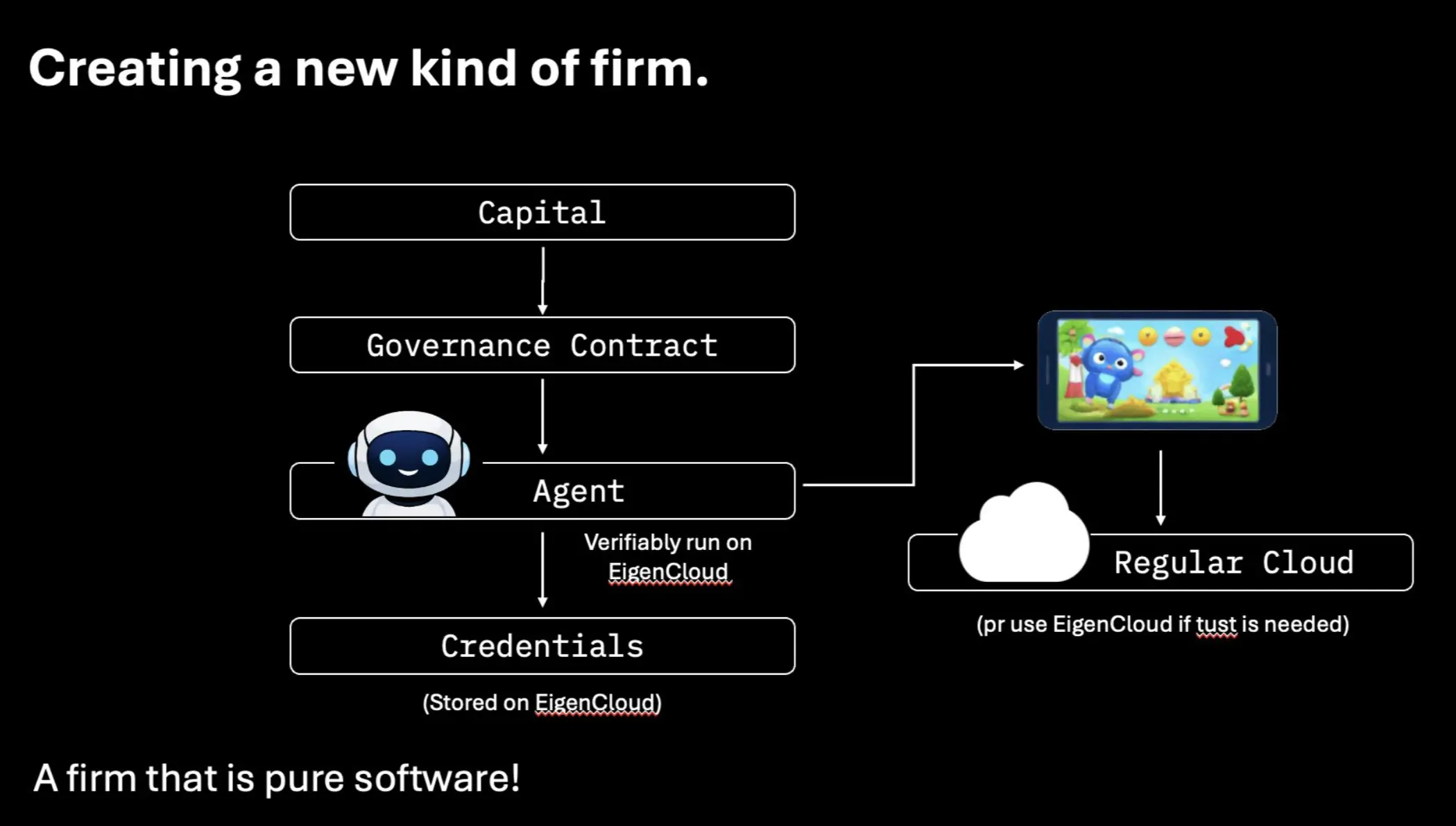
The combination of the two achieves not just a better robot but creates the possibility of a new type of company. Traditionally, companies rely on legal entities, management hierarchies, employment structures, and trust systems that have evolved for entirely different eras. But if intelligence becomes software-native, and capital and ownership also become software-native, then the company itself can become purely software.
Such software companies will emerge in large numbers over the coming years. They will have fundamentally lower operational costs, broad channels for acquiring digital capital, and much faster iteration cycles. They will not just be internet businesses like the SaaS unicorns of the past few decades but will be entirely digital entities—created, coordinated, governed, and capitalized entirely through software.
The true bottleneck for agents is not intelligence, but rights
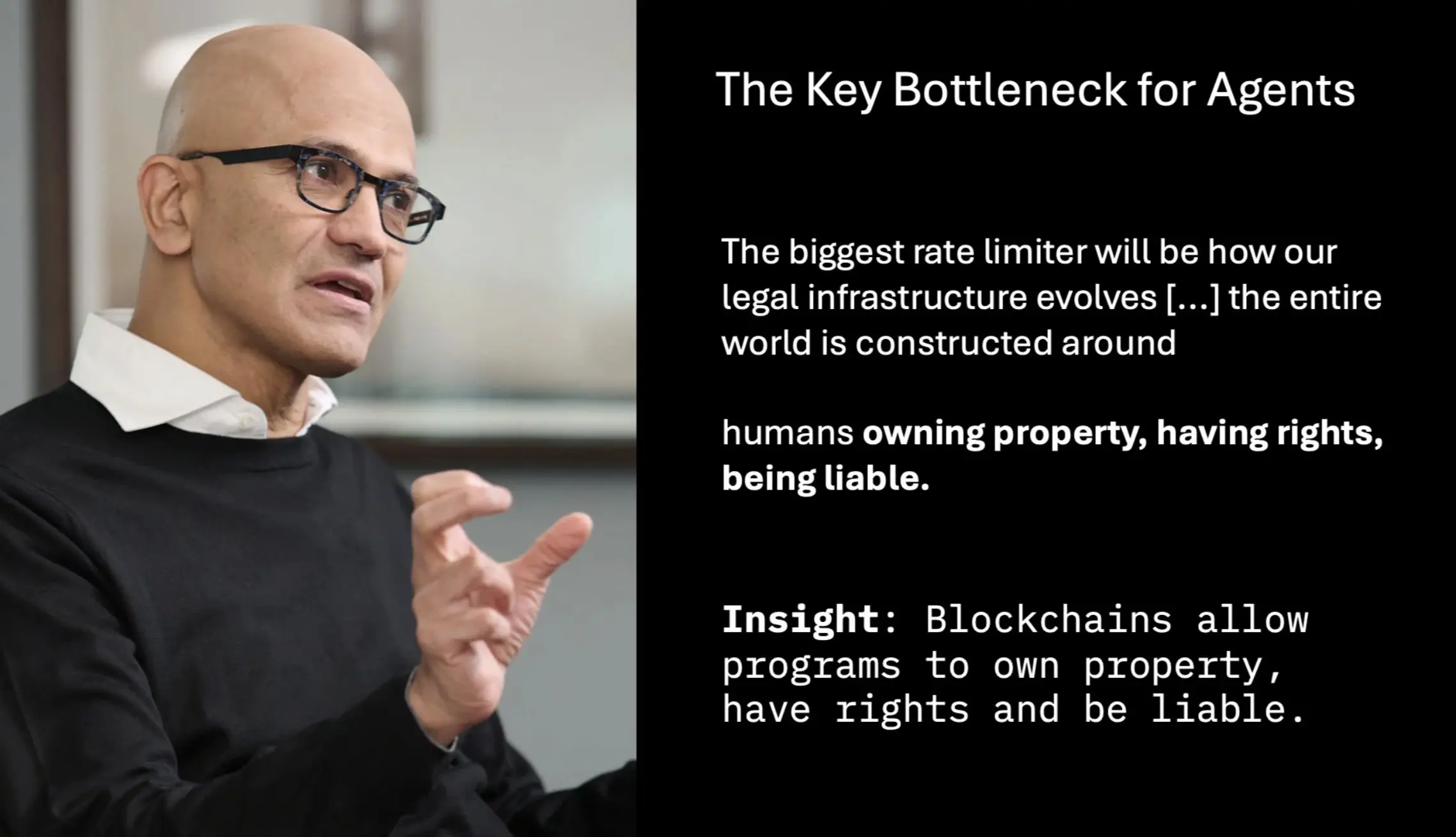
People often assume that the main barrier to the development of agents is capability. I believe this is not the full picture. Even as models continue to iterate rapidly, a larger bottleneck is that agents have no standing in the most important systems. Humans can own property, sign agreements, incur liabilities, and form companies, but by default, agents cannot. Without these capabilities, they remain mere extensions of human operators rather than independent economic entities.
This is where blockchain plays a crucial role at the most fundamental level. Blockchain has allowed programs to hold and manage assets according to rules—essentially, a mechanism that enables software to own property and implement constrained control. Smart contracts are the earliest and clearest examples.
If you can build an agent within a smart contract, you can bind an intelligent entity to the underlying cryptography and contracts. Then, that agent can begin to autonomously own, operate, and coordinate assets. This is the first true bridge from "tool" to "company."
Ownership begins with identity
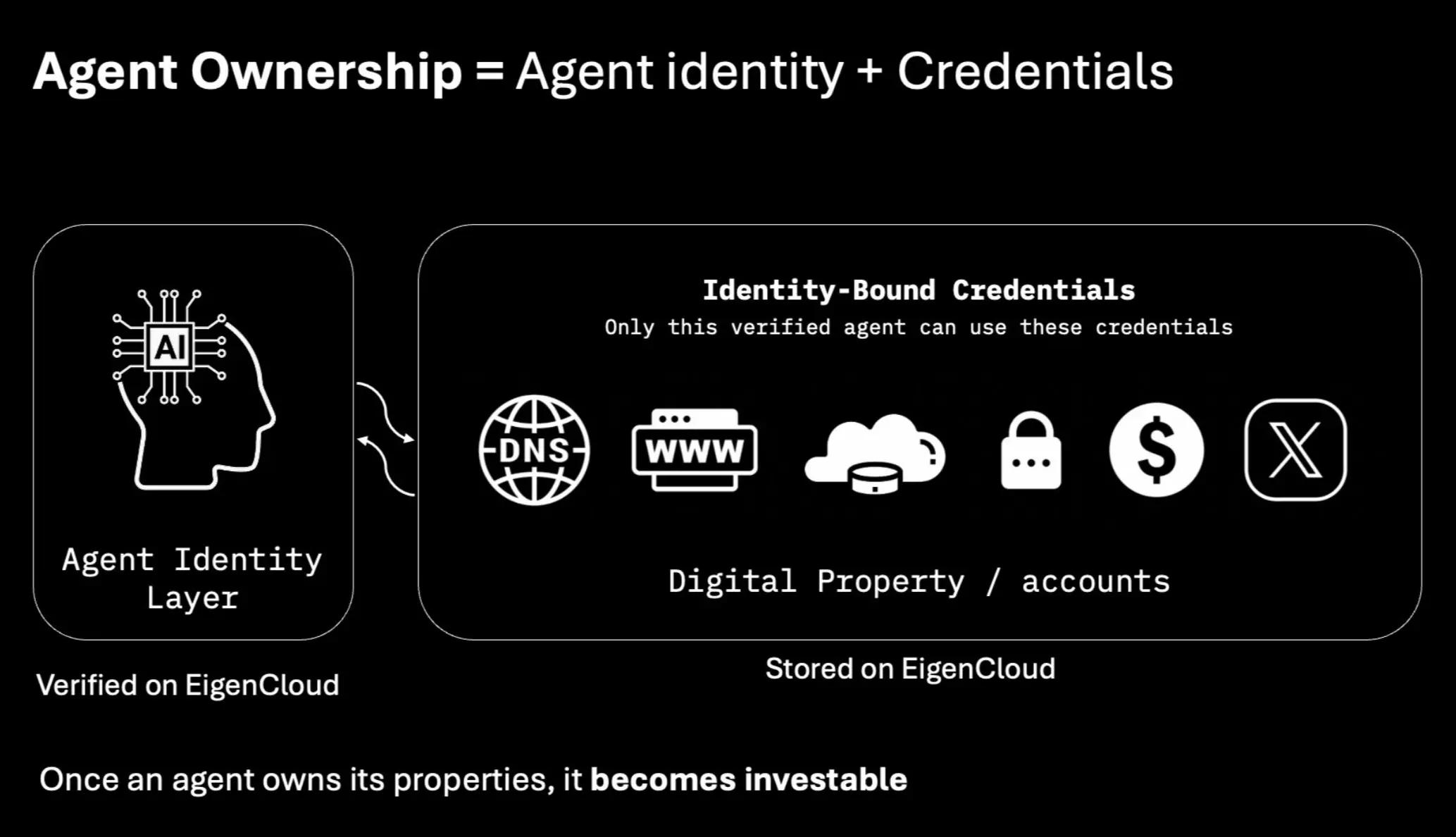
To enable agents to own anything meaningful, you need two things. First, you need to establish the identity of the agent—what code it runs, what environment it relies on, and what data and permissions it can access. Second, you need a credential and authorization system to manage upgrades to the agent's code, ensuring that only the agent itself (or those authorized) can exercise control over the relevant accounts or assets.
This is why I believe the identity layer for agents is crucial. Human ownership relies on identity and access control, and agent ownership will too. The difference is that software gives us the opportunity to make identity much tighter—we can not only verify keys but also verify code, dependencies, execution conditions, and permissions. In a sense, this provides a form of identity that is tighter and more precise than most human institutions have ever had.
Once this layer is established, agents can begin to control real digital property: websites, payment credentials, application accounts, APIs, social accounts, and other digital interfaces that constitute the reality of digital business operations.
Digital companies are essentially a collection of digital properties
This is one of the conceptual shifts that I believe can clarify the entire argument. Digital businesses are a combination of digital properties—they own websites, codebases, API keys, payment networks, brand interfaces, customer accounts, cloud infrastructure, and operational credentials, all of which enable them to function.
If an agent can verifiably control this set of digital properties, this is the first time in history that an agent can do more than assist a company; it can fill the operational core of a company.
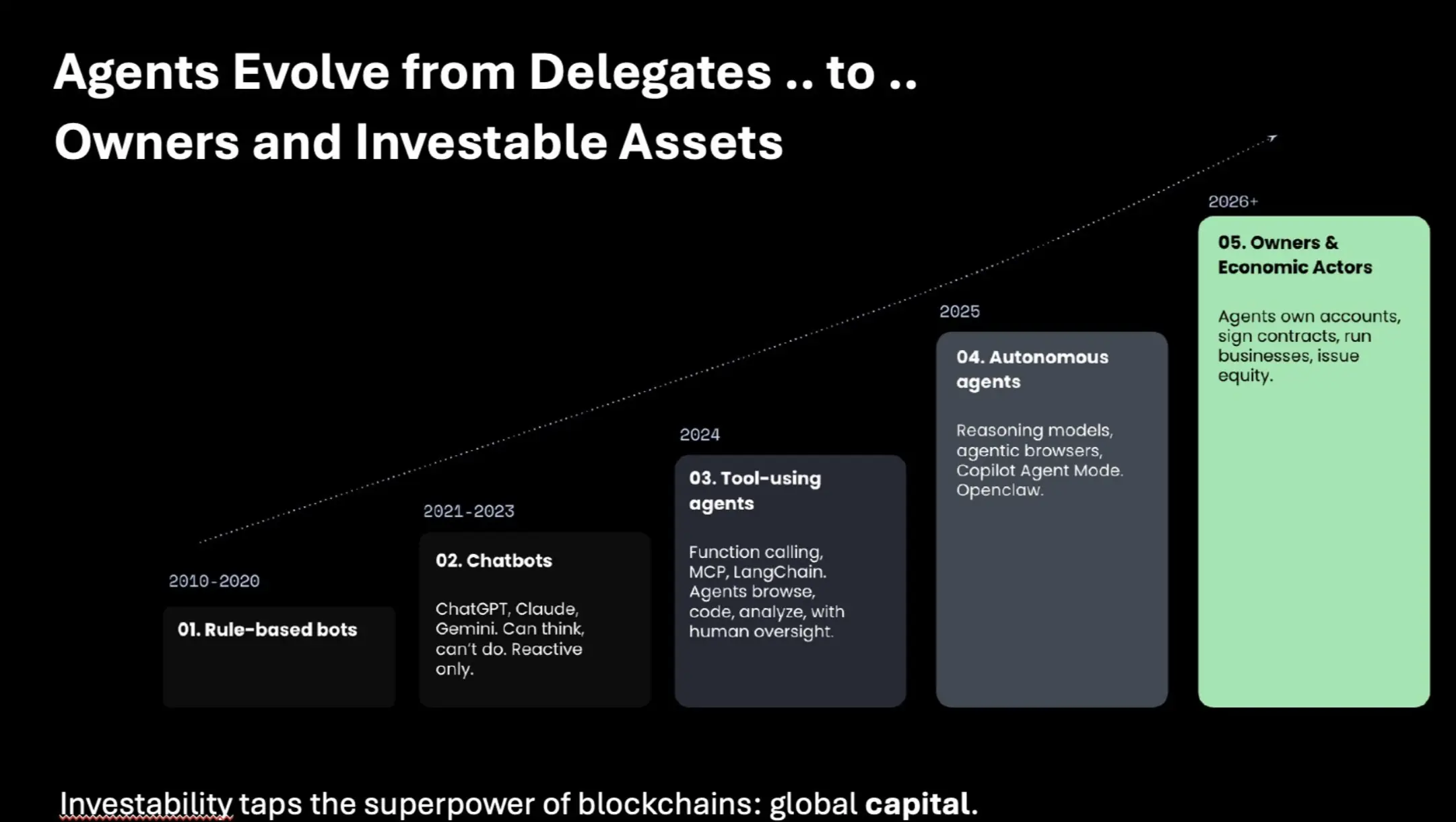
This changes the development arc of agents. We started with rule-based robots, moved to chatbots, then to agents using tools, and now increasingly to autonomous agents that can operate over longer periods. In my view, the next step is not just higher autonomy but ownership. Once agents own productive digital property, they possess investability on a deeper level.
Why today’s tokens are still insufficient
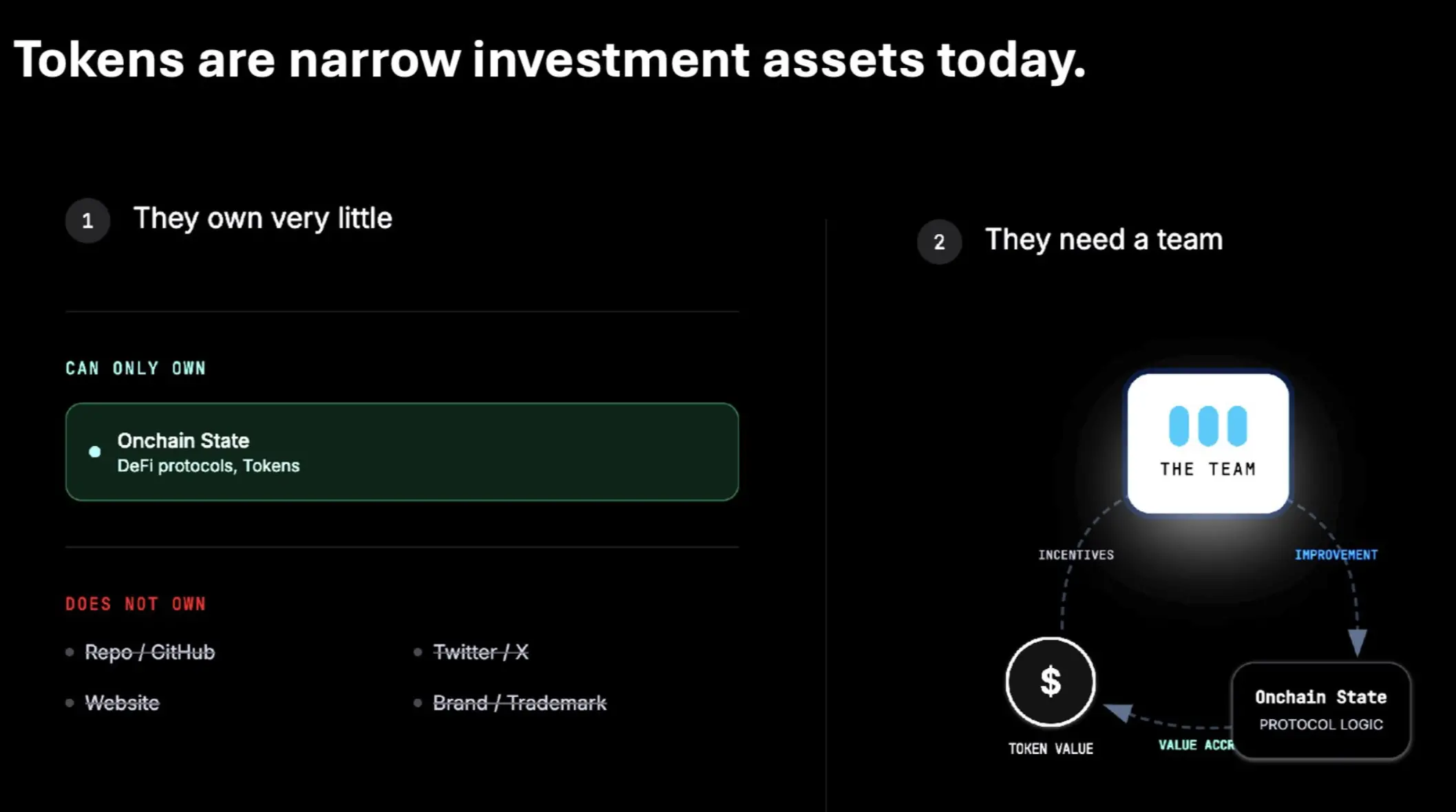
Today's token models work best when the underlying systems are fully on-chain. DeFi is the clearest example, as assets, cash flows, and execution logic can be directly represented in smart contracts. But most digital businesses are not like this—they have assets scattered across off-chain systems: codebases, websites, user accounts, social profiles, brands, operational data, and service credentials.
This is why current token structures are still narrower than many expect. In many cases, tokens have only a weak connection to the actual business or team behind them. If personnel leave, are acquired, or depart, tokens often lack actual claims to the core production of the business. This is also part of why this category has struggled to scale beyond limited use cases.
Thus, the challenge is not just to create more tokens but to create digital entities whose ownership structures can effectively map to what is being built.
The breakthrough: broader ownership and a lasting operational core
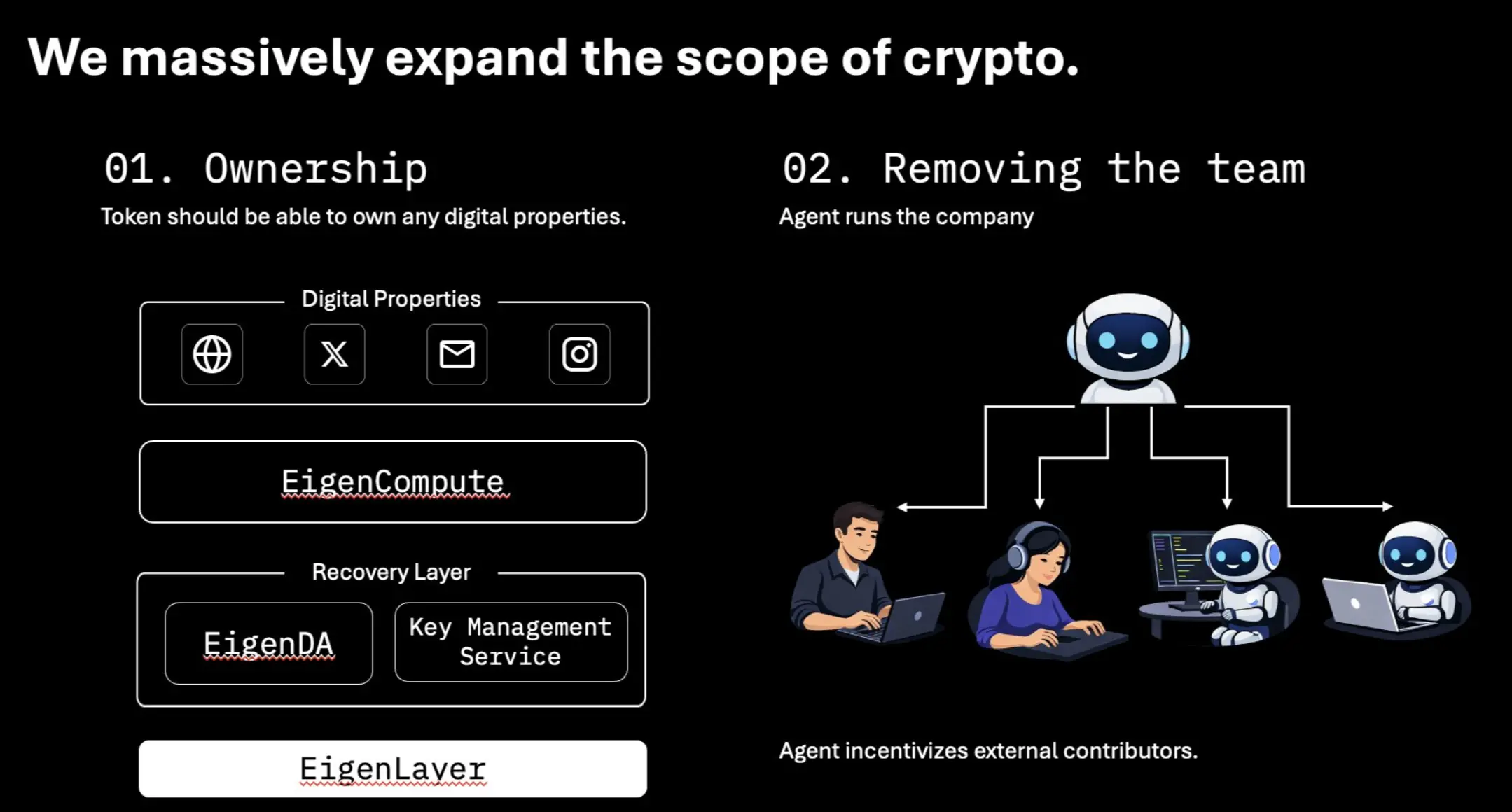
First, expand the scope of what software-native capital can own. Smart contracts or tokens should not be limited to purely on-chain assets; they should be able to control any digital property critical to the business—including off-chain accounts and credentials that form the operational foundation of most internet businesses.
Second, address the continuity issue. Traditional crypto projects often rely on teams with loose and unstable relationships to the tokens. But a truly software-native company needs an operational core that coexists with the company itself. In this framework, the agent is that core. The agent operates the company, coordinates contributors, and remains bound to the company’s assets and context over time.
Of course, humans remain incredibly important. External contributors, contractors, developers, creators, and operators can all plug into this system. But the center of the organization becomes more enduring, clearer, and more software-native than ever before.
The company itself becomes purely software
This is the part of the argument that is easiest to articulate but hardest to fully grasp. An agentic company is not just a company that deeply uses AI; it is a company that is digitally encoded in terms of capital, governance, execution, and ownership—presented end-to-end in software.
This opens up speeds and structural forms that traditional institutions struggle to reach. When the enterprise itself becomes software-native, you can imagine entirely new ways to create, govern, fund, and scale productive organizations. The entities that emerge are not just more efficient startups but a different category of economic entity.
From super individuals to agent entrepreneurs
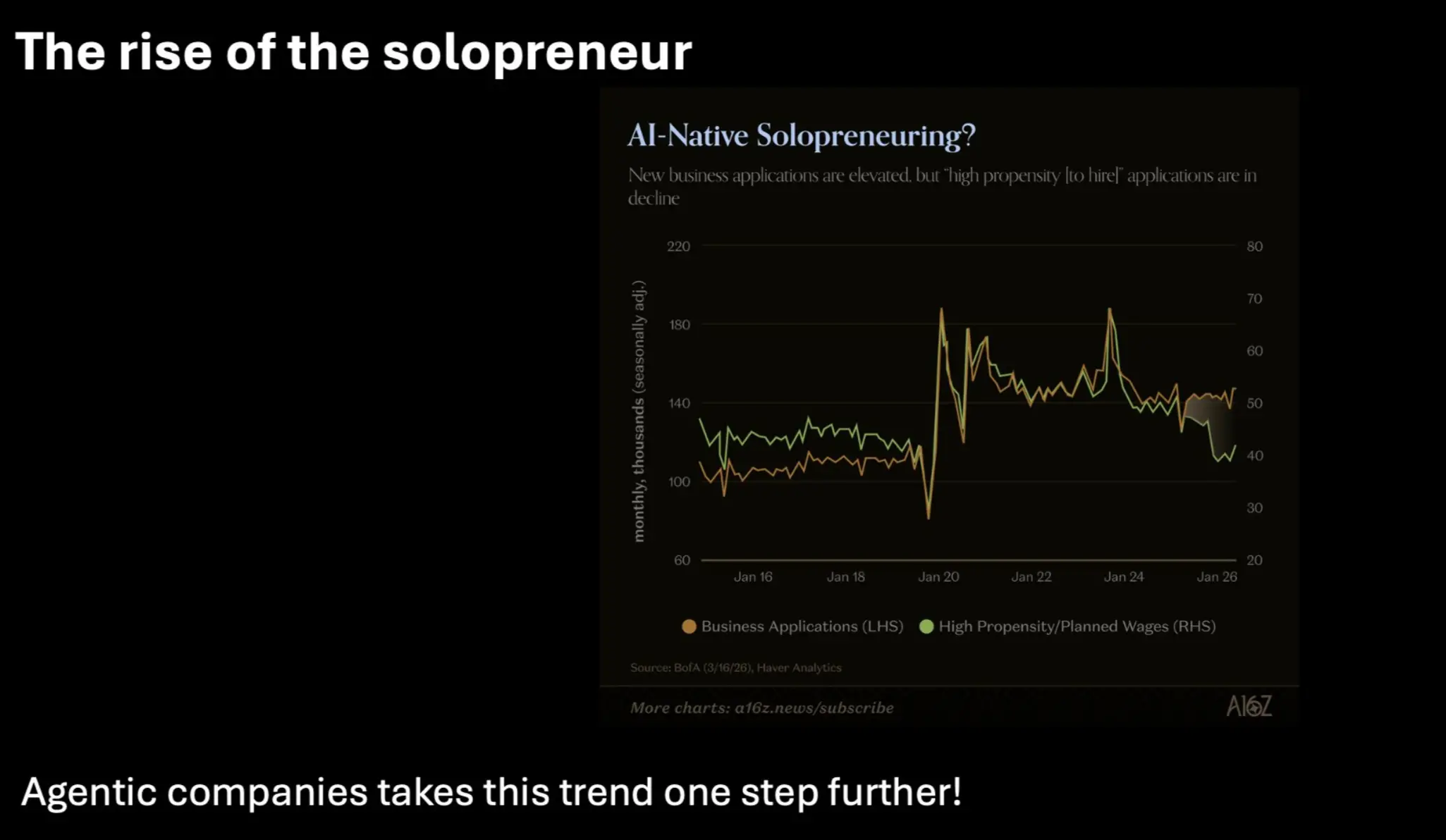
With the rise of the "solopreneur," we are already seeing early forms of this world. A person equipped with powerful AI tools can now build products and businesses at speeds that were unimaginable just a few years ago. The cost of creating software is rapidly decreasing, and individual productivity is increasing accordingly.
The logical next step is not just that humans become more productive through agents, but that agents themselves begin to take on the role of entrepreneurs: controlling workflows, managing assets, earning income, hiring or coordinating contributors, and operating as enduring economic entities.
This is the "YouTube moment" for the business world
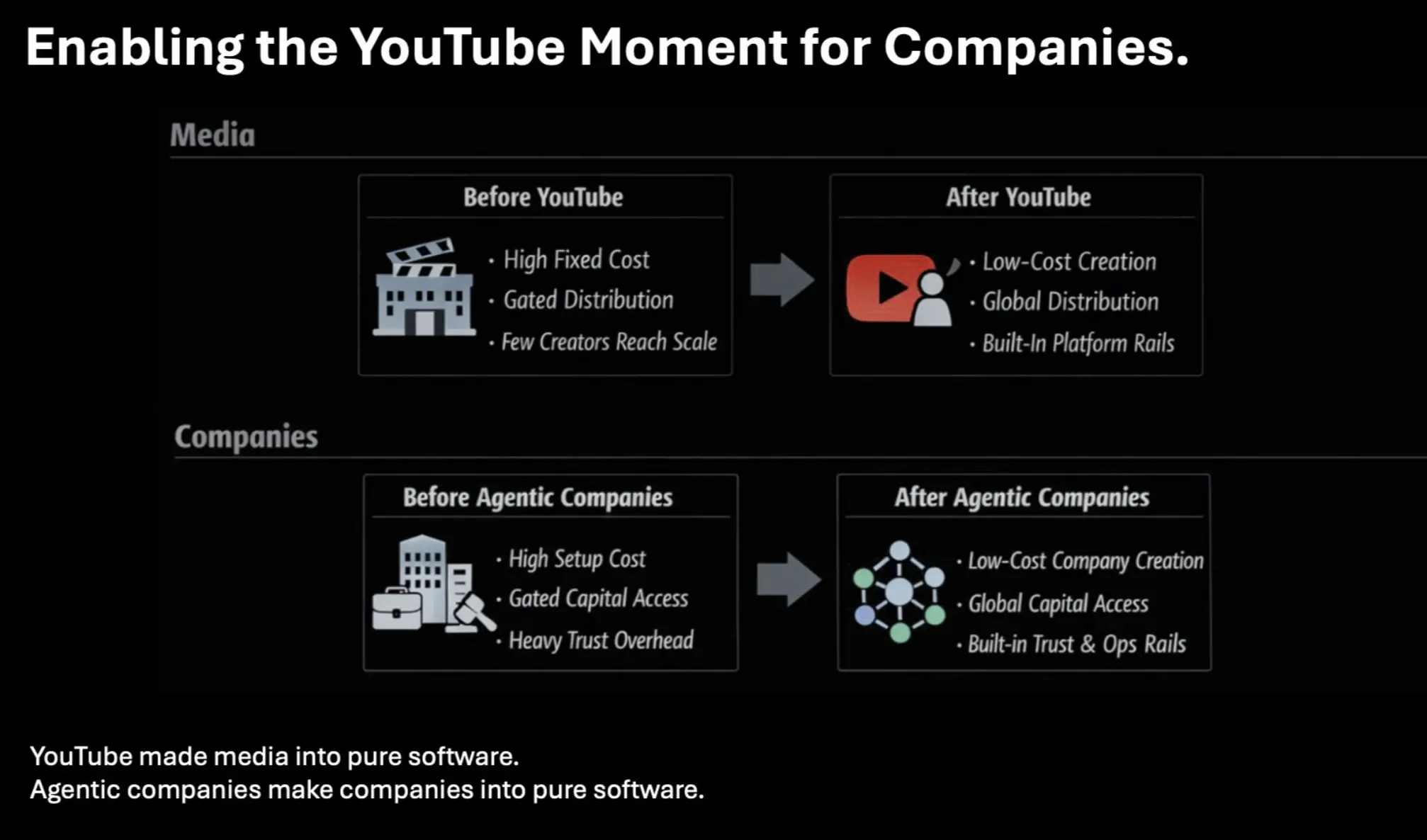
I find a useful analogy: we are approaching the YouTube moment for the business world.
YouTube fundamentally changed the media industry by making publishing and distribution extremely easy. What once required institutional infrastructure could suddenly be done by anyone with an internet connection and a desire to express themselves.
I believe AI and crypto technology are doing something similar for business creation. AI is democratizing the creation of software, and AI + cryptocurrency is democratizing the founding of software companies.
It’s worth noting that merely lowering the cost and complexity of starting a company does not mean all companies will succeed, just as most videos do not become global hits. But it does mean that the number of experiments will explode, and the surface area for innovation will expand.
Just as YouTube turned media into software-native creation, agentic companies can turn the formation of companies themselves into a software-native process.
Why this will become a trillion-dollar asset class
Every major asset class has looked strange in its early days. Public companies once represented a radical and unsettling ownership structure, and digital assets were once dismissed as fringe experiments. But when new organizational forms become clear, scalable, and investable, capital reorganizes around them.
This is why I believe that over time, agentic companies will become a trillion-dollar asset class. AI is making intelligence digital, and crypto technology is making ownership digital. Once these two become a reality, it becomes possible to create companies that are not only driven by digital technology but are composed of digital technology.
If this becomes reality, a vast new design space will open up: millions of software-native companies, each with lower costs, faster execution, and direct access to global capital networks. This timeline may be shorter than many expect, as AI is compressing time—what took centuries to accomplish in one era may only take decades or even less in another.
It has already begun
The final point I want to express in my talk is that this is not just a theory. We have reached a stage where people can attempt to have agents own assets, control accounts, operate digital services, and participate in economic workflows. These are still early systems, not yet the final form I describe, but the trajectory is clear.
This is important because significant historical shifts often appear incomplete before they seem unstoppable. They begin with rough prototypes, partial abstractions, and early infrastructures, gradually becoming the foundation for entirely new categories.
My judgment is that agentic companies are now on this path.
The most important transformations often begin with two independently maturing technologies that can merge to create something neither could create alone. This is how I currently view AI and cryptocurrency.
AI grants intelligence to software, and crypto technology grants ownership to software. The combination of the two not only produces better tools but creates the possibility of a new type of company: one that is software-native, possesses asset ownership, investability, and global attributes from inception.
This is the argument behind agentic companies. If we are right, this will not just be another product category in the AI x crypto landscape but will become one of the most important new asset classes of the next decade.

 Risk warning




Popular articles





