








Summarizing the 35-year cycle of U.S. interest rates, can a rate cut 42 days later trigger the second bull market for Bitcoin?

 From a historical perspective, interest rate cuts are unlikely to be the fundamental driving force behind the rise of Bitcoin and the cryptocurrency market.
Author: Nan Zhi, Odaily Planet Daily
Since Bitcoin broke through the new high of $69,000 three years ago, it has been fluctuating widely in the range of $50,000 to $70,000 for several months. After the Bitcoin halving, the only foreseeable grand narrative left is the Federal Reserve's interest rate cut.
The date of this event is already set in stone. According to CME FedWatch data, the probability of the Federal Reserve cutting rates on September 24 has risen to 100%, with only a difference of 25 basis points or 50 basis points, and currently, both probabilities are about fifty-fifty.
So, can a rate cut bring a big market rally for Bitcoin and the entire crypto market? Odaily reviews the five major rate-cutting cycles of the Federal Reserve from 1989 to 2019 in this article to explore whether there are objective laws.
The Boat Carving 2018-2020
This round of Federal Reserve rate hikes ended on December 19, 2018, and the first rate cut began on July 31, 2019, three quarters later. This round of rate cuts is also the first and only rate-cutting cycle that Bitcoin and the crypto market have experienced. The price trends of Bitcoin, the Nasdaq index, and gold are shown in the figure below:

From the chart, it is clear that the rate cut was already significantly priced in before it occurred, especially with Bitcoin having the largest lead. During the period from the last rate hike to the first rate cut, Bitcoin rose by 161.7%, the Nasdaq rose by 23.2%, and gold rose by 13.7%. After the rate cut, only the Nasdaq and gold continued to rise, while Bitcoin remained in a wide fluctuation.
Before the last rate cut (March 15, 2020), Bitcoin experienced the well-known "312" crash, and the global market was similarly bleak. However, at this point, the Federal Reserve had already lowered interest rates to 0.00% - 0.25%, thus adopting a massive quantitative easing policy, which ultimately overflowed liquidity into the crypto market, triggering the bull market of 2021.
The trends of the three major markets after the last rate hike on July 27, 2023, are compared below. At that moment, just like this moment, from the last rate hike to August 2 (as gold data was only collected until this date), Bitcoin rose by 122.6%, the Nasdaq rose by 19.4%, and gold rose by 27%. Bitcoin may have once again priced in the rate hike.

Looking Back at 1989-2008
Going further back, the U.S. rate-cutting cycle can be traced back to 2007, when Bitcoin had not yet been born. However, it is now generally believed that the crypto market still has a strong correlation with the U.S. stock market, so we still use the Nasdaq and gold price trends as research subjects and substitutes for Bitcoin prices to explore the relationship between rate cuts and price fluctuations.
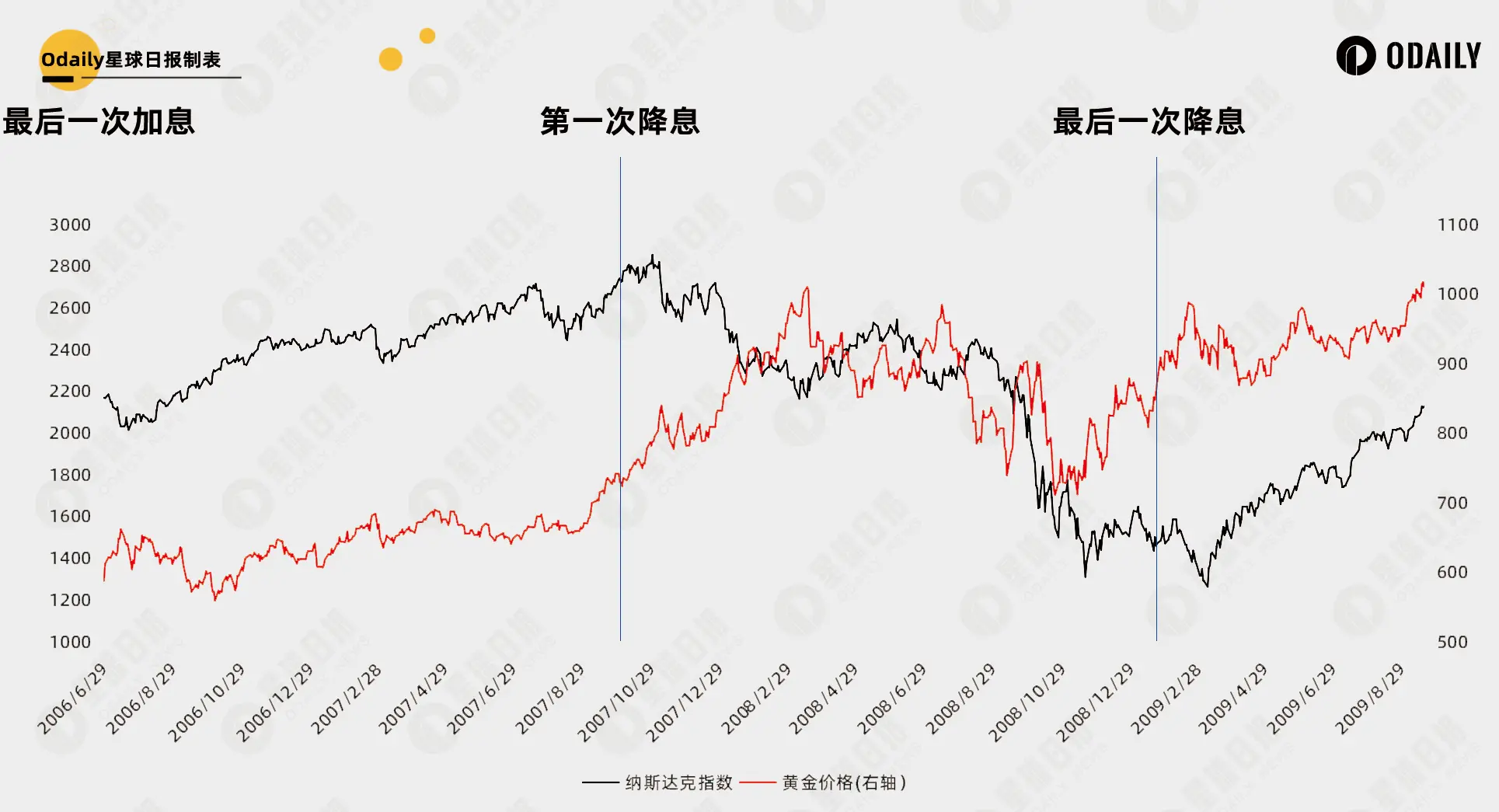
2006 - Hard Landing
In the cycle that began in 2006:
The last rate hike occurred on June 29, 2006, with the federal funds rate rising to 5.25%.
The first rate cut occurred on September 18, 2007, with the federal funds rate lowered from 5.25% to 4.75%.
The last rate cut occurred on December 16, 2008, with the federal funds rate lowered to 0% to 0.25%.
In terms of trends:
The Nasdaq rose before the rate cut, fell after the rate cut, and rose again before and after the end of the rate cut;
Gold rose before the rate cut and fluctuated upward after the rate cut.
In terms of the historical context:
The subprime mortgage crisis erupted in 2007, the financial system collapsed, and the Federal Reserve began cutting rates in September to respond to the worsening financial situation and the threat of economic slowdown, followed by the birth of BTC.
2000 - Hard Landing
In the cycle that began in 2000:
The last rate hike occurred on May 16, 2000, with the federal funds rate rising to 6.50%.
The first rate cut occurred on January 3, 2001, with the federal funds rate lowered from 6.50% to 6.00%.
The last rate cut occurred on June 25, 2003, with the federal funds rate lowered to 1.00%.
In terms of trends:
The Nasdaq rose before the rate cut, fell after the rate cut, and rose again before and after the end of the rate cut (the first peak was seen in June 2004, which is not shown in the chart);
Gold rose before the rate cut and fluctuated upward after the rate cut.
In terms of the historical context:
The internet bubble burst in 2000, and the valuations of tech stocks and internet companies plummeted. The Federal Reserve began a series of rate cuts in early 2001 to try to alleviate the pressures of economic recession. However, due to the market crash caused by the bubble burst and the significant decline in corporate profits, market sentiment was extremely pessimistic.

1995 - Soft Landing
In the cycle that began in 1995:
The last rate hike was completed on February 1, 1995, and the rate cuts began on July 6 of the same year, with the last rate cut on December 19. The entire cycle was relatively short compared to other years.
In terms of trends:
The Nasdaq rose before the rate cut and continued to rise after the rate cut;
Gold fluctuated before the rate cut and fell after the rate cut.
In terms of the historical context:
At that time, the U.S. economy was relatively strong and was in the early stages of technological innovation and internet development. The rate cut in 1995 was a preventive measure aimed at supporting the ongoing expansion of the economy, which is why it was very short-lived.

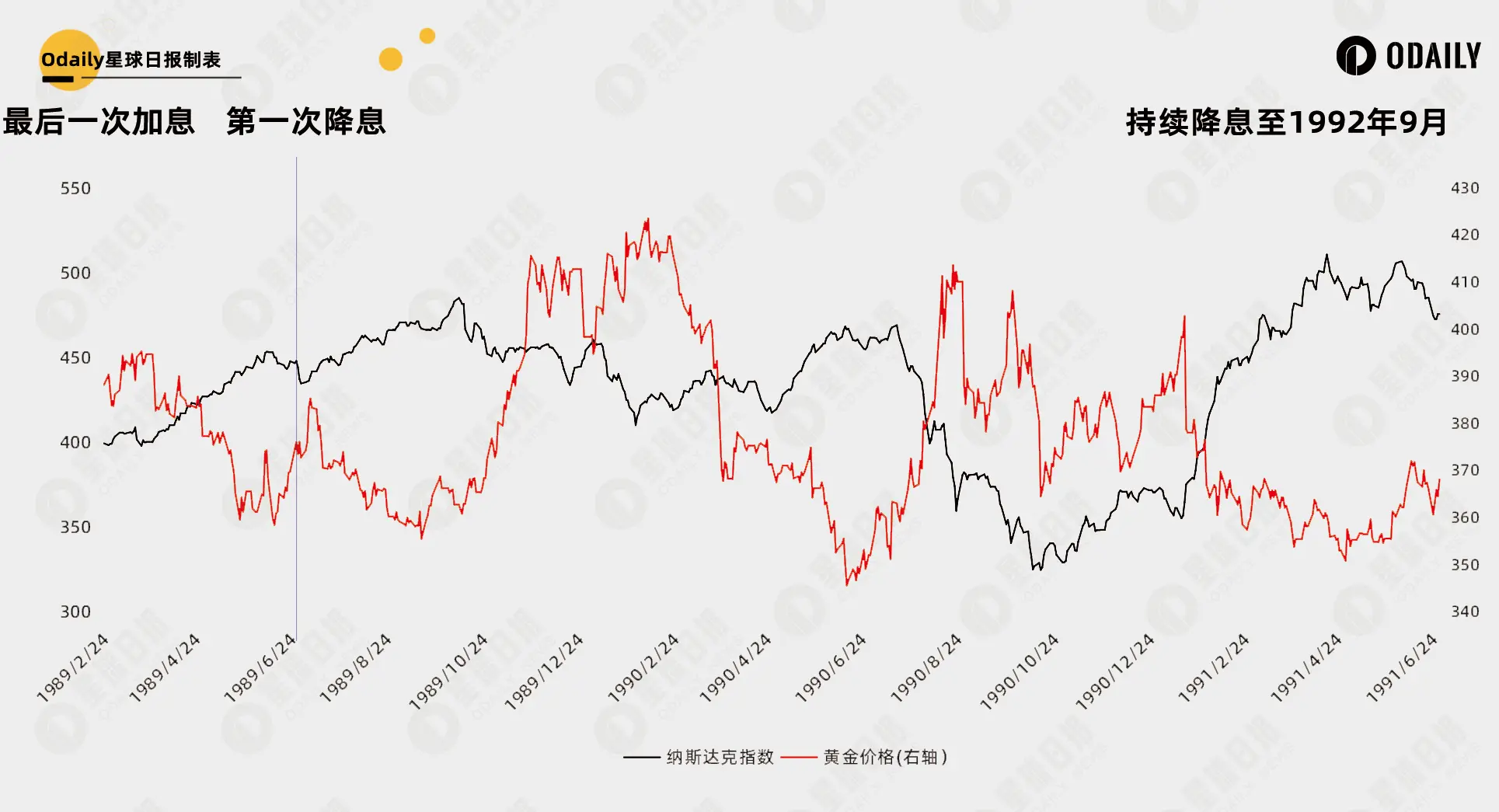
1989 - Soft Landing
In the cycle that began in 1989:
The last rate hike occurred on February 24, 1989, with the federal funds rate rising to 9.75%.
The first rate cut occurred on June 28, 1989, with the federal funds rate lowered from 9.75% to 9.5%.
The last rate cut occurred on September 4, 1992, with the federal funds rate lowered to 3.00%.
In terms of trends:
The Nasdaq rose before the rate cut and fluctuated after the rate cut;
Gold fell before the rate cut and fluctuated after the rate cut.
In terms of the historical context:
The U.S. economy experienced a long expansion period in the 1980s. By 1989, the economic expansion had lasted for 7 years, becoming one of the longest post-war economic expansions. By the late 1980s, the U.S. faced high inflation pressures, and the Federal Reserve raised rates in 1988 to combat inflation, but these rate hikes began to show their suppressive effects on economic growth in 1989.
Conclusion
In summary, there are several significant conclusions:
Rate cuts do not directly trigger bull markets in stocks and major assets; the related impacts are often already priced in;
The impact of rate cuts on future markets depends on the overall economic situation at that time, whether the rate cuts are proactive to promote economic development or forced due to black swan events. From the perspective of the U.S. stock market, it is a struggle between economic resilience and liquidity easing pricing.
Gold generally benefits from falling interest rates (and a declining dollar) and tends to perform better in hard landing scenarios.
Therefore, from a historical perspective, it is difficult for rate cuts to become the fundamental driving force behind the rise of Bitcoin and the crypto market. Since 2024, we have experienced events such as Bitcoin spot ETFs and halving; the market needs the next grand narrative or fundamental change.
 Risk warning Risk warning

Popular articles





