The new "crypto czar" of the White House, David Sacks, supports Bitcoin with ten statements
 David Sacks has publicly expressed his support for Bitcoin and cryptocurrencies multiple times. He believes that Bitcoin is a tool to counter traditional financial systems and centralization, especially in the context of global economic uncertainty and currency devaluation, showcasing its value. He believes that DeFi and blockchain technology can make the financial system more transparent.
Author: Cat Brother, Wu Says Blockchain
On December 6, the U.S. President-elect Trump will appoint David Sacks as the White House Director of Artificial Intelligence and Cryptocurrency, making him the new "Crypto Czar" of the White House.
David Sacks is a South African-American entrepreneur and writer, who served as the Chief Operating Officer during the founding period of PayPal and has publicly expressed his support for Bitcoin and cryptocurrencies multiple times. He believes that Bitcoin is a tool to combat traditional financial systems and centralization, especially demonstrating its value against the backdrop of global economic uncertainty and currency devaluation. He thinks that DeFi and blockchain technology can make financial systems more transparent. Through his venture capital fund Craft Ventures, David Sacks has invested in several cryptocurrency projects, including: dYdX, Lightning Labs, River Financial, Kresus, Set Protocol, FOLD, Harbor, Handshake, Voltage, Galy, Lumina, Rare Bits.
In addition, David Sacks is a staunch supporter of Solana. In 2018, David Sacks announced an investment in the crypto venture firm Multicoin on behalf of Craft Ventures. Multicoin was one of the early investors in Solana, leading a $20 million financing round for Solana in July 2019. In December 2023, David Sacks clarified that he did not sell Solana after the FTX incident and tweeted, "One of the dumbest attacks against me this year was saying I sold Solana (SOL) tokens to retail. If that were true, they should have made a fortune by now. Congratulations to all SOL holders." Two years ago, David Sacks also discussed the prospects of Solana in depth on his podcast "All-In Podcast." He mentioned that many elites in Silicon Valley have high hopes for Solana, believing it could eventually surpass Ethereum. Even if this vision has not been fully realized, Solana is fully capable of ranking third in the crypto space.
Community member EliNagarBrr also compiled ten statements about his stance on Bitcoin, which he received a retweet from him, original link.
1. "I'm buying"
As @chamath explained, Bitcoin has the potential to become the next internet - the currency internet. I'm buying. --- David Sacks stated on May 31, 2013.
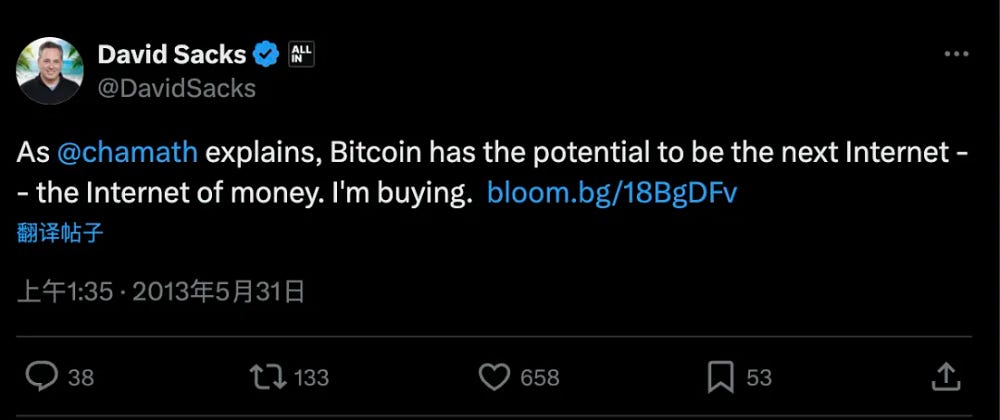
Since 2013, Sacks has been a Bitcoin HODLer, starting to buy Bitcoin when its price was only $130. Today, the price of Bitcoin has risen by 76,000%.
2. The transformative nature of Bitcoin lies in its potential as a non-fiat currency
In an interview on May 23, 2022 (from 46 to 49 minutes), David Sacks expressed this view, interview link.
David Sacks stated: My personal interest in Bitcoin dates back to 2012 when I first purchased Bitcoin. Although my primary investment focus is not on cryptocurrencies, we recognized that the crypto space was developing between 2017 and 2018. We predicted it would shift from a consumer-centric, retail-oriented phenomenon to an institutional asset class. To seize this opportunity, we invested in key infrastructure, including institutional custody provided by BitGo, and became seed investors in the crypto-focused hedge fund Multicoin Capital. Our core thesis is that as this asset class matures, it will require professional fund managers. While my expertise lies in SaaS investments, I saw the opportunity to support teams focused on the crypto space, and this strategy has yielded significant results.
The transformative nature of Bitcoin lies in its potential as a non-fiat currency. Historically, fiat currencies face significant risks when managed by governments, especially regarding currency devaluation. This is particularly true for reserve currencies like the dollar, as the temptation to print money to cover fiscal deficits and repay debts is immense. Currently, the U.S. debt-to-GDP ratio has exceeded 130%, meaning the total debt exceeds the nation's annual economic output - making it nearly impossible to repay without devaluing the currency. Historically, currency devaluation has been a common means of addressing excessive debt.
Bitcoin offers an alternative. It is not governed by a central authority but operates on principles of cryptography and immutable code. Its fixed total supply of 21 million coins eliminates the inflation risk caused by arbitrary monetary policies. Trust in Bitcoin does not rely on confidence in the government but rather on trust in the security and integrity of its underlying technology. As long as the system remains unbroken, its monetary policy will not change.
As individuals and institutions become increasingly aware of the systemic vulnerabilities of fiat currencies, Bitcoin's appeal as a reliable currency may continue to grow. Its journey is not over, but its foundational commitments to financial sovereignty and anti-inflation resonate with many.
3. Satoshi Nakamoto should be a billionaire
The first Bitcoin miner has 1 million Bitcoins, now worth $1 billion. I hope that person is Satoshi Nakamoto because he/she/they should be a billionaire. --- David Sacks stated on November 29, 2013.

4. He is making a fictional feature film about Satoshi Nakamoto
Sacks said, "This movie is like watching 'The Social Network' but not knowing who the Zuckerberg character is."

5. Sacks understands the utility of Bitcoin as a highly liquid and non-seizable store of value
Also in the interview on May 23, 2022 (from 50 to 52 minutes), David Sacks stated: The concept of Bitcoin as a global reserve currency is quite appealing. Some people, like Balaji Srinivasan, believe that the three currencies currently with global potential are: the dollar, the yuan, and Bitcoin. Each currency represents a different geopolitical or technological paradigm. The dollar symbolizes America's financial empire, the yuan is linked to China's rise, while Bitcoin symbolizes a decentralized and cryptography-driven future.
For Bitcoin to become a global reserve currency, significant systemic changes may need to occur, such as the collapse of the dollar or other catastrophic economic events. However, even without such upheavals, Bitcoin can play an important role. In countries facing oppressive regimes, export controls, or economic instability, Bitcoin provides a lifeline - a portable, censorship-resistant store of value, referred to as "new gold" or "digital diamonds." Its appeal lies in its ability to secure wealth independently of any nation.
6. He believes Bitcoin has the potential to separate currency from the state
In the interview from 52 to 55 minutes, David Sacks stated:
The grander vision of Bitcoin is to achieve a separation of currency from state control. Historically, similar transformative moments have changed social structures, such as the separation of church and state. Likewise, the separation of currency from the state could have equally profound implications, giving rise to a currency system independent of government intervention. This notion may sound like science fiction today, but Bitcoin offers a glimpse of that future.
The timeline for this transition is uncertain - it may take decades or even centuries. The speculative nature of Bitcoin's potential role in the global economy also makes it difficult to assign it a clear value. This uncertainty is why some, including myself, are cautious about active speculation. However, Bitcoin's potential lies in its ability to challenge traditional paradigms, even if its ultimate trajectory remains unknown.
7. He is not a Bitcoin maximalist
In the interview from 55 to 58 minutes, the host asked: Are you still buying Bitcoin? David Sacks replied:
I hold a certain amount of Bitcoin, but my approach is to "set it and forget it." I have experienced many market cycles - both dramatic rises and sharp declines - so I tend to allocate a portion of my net worth to Bitcoin and let it sit. For me, this is a long-term bet: while the risk of Bitcoin going to zero always exists, it also has the potential to evolve into a dominant currency over the next few decades. If that happens, I would regret not getting in earlier. Therefore, I have basically completed my investment and let it sit quietly without any active trading or attempts to time the market.
I would not classify myself as a Bitcoin extremist (Bitcoin Maximalist). While I believe Bitcoin has the strongest reasons to support it among all cryptocurrencies - as evidenced by its price performance and relative stability - I also recognize the value of the broader innovations sparked by Bitcoin.
For example, the blockchain technology that Bitcoin relies on has spawned other significant advancements, particularly in the realm of smart contracts. Platforms like Ethereum and Solana offer smart contract functionality, with their native tokens serving as "fuel" (gas) to purchase computational power. These platforms support various decentralized applications, especially in the decentralized finance (DeFi) space, which has reached a certain scale.
Despite the potential of blockchain technology, I remain skeptical about its applicability beyond certain use cases. Many problems that projects attempt to solve are actually more easily addressed through centralized databases. For instance, financial applications like trading, derivatives, and settlement make sense on the blockchain because they can benefit from the transparency and programmability it offers. DeFi contracts are open, auditable, and transparent, in stark contrast to the opaque over-the-counter derivatives on Wall Street.
However, the broader application prospects of blockchain remain uncertain. While DeFi has shown real potential, it is still unknown whether blockchain can support meaningful innovation in other areas. Much of the enthusiasm in this field seems misguided or overly optimistic, believing that blockchain can disrupt industries where centralized systems have already been functioning well.
Currently, I believe Bitcoin is the most robust and credible of all cryptocurrencies, especially in its role as a potential store of value. However, I also recognize other blockchain-based innovations, particularly in the fields of smart contracts and financial systems. This field is still developing, and the full scope of its applications has yet to be fully revealed. Whether these platforms will expand beyond DeFi into broader use cases or remain within a narrower scope will ultimately determine the long-term impact of blockchain technology.
8. Through his venture capital firm Craft Ventures, Sacks has invested in several Bitcoin-related companies, such as Lightning Labs, Fold, Bitwise, and Bitgo
Congratulations to starkness, roasbeef, and lightning for launching the beta version of the Lightning protocol. This is the most important scaling solution for Bitcoin and one of the most important projects in the entire crypto industry. I'm glad to be an investor! --- David Sacks stated on March 16, 2018.

9. After PayPal, he thought he would never be interested in the payments space again, but the emergence of Bitcoin changed everything. "Bitcoin is realizing PayPal's original vision of creating a new world currency."

This is an article published on August 14, 2017, original link.
At that time, his views included:
● He believes that cryptocurrencies are becoming the foundation of Web 3.0. Blockchain technology has become a developer platform, especially Ethereum, supporting the creation of decentralized applications and tokens, while also providing a new avenue for innovative financing through initial coin offerings (ICOs).
● In response to Howard Marks of Oaktree saying "Bitcoin is not real," Sacks countered that Bitcoin's "reality" is akin to software, relying on trust and network effects. Bitcoin guarantees scarcity through cryptography and economic incentives, and this trust is sometimes more reliable than government credit.
● Sacks believes that the current technological development of cryptocurrencies is akin to 1995, while market valuations are close to those during the 1999 internet bubble. He anticipates a correction, with regulatory policies being a major trigger.
● He hopes this correction will be more like a "soft landing" rather than a "nuclear winter" after the internet bubble, pointing out that the irrational valuations of ICOs are a focal point for market rectification.
● Sacks noted that protocol coins in ICOs have practical uses in software ecosystems and should not be viewed as securities. In contrast, asset coins will be securities that need to be issued correctly, but this area is full of potential.
● He believes that in the future, almost any illiquid asset could be blockchainized and tokenized, enhancing market liquidity and price discovery efficiency. Even liquid assets like stocks may shift to this platform due to the advantages of blockchain technology.
● Crypto capitalism poses a long-term threat to venture capitalism. Many startups can finance through ICOs without needing traditional VC funding.
● He predicts that the limited partner (LP) interests of VCs will also be tokenized, enhancing financing efficiency. While top VCs may stick to traditional models, tokenization will become a competitive advantage for other VCs.
10. David Sacks states that Bitcoin is the invention of digital scarcity
Those so-called critics, like Charlie Munger, are indeed very good investors, but they are not technology experts. That is their blind spot. One point they do not understand about this technology is that Bitcoin is the first digital asset in history that cannot be infinitely replicated.
Think about it, for example, a song, a photo, or a video; anything digital can be infinitely copied. That is one of the meanings of "digital," right? So how can you have a digital currency that cannot be infinitely copied? Clearly, if it could be copied at will, its value would be completely destroyed.
The genius of Bitcoin lies in the fact that every transaction is recorded in a decentralized ledger - the blockchain. Over the past decade, no one has been able to forge Bitcoin, create copies, or achieve double spending. That is the unique value of Bitcoin.
 Risk warning Risk warning