








Brokerages "receive coins," exchanges "break the circle": Is a new era of cryptocurrency circulation beginning?

 On one side, brokerages are opening up access to cryptocurrencies, while on the other side, exchanges are integrating resources to expand payment and compliance channels. Will 2025 be a new starting point for the circulation of crypto assets?
Author: Fairy, ChainCatcher
Editor: TB, ChainCatcher
Internet brokerages are "accepting coins," and cryptocurrency exchanges are also "breaking boundaries."
Yesterday, Futu Securities announced the launch of Bitcoin, Ethereum, and USDT deposit services, allowing users to transfer crypto assets directly into their accounts, bridging the funding channel from the crypto world to the stock market. On the other hand, cryptocurrency exchanges are no longer limited to their internal ecosystems; they are expanding into payment scenarios, with some platforms even incorporating traditional assets like US stocks and gold into their trading landscape.
On one side, brokerages are opening up crypto access, while on the other, exchanges are integrating resources and expanding payment and compliance pathways. Will 2025 be a new starting point for the circulation of crypto assets?
Futu's Crypto Ambitions
Futu Securities has long maintained a top position in the Hong Kong stock app download rankings, with over 25 million registered users globally and customer assets reaching HKD 743.3 billion. Now, it is accelerating its entry into the fast lane of crypto assets.
As early as 2023, Futu began laying out its crypto strategy. Its virtual asset platform, PantherTrade, submitted an application for a virtual asset trading platform license to the Hong Kong Securities and Futures Commission in November of that year. On August 1, 2024, Futu officially launched cryptocurrency trading features, opening up spot trading pairs for BTC and ETH.
Yesterday, Futu took another step forward by opening deposit services for Bitcoin, Ethereum, and USDT. Eligible users can directly transfer crypto assets into their Futu accounts, freely switching between Hong Kong and US stocks, ETFs, funds, bonds, and virtual assets in a diversified investment portfolio.
According to information on Futu's official website, the minimum deposit thresholds for BTC and ETH are currently 0.0002 BTC and 0.001 ETH, respectively, while USDT deposits are only available to professional investors. Some users have reported that Futu's deposit speed is comparable to that of mainstream exchanges, providing a smooth experience.
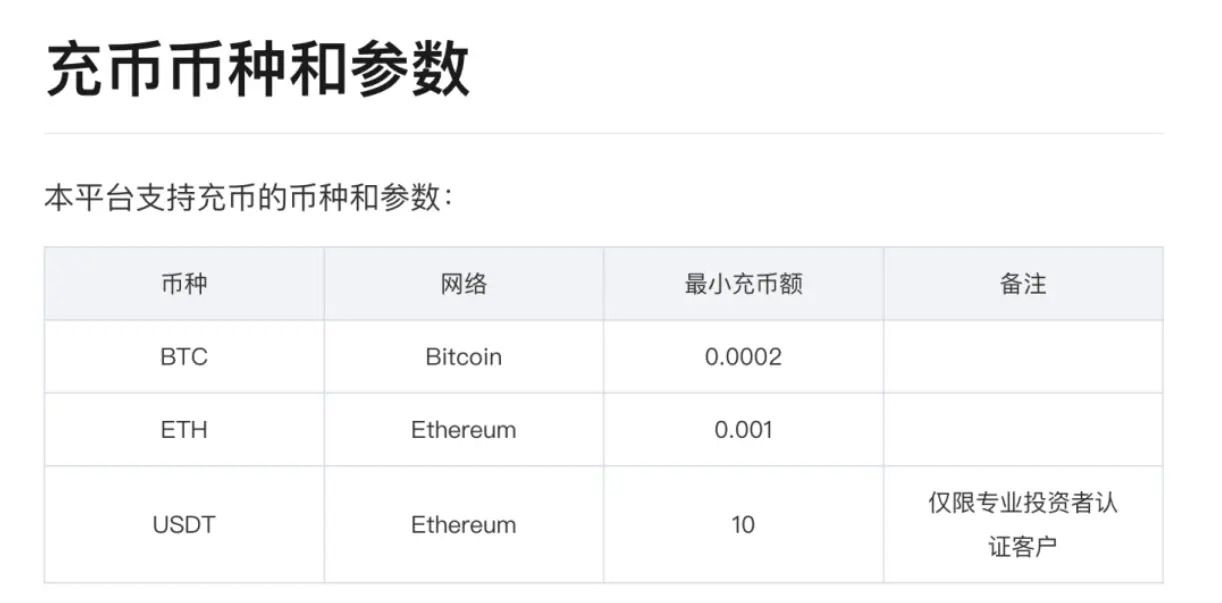
Image source: Futu official website
"Brokerages Accepting Coins" is a Trend
Futu is not an isolated case; the acceleration of traditional brokerages embracing crypto assets has become a global trend. In the Hong Kong market, Victory Securities took steps earlier, opening up the ability for users to deposit and withdraw USDT and USDC through the VictoryX app in May 2024, and this year proposed to develop as a "comprehensive service provider for virtual assets" as its core focus for the next three years.
On the global stage, US brokerage Robinhood is one of the earliest representatives of "accepting coins." In 2024, its crypto trading volume soared to $143 billion, a year-on-year increase of 259%, approaching two-thirds of Coinbase's retail trading volume. Robinhood is not satisfied with this; through the acquisition of Bitstamp, it plans to launch crypto services in Singapore by the end of 2025, accelerating its entry into the Asia-Pacific market.
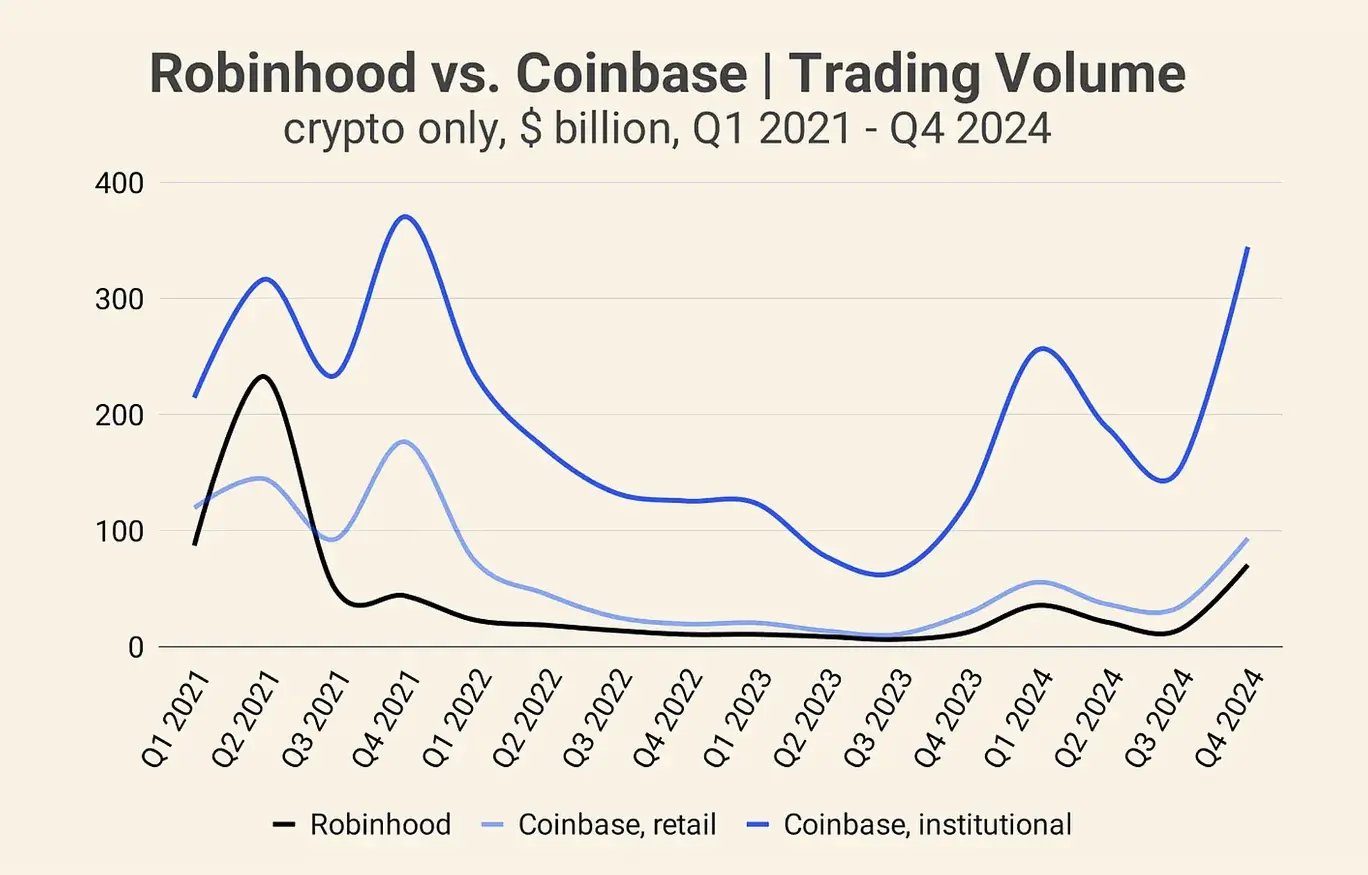
Coinbase and Robinhood crypto trading volumes, image source: insights4.vc
New entrants are increasing their stakes, while observers are catching up. Charles Schwab is expected to open BTC and ETH spot trading within the year, and Morgan Stanley's E*Trade also plans to launch crypto services before 2026.
Crypto Platforms "Breaking Boundaries" and Upgrading
Not only are traditional brokerages moving closer to crypto assets, but crypto platforms are also "breaking boundaries" in the opposite direction, actively connecting with traditional financial markets.
Bybit recently revealed plans to launch trading features for US stocks and other traditional assets, aiming to enable direct trading of US stocks, indices, gold, crude oil, and more within the platform by the end of the year, further expanding its asset coverage.
At the same time, crypto platforms are accelerating the integration of payment and consumption scenarios. OKX launched the "Crypto Balance Treasure" OKX Pay, allowing users to convert idle assets into stable income tools; platforms like Bitget and Coinbase have already introduced crypto cards, and OKX and Kraken's crypto cards are also in preparation, seamlessly integrating digital assets into online and offline consumption.
The layout around "crypto cards" is expanding from point to surface; this move by exchanges not only broadens the application boundaries of crypto assets but also strengthens the platform's ecological closed loop, enhances user stickiness, and becomes a new growth curve for business.
Starting from crypto assets and connecting with mainstream global investment varieties and payment channels, the boundaries of crypto platforms are being reshaped. Crypto KOL Rocky asserts: "In the future, there will only be two types of exchanges: one is a comprehensive platform that integrates RWA, and the other is a traditional exchange that still adheres to pure crypto assets."
Perhaps the next generation of exchanges is being redefined.
Coin-Stock Interconnectivity is an Inevitable Trend
The trend of coin-stock interconnectivity is accelerating, bringing both opportunities and challenges. In the future, crypto projects will compete directly with global capital markets for liquidity and attention. At the same time, more investors may begin to evaluate crypto assets from the perspective of US and Hong Kong stocks, leading to the accelerated elimination of low-quality tokens and pushing the market towards high-quality targets. The adoption rate of stablecoins will continue to rise, as the crypto market moves towards the mainstream financial system.
From a global perspective, regulatory frameworks are becoming increasingly clear, and compliance thresholds are rising, providing a stable development path for traditional brokerages and mainstream crypto platforms; on the other hand, listings, mergers and acquisitions, and cross-border integrations are becoming normalized, reshaping the market landscape through the fusion of traditional financial capital and crypto infrastructure.
Crypto assets are crossing ecological islands, moving towards broader circulation and application scenarios.
 Risk warning
 Risk warning



Popular articles





