








U.S. listed companies are flocking to "buy coins." What is the effectiveness of the second growth curve?

 Short-term effectiveness, long-term mystery.
Author: Fairy, ChainCatcher
Editor: TB, ChainCatcher
"Buying coins" has become a cheap and quick method for market capitalization lifting in the stock market.
The "shanzhai season" craze in the US stock market is rolling in, with the main business of listed companies becoming a backdrop, while digital assets have turned into a new engine for market capitalization.
But the problem is becoming increasingly sharp: Will the market really keep paying for this valuation game under the guise of buying coins?
Valuation Logic: How Does Buying Coins Affect Corporate Value?
"Buying coins" resembles an experiment in valuation shift woven from emotions, liquidity, and narratives.
In the traditional valuation framework, a company's market value derives from the comprehensive pricing of core variables such as its profitability, capital structure, growth potential, and free cash flow. However, in this wave of "buying coins," companies have leveraged their "financial allocation" behavior of holding crypto assets to drive a repricing of their valuations in the market.
When companies incorporate Bitcoin or other mainstream crypto assets into their balance sheets, the market's valuation attaches a premium multiple based on the price elasticity and trading expectations of crypto assets. In other words, a company's market value not only stems from value creation but also from a leveraged amplification of the possibility of "coin price increases."
Yet this structure almost places the "liquidity narrative" above corporate operations, transforming financial allocation into the main axis of capital operations.
Short-term Boost, Long-term Still a Question Mark
It is undeniable that entering the crypto space does have the ability to stimulate stock prices in the short term. Take the automotive trading service provider Cango as an example; the company announced in November 2023 that it would enter the Bitcoin mining field, investing $400 million to acquire 50 EH/s of computing power resources, and its stock price subsequently soared by 280%. Similarly, many companies with lackluster main business performance or even deep financial troubles are also trying to leverage the "buying coins" narrative to seek revaluation in the capital market. (Related reading: ETH and SOL Version of "MicroStrategy" Trend: A New Type of Speculative Script Driven by Coin and Stock?)
We have compiled a set of stock price data from listed companies that achieved "coin-stock linkage" through cryptocurrency purchases:
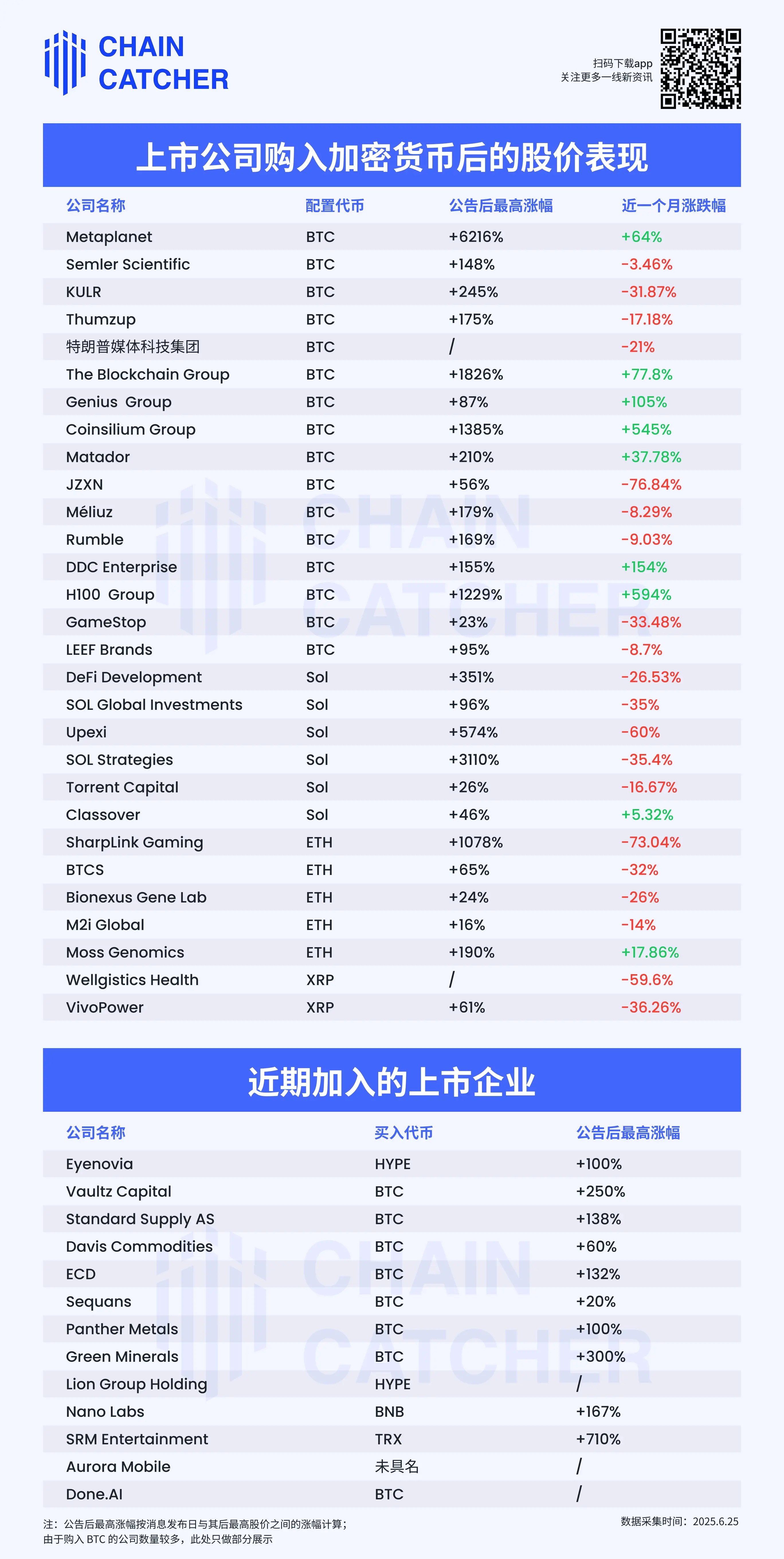
From the market performance, the phenomenon of "buying coins leads to soaring prices" has played out multiple times. As long as the concept of "crypto assets" is put forward, short-term funds quickly flow in. However, after the short-term surge, many "coin-holding companies" face stock price corrections, and without continuous buying actions or other favorable news to sustain the momentum, the gains are hard to maintain.
Therefore, while the "buying coins" strategy can ignite market enthusiasm in the short term, whether it can translate into long-term competitiveness and sustained growth for companies remains full of uncertainty. The market is also unlikely to genuinely recognize those who merely seek attention through one or two coin purchases or vague "holding plans."
Are Speculators Starting to Sell?
The story of "buying coins to lift valuations" continues to ferment, but some core players seem to be quietly cashing out.
Strategy, the proponent of this "infinite growth" theory, has seen its internal executives continuously reduce their holdings of $MSTR stock. According to SecForm4.Com data, since June 2023, insiders at Strategy have entered a concentrated selling period. Protos reports that in just the past 90 days, executives have sold a total of $40 million in stock, with the number of sales being ten times that of purchases.
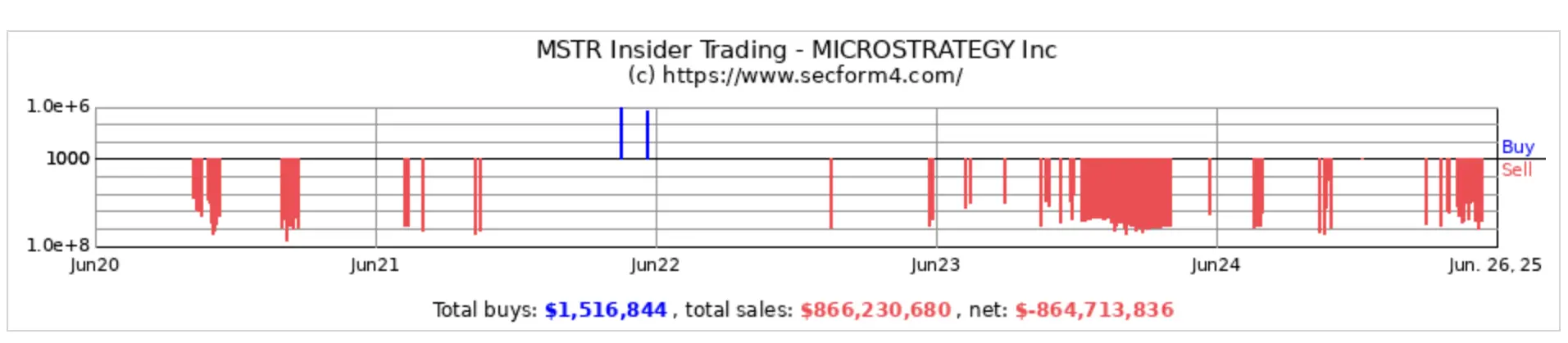
Source: secform4.com
The "Sol version of MicroStrategy," Upexi, is also facing pressure; the company previously raised $100 million to establish a Sol treasury. However, Upexi's stock plummeted by 61.2% yesterday, as investors registered to sell 43.85 million shares, equivalent to its total circulating shares at the beginning of April. (Related reading: SOL Returns to $150, Upexi Becomes "Solana Version of MicroStrategy," Is Infinite Growth About to Begin?)
On the other hand, stablecoin issuer Circle saw its stock price soar to nearly $300 after going public. However, Ark Invest, which had strongly supported it before its IPO, has been continuously reducing its holdings. It is reported that Ark Invest has sold Circle stock four times in a row, cumulatively reducing its holdings by over 36%.

When "buying coins" becomes a packaging, a market capitalization tool, or even a narrative shell to evade fundamental questioning, it is destined not to be the "key" for all companies. Today's market is willing to pay for "financial allocation," but tomorrow's market may return to a genuine inquiry into growth and profitability.
The buy orders in the secondary market do not necessarily indicate recognition; more likely, they represent a rotation of speculative chips.
 Risk warning
 Risk warning




Popular articles





