Stablecoin Economics: Analysis of Cross-Border Payments, Currency Substitution, and Financial Innovation

 Stablecoins represent a new type of payment technology and model, which may have positive spillover effects that are not clearly visible at present, and completely denying them is not the optimal choice.
Author: Peng Wensheng, CICC
Stablecoins are private currencies pegged to fiat currencies, and the operational model of dollar stablecoins is similar to the concept of narrow banking, where the liabilities of the issuer (stablecoins) pay zero interest, while the safe assets used as redemption guarantees earn interest. The supply of stablecoins is highly elastic, and the significant interest rate differentials resulting from the sharp rise in dollar interest rates in recent years have motivated issuing institutions to increase supply, but the zero-interest nature means that their circulation is mainly determined by demand. The reason why demand-side participants are willing to forgo interest income is that stablecoins provide other conveniences, such as being used for cryptocurrency trading, which is cheaper for cross-border payments compared to traditional banking payment systems, with regulatory arbitrage being an important aspect, and another possibility is their use as a tool to replace unstable currencies. Theoretically, these could also be achieved through stablecoins of other currencies, but the dollar, as the international reserve currency, has an incumbency advantage. Its established network and scale effects put stablecoins of other currencies at a disadvantage in competition with dollar stablecoins. This may explain why the European Central Bank advocates issuing a digital euro (central bank digital currency) rather than using euro stablecoins to respond to the challenges posed by dollar stablecoins. For China, the first step should be to vigorously promote the use of third-party payment tools in cross-border payments. From an economic mechanism perspective, platforms like WeChat Pay and Alipay are similar to RMB stablecoins, having already formed a strong network and scale economy domestically, and compared to dollar stablecoins, RMB platform stablecoins have stronger economic attributes and weaker financial attributes, better leveraging China's scale advantages in manufacturing and finished goods trade. Secondly, central bank digital currency, as an exogenous force, is beneficial in countering the endogenous advantages of incumbent international currencies in market competition, such as establishing cross-border payment infrastructure through multilateral central bank digital currency cooperation. Furthermore, as a new payment technology and business model, the mechanism of dollar stablecoins may have spillover effects that are not yet clear, and outright denial is not the optimal choice. Hong Kong can play a role as an international financial center and offshore RMB center by piloting RMB stablecoins.
Recently, the dynamics in the digital currency field, especially the development of dollar stablecoins, have attracted attention. Since re-entering the White House, the Trump administration has made numerous statements regarding digital currencies, including developing stablecoins pegged to the dollar, opposing the Federal Reserve's issuance of central bank digital currency, and advocating for including cryptocurrencies like Bitcoin as reserve assets. Recently, U.S. Treasury Secretary Janet Yellen stated at the White House's first digital asset summit that the U.S. "will maintain the dollar's status as the world's dominant reserve currency" and "will use stablecoins to achieve this goal."
Other countries and regions around the world have also reacted. ECB President Christine Lagarde recently emphasized the need to quickly establish a legislative framework to pave the way for a potential digital euro (central bank digital currency) to address the challenges posed by the rapid development of stablecoins and cryptocurrencies. Interestingly, she did not propose using euro stablecoins as a response. Hong Kong has passed the "Stablecoin Regulation Draft," which allows licensed institutions to issue stablecoins pegged to fiat currencies and sets relevant regulatory requirements.
Stablecoins are not only a hot topic of global concern but also an economic event that is happening in reality, which may have significant implications for the global economy and financial landscape. This article attempts to analyze how to understand the economic logic and public policy implications of stablecoins.
1. What are stablecoins? What are they not?
Stablecoins are a type of cryptocurrency that is pegged to specific assets and aims to maintain a relatively stable value. Currently, dollar stablecoins backed by highly liquid assets (such as USDT and USDC) account for over 90% of the total market capitalization of all stablecoins. The stablecoins discussed in this article refer only to these dollar stablecoins. Stablecoin trading can be divided into primary and secondary markets. In the primary market, stablecoin issuers typically promise to redeem 1 stablecoin for 1 dollar, but there are high participation thresholds, generally allowing only institutional users to participate, while also requiring compliance with Know Your Customer (KYC) requirements, and redemptions may have processing delays. The secondary market is where market participants trade autonomously, and the price of stablecoins is influenced by supply and demand, sometimes deviating from the pegged price of 1 dollar. Stablecoins have both technical and monetary characteristics, with several points worth noting. (1) Digital technology enhances payment settlement efficiency but does not decentralize. Theoretically, stablecoins operate on a distributed ledger of blockchain, possessing decentralized attributes. At the same time, stablecoins can be embedded in smart contracts, supporting applications such as lending and trading in decentralized finance (DeFi), allowing for automatic execution without traditional financial intermediaries, achieving fast and low-cost settlements. However, in reality, the decentralization of stablecoins has certain limitations. For example, the issuing companies of USDT and USDC control the issuance and redemption of stablecoins and manage reserve funds, presenting certain centralized characteristics. (2) From the holder's perspective, stablecoins are private currencies, not government currencies. According to the "Stablecoin Innovation and Guidance Act (GENIUS Act)" proposed in the U.S. in 2025 (draft), stablecoin issuers are prohibited from paying any form of interest to holders. At the same time, the act requires stablecoin issuers to hold no less than 1:1 of highly liquid assets as reserves. From a monetary attribute perspective, stablecoins are essentially a form of private currency based on the credit of the dollar and the issuing institution. (3) From the issuer's perspective, the stablecoin model is similar to "narrow banking," not just liabilities. The operation of stablecoins is similar to the narrow banking model. Traditional banks adopt a "short-term debt, long-term investment" model, using short-term deposits to issue long-term loans, where maturity mismatches can trigger liquidity crises, as seen in historical bank panics and runs. The modern central banking system enhances financial stability through a multi-layered regulatory framework, including various liquidity tools, deposit insurance systems, capital liquidity requirements, and macro-prudential policies. In contrast, stablecoins resemble the concept of narrow banking, where the core is to strictly limit the scope of business, only allowing the holding of low-risk, highly liquid assets such as cash and short-term government bonds. By maintaining sufficient or even excess assets, they uphold their redemption guarantees against deposits, avoiding crises caused by maturity mismatches, credit risks, or excessive speculation. In this model, the functions of money creation and credit issuance are separated: in some theoretical constructs represented by the "Chicago Plan," narrow banks act merely as "money warehouses," responsible for safely holding deposits and providing payment services, while credit issuance such as corporate loans is completed by other non-bank financial institutions (such as specialized lending institutions), with strict legal and financial separation between the two. (4) The RMB already has stablecoins: WeChat Pay and Alipay. From an economic mechanism perspective, platform currencies of third-party payment tools have similar functions to stablecoins, and China has certain comparative advantages in this regard, having formed a relatively complete regulatory framework. The Chinese digital payment industry, represented by WeChat Pay and Alipay, is leading globally, with "WeChat balance" and "Alipay balance" as user claims against payment institutions, supporting real-time account top-ups and withdrawals to cards, and facilitating various consumption, transfer, and financial scenarios. Under the centralized management system for customer reserve funds, these funds must be 100% deposited with the People's Bank of China (constituting "non-financial institution deposits" on the central bank's balance sheet), thereby constraining the use of funds by payment institutions and fully safeguarding users' assets. Thus, similar to offshore stablecoins, platform currencies are also extensions of fiat currencies, maintaining a 1:1 ratio between digital currency symbols and fiat currencies through a mechanism, with the difference being that the stability mechanism of platform currencies is stricter, and the safety of customer reserve funds is effectively guaranteed by the central bank's base currency, while regulatory norms impose stricter limits on their financial expansion attributes.
2. As a payment tool, what costs can stablecoins reduce, and what costs can they not reduce?
Currently, the user base for stablecoins in conventional retail payments is very small, and application scenarios are limited. Third-party payment platforms such as WeChat, Alipay, Apple Pay, and PayPal have already formed network effects and economies of scale, enjoying first-mover advantages in their respective currency zones. In terms of payment convenience and security, stablecoins do not have a clear advantage over existing third-party payment systems. The potential for stablecoins to reduce transaction costs mainly lies in cross-border payments.
What factors give stablecoins a low-cost advantage in cross-border payments? A relatively sufficient market competition landscape may be an important reason. Traditional banking systems provide dollar cross-border remittance and payment services, but the centralization of the clearing system is high. The Clearing House Interbank Payments System (CHIPS) in New York, as one of the core infrastructures for dollar cross-border payment clearing, handles about 96% of global dollar cross-border payments. The card payment clearing institutions are dominated by a few oligopolies such as Visa and MasterCard, where first-mover advantages and economies of scale lead to high entry barriers and industry concentration, thus raising transaction costs.
Third-party digital payment platforms have lower transaction costs between private parties compared to traditional cross-border payment systems, with more transparent fee structures. These payment platforms typically integrate digital wallet functionalities, and diverse user demands compel suppliers to iterate and upgrade payment services, creating differentiated competition across different regions and usage scenarios. Many third-party payment platforms have established their highlights in niche markets, such as Stripe, which offers lower cross-border fees and customizable business solutions, primarily serving online businesses with high transaction volumes or international trading needs. However, from the merchant's perspective (the payee), the transaction fees for third-party payments remain relatively high.
The openness and infrastructure of stablecoins make it more likely to form a competitive market landscape and bypass existing payment systems to achieve low-cost cross-border payments. First, the digital economic characteristics of stablecoins make it possible to reduce costs using new technologies, such as the competition and optimization of stablecoin public chains helping to drive down transaction fees (gas fees). Second, the competition in the stablecoin market is relatively sufficient, with multiple existing or potential issuers competing globally, which helps keep transaction fees at a lower level. Third, compared to the banking system and third-party digital payment platforms, stablecoins face looser regulation, creating some regulatory arbitrage space. In contrast, the regulatory framework for existing payment methods is relatively well-established, with banks facing strict constraints in terms of capital adequacy, deposit insurance, liquidity management, anti-money laundering (AML), and KYC, while third-party digital payment platforms have clear regulations regarding payment licenses, fund custody, anti-money laundering, and cross-border settlement. In comparison, stablecoins have strong anonymity, often bypassing traditional bank cross-border settlement systems without having to comply with strict foreign exchange or capital flow controls.
It is worth noting that stablecoins can reduce the costs of cross-border payments within the same currency, but for payments involving exchanges between different currencies, the situation is more complex. Stablecoins cannot eliminate the exchange costs between two currencies, which are subject to local banking systems, anti-money laundering, and capital account control regulatory requirements that increase transaction costs. Of course, as one party in the transaction currency, the dollar has economies of scale, and exchanges between other currencies are generally conducted through the dollar. This cost advantage stems from the dollar's status as an international transaction medium. In terms of digital technology itself, dollar stablecoins do not necessarily have a competitive advantage over third-party payment tools or central bank digital currencies of other currencies. An important implication is that the role of stablecoins of other currencies in reducing the costs of cross-border economic activities is much more limited than that of dollar stablecoins.
3. The supply of stablecoins is highly elastic, and their circulation is mainly determined by demand.
From the perspective of stablecoin supply, the income of issuing institutions comes from the interest rate spread between assets and liabilities. Stablecoin issuers pay zero interest on the liability side while holding interest-earning safe assets such as government bonds and bank deposits on the asset side. The net interest margin (interest spread minus operating costs) is larger, the stronger the motivation for issuers to provide stablecoins. Theoretically, as long as the net interest margin is positive, supply could potentially be unlimited. The market capitalization of dollar stablecoins increased from several billion in 2020 to over $220 billion in the first quarter of 2025, accounting for 99.8% of the total amount of fiat-pegged stablecoins. During these years, dollar short-term interest rates rose from nearly zero during the COVID-19 pandemic to around 4% now, providing stablecoin issuers with a nearly risk-free large interest spread. This may explain why more and more institutions are willing to issue stablecoins.
Given the characteristic of high supply elasticity, the circulation of stablecoins is primarily determined by demand. As a non-interest-bearing payment tool, no one is willing to hold significantly more zero-interest assets than their transaction needs. Due to the uncertainty of transaction demand, people are willing to hold some reserves, and the demand for reserves partly depends on the opportunity cost of forgoing interest income. When the yields on bank deposits or other safe assets (such as government bonds) rise, the opportunity cost for holders increases, leading to a decrease in reserve demand. In other words, the recent rise in dollar interest rates should reduce the demand for stablecoins. So how do we explain the rapid growth of dollar stablecoins during the same period?
From another perspective, the interest that stablecoin holders forgo is the price they pay for the convenience of obtaining stablecoins. Higher interest rates lead to lower stablecoin balances, but the convenience benefits provided by each stablecoin to holders increase. So what types of convenience benefits can offset the opportunity costs brought by the significant rise in interest rates?
The first possibility is the currency substitution effect. The dollar, as the incumbent international currency, provides liquidity/safe assets, especially for economies with high inflation or continuous depreciation of their local currencies, where the dollar serves as a substitute for local currencies. Research has found that the willingness to hold stablecoins has increased in developing countries such as Turkey, Argentina, Indonesia, and India. For example, in Turkey, where inflation is high, the scale of stablecoins purchased with fiat currency in 2023 was equivalent to 3.7% of GDP. However, this currency substitution should be limited. From a store of value perspective, especially considering the rising dollar interest rates, the dollar's substitution for local currencies should be more reflected in interest-bearing safe assets, such as local bank dollar deposits. Another possibility is that dollar stablecoins could replace dollar cash, but there is no evidence to indicate the significance of this option. In comparison, both dollar cash and stablecoins pay no interest, but stablecoins offer convenience in carrying and do not carry the risk of physical damage, especially advantageous for large payments, while the advantage of dollar cash is the absence of redemption risk.
The second possibility is related to traditional cross-border trade payments. Traditional cross-border payments have long been plagued by high costs and low efficiency, mainly due to monopolies caused by highly centralized infrastructures, complex and lengthy processes, and layered compliance costs. In this context, stablecoins offer an alternative that bypasses or simplifies traditional hierarchical structures, using digital means to achieve more direct cross-border payments, thus breaking existing patterns and reducing transaction costs. For cross-border e-commerce sellers and businesses or individuals frequently engaged in small cross-border trades, this cost reduction is highly attractive, potentially leading to demand for stablecoins. However, reducing cross-border payment costs is not the "patent" of stablecoins; digital payment platforms like PayPal also have the potential to break the traditional cross-border payment monopoly.
The third possibility is related to cryptocurrency trading. In recent years, the prices of cryptocurrencies like Bitcoin have risen sharply and exhibited high volatility, increasing the demand for dollar stablecoins as reserves for cryptocurrency trading. Stablecoins serve as the main intermediaries for cryptocurrency trading and are ideal safe havens during periods of price volatility for major cryptocurrencies like Bitcoin. Whether the Bitcoin market is rising or falling, the existence of derivatives such as futures contracts and perpetual contracts has led to a sustained increase in the market's demand for stablecoins as collateral.
The fourth possibility is related to underground economic activities, regulatory arbitrage, and evading financial sanctions. The anonymity of stablecoins in transactions makes it difficult to trace and regulate, facilitating illegal and non-compliant transactions, especially in cross-border payments, where they can be used to bypass capital account controls, increasing the difficulty of tax collection and anti-money laundering efforts. The returns from evading regulation can be seen as the convenience benefits that stablecoins provide to their holders, thus generating demand for stablecoins. Stablecoins can also be used to circumvent the current U.S.-dominated international payment system, thereby evading financial sanctions in geopolitical competition. For example, Russia has turned to stablecoins to facilitate oil trade with other countries, using USDT as a bridge for local currency trade settlements, and countries like Iran and Venezuela have also used cryptocurrencies for trade settlements.
Among the four possibilities mentioned above, the third and fourth are currently more reasonable guesses and are somewhat related. The demand for cryptocurrency trading and gray market activities is mutually reinforced by the weak regulatory environment of offshore exchanges, with most cryptocurrency exchanges established in offshore financial centers, making regulatory enforcement difficult and international regulatory cooperation challenging.
4. Future Development Potential: What Stablecoins Can and Cannot Do
How should we view the growth potential of stablecoins in the future? Similar to cash, bank demand deposits, and third-party payment reserves, the circulation of stablecoins is mainly determined by transaction demand, leading to an important implication. In situations that do not involve cross-border transactions, since none of them pay interest, stablecoins do not have a clear advantage over cash, demand deposits, or third-party payment systems. Although anonymity makes stablecoins easy to engage in underground economic activities, it may conversely promote such activities, and this positive cycle could foster a shadow financial system aimed at gray market transactions, making it hard to imagine that monetary authorities would continuously tolerate such regulatory arbitrage behavior. The growth potential of stablecoins lies in cross-border economic activities. (1) The growth potential of dollar stablecoins primarily benefits from the dollar's status as an international currency. At the international level, the incumbency network advantages make the dollar most likely to benefit from the market mechanisms of stablecoins. In other words, the rapid growth of dollar stablecoins is primarily a result of the dollar's status as an international currency. Conversely, can stablecoins consolidate or even expand the role of the dollar? This depends on the performance of stablecoins in the three major functions of money (unit of account, medium of exchange, store of value). Currency substitution phenomena may occur in all three functions, but which function is more important?
The credibility of sovereign currency as a unit of account comes from government backing and is a core reflection of national economic sovereignty. The extent to which legally established currencies extend internationally or are eroded domestically is reflected in their market competition in terms of payment and store of value functions.
As mentioned earlier, in terms of the efficiency of payment means, dollar stablecoins benefit from the dollar's incumbency as an international currency. At the same time, regarding regulatory arbitrage, the degree of financial liberalization in the U.S. is higher than in other countries, and the impact of regulatory arbitrage on the U.S. is smaller than on other economies, placing dollar stablecoins in a more advantageous position.
So, what is the source of the dollar's competitiveness as an international currency? The key is the store of value function of money. The U.S. financial market is large, deep, and broad, and is also the most open among large economies, attracting global investors, especially U.S. Treasury bonds, which provide safe assets for the global market. Dollar stablecoins benefit from the incumbency advantage of the dollar as an international reserve currency, while stablecoins, as new technological tools, provide a new vehicle for the dollar's expansion as a store of value in the global market. (2) Dollar stablecoins can, in turn, promote dollarization, but there are two resistances. Globally, competition between currencies is a zero-sum game, meaning that the dollar's gains in the international currency market imply losses for other countries. Based on the above analysis, the main countries affected by dollar stablecoins are two types: developing countries with weak financial systems, small economies, high inflation, and volatile exchange rates, and countries with capital account controls. The losses for other countries mainly occur in two aspects. First, there is a loss of seigniorage and related revenues; the monetary returns forgone by dollar stablecoin holders are obtained by stablecoin issuers and the U.S. government, the latter reflected in the demand for safe assets generated by stablecoins, which lowers the U.S. government's borrowing costs. Second, the effectiveness of monetary management policies declines. As a new payment tool, the overall scale of stablecoins is still relatively small, and regulatory agencies remain in a wait-and-see state. However, as the issuance volume increases, their negative impacts may become apparent, prompting relevant policy authorities in other countries to respond by strengthening regulations to curb demand for dollar stablecoins.
Secondly, stablecoins themselves also have vulnerabilities; although they are pegged to the dollar, they are essentially private "currencies" issued by private institutions. Compared to payment methods regulated and protected under the central banking system (including third-party payment tools like WeChat Pay and Alipay), stablecoins led by the private sector may lack sufficient investment capacity and willingness in terms of security. This involves both technical mechanisms, such as potential vulnerabilities in blockchain technology's consensus mechanisms and smart contracts, as well as economic issues, particularly the convertibility of stablecoins.
Although stablecoin issuers hold 100% liquid assets as redemption guarantees, it is difficult to completely avoid scenarios where holders lose confidence in their pegged value. Since the development of stablecoins, there have been multiple instances of large-scale concentrated redemptions or sell-offs by users within a short period, exceeding the capacity of their supporting mechanisms, ultimately leading to a detachment from their pegged value (such as decoupling from the dollar), as seen with USDC's rapid decoupling after the collapse of Silicon Valley Bank (SVB) in 2023. In the digital and intelligent era, the rapid spread of information, including misinformation, means that any rumors of insufficient reserves can trigger panic-driven runs, and panic has a herd effect.
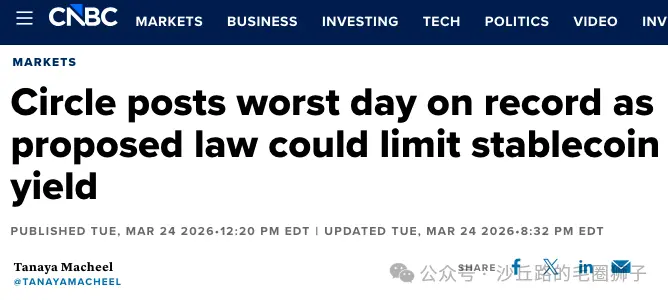
Looking further ahead, stablecoin issuers may also have a potential motive to leverage for profit, holding lower liquidity risk assets, which makes stablecoin issuers potentially the "wildcat banks" of the new era. Taking Tether as an example, its reserve assets are not all high-security and high-liquidity cash and cash equivalents; they also include volatile assets like Bitcoin and precious metals, as well as secured loans and other investments that are not fully transparent. Some opinions suggest that compared to Circle, which issues USDC with 100% reserve compliance, Tether has less than 20% of its reserve assets compliant with the "Stablecoin Innovation and Guidance Act," but this portion of assets is Tether's main source of profit.
It is worth mentioning that narrow banking, as a concept of financial reform, has not been realized in practice, primarily because financial institutions have expansion functions. Stablecoins are still in the early stages of development and face a favorable environment with high interest spreads. Looking ahead, if the Federal Reserve lowers interest rates and U.S. Treasury yields decline, the interest income for stablecoin issuers will significantly narrow. The profit motive may lead to the expansion of narrow banking operations, increasing credit risks on the asset side and maturity mismatches, thereby exacerbating the credit risks of issuing institutions.
5. From Cryptocurrency to Reserve Asset?
Recently, another topic related to dollar stablecoins (cryptocurrencies) is the U.S. government's plan to establish a "Strategic Bitcoin Reserve" and a "U.S. Digital Asset Reserve" that includes assets beyond Bitcoin. There may be many reasons for bullish sentiment on Bitcoin; over a decade ago, many believed that Bitcoin, as a digital currency (cryptocurrency), could replace the dollar and serve as the monetary foundation for future decentralized finance. Now, few hold such views; the new narrative is that Bitcoin is a reserve asset, digital gold, which can support a fiat currency (dollar)-centered monetary system. Thus, from cryptocurrency to crypto assets, the latter serves as a reserve for the former, forming a closed loop that constructs a new monetary system for the digital age.
We can analyze this issue from three perspectives. First, the closed loop from cryptocurrency to crypto assets does not exist. Although stablecoins use digital technology, they are economically private currencies pegged to the dollar, extensions of the dollar, and debt currencies, with no economic mechanism linking them to cryptocurrencies like Bitcoin.
Second, the form of money in modern economies has long shifted from commodity money represented by gold to credit/debt money, which also applies to today's "digital gold." The core characteristic of credit money is that its value relies on the issuer's (usually the government or central bank) credit, thus closely linking money to "debt." Modern economies rely on "credit payments" (such as corporate sales on credit, loan consumption, bond trading), requiring money to possess transferability and deferred payment capabilities. Debt money naturally fits this demand through "credit-debt relationships." For example, bank deposits are essentially "claims against the bank," while stablecoins are claims against their issuers that can be transferred to third parties at any time.
Keynes referred to the gold standard as a "relic of the barbaric age," criticizing its rigid rules and conflicts with modern economic needs. The gold standard bound money as an appendage to gold, directly linking the money supply to gold reserves, leading to a lack of adaptability in monetary policy to economic cycles, ultimately exacerbating economic fluctuations and even becoming a catalyst for social inequality. Keynes's monetary views propelled the shift in 20th-century monetary policy from "gold standard constraints" to "state credit dominance," providing a theoretical basis for modern central banks' "counter-cyclical adjustments" (such as interest rate cuts and quantitative easing).
The ultimate backing of credit money is national credit. For the dollar, a key reflection is that the base money corresponds to the liabilities of the Federal Reserve, with assets corresponding to U.S. Treasury bonds it holds. Bank money (broad money, or bank deposits) derives its credit from government guarantees and regulation, including the central bank as the lender of last resort, deposit insurance mechanisms, and even comprehensive guarantees during crises, extending government debt. The assets corresponding to dollar stablecoins are U.S. Treasury bonds and other high-grade liquid assets, supported by government credit but lacking the regulatory and guarantee mechanisms that ensure redemption like bank money. Extending to the international level, the dollar, as the world's primary reserve currency, is rooted in U.S. national credit, including being the largest economy and having the largest financial market.
Third, there may be a possibility that governments enhance their credit by holding assets with appreciation potential. For a small economy, due to its limited endogenous asset range and long-term appreciation potential, holding exogenous assets is somewhat reasonable, such as the sovereign fund models of Norway and Singapore, or some emerging markets and developing countries' central banks holding dollar assets to enhance the external value of their local currencies. However, it is hard to imagine that a large economy, especially one providing the global reserve currency, can effectively support its credit through the value of exogenous assets.
From a broader perspective, beyond monetary reserve assets, can cryptocurrencies like Bitcoin serve as strategic investments for governments? The long-term returns of assets can be divided into two categories: cash flow-driven returns (stocks, bonds) and price volatility-driven returns (gold). The former can achieve wealth appreciation through "compound interest effects," with the level of compounding depending on economic growth, while the latter derives solely from price fluctuations caused by market supply and demand changes, with appreciation relying to some extent on speculative behavior of "buy low, sell high."
Specifically regarding government strategic investments in cryptocurrencies like Bitcoin, one possible reason is that assets like Bitcoin involve blockchain and other cryptographic technologies, and government backing may promote innovation in this field, with the spillover effects of innovation potentially benefiting society as a whole, i.e., enjoying the "compound interest effects" of innovation. Although this positive externality cannot be ruled out, it needs to be balanced against the negative externalities of Bitcoin. The scale of Bitcoin's non-economic attributes means that increased demand for it can only be achieved through price increases, exerting a crowding-out effect on other investments, especially real investments. In this sense, government strategic investments in cryptocurrencies like Bitcoin are not necessarily superior to investments in equities and stocks or investments in basic research, thus lacking inherent necessity.
6. Policy Implications
Based on the above analysis, three aspects of policy implications are worth discussing.
First, the dollar stablecoin embodies a contradiction between the public good attributes of the payment system and private profit motives, and its impact on macroeconomic and financial stability will force regulatory strengthening. The current development of dollar stablecoins relies on private institutions issuing private "currencies" and allowing them to profit from interest rate spreads. This model fundamentally contradicts the public good attributes of the payment system (which require safety, stability, and inclusiveness). Throughout the history of monetary and financial development, the public good attributes of bank money have been gradually improved under mechanisms of financial regulation and government guarantees. The success of China's digital payment models like WeChat Pay and Alipay lies in adhering to market-oriented operations while effectively maintaining the public good attributes of payment channels through regulation. The general rule of market innovation in finance preceding regulatory strengthening should also apply to stablecoins.
Second, from the perspective of international currency competition, the U.S. benefits the most from the mechanisms of stablecoins. As private currencies provided by narrow banks, dollar stablecoins benefit from the dollar's status as an international reserve currency, including the incumbency advantages of its financial markets. The expansion of dollar stablecoins is an extension of the dollar's status as an international reserve currency, and their network effects and regulatory arbitrage may, in turn, help strengthen the dollar's international position. For other non-U.S. economies, facing the endogenous advantages of incumbent international currencies in market competition, developing local currency stablecoins to counter dollar stablecoins is not the optimal strategy. This is not only because other countries' comparative advantages do not lie in finance but may also introduce new complexities and risks, such as impacting the efficiency of monetary management and capital account management, which may explain why the ECB emphasizes developing a digital euro (central bank digital currency) to respond to dollar stablecoins.
Third, for China, the key to the response strategy lies in leveraging China's large real economy and population (broad application scenarios) advantages. It should vigorously promote the application of digital currencies from platforms like WeChat Pay and Alipay in cross-border payment scenarios while utilizing the exogenous force of central bank digital currency to support the development of platform currencies in cross-border payment businesses, building a new type of efficient, low-cost cross-border payment infrastructure (including through multilateral central bank digital currency cooperation). Platform currencies of third-party payment tools inherently have characteristics of stablecoins, and compared to dollar stablecoins, they have stronger real economy attributes and weaker financial attributes, and under the empowerment of platforms, they have already formed certain network effects, which is China's comparative advantage.
Of course, stablecoins represent a new payment technology and model, which may have currently unclear positive spillover effects, and outright denial is not the optimal choice. How to leverage Hong Kong's unique advantages as an international financial center and the largest offshore RMB market is worth exploring, with Hong Kong playing a proactive role as a controlled testing ground and regulatory correction field for RMB stablecoins, which is conducive to balancing the multidimensional relationship between technological innovation potential and maintaining the public good attributes of payments, financial stability, and national currency sovereignty.
 Risk warning
 Risk warning