








From Wyoming to Capitol Hill, how does Bitcoin Senator Lummis promote a trillion-dollar financial gamble?

 She hopes the United States will purchase one million bitcoins.
Author: Thejaswini M A
Compiled by: Luffy, Foresight News
Laser eyes say it all. In January 2025, Senator Cynthia Lummis updated her personal avatar on the X platform to a flashing red laser eyes meme. This was seen as a battle cry among Bitcoin believers.
The 70-year-old senator from Wyoming announced that she would make the largest financial bet in U.S. history. Hours later, the news came: she was appointed chair of the Senate Digital Assets Banking Subcommittee. After managing Wyoming's mineral resources for decades, Lummis is now persuading Congress to purchase $100 billion worth of Bitcoin.

Her plan is to buy one million Bitcoins within five years, establishing a strategic Bitcoin reserve that would make the U.S. the largest institutional holder in the world, larger than Strategy Company or any government. But to understand how a woman who witnessed the collapse of cattle prices during the COVID-19 pandemic came to grasp the value of hard assets and became the most influential political advocate for Bitcoin, we need to trace back to her origins.
On a ranch in Laramie County, a young girl learned that survival meant seeing opportunities where others only saw risks.
The Ranch that Shaped a Vision
September 10, 1954, Cheyenne, Wyoming.
Cynthia Marie Lummis was born into a world where cattle, land, and agricultural precision were core values. The Lummis ranch has been passed down through four generations, and the long years have taught them that wealth that cannot flow will eventually be lost.

In an environment where nature never compromises, Lummis learned the earliest professional rules. Cattle die, markets crash, and natural disasters can destroy everything. Her parents, Doran and Enid, may never have taught these lessons through preaching, but ranch life taught her the reality: witnessing commodity prices fluctuate wildly due to uncontrollable factors, watching diseases wipe out herds overnight, and understanding that global trade decisions made in Washington could bankrupt Wyoming ranchers by Tuesday. It is in such an environment that people learn to think with a hedging mindset, prepare for shocks, and diversify against forces that transcend individual operations.
Most importantly, you come to understand that conventional wisdom is often wrong. Survival means making bets that others wouldn’t consider.
The Unexpected Politician
1978, University of Wyoming.
At 24, Cynthia Lummis became the youngest female state representative in Wyoming's history while completing her biology degree. This was a pragmatic decision, as she understood that the policies affecting her family’s ranch were made by those who had never experienced the consequences of those policies firsthand.
Her education followed the same logic. She earned a degree in animal science in 1976, a degree in biology in 1978, and a law degree in 1985. She obtained three degrees from the University of Wyoming. She is deeply rooted in Wyoming, a state whose livelihood depends on an understanding of tangible value.
Her experience as Wyoming's state treasurer from 1999 to 2007 was crucial to her later achievements. While managing the state's mineral revenues and investment funds, she constantly pondered one question: how to maintain purchasing power when the government controls the money supply?
Sixteen years later, her daughter and son-in-law provided her with an answer in the form of a digital asset, while most politicians still regarded it as a scam or a curiosity.
The $330 Experiment
In 2013, Bitcoin traded at $330.
While most Americans were just beginning to learn the term "cryptocurrency," Cynthia Lummis purchased her first Bitcoin for $330. This was not because she understood the technology at the time, but because her years as state treasurer taught her how to find means of value storage outside the traditional monetary system. "I was always looking for a store of value," she once said, "and I think Bitcoin is a fantastic store of value."
The amount she purchased was small, merely experimental. But it indicated that her purchase of Bitcoin was not driven by ideology or speculation. She bought Bitcoin because of its fixed supply, lack of central authority, and resistance to currency devaluation. For someone who had witnessed inflation erode national funds for years, Bitcoin offered a currency that the government could not print, manipulate, or seize.
Starting with her initial purchase of Bitcoin worth $330, she later revealed that she bought Bitcoin worth up to $100,000 in 2021.
More importantly, this transaction earned her credibility, proving that she recognized Bitcoin's potential earlier than Wall Street. Long before Bitcoin gained political legitimacy, she had invested her own funds into the idea.
The Libertarian Caucus Era
In 2009, Washington D.C.
After entering the House of Representatives, Lummis had a profound understanding of how monetary policy affects real people. As a founding member of the House Libertarian Caucus, she consistently advocated for fiscal conservatism and sound money principles. During her time in the House, she established a reputation for challenging financial orthodoxy. She criticized the Federal Reserve's policies, arguing that they "punish savers and reward debtors." She advocated a return to sound money principles and pushed for policies that protect individual financial sovereignty.
Her work on Western issues, public land management, energy interests protection, and navigating complex federal-state relations demonstrated her ability to systematically think about how national policies impact localities. When she chose not to seek re-election in 2016, it seemed like she was stepping back from the national political stage, but in reality, she was preparing for her most ambitious project.
The Senate Game
In 2020, Wyoming Senate campaign.
Lummis's return to federal politics brought some changes: she now openly advocated for Bitcoin and made it a core part of her campaign platform. She positioned Bitcoin advocacy as central to attracting voters.
Wyoming voters elected the first woman to represent the state in the U.S. Senate, and Lummis arrived in Washington with a mission to challenge traditional monetary policy.
She collaborated with Democrat Kirsten Gillibrand to draft the Responsible Financial Innovation Act, showcasing her ability to build a bipartisan coalition around cryptocurrency policy. She co-founded the Financial Innovation Caucus with Democrat Kyrsten Sinema, establishing a framework for cryptocurrency advocacy within Congress.
One of Lummis's most notable contributions was using her expertise in Wyoming's energy sector to respond to criticisms regarding Bitcoin's environmental impact. She did not ignore environmental issues but advocated for policies that encourage the use of stranded natural gas for Bitcoin mining, thereby capturing energy that would otherwise be wasted. She argued that "40% of Bitcoin mining's energy comes from renewable sources," and that economic incentives for renewable energy production could accelerate the development of clean energy.
By 2025, when Senate Banking Committee Chairman Tim Scott appointed Lummis as the first chair of the Digital Assets Subcommittee, she had positioned herself at the intersection of cryptocurrency advocacy and mainstream Republican politics.
She was no longer just a believer in Bitcoin but a powerful political defender of it.
The Bitcoin Bill: America's $100 Billion Bet
In March 2025, Capitol Hill.
The Bitcoin Bill—designed to promote innovation, technology, and competitiveness through optimized investments nationwide—represents the boldest monetary policy proposal in U.S. history.
One million Bitcoins, to be purchased within five years, would account for about 5% of the total Bitcoin supply. At current prices, this would be worth approximately $100 billion, but if the purchase itself drives the price up, its value could be even higher.
The proposed financing mechanism is very clever. It diversifies existing funds within the Federal Reserve system and the Treasury, rather than requiring new appropriations; it utilizes the proceeds from existing gold reserves; and it leverages Bitcoins obtained through criminal and civil forfeiture.
Just as the Louisiana Purchase ensured America's westward expansion, a strategic Bitcoin reserve could secure the U.S.'s position in the emerging digital financial system.
The political challenges are immense. The proposal requires Congressional approval, which amounts to the largest cryptocurrency purchase in history. It needs to convince fiscal conservatives that Bitcoin is a prudent store of value. It must address Democrats' concerns about volatility, environmental impact, and the image of profit-seeking cryptocurrency interest groups under Trump.
Lummis has set an ambitious timeline: to pass comprehensive digital asset legislation by the end of 2025.
Challenges from the Opposition
Lummis faces resistance from multiple fronts.
Fiscal conservatives worry about betting national resources on a volatile asset; Democrats associate Bitcoin with speculation and environmental degradation; traditional banks fear that the adoption of cryptocurrency will have disruptive effects.
Some Democrats refuse to support any cryptocurrency legislation, while Trump profits from memecoins and World Liberty Financial.
Lummis attempts to address concerns through transparency, bipartisan cooperation, and consumer protection provisions, but the political environment remains harsh.
Lummis frames Bitcoin as a national security issue.
She cites China's digital yuan as an example, warning that the U.S. is falling behind in financial innovation; Singapore and Europe have clearer cryptocurrency regulations, attracting more businesses away from the U.S.
Her strategic Bitcoin reserve plan positions early accumulation as an economic war, with digital assets akin to past gold reserves, providing geopolitical advantages.
At the 2025 Bitcoin Conference in Las Vegas, she revealed that several U.S. military leaders support establishing a Bitcoin reserve, positioning cryptocurrency as a matter of national financial security rather than speculation.
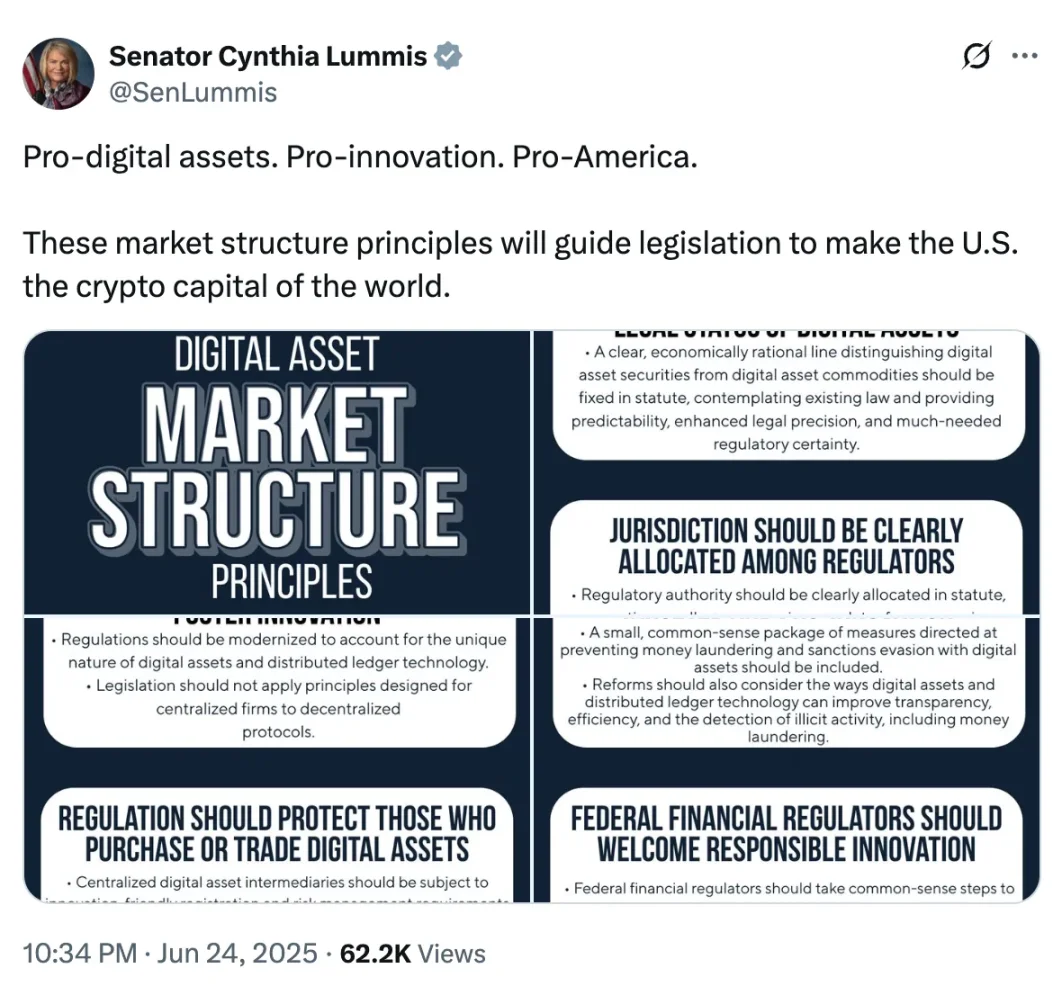
This national security angle appeals to Republicans who might otherwise be skeptical of cryptocurrency. She is now further pushing comprehensive market structure principles aimed at making the U.S. the "crypto capital of the world."
Institutional Legacy
Regardless of whether her bill passes, Lummis has changed the way U.S. institutions view cryptocurrency.
The Senate Digital Assets Banking Subcommittee ensures that cryptocurrency receives focused attention from Congress, while the Financial Innovation Caucus provides training for members who need to understand blockchain technology.
Her collaboration with Democrat Kirsten Gillibrand demonstrates that when focusing on practical interests rather than ideology, cryptocurrency policy can achieve bipartisan consensus.
Her transparency—disclosing Bitcoin holdings, using blind trusts, and fostering bipartisan cooperation—has normalized cryptocurrency advocacy within mainstream Republican politics. She has elevated cryptocurrency from a technological curiosity to a core financial policy issue, creating an institutional framework that transcends her individual career.
During her time in federal office, Lummis supported Wyoming becoming the most cryptocurrency-friendly state in the U.S. Wyoming established Special Purpose Depository Institutions (SPDIs) that allow cryptocurrency companies to safeguard digital assets while obtaining banking services. The state protects private keys as property, supports digital asset custody, and creates regulatory sandboxes for blockchain innovation.

Lummis's influence has promoted these innovations, establishing Wyoming as a model for other states. Her approach shows how state-level innovation can inform federal policy.
The Wyoming model, with clear regulations, self-custody protections, and access to banking for legitimate crypto businesses, provides a template for the comprehensive framework Lummis seeks at the federal level.
The ultimate test lies in whether she can persuade the U.S. government to undertake the largest cryptocurrency purchase in history, with the strategic Bitcoin reserve betting on whether U.S. institutions can quickly adapt and maintain global financial leadership.
If successful, the U.S. will position itself as a leader in the digital asset space and could gain immense value as cryptocurrency adoption accelerates. Government-held Bitcoin could appreciate significantly, providing resources for debt reduction and infrastructure development.
If unsuccessful, the U.S. may fall behind jurisdictions that more aggressively embrace crypto innovation. Digital asset businesses may migrate elsewhere, taking jobs, tax revenue, and innovation with them.
This is the story of a rancher’s daughter who learned to find value in cattle, and now she is asking America to make the largest financial bet of the digital age.
 Risk warning Risk warning



Popular articles





