








Backroom: Information Tokenization, a Solution for Data Redundancy in the AI Era? | CryptoSeed

 Using AI to organize alpha from massive amounts of information and filter out noise, Backroom aims to inject new vitality into the InfoFi track.
Author: Jiahua, ChainCatcher
In the age of AI, information overload has become a common challenge. Users not only need to find Alpha (high-value information) from a vast amount of information but also need to discern the authenticity of that information. As Nobel laureate Herbert Simon said, "A wealth of information creates a poverty of attention."
This is also the current dilemma in the crypto space: users cannot efficiently determine whether a project is worth participating in and how to participate. The flood of garbage information and projects on Twitter and TG wastes a significant amount of attention and time. To address this pain point, Backroom has proposed a solution based on InfoFi.
What is Backroom?
Backroom is an AI-driven InfoFi protocol that captures the information flow within groups and filters out noise, transforming it into a real-time, tradable information market. Creators launch tokenized rooms, using AI to convert their insights into monetizable content. Users can unlock noise-free, high-value intelligence by purchasing on-chain keys linked to each creator's room.
Mechanism Breakdown and Innovations
For creators, the entire process can be completed by setting up the Room description, adding Backroom's AI Bot to Discord or Telegram groups, and pricing the Room, allowing them to focus on creation itself. The AI Bot will filter out noise and irrelevant information from the group, selecting Alpha and automatically organizing it into the Room.
For users, purchasing keys is necessary to access these rooms, and both the purchase and trading of keys require the use of $ROOM tokens.
At the same time, the project team allocates 25% of the tokens for growth and creator incentives, while the transaction fees from purchasing $ROOM (no detailed ratio available yet) and $ROOM tokens serve as creator incentives. This can kickstart an economic flywheel: creator incentives attract more excellent creators, providing more Alpha information → more key demand → more $ROOM demand → higher rewards → more creators and traders → more Alpha.
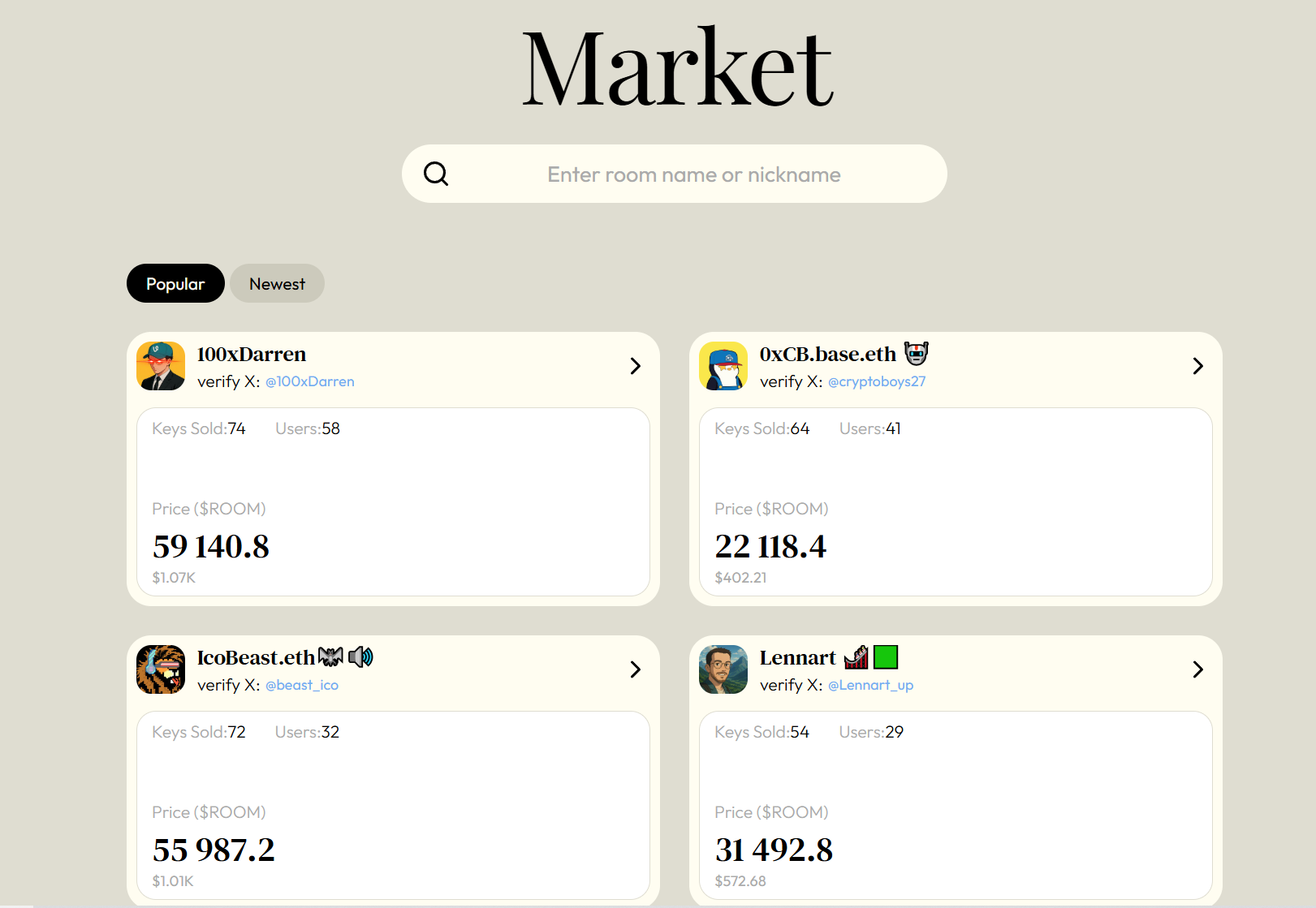
The most significant innovation of Backroom lies in emphasizing the extraction of "Alpha" in private domains. In an era of information overload, public platforms like Twitter are filled with noise, while private groups often hide the earliest discussions. Backroom aims to utilize AI to monitor these closed spaces in real-time, quantifying information quality to provide users with high-quality, exclusive intelligence streams.
InfoFi Project Comparison
InfoFi (Information Finance) refers to the tokenization of information, transforming information into tradable assets. The goal of InfoFi is to optimize the noise in the market, allowing the market to determine the direction of attention flow rather than being constrained by platform-created information echo chambers or algorithmic biases. Creators gain airdrops and traffic through their creations, project teams seek exposure and attention, and users participate and learn about genuinely valuable projects.
InfoFi aims to address the inefficiencies and unfairness in the current market caused by information clutter (creators can only earn a small portion of the creative revenue, and users find it challenging to locate Alpha despite investing time and attention), while making the information streams users receive more intelligent and efficient.
In fact, InfoFi encompasses all projects that treat information as a commodity: such as Nansen, Dune, and even Polymarket, as well as Kaito, Cookie, and others. Most of InfoFi's revenue opportunities come from direct participation in projects, such as Kaito sharing insights on projects on Twitter to attract traffic or Backroom focusing on organizing Alpha information.

Issues and Summary
Although Backroom innovates to some extent compared to previous InfoFi projects, it still faces several issues.
First, the $ROOM token lacks sufficient empowerment. The price of the $ROOM token depends on the trading volume of Keys. If early user growth is slow or quality Rooms are scarce, the token value may continue to decline, leading to a lack of motivation for creators to join, creating a vicious cycle.
Second, there is insufficient differentiation from traditional paid small group models. Backroom's Rooms are similar to private Telegram groups or WeChat small groups, relying on content scarcity to attract users. Moreover, traditional group models already have a user base, and if Backroom does not innovate, it will struggle to attract new users.
Additionally, Backroom relies on a dedicated AI Bot to capture key information from groups for dissemination, which is a crucial production link in the entire economic flywheel. However, the AI model may misjudge messages due to insufficient training data or algorithmic biases, such as mistaking irrelevant discussions for Alpha or overlooking implicit key information.
Final Thoughts: Future Prospects of the InfoFi Track
Whether it's Backroom, Kaito, or Trends, the core focus of InfoFi projects should be on how to bring more authentic and effective information to the market, thereby injecting more liquidity into the current market. InfoFi currently faces many issues, such as opaque rules for calculating points and significant reliance on AI.
The significance of InfoFi projects may lie in promoting current market users from "mining, withdrawing, and selling" to deeply understanding project mechanisms and diligently building. Project teams should also allocate airdrop rewards to users and creators who genuinely participate. When more people begin to output and provide high-quality, authentic content, and when the market pays more attention to proactive and creative projects, the arrival of a bull market will no longer be determined solely by cycles but will be driven by innovation and value.
(This article is for informational purposes only and does not constitute investment advice.)
Recommended Reading:
The Dilemma of InfoFi in the Attention Economy
KOL's Account: InfoFi is Here, and My Traffic has Dropped to Historic Lows
 Risk warning
 Risk warning


Popular articles





