








From zkVM to Open Proof Market: RISC Zero and Boundless Analysis

 ZK technology is evolving from a single scaling tool into a universal cornerstone of trusted computing in blockchain.
Author: 0xjacobzhao
In the field of blockchain, cryptography is the core foundation of security and trust. Among them, Zero-Knowledge Proofs (ZK) can compress any complex off-chain computation into a short proof and efficiently verify it on-chain without relying on third-party trust, while also selectively hiding inputs to protect privacy. With the combination of efficient verification, versatility, and privacy, ZK has become a key solution for various applications such as scalability, privacy, and cross-chain interactions. Although there are still challenges such as high proof generation costs and complex circuit development, the engineering feasibility and implementation of ZK have far surpassed other paths, making it the most widely adopted trusted computing framework.
I. Development History of the ZK Track
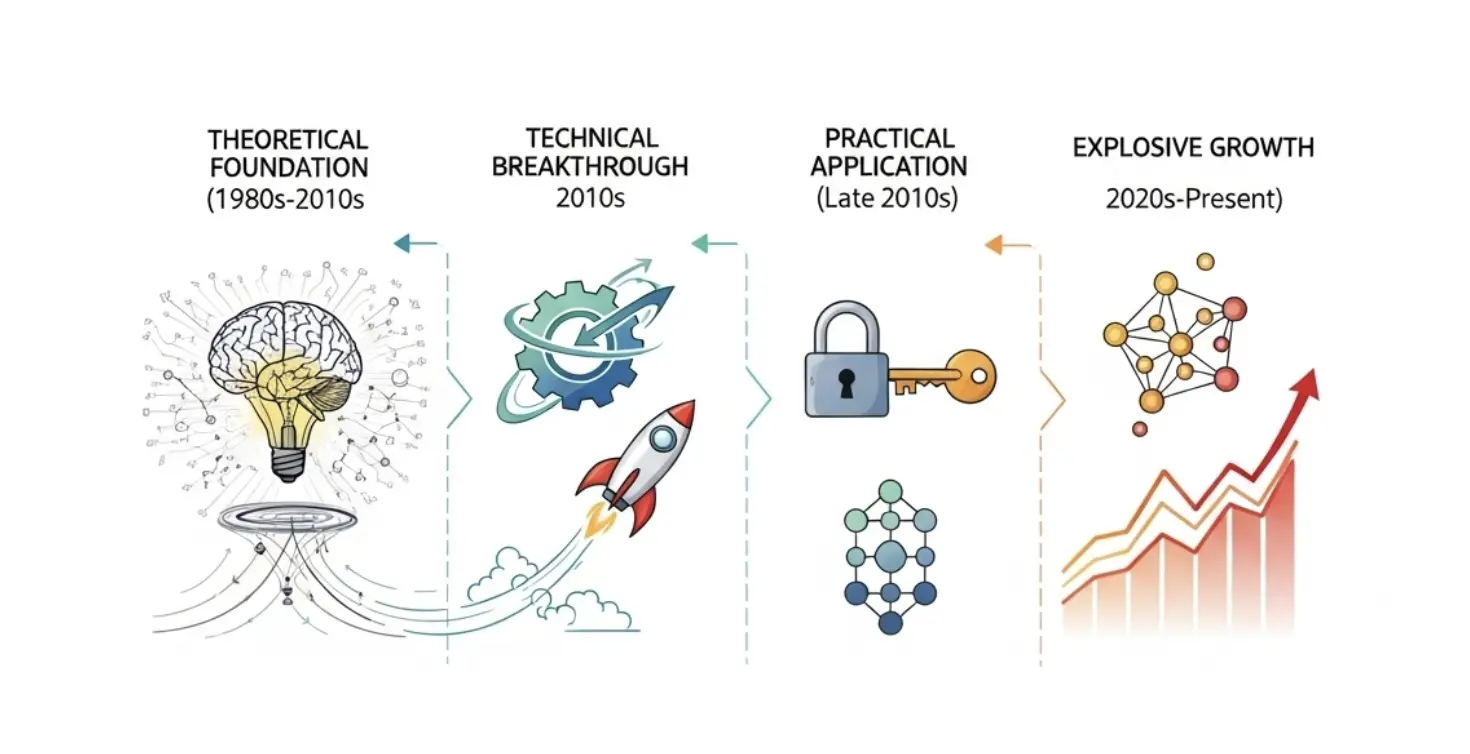
The development of Zero-Knowledge Proof (ZK) technology has not been achieved overnight, but rather has undergone decades of theoretical accumulation and engineering exploration. It can be divided into the following key stages:
Theoretical Foundation and Technological Breakthrough (1980s--2010s): The concept of ZK was proposed by MIT scholars Shafi Goldwasser, Silvio Micali, and Charles Rackoff, initially remaining in the realm of interactive proof theory. In the 2010s, with the emergence of Non-Interactive Zero-Knowledge Proofs (NIZK) and zk-SNARKs, proof efficiency was greatly improved, although early implementations still relied on trusted setups.
Blockchain Applications (Late 2010s): Zcash introduced zk-SNARKs for privacy-preserving payments, achieving large-scale blockchain implementation for the first time. However, due to the high costs of proof generation, practical implementation scenarios remained limited.
Explosive Growth and Expansion (2020s to Present): During this period, ZK technology has fully entered the mainstream of the industry:
- ZK Rollup: Achieves high throughput and security inheritance through off-chain batch computation and on-chain proof, becoming the core path for Layer 2 scalability.
- zk-STARKs: StarkWare launched zk-STARK, eliminating trusted setups and enhancing transparency and scalability.
- zkEVM: Teams like Scroll, Taiko, and Polygon are dedicated to EVM bytecode-level proofs and seamless migration of existing Solidity applications.
- General zkVM: Projects like RISC Zero, Succinct SP1, and Delphinus zkWasm support verifiable execution of any program, expanding ZK from a scalability tool to a "trusted CPU."
- zkCoprocessor: Packages zkVM as a coprocessor, supporting complex logic outsourcing (e.g., RISC Zero Steel, Succinct Coprocessor);
- zkMarketplace: Markets proof computing power, forming a decentralized prover network (e.g., Boundless), promoting ZK to become a universal computing layer.
To date, ZK technology has evolved from an obscure cryptographic concept to a core module in blockchain infrastructure. It not only supports scalability and privacy protection but also demonstrates strategic value in cutting-edge scenarios such as cross-chain interoperability, financial compliance, and artificial intelligence (ZKML). With the continuous improvement of toolchains, hardware acceleration, and proof networks, the ZK ecosystem is rapidly moving towards scalability and universality.
II. Comprehensive Applications of ZK Technology: Scalability, Privacy, and Interoperability
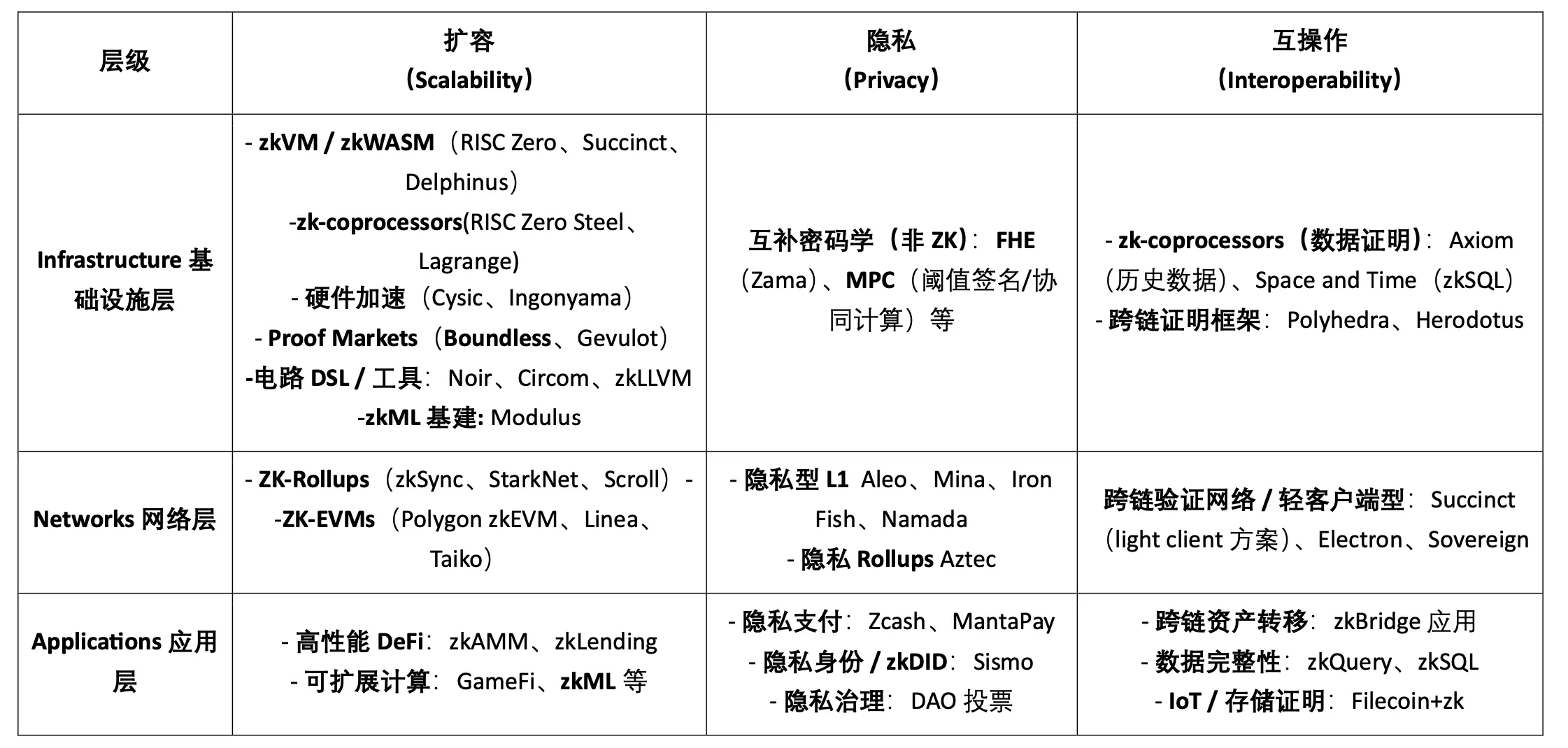
Scalability, Privacy, and Interoperability & Data Integrity are the three foundational scenarios of current ZK "trusted computing" technology, corresponding to the native pain points of insufficient blockchain performance, lack of privacy, and multi-chain trust.
- Scalability is the earliest and most widely applied scenario for ZK. The core idea is to move transaction execution off-chain and then verify it on-chain using a short proof, significantly improving TPS and reducing costs without sacrificing security. Typical paths include: zkRollup (zkSync, Scroll, Polygon zkEVM), which achieves scalability through batch transaction compression; zkEVM, which builds circuits at the EVM instruction level for Ethereum-native compatibility; and the more general zkVM (RISC Zero, Succinct), which supports verifiable outsourcing of any logic.
- Privacy Protection aims to prove the legitimacy of transactions or actions while avoiding the exposure of sensitive data. Typical applications include: privacy payments (Zcash, Aztec), ensuring the validity of fund transfers without disclosing amounts and counterparties; privacy voting and DAO governance, completing governance without revealing voting content; and privacy identity/KYC (zkID, zkKYC), proving "eligibility" without disclosing additional information.
- Interoperability & Data Integrity is the key path for ZK technology to solve the trust issues in a "multi-chain world." By generating proofs of the state of another chain, cross-chain interactions can be freed from centralized relays. Typical forms include zkBridge (cross-chain state proofs) and light client verification (efficiently verifying source chain block headers on the target chain), with representative projects like Polyhedra and Herodotus. At the same time, ZK is also widely used for data and state proofs, such as Axiom and Space and Time's zkQuery/zkSQL, or data integrity verification in IoT and storage scenarios, ensuring the trustworthiness of off-chain data on-chain.
Building on these three foundational scenarios, ZK technology has the opportunity to gradually extend to broader industry applications in the future: including AI (zkML), generating verifiable proofs for model inference or training to achieve "trusted AI"; financial compliance, such as proof of reserves (PoR), clearing, and auditing, reducing trust costs; and gaming and scientific computing, ensuring the authenticity of logic and experimental results in GameFi or DeSci. Essentially, they all represent the landing expansion of "verifiable computation + data proof" in different industries.
III. Beyond zkEVM: The Rise of General zkVM and the Proof Market
In 2022, Ethereum founder Vitalik proposed four categories of ZK-EVM (Type 1--4), revealing the trade-offs between compatibility and performance:
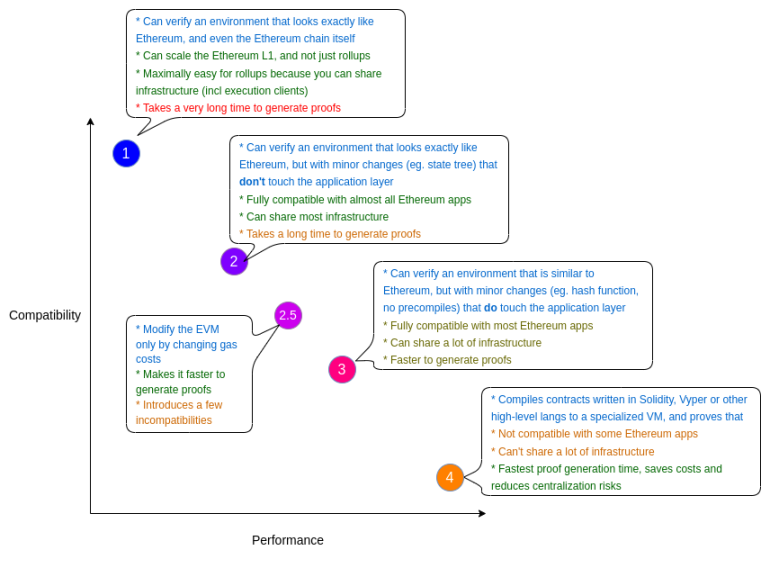
- Type 1 (Fully Equivalent): Bytecode is completely consistent with Ethereum L1, with the lowest migration cost but the slowest proof. Representative project: Taiko.
- Type 2 (Fully Compatible): Maintains high EVM equivalence with minimal underlying optimizations, offering the strongest compatibility. Representative projects: Scroll, Linea.
- Type 2.5 (Semi-Compatible): Slightly modifies EVM (e.g., gas costs, precompiled support), sacrificing a small amount of compatibility for performance gains. Representative projects: Polygon zkEVM, Kakarot (EVM running on Starknet).
- Type 3 (Partially Compatible): More thorough modifications to the underlying structure, capable of running most applications but unable to fully reuse Ethereum infrastructure. Representative project: zkSync Era.
- Type 4 (Language-Level Compatible): Abandons bytecode compatibility, directly compiling from high-level languages to zkVM, offering the best performance but requiring ecosystem reconstruction. Representative project: Starknet (Cairo).
The theme of this stage is the "zkRollup War," aimed at alleviating Ethereum's execution bottleneck. However, two major limitations have emerged: first, the difficulty of circuitizing EVM and the limited proof efficiency; second, the potential of ZK far exceeds scalability, extending to cross-chain verification, data proof, and even AI computation.
Against this backdrop, general zkVM has risen, replacing the "Ethereum-compatible thinking" of zkEVM and shifting towards "chain-agnostic trusted computing." zkVM is based on general instruction sets (such as RISC-V, LLVM IR, Wasm), supporting languages like Rust and C/C++, allowing developers to build any application logic using mature ecosystem libraries, and then verify it on-chain through proofs. RISC Zero (RISC-V) and Delphinus zkWasm (Wasm) are typical representatives. Its significance lies in the fact that zkVM is not just a scalability tool for Ethereum but a "trusted CPU" in the ZK world.
- RISC-V Route: Represented by RISC Zero, it directly chooses the open general instruction set RISC-V as the execution core of zkVM. The advantages are its open ecosystem, simple instruction set, and ease of circuitization, capable of handling compilation results from mainstream languages like Rust and C/C++, making it suitable for a "general zkCPU." The disadvantage is that it does not have natural compatibility with Ethereum bytecode and needs to be embedded through a coprocessor model.
- LLVM IR Route: Represented by Succinct SP1: the front end uses LLVM IR to be compatible with multiple languages, while the back end is still based on RISC-V zkVM, essentially being "LLVM front end + RISC-V back end," which is more general than the pure RISC-V model, but LLVM IR instructions are complex, leading to higher proof costs.
- Wasm Route: Represented by Delphinus zkWasm. The WebAssembly ecosystem is mature, with high developer familiarity and natural cross-platform support, but the Wasm instruction set is relatively complex, limiting proof performance.
In further evolution, ZK technology is moving towards modularization and marketization. First, zkVM provides a general trusted execution environment, equivalent to the "CPU/compiler" of zero-knowledge computation, providing applications with underlying verifiable computing capabilities. On top of this, zk-coprocessor packages zkVM as a coprocessor, allowing chains like EVM to outsource complex computation tasks to be executed off-chain and verified back on-chain through zero-knowledge proofs, with typical cases including RISC Zero Steel and Lagrange, whose roles can be likened to "GPU/coprocessor." Further, zkMarketplace realizes the market distribution of proof tasks through a decentralized network, where global prover nodes complete tasks through bidding, such as Boundless, which builds a computing power market for zero-knowledge computation.
Thus, the zero-knowledge technology stack gradually presents an evolution chain from zkVM → zk-coprocessor → zkMarketplace. This system marks the evolution of zero-knowledge proofs from a single Ethereum scalability tool to a general trusted computing infrastructure. In this evolution chain, RISC Zero, with RISC-V as the core of zkVM, strikes the best balance between "openness, circuitization efficiency, and ecosystem adaptability." This allows it to provide a low-threshold development experience while evolving zkVM into zk-coprocessor and decentralized proof markets through layers like Steel, Bonsai, and Boundless, thereby opening up broader application spaces.
IV. RISC Zero's Technical Path and Ecological Landscape
RISC-V is an open, royalty-free instruction set architecture that is not controlled by a single vendor, possessing inherent decentralized characteristics. RISC Zero relies on this open architecture to build a zkVM compatible with general languages like Rust, breaking through the limitations of Solidity within the Ethereum ecosystem, allowing developers to directly compile standard Rust programs into applications that can generate zero-knowledge proofs. This path expands the application range of ZK technology from blockchain contracts to a broader general computing field.
RISC0 zkVM: A General Trusted Computing Environment
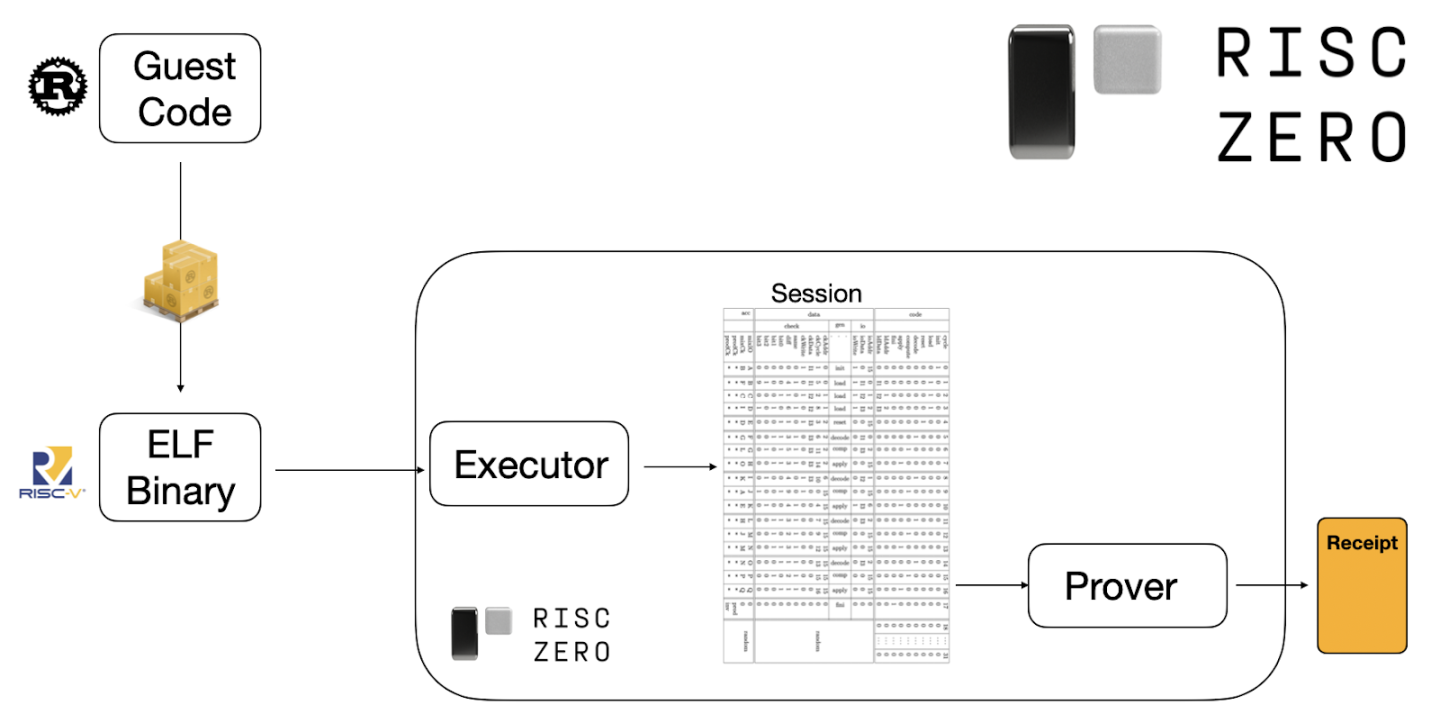
Unlike zkEVM projects that need to be compatible with complex EVM instruction sets, RISC0 zkVM is based on the RISC-V architecture, designed to be more open and general. Its applications consist of Guest Code compiled into ELF binary files, with the Host running and recording the execution process (Session) through an Executor. The Prover then generates a verifiable Receipt, which includes public outputs (Journal) and cryptographic proofs (Seal). Third parties only need to verify the Receipt to confirm the correctness of the computation without needing to re-execute it.
The release of R0VM 2.0 in April 2025 marks the entry of zkVM into the real-time era: the proof time for Ethereum blocks has been reduced from 35 minutes to 44 seconds, with costs reduced by up to 5 times, and user memory expanded to 3GB, supporting more complex application scenarios. Additionally, two key precompiles, BN254 and BLS12-381, have been added to comprehensively cover mainstream Ethereum needs. More importantly, R0VM 2.0 introduces formal verification for security, having completed deterministic verification for most RISC-V circuits, aiming to achieve the first block-level real-time zkVM (proofs in <12 seconds) by July 2025.
zkCoprocessor Steel: A Bridge for Off-Chain Computation
The core idea of zkCoprocessor is to offload complex computation tasks from on-chain to off-chain execution and then return results through zero-knowledge proofs. Smart contracts only need to verify the Proof without recalculating the entire task, significantly reducing gas costs and breaking through performance bottlenecks. For example, RISC0's Steel provides an external proof interface for Solidity, allowing for outsourcing large-scale historical state queries or cross-block batch computations, and can even use a single Proof to verify dozens of Ethereum blocks.
Bonsai: SaaS-based High-Performance Proof Service
To meet the needs of industrial applications, RISC Zero launched Bonsai, an officially hosted Prover-as-a-Service platform that distributes proof tasks through GPU clusters, allowing developers to obtain high-performance proofs without building their own hardware. At the same time, RISC Zero provides the Bento SDK to help developers achieve seamless interaction between Solidity and zkVM, significantly reducing the integration complexity of zkCoprocessor. In contrast, Boundless realizes decentralized proof through an open market, with both forming a complementary relationship.
RISC Zero Full Product Matrix
The product ecosystem of RISC Zero extends upwards around zkVM, gradually forming a complete matrix covering execution, network, market, and application layers:
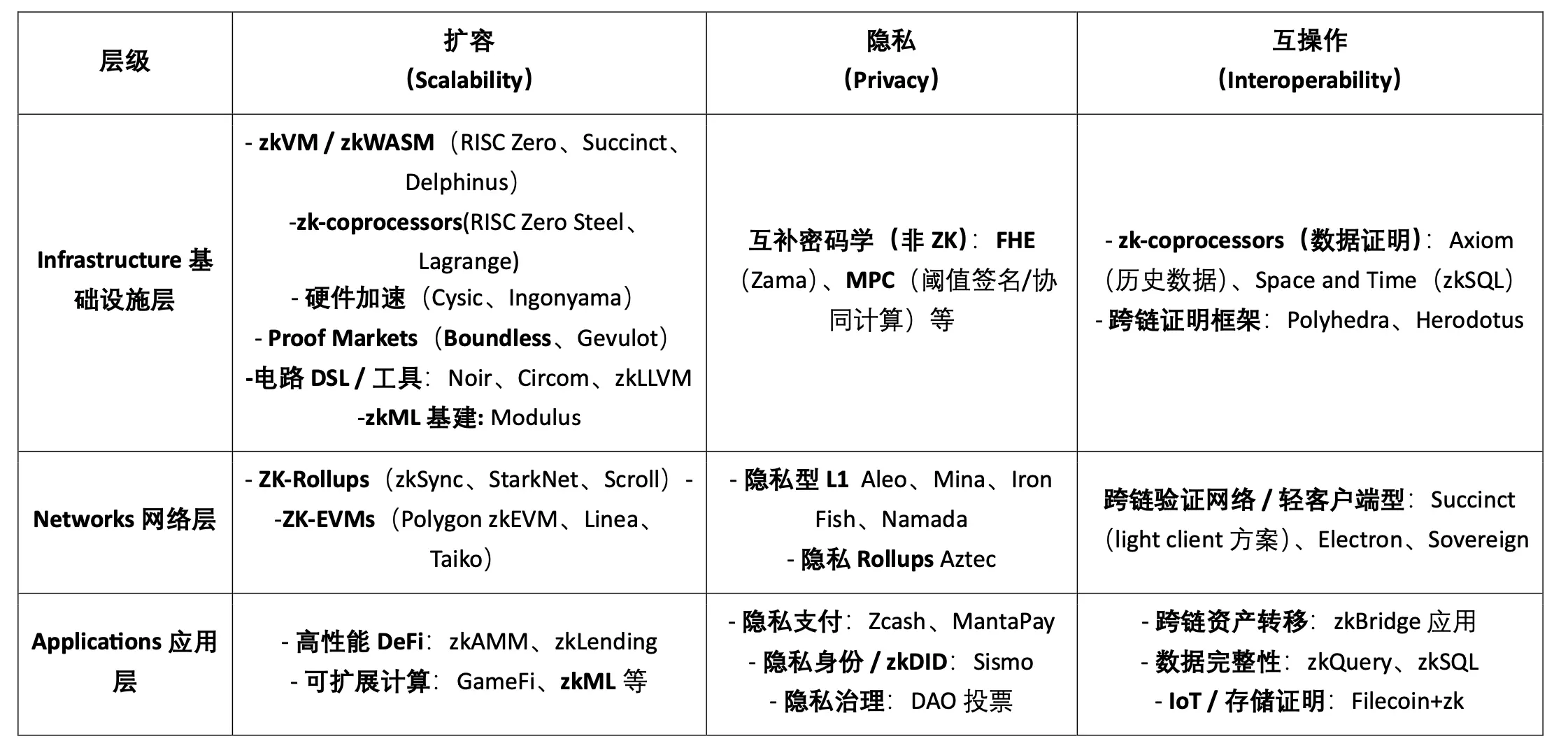
V. ZK Market: Decentralized Commodityization of Trust Computing
The Zero-Knowledge Proof (ZK) market decouples the high-cost, complex proof generation process and transforms it into a decentralized, tradable computing commodity. Through a globally distributed prover network, computing tasks are outsourced through bidding, dynamically balancing cost and efficiency, and continuously attracting GPU and ASIC participants through economic incentives, forming a self-reinforcing cycle. Boundless and Succinct are representatives in this track.
5.1 Boundless: A General Zero-Knowledge Computing Market
Concept Positioning
Boundless is a general ZK protocol launched by RISC Zero, aimed at providing scalable verifiable compute capabilities for all blockchains. Its core lies in decoupling proof generation from blockchain consensus and distributing computing tasks through a decentralized market mechanism. After developers submit proof requests, Prover nodes compete to execute through a decentralized incentive mechanism and earn rewards through "Proof of Verifiable Work." Unlike traditional PoW's meaningless power consumption, Boundless transforms computing power into real ZK results, giving computational resources actual value.
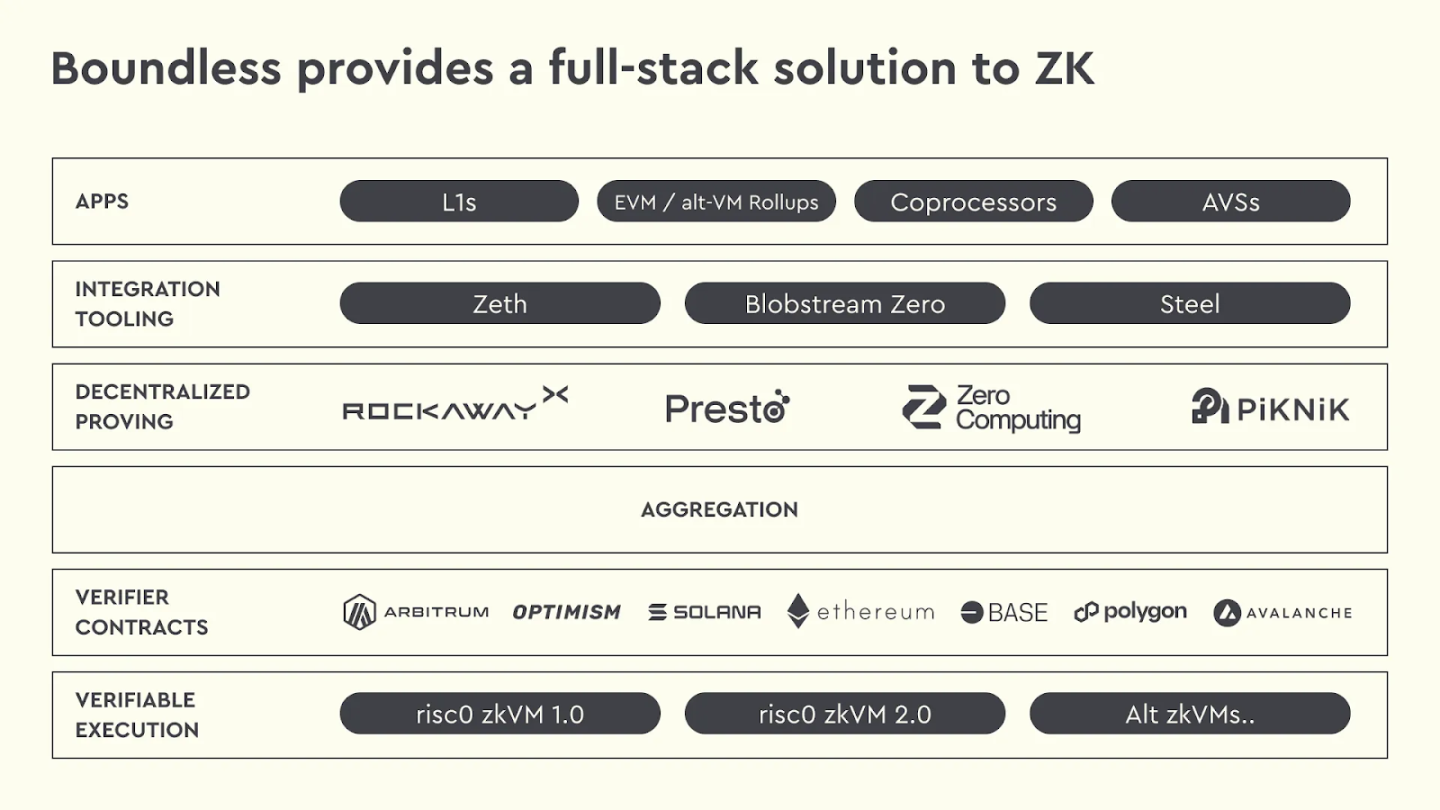
Architecture and Mechanism
The workflow of the Boundless market includes:
- Request Submission: Developers submit zkVM programs and inputs to the market;
- Node Bidding: Prover nodes evaluate tasks and bid, gaining execution rights after locking the task;
- Proof Generation and Aggregation: Complex computations are broken down into subtasks, each generating zk-STARK proofs, which are then compressed into a unified ultimate proof through recursion and aggregation circuits, significantly reducing on-chain verification costs;
- Cross-Chain Verification: Boundless provides a unified verification interface across multiple chains, achieving one-time construction and cross-chain reuse.
This architecture allows smart contracts to complete confirmations by verifying short proofs without needing to re-execute complex computations, thus breaking through gas limits and block capacity constraints.
Ecosystem and Applications: As a market layer protocol, Boundless complements other products from RISC Zero:
- Steel: The ZK Coprocessor for EVM, capable of migrating complex Solidity executions off-chain and verifying back on-chain;
- OP Kailua: Provides a ZK upgrade path for OP Stack chains, achieving higher security and faster finality.
Boundless aims to achieve sub-12 second real-time proofs on Ethereum, with paths including FRI optimization, polynomial parallelization, and VPU hardware acceleration. As nodes and demand grow, Boundless will form a self-enhancing computing power network, not only reducing gas costs but also opening new application scenarios such as on-chain verifiable AI, cross-chain liquidity, and infinite computation.
5.2 Boundless for Apps: Breaking Gas Limits
Boundless for Apps aims to provide "unlimited computing power" for Ethereum and L2 applications, offloading complex logic to a decentralized proof network for execution, and then verifying back on-chain with ZK proofs. Its advantages include: unlimited execution, constant gas costs, compatibility with Solidity/Vyper, and native cross-chain support.
Among them, Steel, as the ZK Coprocessor for EVM, allows developers to implement large-scale state queries, cross-block computations, and event-driven logic in Solidity contracts, and achieve cross-chain data verification between ETH and OP Stack through R0-Helios light clients. Projects including EigenLayer are already exploring integration, showcasing its potential in DeFi and multi-chain interactions.
Steel: The Scalable Computing Layer for EVM
The core goal of Steel is to break through Ethereum's limitations in gas limits, single block execution, and historical state access, migrating complex logic off-chain and verifying back on-chain through zero-knowledge proofs. While ensuring security, it provides nearly unlimited computing power support with constant verification costs.
In Steel 2.0, developers can leverage three capabilities to expand the contract design space:
- Event-Driven Logic: Directly using Event logs as input, avoiding reliance on centralized indexers;
- Historical State Queries: Accessing storage slots or account balances from any block since the Dencun upgrade;
- Cross-Block Computation: Executing calculations across multiple blocks (e.g., moving averages, cumulative metrics) and submitting them to the chain with a single proof.
This design significantly reduces costs, and the emergence of Steel allows applications originally limited by EVM (e.g., high-frequency computations, state backtracking, or cross-block logic) to land and gradually become a key bridge connecting off-chain computation with on-chain verification.
5.3 Boundless for Rollups: ZK-Driven Rollup Acceleration Solutions
Boundless for Rollups provides faster and more secure settlement paths for Layer 2 chains like OP Stack through a decentralized proof network. Its core advantages are reflected in:
- Accelerated Finality: Reducing the settlement time from 7 days to about 3 hours (Hybrid mode) or <1 hour (Validity mode);
- Stronger Security: Gradual upgrades through ZK Fraud Proof and Validity Proof, providing cryptographic-level security;
- Decentralized Evolution: Rapidly advancing towards Stage 2 decentralization based on a distributed Prover network and low collateral requirements;
- Native Scalability: Maintaining stable performance and predictable costs on high-throughput chains.
OP Kailua: Providing ZK Upgrade Paths for OP Chains
As the core solution for Boundless for Rollups, OP Kailua, launched by RISC Zero, is designed specifically for Rollups based on Optimism, enabling teams to surpass traditional OP architectures in performance and security.
Kailua offers two modes, supporting gradual upgrades:
- Hybrid Mode (ZK Fraud Proof): Replaces multi-round interactive Fault Proof with ZK Fraud Proof, significantly reducing the complexity and cost of dispute resolution. The proof cost is borne by the malicious party, shortening finality to about 3 hours.
- Validity Mode (ZK Validity Proof): Directly transforms into a ZK Rollup, completely eliminating disputes using zero-knowledge validity proofs, achieving <1 hour finality and providing the highest level of security.
Kailua supports a smooth upgrade path for OP chains from optimistic → hybrid → ZK Rollup, meeting Stage 2 decentralization requirements, lowering upgrade thresholds, and enhancing the economics of high-throughput scenarios. While maintaining continuity for existing applications and toolchains, the OP ecosystem can gradually gain rapid finality, lower staking costs, and stronger security. Eclipse has already achieved ZK Fraud Proof with Kailua to accelerate upgrades; BOB has completed the transition to ZK Rollup.
5.4 The Signal: A ZK Signal Layer for Cross-Chain Interoperability
Positioning and Mechanism
The Signal is the core application launched by Boundless—a decentralized open-source ZK consensus client. It compresses the finality events of the Ethereum beacon chain into a single zero-knowledge proof, allowing any chain or contract to directly verify this proof, thus achieving trust-minimized cross-chain interactions without multi-signatures or oracles. Its value lies in granting the final state of Ethereum "global readability," laying the foundation for cross-chain liquidity and logical interactions, while significantly reducing redundant computations and gas costs.
Operational Mechanism
- Boost The Signal: Users can "enhance the signal" by submitting proof requests, with all ETH directly used to request new proofs, extending the signal duration, benefiting all chains and applications.
- Prove The Signal: Anyone can run a Boundless Prover node to generate ZK proofs for Ethereum blocks and broadcast them, replacing traditional multi-signature verification and forming a cross-chain consensus layer that "replaces trust with mathematics."
- Expansion Path: First, generate continuous proofs for Ethereum's finalized block, forming the "Ethereum signal"; then promote it to other public chains, building a unified multi-chain signal; ultimately interconnect on the same cryptographic signal layer, forming a "shared wavelength" for cross-chain interoperability without wrapped assets or centralized bridges.
Currently, over 30 teams are participating in advancing The Signal, and the Boundless market has aggregated over 1,500 Prover nodes competing for 0.5% token incentives, with any user possessing a GPU able to join without permission. The Signal has launched on the Boundless mainnet Beta and supports production-level proof requests based on Base.
VI. Boundless Roadmap, Mainnet Progress, and Ecosystem
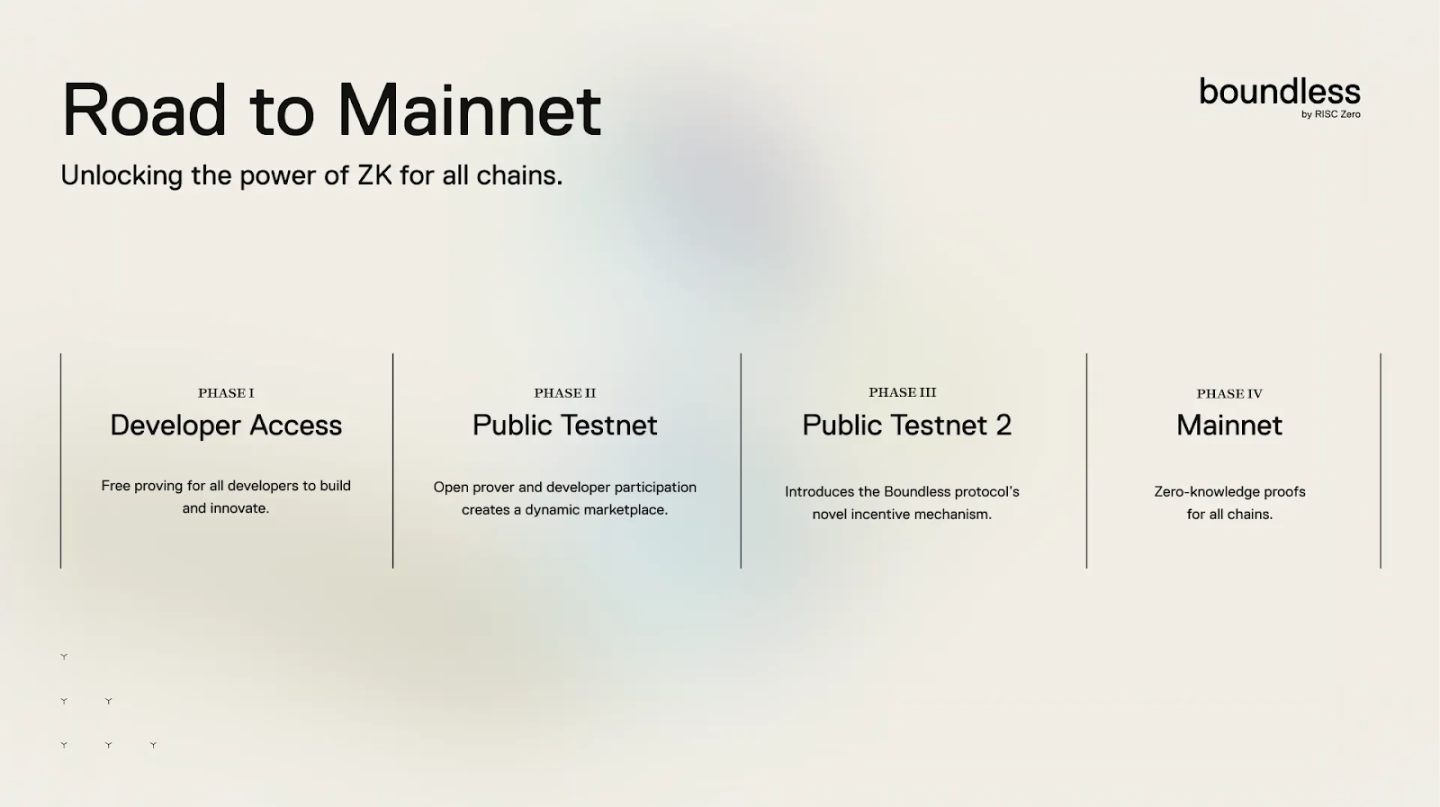
The development of Boundless follows a clear phased path:
- Phase I -- Developer Access: Early access for developers, providing free proof resources to accelerate application exploration;
- Phase II -- Public Testnet 1: Launching a public testnet, introducing a bilateral market mechanism for developers and Prover nodes to interact in a real environment;
- Phase III -- Public Testnet 2: Introducing market incentives and a complete economic mechanism to test a self-sustaining decentralized proof network;
- Phase IV -- Mainnet: Full mainnet launch, providing general ZK computing capabilities for all chains.
On July 15, 2025, the Boundless mainnet Beta officially launched, entering the production environment first on Base. Users can request proofs with real funds, while Prover nodes can join without permission, with each node supporting up to 100 GPUs and participating in bidding. As a demonstrative application, the team launched The Signal, an open-source ZK consensus client that compresses Ethereum beacon chain finality events into a single zero-knowledge proof, verifiable by any chain or contract. Thus, the final state of Ethereum achieves "global readability," providing a foundation for cross-chain interoperability and secure settlement.
Operational data from the Boundless browser shows that the overall network has exhibited rapid growth and strong resilience. As of August 18, 2025, it has processed a cumulative 542.7 trillion computing cycles, completed 399,000 orders, covering 106 independent programs. The largest single proof scale has surpassed 106 billion computing cycles (August 18), and the network's peak computing power reached 25.93 MHz (August 14), both setting industry records. In terms of order fulfillment, the average daily order count exceeded 15,000 in mid-August, with daily peak computing power surpassing 40 trillion cycles, demonstrating exponential growth. Meanwhile, the order fulfillment success rate has consistently maintained a high level of 98%--100%, indicating that the proof market mechanism has matured significantly. Notably, as prover competition intensifies, the cost per cycle has dropped to nearly 0 Wei, signaling that the network is entering an era of efficient, low-cost large-scale computing.
Additionally, Boundless has attracted active participation from leading miners. Major manufacturers like Bitmain have begun developing dedicated ASIC mining machines; companies such as 6block, Bitfufu, Yuanli District, Intchain, and Nano Labs have joined the network, converting existing mining pool resources into ZK proof computing nodes, further advancing Boundless's ZK market towards a scaled industrialization phase.
VII. ZK Coin Token Economic Model Design
ZK Coin (ZKC) is the native token of the Boundless protocol and serves as the economic and security anchor for the entire network. Its design goal is to build a trusted, low-friction, and sustainably scalable zero-knowledge computing market. The total supply of ZKC is 1 billion tokens, adopting a gradually decreasing inflation mechanism: the annual inflation rate in the first year is approximately 7%, gradually decreasing to 3% by the eighth year, and maintaining long-term stability at this level. All newly issued tokens are distributed through Proof of Verifiable Work (PoVW), ensuring that issuance is directly tied to real computing tasks.
Proof of Verifiable Work (PoVW) is Boundless's core innovative mechanism, transforming "verifiable computation" from a technical capability into a measurable, tradable commodity. Traditional blockchains rely on the repeated execution of all nodes, constrained by single-node computing power bottlenecks, while PoVW achieves single computation and global verification through zero-knowledge proofs, introducing a trustless measurement system that converts computational workload into a priceable resource. Thus, computation can scale on demand, discover prices through the market, sign service contracts, and incentivize Prover nodes, forming a demand-driven positive cycle. The introduction of PoVW allows blockchains to break free from power scarcity for the first time, supporting applications such as cross-chain interoperability, off-chain execution, complex computation, and privacy protection, laying a dual economic and technical foundation for Boundless to build a universal ZK computing infrastructure.
Token Roles and Value Capture
ZK Coin (ZKC) is the native token of Boundless and serves as the economic pillar of the entire network:
- Staking Collateral: Provers must stake ZKC (usually ≥10× the maximum request fee) before accepting orders; if they fail to deliver on time, they are penalized (50% destroyed, 50% rewarded to other provers).
- Proof of Verifiable Work (PoVW): Provers earn ZKC incentives by generating zero-knowledge proofs, similar to a mining mechanism. The reward distribution is: 75% to the prover, 25% to protocol stakers.
- Universal Payment Layer: Application parties pay proof fees using their native tokens (e.g., ETH, USDC, SOL), but provers need to stake ZKC, so all proofs are backed by ZKC.
- Governance Function: ZKC holders can participate in Boundless governance, including market mechanisms, zkVM integration, fund allocations, etc.
Token Distribution (Initial Supply of 1 Billion Tokens)
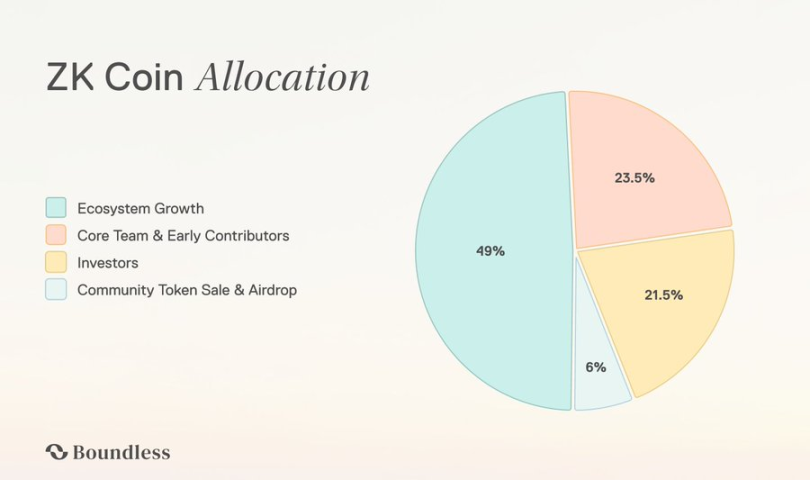
Ecosystem Growth (49%)
- 31% Ecosystem Fund: Supports application development, developer tools, education, and infrastructure maintenance; linear unlocking until the third year.
- 18% Strategic Growth Fund: Used for enterprise-level integration, BD cooperation, and institutional prover cluster introduction; gradually unlocked over 12 months, linked to cooperation outcomes.
Core Team and Early Contributors (23.5%)
- 20% for Core Team and Early Contributors: 25% one-year cliff, remaining 24 months linear unlocking.
- 3.5% allocated to RISC Zero: For zkVM research and development fund.
Investors (21.5%): Strategic capital and technical supporters; 25% one-year cliff, remaining two years linear unlocking.
Community (Approx. 6%): Community public offerings and airdrops to enhance community participation; public offerings unlock 50% at TGE, 50% after 6 months; airdrops unlock 100% at TGE.
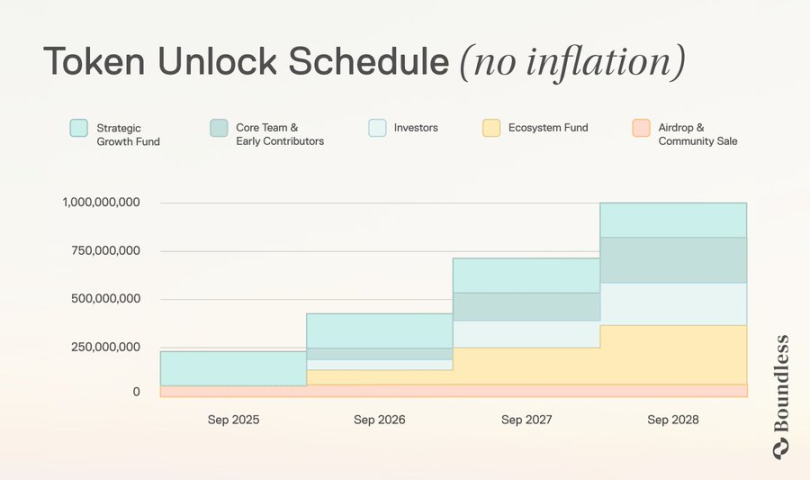
ZKC is the core economic and security anchor of the Boundless protocol, serving as collateral to ensure proof delivery, binding issuance to real workloads through PoVW, and acting as a payment backing layer to support the entire chain's ZK demand, while empowering token holders to participate in protocol evolution at the governance level. As proof requests increase and the penalty destruction mechanism accumulates, more ZKC will be locked and exit circulation, forming long-term value support under the dual effects of growing demand and shrinking supply.
VIII. Team Background and Project Financing
The RISC Zero team was established in 2021. The team consists of engineers and entrepreneurs from well-known technology and crypto institutions such as Amazon, Google, Intel, Meta, Microsoft, Coinbase, Mina Foundation, and O(1) Labs, and has created the world's first zkVM capable of running arbitrary code, building a general zero-knowledge computing ecosystem based on this.
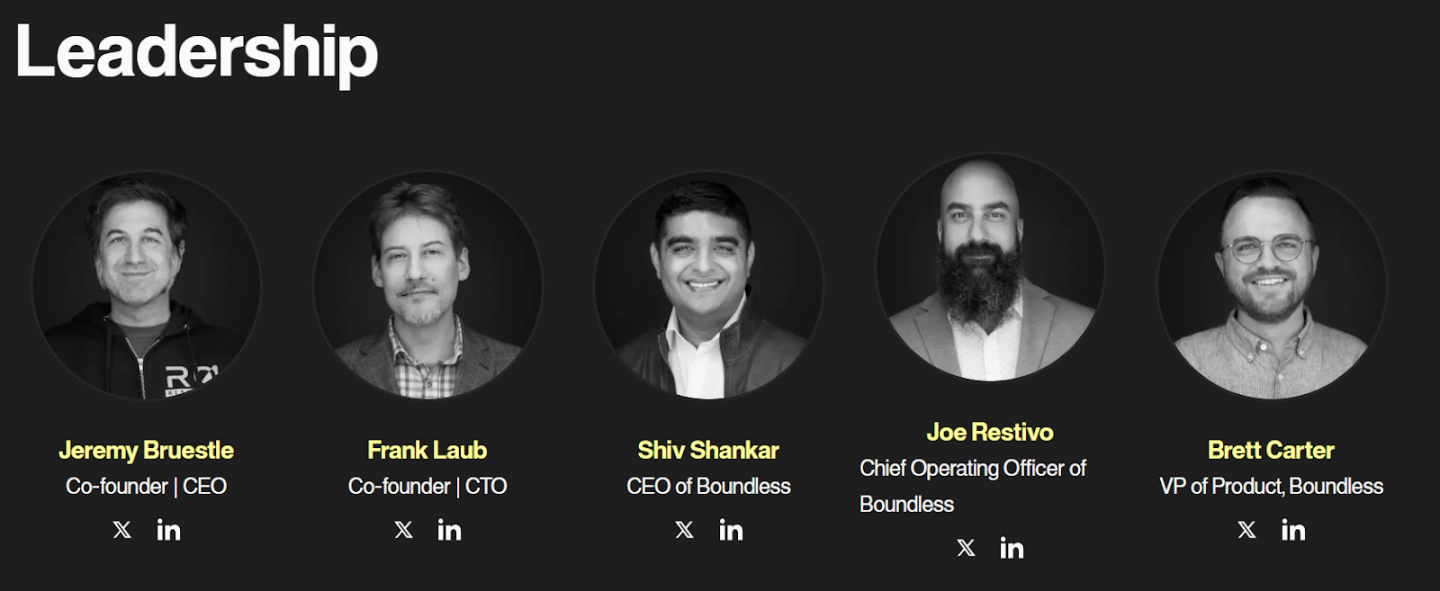
Jeremy Bruestle -- Co-founder & CEO, RISC Zero
Jeremy is a seasoned technology expert and serial entrepreneur with over twenty years of experience in system architecture and distributed computing. He previously served as Principal Engineer at Intel, co-founder and Chief Scientist at Vertex.AI, and co-founder and board member at Spiral Genetics. He founded RISC Zero in 2022 and serves as CEO, leading the research and development of zkVM technology and driving the application of zero-knowledge proofs in general computing.
Frank Laub -- Co-founder & CTO, RISC Zero
Frank has long been engaged in deep learning compiler and virtual machine technology, having worked on deep learning software development at Intel Labs and Movidius, and accumulated rich engineering experience at Vertex.AI, Peach Tech, and other companies. Since co-founding RISC Zero in 2021, he has served as CTO, leading the construction of the zkVM kernel, Bonsai network, and developer toolchain.
Shiv Shankar -- CEO, Boundless
Shiv has over fifteen years of experience in technology and engineering management, covering multiple fields including fintech, cloud storage, compliance, and distributed systems. He has served as CEO of Boundless since 2025, leading product and engineering teams to promote the marketization of zero-knowledge proofs and the construction of cross-chain computing infrastructure.
Joe Restivo -- COO, RISC Zero
Joe is a serial entrepreneur and operations expert with three successful exits, possessing extensive organizational management and risk control experience. Two of his companies were acquired by Accenture and GitLab, respectively. He teaches risk management courses at the University of Washington's business school. He joined RISC Zero in 2023 and currently serves as COO, responsible for the company's operations and scaling management.
Brett Carter -- VP of Product, RISC Zero
Brett has extensive experience in product management and ecosystems. He previously served as a senior product manager at O(1) Labs. He joined RISC Zero in 2023 and currently serves as Vice President of Product, responsible for product strategy, ecosystem application implementation, and market integration with Boundless.
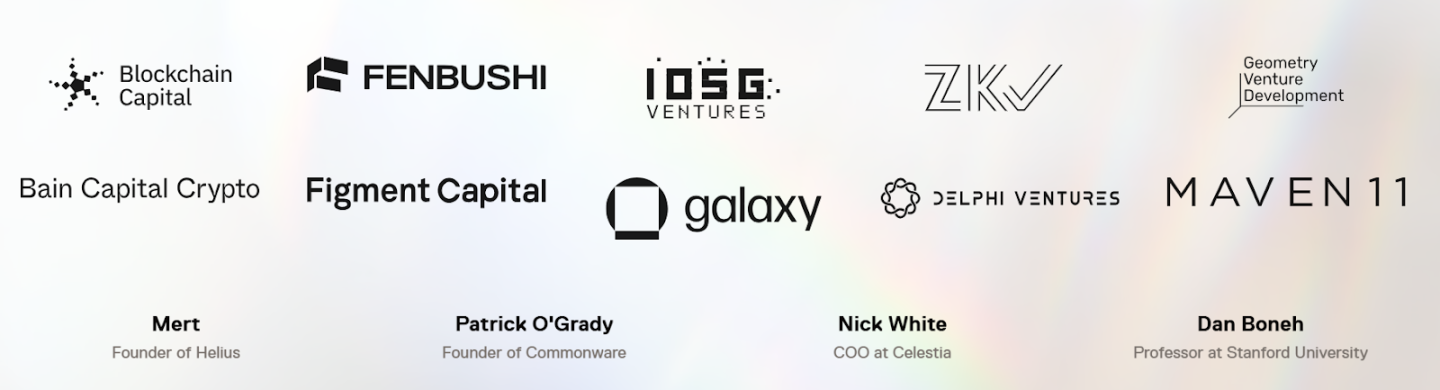
In terms of financing, RISC Zero completed a $40 million Series A funding round in July 2023, led by Blockchain Capital, with seed round lead Bain Capital Crypto continuing to participate, and other investors including Galaxy Digital, IOSG, RockawayX, Maven 11, Fenbushi Capital, Delphi Digital, Algaé Ventures, IOBC, Zero Dao (Tribute Labs), Figment Capital, a100x, and Alchemy.
IX. ZKVM and ZK Market Competitive Analysis
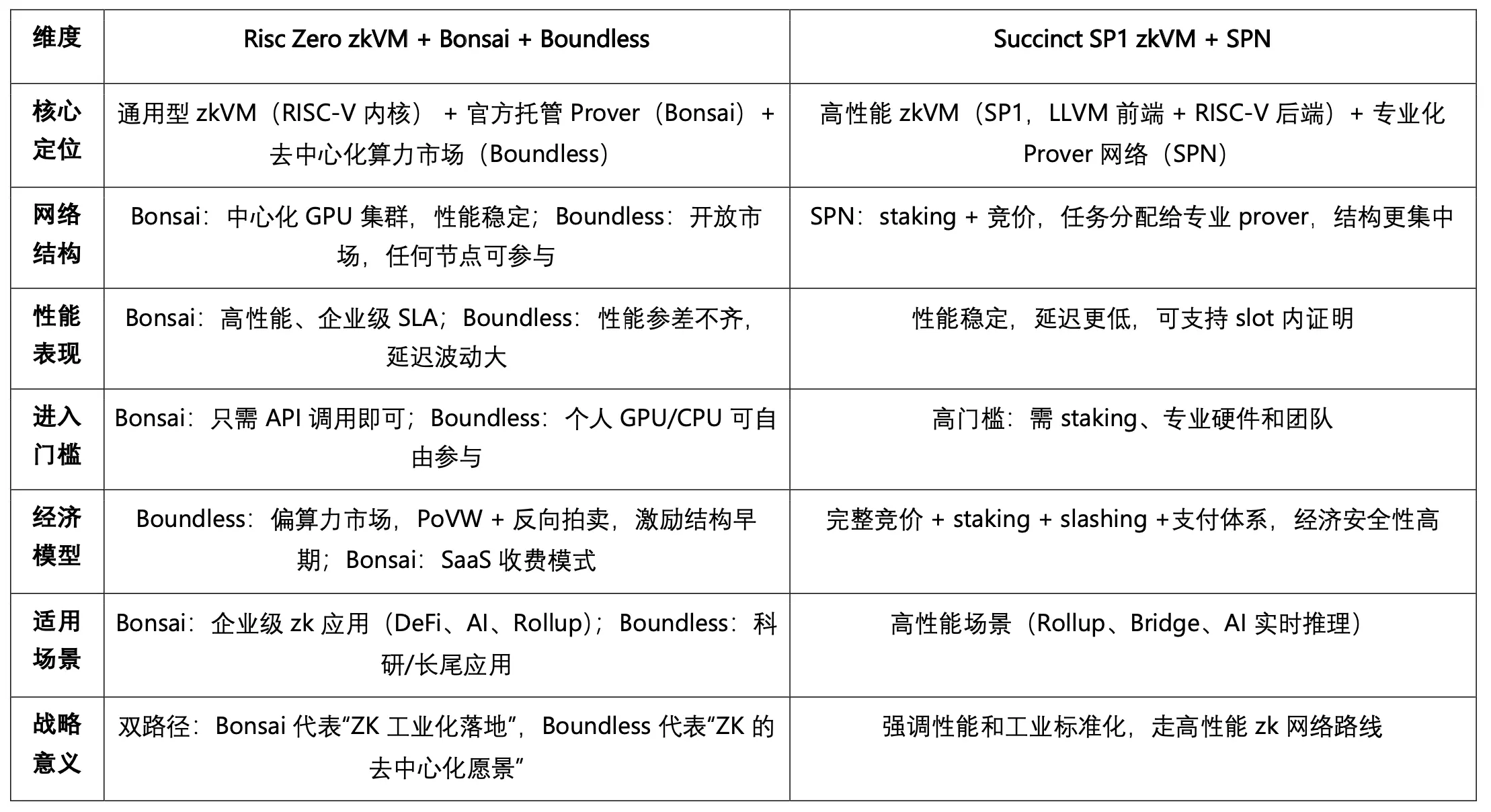
Currently, the representative projects in the market that possess both zkVM and zkMarketplace are Succinct, consisting of SP1 zkVM and Succinct Prover Network (SPN). SP1 is built on RISC-V and is compatible with multiple languages through an LLVM IR front end; SPN is deployed on Ethereum, distributing tasks through staking and bidding mechanisms, with the $PROVE token serving payment, incentive, and security functions. In contrast, RISC Zero adopts a "dual-engine" strategy: on one hand, Bonsai provides an officially hosted Prover-as-a-Service, high-performance, and stable for enterprise applications; on the other hand, it builds an open decentralized proof market through Boundless, allowing any GPU/CPU node to join freely, maximizing decentralization and node coverage, but with relatively insufficient performance consistency.
RISC Zero balances openness and industrial implementation, while Succinct focuses more on high performance and standardized paths.
Differences and Positioning between Risc Zero (zkVM + Bonsai + Boundless) and Succinct (SP1 zkVM + SPN)
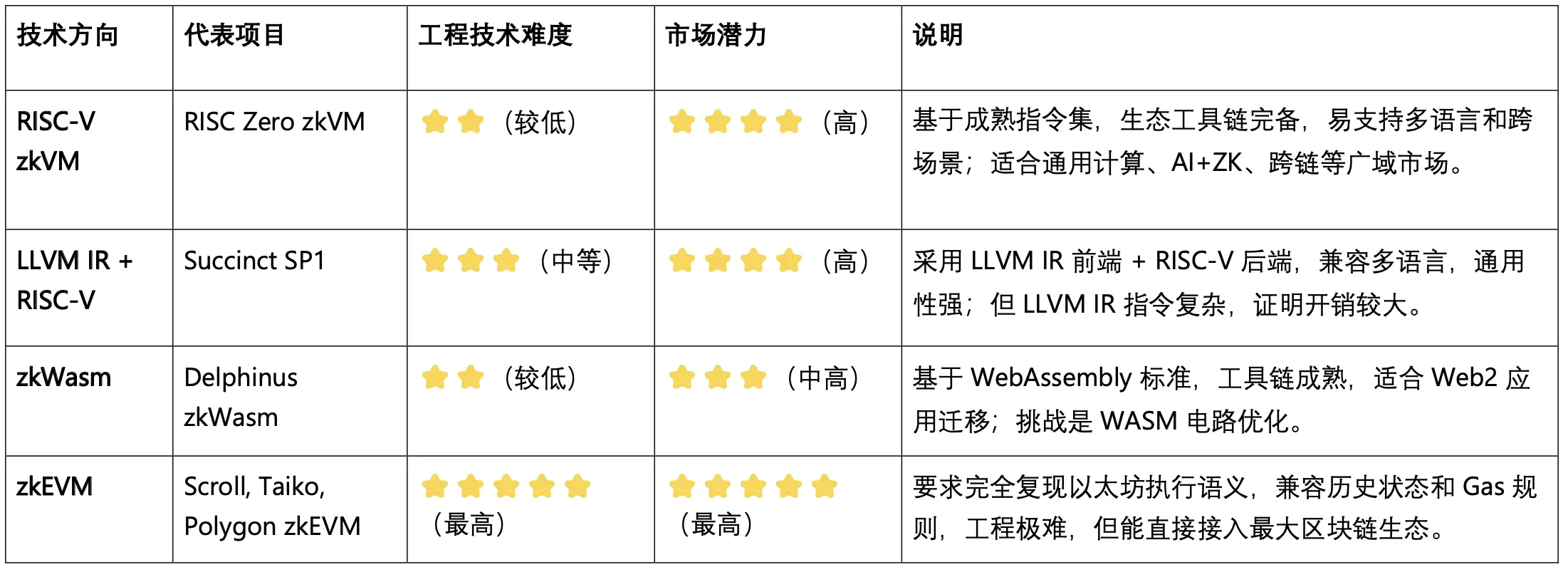
Comparison of RISC-V and Wasm
RISC-V and WASM are the two main routes for general zkVM; the former is a hardware-level open instruction set with simple rules and a mature ecosystem, conducive to circuit performance optimization and future verifiable hardware acceleration; however, it has limited integration with traditional web application ecosystems. WASM, on the other hand, is cross-platform bytecode that naturally supports multi-language and web application migration, with a mature runtime, but its stack-based architecture has a performance ceiling lower than that of RISC-V. Overall, RISC-V zkVM is more suitable for pursuing performance and general computing scalability, while zkWasm has advantages in cross-language and web scenarios.
X. Conclusion: Business Logic, Engineering Implementation, and Potential Risks
ZK technology is evolving from a single scalability tool into a universal cornerstone of trusted computing for blockchain. RISC Zero breaks through EVM dependency with its open RISC-V architecture, extending zero-knowledge proofs to general off-chain computing and giving rise to zk-Coprocessors and decentralized proof markets (such as Bonsai and Boundless). Together, they build a scalable, tradable, and governable layer of computational trust, bringing higher performance, stronger interoperability, and broader application scenarios to blockchain.
Of course, the ZK track still faces many challenges in the short term: after the peak of ZK concept speculation in the primary market in 2023, the mainstream zkEVM projects launching in 2024 will also consume secondary market enthusiasm. Additionally, many leading L2 teams adopt self-developed provers, and application scenarios such as cross-chain verification, zkML, and privacy computing are still in their early stages, with limited tasks to facilitate. This means that the order volume of the open proving marketplace may struggle to support a large network, with its value more in pre-aggregating prover supply to seize opportunities when demand surges in the future. Meanwhile, although zkVM has a low technical threshold, it is challenging to directly penetrate the Ethereum ecosystem, but it may have unique supplementary value in scenarios such as complex off-chain computation, cross-chain verification, and non-EVM chain integration.
Overall, the evolution path of ZK technology has gradually become clear: from the exploration of zkEVM compatibility to the emergence of general zkVM, and then to the decentralized proof market represented by Boundless, zero-knowledge proofs are accelerating towards commoditization and infrastructure development. For investors and developers, the current period may still be one of validation, but it harbors core opportunities for the next industrial cycle.
Click to learn about job openings at ChainCatcher
Recommended Reading:
Backroom: Tokenization of Information, a Solution for Data Redundancy in the AI Era? | CryptoSeed
 Risk warning
 Risk warning

Popular articles





