








CFTC New Regulations Quick Read: How Foreign Exchanges Can Legally Enter the U.S., Which Businesses Benefit, and What to Focus on in the Short Term?

 A new round of exchange compliance competition has begun, and this time the target is America.
Original Author: Hunt
Original Compilation: Azuma, Odaily Planet Daily
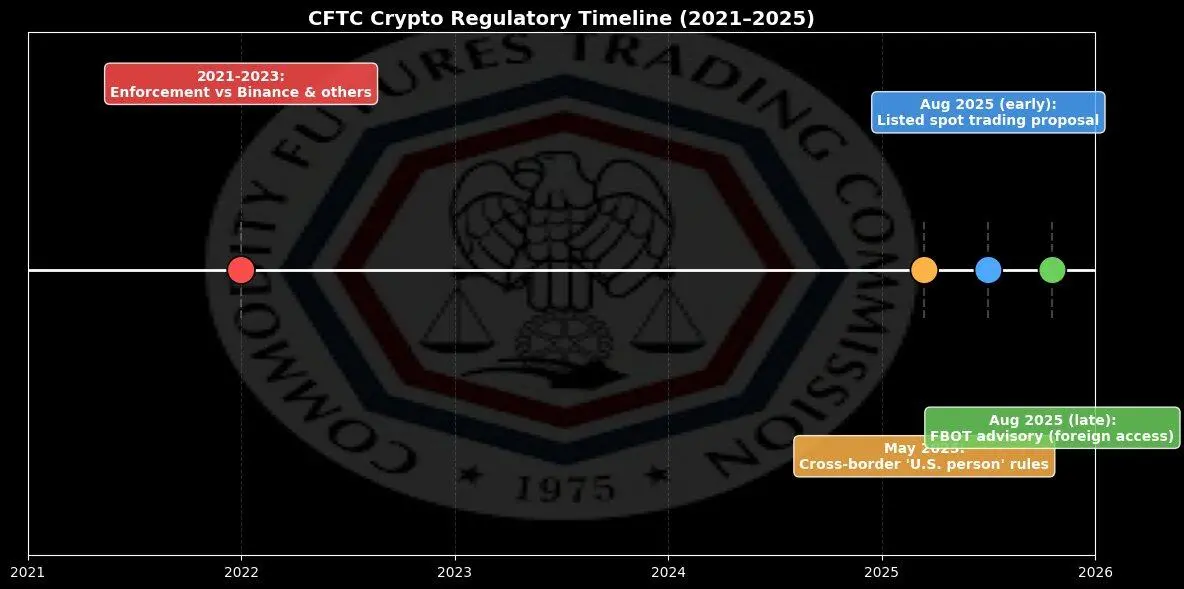
Editor’s Note: Early this morning, the U.S. Commodity Futures Trading Commission (CFTC) officially released a guidance document that clarifies its registration rules for foreign trading platforms (FBOT), providing a legal registration pathway for non-U.S. trading platforms and allowing U.S. users to trade on such platforms.
The clarification of this rule will undoubtedly bring significant changes to the trading methods of U.S. cryptocurrency users and the competitive landscape of the entire exchange sector. This morning, cryptocurrency analyst Hunt (@hunt029) published a brief analysis on what the new rules mean, what limitations exist, which businesses benefit, and what changes to watch for in the short term.
Below is the full content of the CFTC announcement and Hunt's analysis, compiled by Odaily Planet Daily.
Full Text of CFTC Announcement
The U.S. Commodity Futures Trading Commission (CFTC) Market Oversight Division today released a consultation document regarding the registration framework for foreign exchanges (FBOT). This framework applies to all non-U.S. entities that are legally established and operating outside the United States and wish to provide direct market access to users located in the U.S. The CFTC's FBOT registration framework applies to all markets, regardless of asset class, covering both traditional and digital asset markets.
CFTC Acting Chair Caroline D. Pham stated:
"The FBOT consultation document released today provides the regulatory clarity needed by the market, allowing trading activities that were previously forced out of the U.S. due to the 'enforcement equals regulation' approach to return legally to the U.S. By reaffirming the CFTC's consistent policy—providing U.S. traders with choices and access to the deepest and most liquid global markets across various products and asset classes—U.S. companies that were previously forced to establish operations overseas to support cryptocurrency trading now have a pathway to return to the U.S. market. As I have said before, the existing registration categories of the CFTC are the simplest and fastest solutions. Since the 1990s, Americans have been able to trade on non-U.S. exchanges registered as FBOT. From now on, the CFTC welcomes those who wish to trade efficiently and safely under CFTC regulation, while also opening the U.S. market to the world. This once again demonstrates that the CFTC will continue to support President Trump's 'crypto sprint' initiative."
As the global derivatives market continues to evolve, new products, asset classes, and trading platforms are emerging both domestically and internationally, and the CFTC Market Oversight Division has received an increasing number of inquiries, including: when FBOT registration is required and the specific requirements and processes for obtaining FBOT registration.
Additionally, recent enforcement actions by the CFTC based on new interpretations inconsistent with decades of past practices have caused confusion and disruption regarding whether non-U.S. exchanges should register as Designated Contract Markets (DCM) or FBOT.
By reaffirming the CFTC's long-standing FBOT registration framework, this consultation aims to promote regulatory clarity and market access.
Analysis and Interpretation
The announcement from the U.S. Commodity Futures Trading Commission (CFTC) today will allow Americans to trade legally on certain "offshore" cryptocurrency exchanges in a simpler manner.
What does this mean? Why is it important? And how might it reshape the market?
Until now, U.S. users often traded on overseas platforms using VPNs or other means—this trading model carries significant risks. Now, if an overseas exchange registers with the CFTC as an FBOT (Foreign Board of Trade), U.S. traders will be able to access the services of that exchange legally.
It is important to clarify that this is not a complete deregulation:
- Only compliant and regulated exchanges can qualify.
- Access typically requires routing through U.S. brokers or futures firms.
- Unregistered "wild west" exchanges remain prohibited for U.S. users.
Why is this important?
- First, in terms of liquidity: U.S. capital flowing into global markets means deeper order books and smaller slippage;
- Second, in terms of legitimacy: Compliant overseas exchanges will be able to openly serve U.S. customers;
- Third, reducing detours like VPNs: Clear rules are always better than various covert workarounds.
Currently, the total market capitalization of the cryptocurrency market is approximately $3.9 trillion, with Bitcoin (BTC) having a market cap of over $2.2 trillion (market share 56-57%) and Ethereum (ETH) around $580 billion (market share 14-15%), both close to historical highs. Many analysts optimistically predict that BTC could reach $150,000 to $225,000 by the end of the year, and ETH could exceed $7,000.
Following the disclosure of the CFTC's new rules, retail and institutional investors will gain safer access to trading; the scale of arbitrage and basis trading between the U.S. and global markets is expected to further expand; and exchanges willing to comply with U.S. regulatory rules will find it easier to expand.
However, some things remain unchanged: perpetual contract trading services aimed at retail must still be conducted on U.S. regulated futures exchanges (DCMs); suspicious offshore platforms remain within the CFTC's enforcement scope.
Overall, the CFTC's announcement will directly benefit the following groups:
- First, overseas exchanges that can meet FBOT registration standards;
- Second, U.S. brokers that can route customer orders to overseas exchanges;
- Third, all trading users sensitive to liquidity ------ because the new rules mean deeper markets and better pricing.
From the perspective of the macro regulatory environment and industry development, the working model of various U.S. regulatory agencies is shifting from "relying solely on enforcement" to "rule-based market access." This is a structural benefit for the adoption, liquidity, and mainstream recognition of cryptocurrencies.
In terms of the competitive landscape of exchanges, U.S. domestic exchanges may have an advantage due to existing infrastructure and regulatory experience, but if overseas FBOTs quickly register and offer competitive liquidity, they can also pose a challenge ------ whoever prioritizes compliant registration to enter the U.S. market may win the competition.
In the short term, the market may need to pay attention to the following three dynamics.
- Which exchanges will be the first to register as FBOT;
- The CFTC's next steps ------ whether to allow U.S. futures exchanges to launch "spot crypto trading";
- Whether the SEC will attempt to intervene in this area.
In short, the CFTC's move opens a two-way channel for Americans and overseas exchanges, allowing U.S. users and global cryptocurrency market liquidity to interact in a compliant manner ------ provided that trading platforms are willing to fulfill all compliance requirements.
The current total size of the cryptocurrency market is nearing $4 trillion. As BTC and ETH continue to rise, the CFTC's regulatory clarity may further heat up the market.
Click to learn about job openings at ChainCatcher
Recommended Reading:
Pantera Capital In-Depth Analysis: The Value Creation Logic of Digital Asset Treasury DATs
Backroom: Information Tokenization, a Solution for Data Redundancy in the AI Era? | CryptoSeed
 Risk warning
 Risk warning



Popular articles





