








Gemini IPO risks highlighted: Compliance advantages are weak, financial and competitive disadvantages drag down investment value?

 Despite Gemini taking the lead in compliance and striving to build a diversified product matrix of "spot + derivatives + stablecoins + payments," why does its investment value rank almost at the bottom in the vertical track of compliant cryptocurrency exchanges?
Original Title: "The Decline of the 'Compliance Moat': Dissecting Gemini's 'Lifeline' IPO and Investment Value
Original Authors: Lyv; Bruce Shen; Felix Xu, Fintech Frontier
Founded by the Winklevoss brothers, the compliance-focused cryptocurrency exchange Gemini has recently officially listed on Nasdaq (ticker: GEMI), becoming the third publicly traded cryptocurrency exchange in the U.S. after Coinbase and Bullish, raising approximately $425 million, with a strong market response. On its first day of trading, GEMI's stock price surged by 45% at one point, ultimately closing up over 14%, with a market capitalization reaching $3.8 billion.
Gemini has positioned itself as "compliance-first," but now faces a stark reality: a net loss of $282.5 million in the first half of 2025 and a long-term negative operating cash flow, with an IPO aiming to raise a maximum of approximately $317 million resembling a "debt repayment priority defensive battle." Despite its product matrix spanning spot/ institutional custody, offshore perpetual contracts, GUSD stablecoin, credit cards, and Nifty Gateway, it still lags behind Coinbase, Robinhood, and others in key metrics such as trading volume, monthly active trading users, and platform assets. "Compliance" has devolved from a premium label to an industry threshold. This article dissects key information from the S-1 filing along product and financial lines, providing a calm assessment of Gemini's competitiveness and investment value, helping to determine whether this "compliance exchange" is worth investing in.
Product and Revenue Engine (Multi-line Parallel)
As a compliance-focused U.S. onshore cryptocurrency exchange, Gemini's product and revenue engine presents a "multi-line parallel" structure. In terms of spot and institutional services, the retail side offers the Exchange App and ActiveTrader, while the institutional side includes Gemini Prime and custody (multi-signature, offline cold storage, compliance auditing), with core revenue coming from trading fees and custody fees.
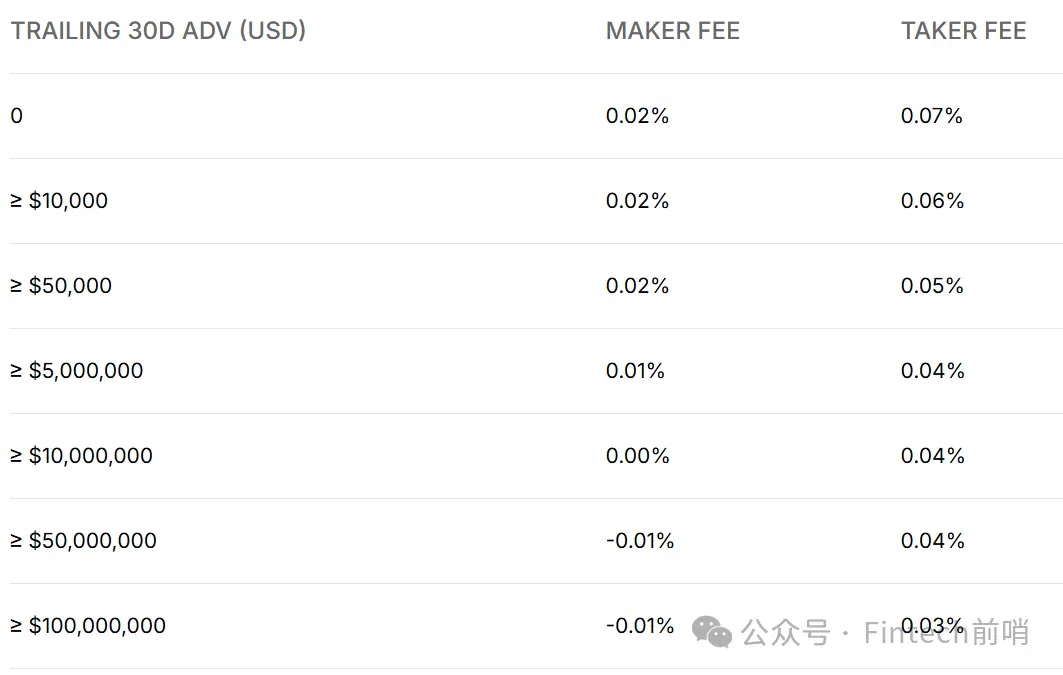
On the retail pricing front, the Gemini App ("Gemini Mode") charges a 1.49% trading fee + 1.00% convenience fee for Instant/Recurring orders (the convenience fee fluctuates with slippage, capped at 2%); Limit orders incur a 1.49% trading fee with no convenience fee. ActiveTrader employs a maker/taker tiered structure: for a 30-day trading volume of < $10k, maker 0.20% / taker 0.40%, dropping to $0.05% / $0.15% for the $1m tier, $0.00% / $0.04% for the $100m tier, and $0.00% / $0.03% for the $250m tier. For institutional and custody services, Gemini Custody® charges an annualized fee of 0.40% or $30/month/asset (whichever is higher), with an administrative withdrawal fee of $125; it is marked "no minimum scale" (provided it covers the minimum monthly fee).
Compliance and security selling points include cold storage, multi-party control and role governance, ISO 27001 and SOC 2 Type 2 certifications, and disclosed hot/cold insurance limits (hot wallet $25M, cold storage $100M, totaling $125M). The institutional trading stack integrates Prime / eOTC / Exchange, serving hedge funds, family offices, and financial institutions, with eOTC supporting delayed net settlement and credit.
From a revenue structure perspective, retail primarily relies on fixed rates (App) + tiered rates (ActiveTrader); institutional business adopts a high volume, low fee traditional approach, lowering the overall take-rate, with trading fees still constituting the main revenue, accounting for about 2/3; custody fees are based on management and withdrawal fees, with capabilities like "instant trading from cold storage" enhancing institutional stickiness. The overall key point is that the security/compliance and cold storage capabilities on the institutional side create differentiation, while the high-tier volume (≥$100m) maker 0 / taker 0.04% is attractive to large clients but may dilute the average fee rate.
The derivatives segment is handled by the Gemini Foundation operating outside the U.S., positioned as a key lever to enhance trading depth and fee income, but it raises higher demands for compliance boundaries and risk control. The product form is linear perpetual contracts in non-U.S. regions (operating entity Gemini Artemis Pte. Ltd.), with contracts priced and settled in GUSD, featuring funding fees and liquidation/insurance fund mechanisms (liquidation transaction fee rate 0.5%, funding fee calculated hourly); media reports indicate it initially offered up to 100x leverage. In terms of fees, the official Derivatives Fee Schedule employs a maker/taker tiered structure and sets negative/zero fee caps for large market-making. In compliance expansion, on May 9, 2025, it obtained a MiFID II investment services license from MFSA, planning to launch regulated derivatives (including perpetuals) in the EU/EEA; on August 20, 2025, it received a MiCA license, covering 30 European countries, further paving the way for derivatives and structured products. Its revenue mainly comes from maker/taker trading fees, 0.5% liquidation fees, and withdrawal/funding-related operational fees; the funding fee essentially represents bilateral settlement between longs and shorts, and the platform does not necessarily account for it as revenue. Overall, the "MiFID II + MiCA" dual-license path significantly reduces compliance uncertainty, aiding in attracting high-net-worth and institutional liquidity in Europe, but ultimate scalability still depends on liquidity introduction, risk management, and robust operation of the clearing system.
 In terms of stablecoins, GUSD is issued by Gemini, pegged 1:1 to the U.S. dollar, benefiting from institutional dividends as U.S. stablecoin legislation advances (e.g., the "GENIUS Act"), but remains small compared to USDT/USDC. In terms of compliance and transparency, GUSD has been regulated by NYDFS since 2018, with Gemini stating that the 1:1 reserves consist of cash, government money market funds, and short-term U.S. Treasury bonds, with independent auditor attestations published monthly, and reserve accounts earmarked for specific use. Scale comparison (reference scale): as of September 3, 2025, GUSD's circulating market cap is approximately $51M; USDC is about $72B, and USDT is about $168B, showing a significant gap. If legislative progress materializes, it will generally benefit compliant stablecoin issuers, including GUSD.
Payment and credit card business is being advanced through Gemini's collaboration with WebBank and Mastercard. According to the card agreement document from February 2025, the credit card has no annual fee, with APR tiered based on creditworthiness and benchmark rates, and rewards credited in real-time as cryptocurrency; Gemini states that residents of all 50 U.S. states can apply (subject to terms). Marketing has previously launched an XRP-themed version page. In terms of incentives, cardholders can choose from various cryptocurrencies offered on Gemini, with compliant spending earning up to 40% cashback; it also provides up to 3% cashback on dining, 2% on groceries, and 1% on other purchases, with rewards automatically deposited into the cardholder's Gemini account. The revenue structure follows industry norms: interest margin/annual fees/penalties/various fees combined with interchange revenue sharing; within the Gemini system, WebBank acts as the issuer, and the specific revenue-sharing ratio has not been disclosed. The strategic value of this business lies in expanding everyday payment touchpoints and strengthening brand penetration, with themed activities aiding customer acquisition and engagement.
In the NFT space, Gemini acquired Nifty Gateway in November 2019 and has since transformed it into Nifty Gateway Studio (NGS) starting in 2024, focusing more on collaboration and production with brands and creators rather than just a trading platform. In recent years, it has announced multiple collaborations with art projects, forming complementary content and ecological touchpoints with its main business. Overall, Gemini is leveraging a diversified matrix of "spot/institutional + derivatives + stablecoins + payment cards + NFTs" to integrate trading, custody, clearing, and compliance, simultaneously enhancing fee structures, institutional stickiness, and brand touchpoints, aiming to improve long-term revenue resilience under the combined effects of compliance dividends and product depth.
Competitive Landscape and Market Share (Exchange)
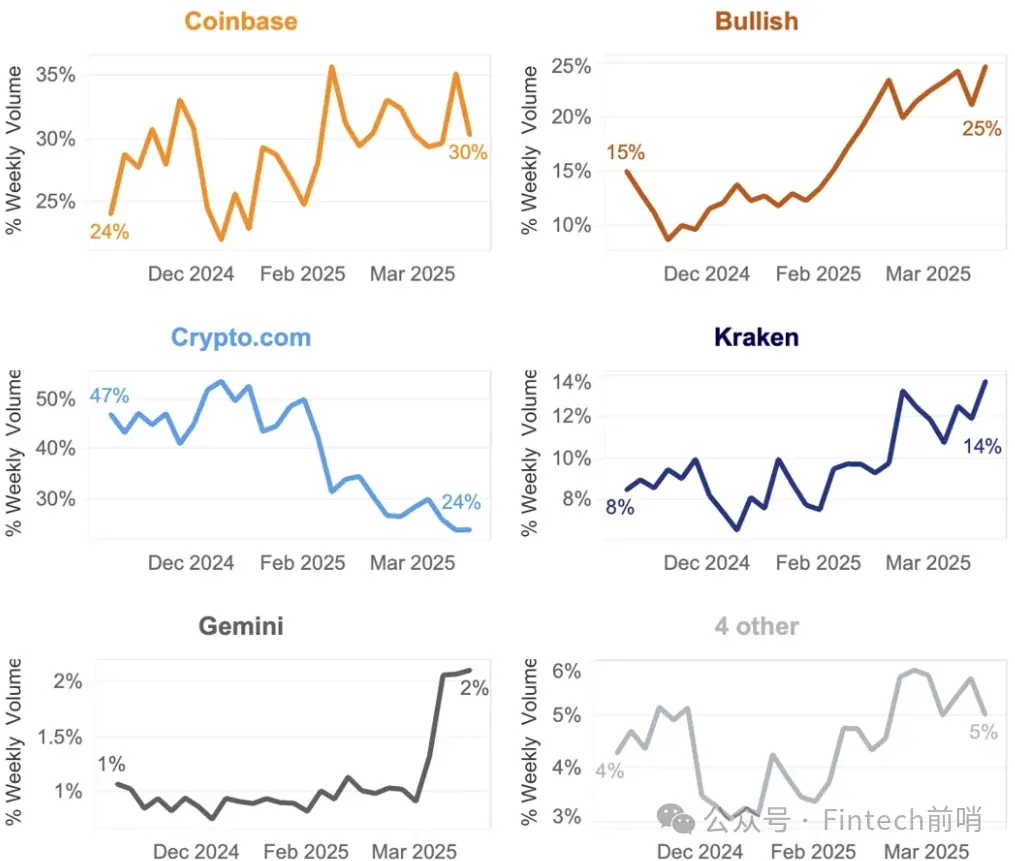
Gemini is positioned in the "top tier but not the first echelon" of compliant spot exchanges. According to Kaiko's comprehensive ranking, in spring 2025, its spot market share rose from about 1% to 2%, displaying an "advance two steps, retreat one step" elastic characteristic, with a temporary increase followed by a partial retraction, reflecting both upward momentum and volatility in the compliance track.
In horizontal comparison, Coinbase remains the leader in U.S. stocks, with clear advantages in integrated retail and institutional operations, and the synergy with options and other derivatives brings stronger economies of scale and brand premiums; Kraken, as a long-established compliant exchange in the U.S., has deep roots in the EU market, with a more solid regional layout. On the retail entry level, Robinhood's acquisition of Bitstamp (announced in 2024, completed in 2025) has filled its institutional and globalization capability gaps, further intensifying competitive pressure on retail entry in the U.S. compliant market.
In the primary market, Bullish successfully went public in 2025, enhancing capital market risk appetite and valuation references for "compliant exchange" assets, which also holds certain implications for Gemini's future potential issuance windows. In this landscape, our view is that Gemini's market share and ranking are not in the first tier, and the differentiation of its exchange business products and services is very low. Although it emphasizes "compliance," compared to other U.S. competitors, its scale is too small to provide a sufficient edge.
User Reputation and Product Richness
From the perspective of user reputation and product coverage, Gemini's listings and available regions are in line with mainstream compliant platforms: currently supporting over 70 cryptocurrency assets, serving over 60 countries (source: S-1/Reuters). In terms of app ratings, third-party assessments show an App Store rating of 4.8/5 and a Google Play rating of 4.3/5, with overall good performance in mobile experience and stability; however, on Trustpilot, reputation is notably polarized, with negative feedback concentrated on risk control triggers and customer service response, indicating that its user communication and process experience under the compliance module still have room for improvement.
Regarding product richness, Gemini's product line is "wide and comprehensive": it offers both institutional custody and trading stacks, while also synchronously laying out derivatives, credit cards, stablecoins, and NFT ecosystems, forming a relatively complete business matrix. However, in terms of depth and activity (such as order book thickness and institutional market-making coverage), there remains a visible gap compared to first-tier platforms—this not only affects pricing power but also directly relates to unit economics. Given that the S-1 currently lacks sufficient disclosure of key operational metrics, ongoing monitoring of its liquidity introduction, institutional cooperation, and fee structure improvements will be necessary.
History and Business Status
Gemini was founded in 2014 by Cameron and Tyler Winklevoss in New York, with the main entity being Gemini Trust Company, LLC. On October 5, 2015, the New York Department of Financial Services (NYDFS) granted it a limited purpose trust company license under the New York Banking Law, establishing a foundational path of "safety/compliance first." In terms of compliance and auditing, Gemini completed a SOC 2 Type 1 audit executed by Deloitte in 2018, and on January 19, 2021, it simultaneously passed SOC 1 Type 2 and SOC 2 Type 2 (covering the exchange and Gemini Custody), early on positioning itself with a "compliance model" mindset to differentiate from peers.
In terms of related parties and business cooperation, the company signs service agreements with entities jointly held with WCF (such as Elysian, Salient, WCM) to obtain key operational support such as equipment leasing, cloud services, data centers, and management consulting; for the C-end and payment ecosystem, it collaborates deeply with multiple parties: first, with Ripple to extend Ripple USD (RLUSD) as the base currency for all spot trading pairs on the platform and jointly launch an XRP rewards credit card; second, in collaboration with WebBank, which acts as the issuing bank for the XRP co-branded credit card, expanding cryptocurrency payment application scenarios and customer touchpoints within a compliance framework.
Operating Scale (Media Transcription of S-1 Disclosure for Scale Reference)
Platform Scale (as of June 30, 2025)
Cumulative Trading Volume (lifetime trading volume) ≈ $285bn;
Assets on our platform (AUC) > $18bn;
Monthly Trading Users (MTUs) ≈ 523k; Institutional Clients ≈ 10k;
Cumulative Processed Transfer Amount > $800bn.
All of the above can be found in multiple authoritative secondary sources reporting on S-1 excerpts/databases: Investopedia, Renaissance Capital/IPO-Scoop, Investing.com, etc.
Product Coverage Supplement (S-1/DRS Excerpt): Supports 80+ trading assets, Custody covers 130+ assets (as of June 30, 2025).
S-1/A Filing Index (for original verification): SEC EDGAR CIK: 0002055592 (latest S-1/A index page).
Financial Condition Analysis: Growth Cannot Hide Losses, Heavily Dependent on External Infusion
Performance Overview: Severe Losses
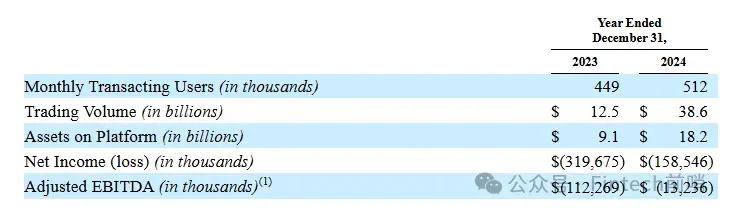
2024 Operating Data: Shows a growth trend, achieving 512,000 monthly trading users, with an annual trading volume of $38.6 billion, and platform custody assets reaching $18.2 billion.
Continued Massive Losses: Growth is severely offset by significant losses. In 2024, a net loss of $159 million was recorded.
- Losses Worsened in the First Half of 2025: The company achieved revenue of $68.6 million, processing $24.8 billion in spot trading volume, but the net loss during the same period reached $282.5 million.
Asset-Liability and Cash Flow Situation
Operating Cash Flow Continues to be Negative: The company's main business has not achieved self-sustainability. In 2024, the operating cash flow was -$109 million, and in 2023, it was -$207 million, mainly due to adjustments for non-cash items and changes in working capital.
Cash Reserves (as of December 31, 2024): Holding cash and cash equivalents of $42.8 million, with restricted cash of $28.4 million.
Client Funds Segregated: Client custody funds amount to $575.6 million, which are segregated and used solely for client interests, reflecting its efforts in asset safety and compliance.
Survival Model: Reliance on External Infusion
High-Risk Financial and Asset Strategy:
Bitcoin "vault asset" strategy: The company treats BTC as a core reserve asset, preferring to finance through U.S. dollar debt rather than directly selling BTC. This can alleviate cash pressure in bull markets but amplifies cyclical risks during market downturns.
Historical Risk Clearance ("Earn Event"): Under NYDFS regulatory requirements, Gemini has returned over $2 billion in cryptocurrency assets to Earn users and paid a $37 million fine. Although costly, this essentially resolved the historical issue, repaired some reputation, and reduced contingent liability risks.
Funding Sources: Multi-party Credit Support to Maintain Operations:
Core support from the founders' fund (WCF): As of the end of 2024, the company's survival heavily relies on WCF's continued "infusion," including:
Unpaid cryptocurrency loans: 5,054 BTC, 26,629 ETH
Unpaid U.S. dollar principal: $116.5 million
WCF also holds all convertible bonds issued by the company.
External Credit as Supplement: Obtained a $75 million credit line from its strategic partner Ripple as additional liquidity support.
Future Plans: IPO Focused on Debt Repayment
The funds raised from this IPO will primarily be used to repay third-party debts, optimizing the capital structure and reducing leverage.
Summary
Gemini's financial condition is concerning, with massive net losses largely driven by non-cash or highly volatile items, such as fair value adjustments of related party convertible bonds, borrowing interest, and fair value changes of held cryptocurrency assets.
The company has long relied on external infusions from the founders' fund, with the primary purpose of this IPO clearly aimed at repaying third-party debts, resembling more of a "lifeline" effort to maintain operations rather than a strategic expansion to drive future growth. The financing amount can only support the company's cash consumption for about two years, with the path to profitability still distant and unclear.
Operating Data and Peer Comparison: Significant Gaps
Analysis of Gemini's Operating Status
Operating Data: In terms of user numbers and trading volume, Gemini achieved relatively modest increases in 2024. Monthly trading users grew from 448,000 in 2023 to 512,000 in 2024, with total trading volume increasing from $12.5 billion to $38.6 billion. Platform assets also saw significant growth, rising from $9.1 billion to $18.2 billion.
Profitability: However, despite improvements in operating data, Gemini's profitability still faces severe challenges. Although EBITDA improved slightly from a negative $110,000 in 2023 to a negative $13,000 in 2024, it remains negative. This indicates that Gemini's revenue cannot cover various operational costs, including employee salaries, and the path to profitability remains unclear and concerning.
Comparison with Peer Operating Data
Trading Volume:
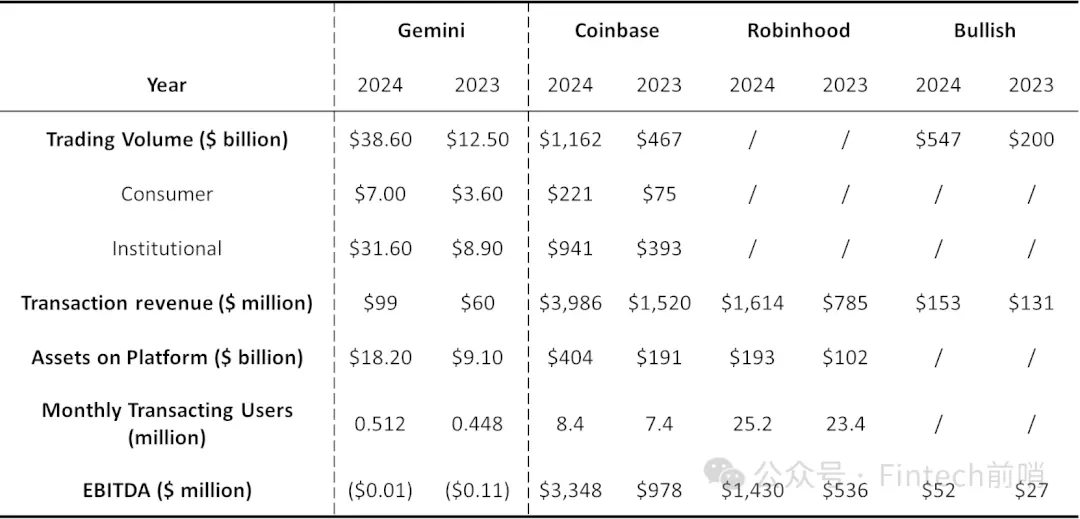
Gemini's trading volume is far below that of Coinbase and Bullish. Coinbase's trading volume in 2024 reached $1.162 trillion, Bullish at $547 billion, while Gemini only reached $38.6 billion.
Gemini's primary revenue comes from retail, and although institutional trading has significantly increased, the total trading volume still lags far behind Coinbase.
User Scale:
Gemini's user scale is significantly smaller than that of Coinbase and Robinhood. Coinbase had 8.4 million monthly trading users in 2024, Robinhood had 25.2 million, while Gemini only had 512,000.
The gap in user numbers compared to Coinbase and Robinhood is substantial.
Profitability:
Both Coinbase and Robinhood achieved profitability in 2024 (with positive EBITDA), while Gemini's EBITDA remains negative.
Coinbase demonstrates a clear absolute advantage in profitability.
Platform Assets:
The platform assets of Coinbase and Robinhood are far higher than those of Gemini. Coinbase's platform assets in 2024 were $404 billion, Robinhood's were $193 billion, while Gemini only had $18.2 billion.
Summary
In summary, while Gemini has experienced growth, it still faces significant gaps in market share, user scale, and profitability compared to major competitors. It needs to further enhance its profitability and market competitiveness. Therefore, the company's core competitiveness does not lie in market share but rather in its differentiated compliance strategy.
Core Team
Founders and Background
Key Figures: The company was founded and is led by twin brothers Cameron & Tyler Winklevoss. They are well-known for their early legal disputes with Mark Zuckerberg over the founding rights of Facebook and have become early investors in Bitcoin and staunch advocates for cryptocurrency using their settlement funds.
Continuous Entrepreneurship and Investment: Before founding Gemini, they established Winklevoss Capital in 2012 as their family office and venture capital tool. Through this company, they actively invested in numerous cryptocurrency and tech startups, building a broad industry ecological network.
Political Involvement and Policy Lobbying
Public Support for the Trump Campaign: The Winklevoss brothers are among the most prominent supporters of Donald Trump in the cryptocurrency industry. In 2024, they each donated $1 million worth of Bitcoin to Trump's campaign and publicly criticized the Biden administration's "war on crypto," arguing that its regulatory policies are stifling innovation.
Systematic Political Donations and Lobbying: Their donations are not isolated actions but part of a wave of political contributions totaling $190 million from the cryptocurrency industry. According to media reports such as the Financial Times, the Winklevoss brothers, along with key figures from Coinbase, Ripple, a16z, and others, have invested large sums through Super PACs to systematically influence the U.S. political landscape.
Conclusion: Investment Value at the Bottom of the Vertical Track
Although Gemini has taken the lead on the compliance path and has worked hard to build a diversified product matrix of "spot + derivatives + stablecoins + payments," a deep analysis of its financial condition, operating data, and competitive landscape reveals that its investment value is nearly at the bottom of the vertical track of compliant cryptocurrency exchanges.
1. Diminished Differentiation Advantage: Its "compliance" label, in the face of giants like Coinbase and Kraken, which have also obtained regulatory licenses, can no longer constitute a sufficiently wide moat. The differentiation of products and services in the exchange business is extremely low, and Gemini's small scale makes it difficult to generate strong network effects and cost advantages, with its "compliance" selling point failing to translate into sustained market share leadership or profitability.
2. Severe Financial Condition: Continued and expanding massive losses, consistently negative operating cash flow, and a heavy reliance on external infusions from the founders' fund reveal fundamental weaknesses in its business model. The primary purpose of this IPO is clearly aimed at repaying third-party debts, resembling more of a "lifeline" effort to maintain operations rather than a strategic expansion to drive future growth. The amount raised can only support the company's cash consumption for about two years, with the path to profitability still distant and unclear.
3. Significant Operational Data Gaps: From an operational data perspective, the gaps between Gemini and the track leaders are comprehensive. In terms of trading volume, monthly trading users, platform asset scale, and profitability, Gemini is far behind competitors like Coinbase and Robinhood, with significant disparities. With Robinhood's acquisition of Bitstamp, market competition will further intensify, continuously squeezing the survival space for second-tier players like Gemini.
Therefore, for investors seeking to invest in compliant cryptocurrency trading platforms, Gemini is not an ideal target. Allocating capital to market share solid leaders like Coinbase, Kraken, and Robinhood, which have more resilient business models and have demonstrated profitability, is undoubtedly a more prudent and wise choice.
Click to learn about job openings at ChainCatcher
Recommended Reading:
Pantera Capital Deep Dive: The Value Creation Logic of Digital Asset Treasury DATs
Backroom: Tokenization of Information, a Solution to Data Redundancy in the AI Era? | CryptoSeed
 Risk warning
 Risk warning





Popular articles




