








What does DeFi's next milestone need?
 Core Viewpoint

 It's not about larger scale, but trust in automation.
Original Title: DeFi's next milestone: What it'll take for agentic finance to work
Original Author: @Lemniscap
Original Compilation: Ismay, BlockBeats
Editor's Note: When the world of DeFi becomes so complex that even professional users struggle to navigate it, how can we return control to ordinary people?
This article from Lemniscap systematically outlines the rise and real challenges of "Agentic Finance." From &milo, Meridian to SendAI, The Hive, these early products demonstrate how AI can become a new interface for on-chain interactions, while also exposing significant gaps in execution reliability, permission security, and verification mechanisms. The author points out that for DeFi to move to the next stage, the key lies not in smarter models, but in more trustworthy underlying structures—ensuring that every action taken by agents is verifiable, traceable, and trustworthy.
This is not only a turning point in technological evolution but also an experiment in reconstructing trust. As stated in the text: DeFi's next milestone is not about scaling up, but about trust in automation.
By 2025, DeFi will look completely different from its early days.
The data speaks for itself: institutional capital inflows exceeded $10 billion in a single quarter, with the number of active protocols across dozens of chains surpassing 3,000. The total locked value of DeFi protocols across the network is expected to reach $160 billion in 2025, a year-on-year increase of 41%; the cumulative trading volume of DEX and Perps is measured in "trillions."
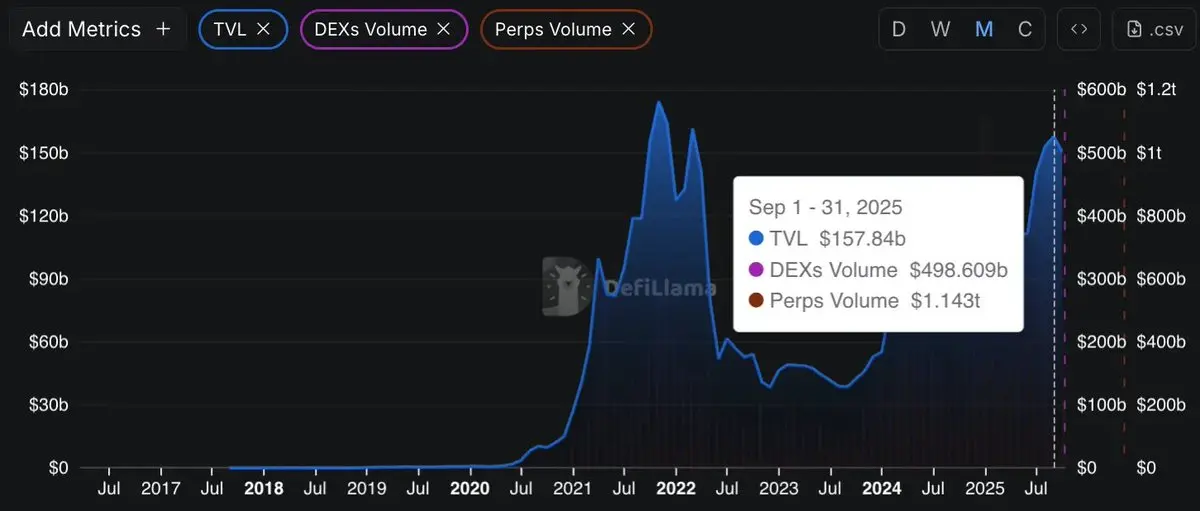
As DeFi grows in scale, the possibilities expand, but so does complexity. Most people simply cannot keep up with everything happening on-chain. If we want more people to seize these new opportunities, we must build tools that make it easier for users to make the right decisions—this is the direction for future development.
Meanwhile, AI has gradually integrated into daily life, and people are beginning to develop new habits around automation. This trend has given rise to "Agentic Finance"—where intelligent agents handle the navigation and execution of financial operations.
Even simple browser-based agents like Comet showcase the rapid evolution of such tools. When you execute a DeFi operation through a browser agent (as demonstrated by SendAI founder Yash), you can see the potential of agentic finance.
This vision is quite intuitive: you no longer need to sift through various dashboards or long posts on X; just tell the AI your goals, and it can automatically help you complete the subsequent steps.
Currently, two types of intelligent agents are emerging:
One type is Copilots, which guide users in making decisions throughout the DeFi world; the other type is Quant Agents, which are more focused on professional automated strategy execution, akin to "Autopilots."
Both are still in their early stages and have flaws, but they point towards a new direction—a fundamentally different, AI-driven way of interacting with DeFi.
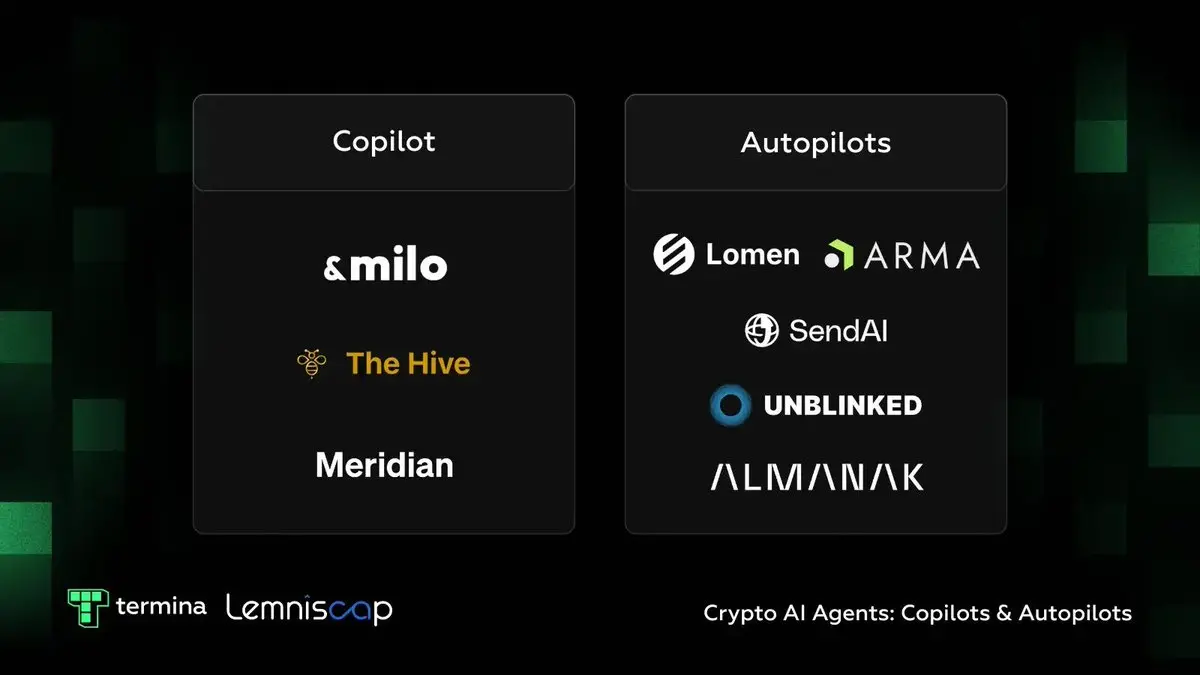
Intelligent Agents as "Co-Pilots"
You can think of these intelligent agents as your personal assistants. You no longer need to look at charts or jump between different protocols; just ask questions in natural language, such as: "What are the hottest tokens right now?" or "Where are the highest yields?" The agent can respond directly and provide next-step suggestions—like a knowledgeable friend who is always available.
Take &milo as an example; its co-pilot mode can assist you in making investment decisions, rebalancing assets, and gaining insights into your portfolio—allowing you to maintain control while saving you from cumbersome operations.
With natural language explanations and intelligent prompts, &milo helps users understand positions and compare yield opportunities without having to sift through various dashboards for data. It demonstrates the evolution of co-pilot agents from simple chat assistants to fully functional DeFi guides.
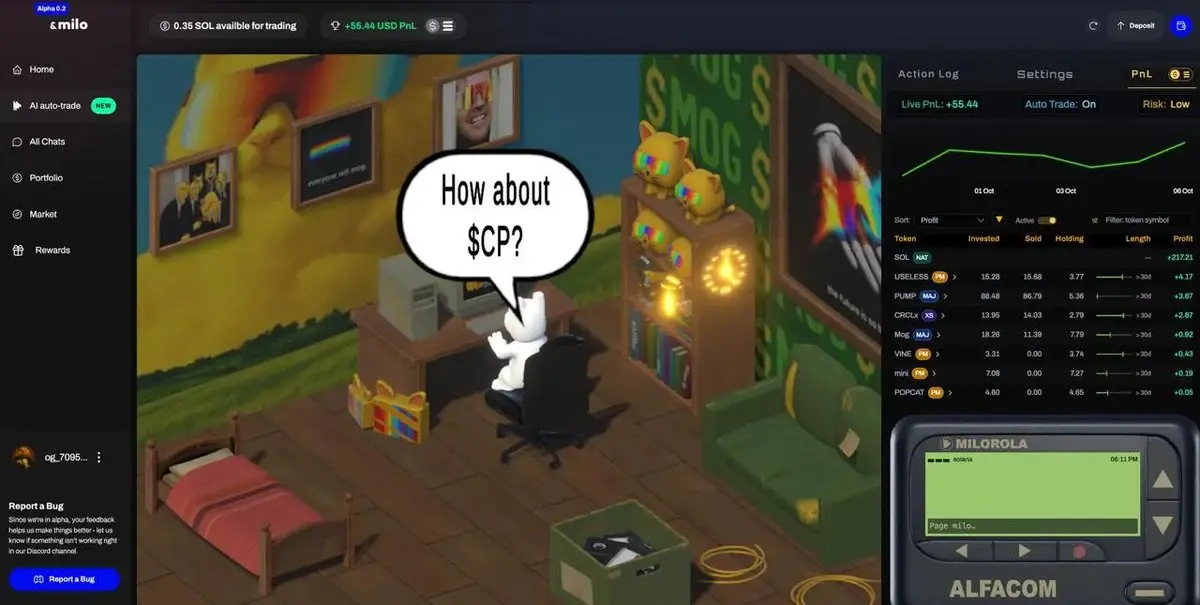
To observe how these agents perform in real operations, we tested several newly released products to experience their capabilities in handling real DeFi tasks.
The results showed that these agents still have limitations. For example, they can successfully identify popular tokens but struggle to execute buy operations; there were two failed transactions with the system indicating "insufficient balance," even though there were enough SOL in the account to cover the fees.
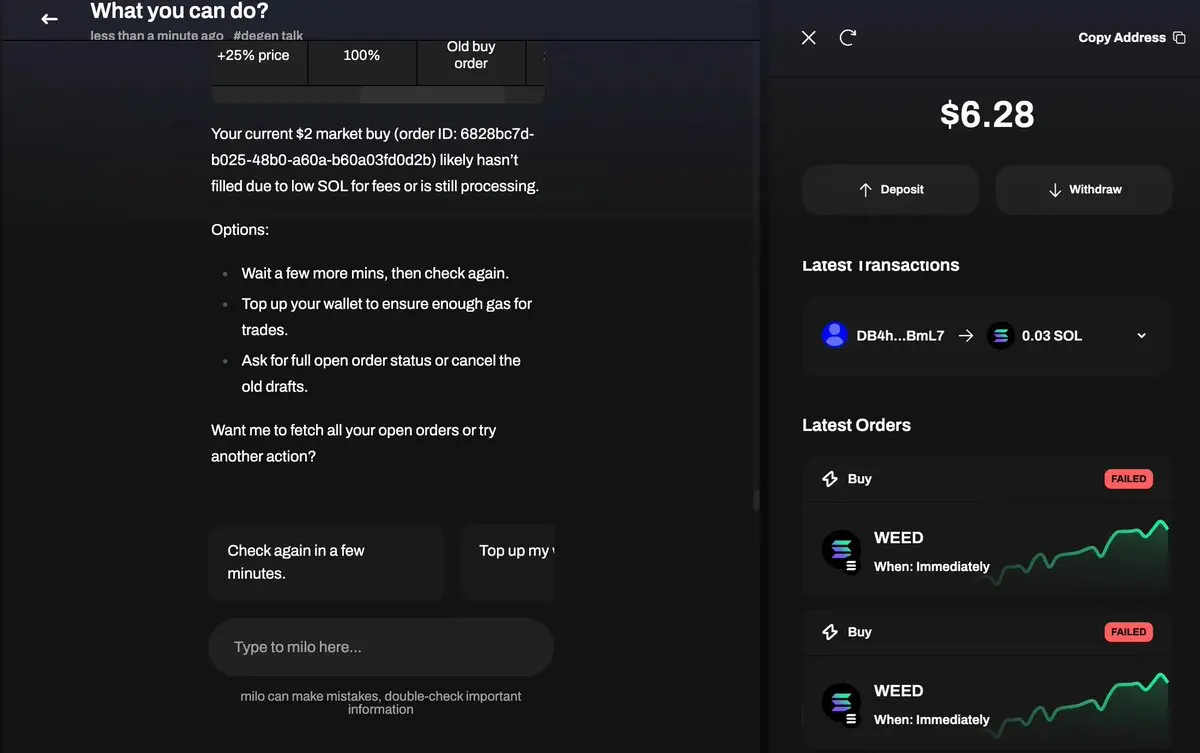
A similar platform, The Hive, has taken a different approach—it combines multiple DeFi agents into a "hive," capable of collaboratively completing complex tasks such as cross-chain operations, yield strategies, and liquidation defenses, all coordinated through a simple chat interface. This network of dedicated agents can perform multi-step on-chain operations using natural language commands.
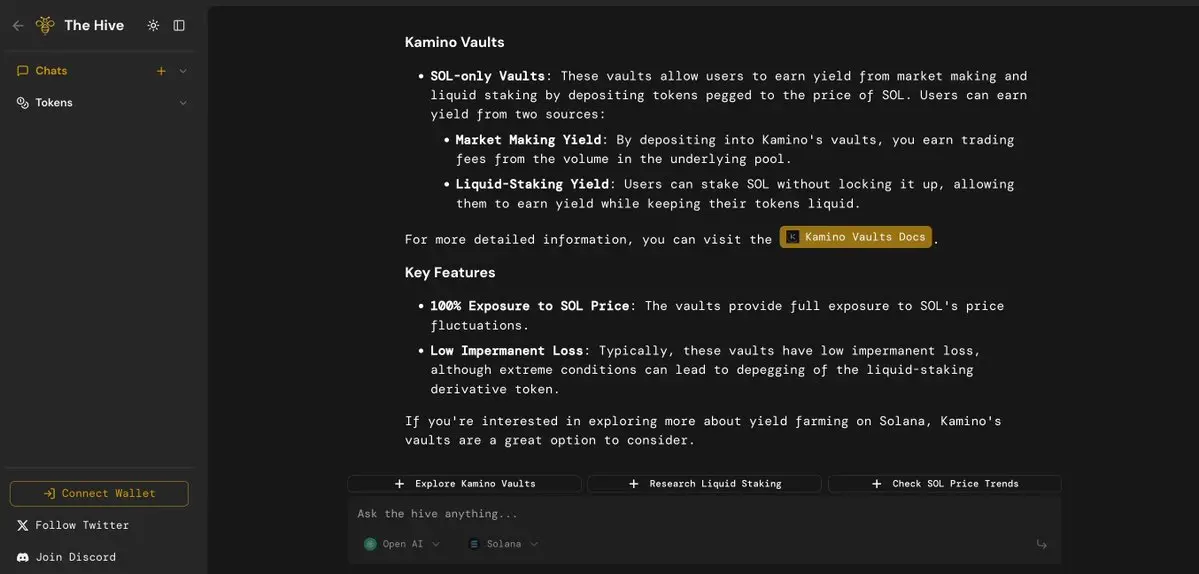
We tested the same buy command with The Hive. The system did recognize the popular token WEED, but returned an incorrect contract address when executing the purchase.
Overall, Milo demonstrates how to integrate portfolio management tools into a seamless process, while The Hive explores how to enable multiple specialized agents to work together. As the capabilities of intelligent agents improve, more distinct divisions of labor are beginning to emerge.
For instance, Meridian focuses on a different user group—helping beginners take their first steps into DeFi. It adopts a mobile-first design with clear prompts, making basic operations like swapping tokens, staking, or checking yields more accessible.
Meridian performs smoothly and executes quickly on these core tasks, and more importantly, it is very clear about its boundaries. When users ask it to perform operations beyond its scope, it explains the reasons instead of blindly attempting—this "honesty" makes it a reliable starting point for newcomers exploring the on-chain world.
Meridian founder Benedict explains:
"Meridian allows users to conduct safe research and operations using natural language. We have made the agent's research capabilities publicly available for free at meridian.app. Users who register for the Meridian mobile app can use the agent's swap, multi-swap, and portfolio purchase features. Currently, accounts are still in a closed testing phase, and interested users can contact @bqbrady on Twitter to apply for access."
Through our testing, we found that most AI agents focused on DeFi navigation still primarily serve as "teachers" or "assistants," mainly helping users complete the most basic operations (like swapping tokens).
To enable them to reliably handle more complex processes—such as providing liquidity or managing leveraged positions—further improvements are still needed.
As pointed out by Rishin Sharma, AI lead at the Solana Foundation:
"Large language models (LLMs) can easily hallucinate when handling broad tasks and struggle to execute deterministic operations. Function calling mechanisms like MCP may be better suited for translating 'action plans' into actual execution. While LLMs perform well in conceptualization and guidance, they still fall short in precise execution. To make agentic finance truly reliable, we must go beyond LLMs and develop specific function calling mechanisms, clear execution strategies, verifiability, and secure permission systems. In other words, the current execution layer of intelligent agents is still underdeveloped—AI's 'brain' is smart enough, but it still lacks a 'body' that can act robustly."
Intelligent Agents as "Autopilots"
If "co-pilot" agents are more like mentors, then "quant" agents are more like autopilot systems. They can not only build strategies but also execute them—monitoring the market in real-time, testing trades, and automatically acting at machine speed, allowing complex DeFi strategies to enter "fully automated" mode.
A typical case in formation comes from SendAI. It is not a quant agent itself but a toolkit that enables others to create these agents. Its "Agent Kit," designed for Solana, supports over 60 autonomous operations, including token swaps, new asset issuance, and loan management, and can interact directly with mainstream protocols like Jupiter, Metaplex, and Raydium.
In other words, it provides developers with a "track system" that allows them to connect decision models directly to on-chain execution.
SendAI founder Yash clearly summarizes their vision:
"We believe that every AI agent will have its own wallet in the future. SendAI is building the tools and economic layers needed for this system, enabling these agents to execute any operation on Solana. We are creating a platform that allows these agents to have contextual awareness and support long-running, persistent, and asynchronous complex task execution."
Meanwhile, other teams are trying to make this capability more accessible. Lomen curates selected strategies and allows users to "deploy with one click," lowering the barrier to enjoying quantitative automation without needing to write code.
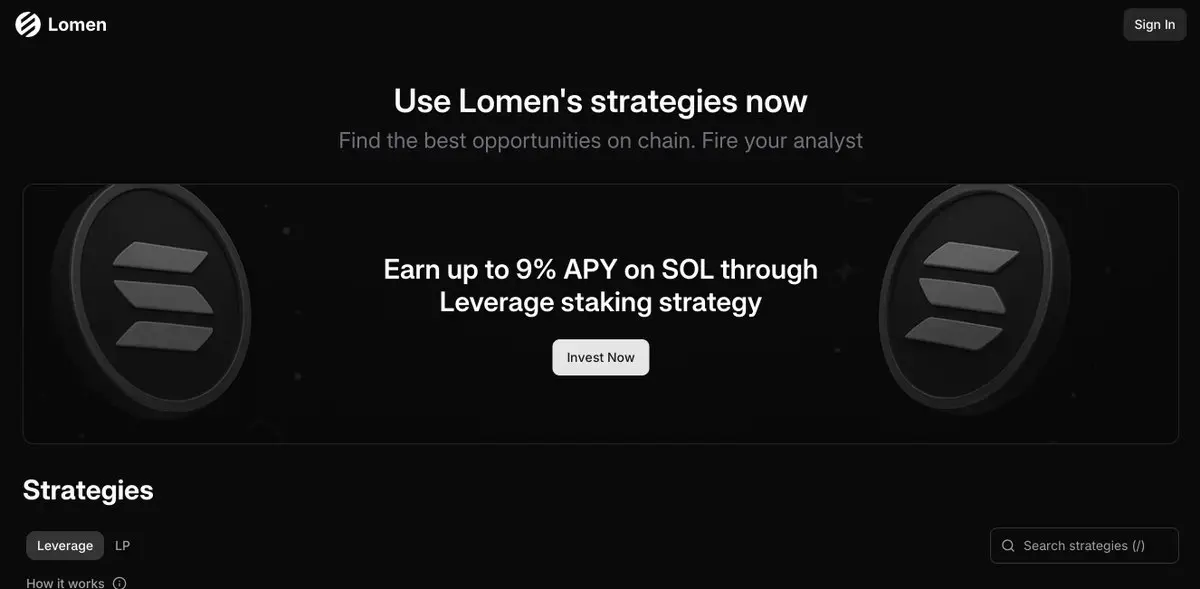
For more advanced players who prefer custom systems, Unblinked offers an AI-driven strategy experimentation environment. It is like a cursor in the trading field: users can sketch out their strategy ideas, run and optimize them in a safe sandbox environment, and then decide whether to invest real money.
Some platforms choose to call upon multiple agents to collaborate on tasks.
For example, Almanak combines "programming agents" with "backtesting agents": users describe strategies in natural language, and the AI automatically generates production-level code, backtesting it with over 10,000 Monte Carlo simulations, ultimately producing a "ready-to-go" strategy outcome.
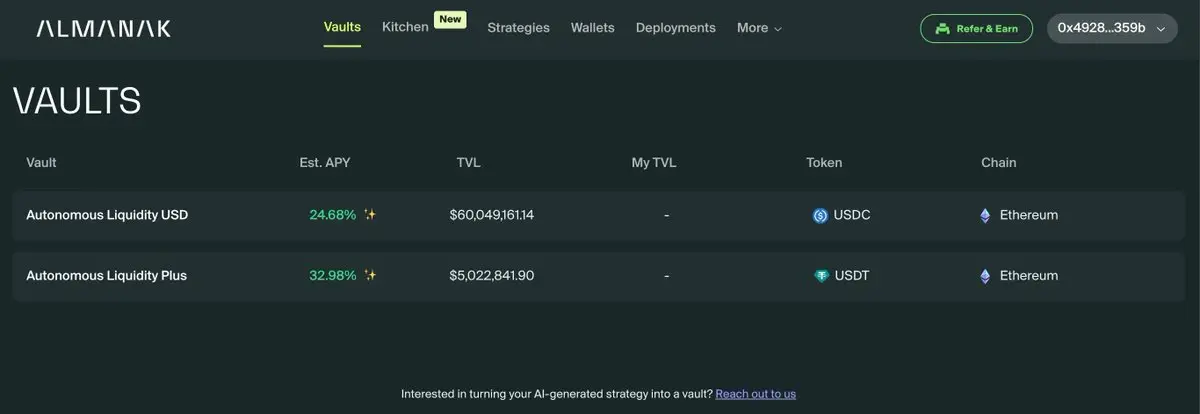
Finally, some teams focus on real-time market advantages.
Giza's ARMA agent actively reallocates funds between lending protocols to maximize stablecoin yields. Instead of letting funds sit in a single pool, ARMA continuously monitors interest rates, liquidity, and gas costs, dynamically moving assets. Its flagship agent has managed over $17 million in funds, claiming yields 83% higher than static holdings.
Overall, these quant agents significantly reduce time costs and allow ordinary users to access complex strategies that were previously the domain of professional quant teams. However, they also reveal the vulnerabilities of automation: when data lags, protocols pause, or markets experience severe fluctuations, agents can still "trip."
In other words, they can indeed make you faster, but they are far from "invincible."
Their Challenges
After spending some time with current intelligent agents, you will notice some common issues: they sometimes suggest executing operations that no longer exist, such as a liquidity pool that has already closed; the data they rely on often lags behind the real on-chain state; and if a multi-step plan encounters an error midway, they do not self-adjust but repeatedly attempt the same action.
Permission management is also quite clumsy—users must either grant full access to the entire wallet or manually approve every minor operation. The testing phase is similarly superficial, as simulated environments struggle to accurately replicate "real-world chaos" such as sudden liquidity changes or governance parameter adjustments.
One of the most serious issues is that these agents operate almost like "black boxes."
Users cannot know what inputs they read, how they weigh options, whether they check real-time states, or why they choose to execute a specific transaction. Without signed verification of operation records, it is impossible to verify the consistency between "promised outcomes" and "actual executions."
Users can only use them while "watching over" the automation process—this is not only inefficient but also makes performance difficult to assess.
Without a mechanism to verify decisions and prove that actions adhere to established strategies, users will never be able to distinguish between "reliable systems" and "well-packaged marketing."
For larger-scale capital, DeFi platforms must shift from "trust us" to "please verify." This is also a key turning point in establishing a "verifiable, governable, and trustworthy" infrastructure for intelligent agent finance.
Infrastructure Gaps
The core issue is that current systems lack the foundational tools to keep agents trustworthy, consistent, and secure in large-scale scenarios. To address this, we need infrastructure that can verify agent behavior, confirm execution results, and adhere to unified rules across all environments. Only then will people feel secure entrusting real money to them.
However, most users do not actually care about the "thought process" of the agents; they just want to confirm that the output results are correct, verified, and within safe boundaries. In building trust, "verifiable reliability" is more important than "visibility."
This is the significance of "Verifiable Reliability." Agents do not need to record every internal operation step, but they should operate under clear strategies and reasonable checks: setting spending limits, execution time windows, confirmation nodes before key operations, etc.
At the foundational level, these rules can be ensured through Trusted Execution Environments (TEE) or similar systems—without exposing all details, they can still prove that agents adhere to boundaries. The result is: outputs that can be audited when needed, and operations that ordinary users can trust immediately.
This verification layer does not have to be "one-size-fits-all." Everyday scenarios can adopt lightweight security protections and standardized metrics; while high-risk or institutional-level scenarios may require stronger proofs and formal verifications. The key is that every layer of infrastructure should provide measurable reliability that matches its risk level.
Preparing Protocols for Agents
The next step is to make protocols "agent-friendly."
Currently, most DeFi protocols are not designed for intelligent agents. They need to provide more stable and secure execution interfaces: allowing operation previews, safe retries, and executing based on consistent data structures. Permission designs should also be "scope-limited" rather than "fully open," allowing agents to operate within clear boundaries instead of controlling the entire wallet.
In the absence of these foundational elements, even the smartest agent frameworks will be tripped up by fragile underpinnings. Once these foundations are solidified, users will no longer need to manually monitor automation processes; development teams can reduce debugging time and focus on innovation; and execution results from different service providers can become comparable due to shared benchmarks—not just marketing slogans.
Parts That Must Change
The solution is not complicated: make agents verifiable (Provable) and prepare protocols for agents (Agent-ready). Introduce a strategy layer between agents and wallets, and require all execution processes to be traceable and verifiable, rather than operating as "black boxes."
For example, Termina's SVM engine is built on this principle—it provides AI agents with a true Solana runtime environment, enabling agents to model, decide, and learn based on on-chain data. Meanwhile, protocol providers should open up operation interfaces that can be "dry-run," with clear error codes, safe retry mechanisms, and consistency of core data structures (positions, fees, health), as well as session-based permission controls.
When these functionalities are implemented, users will be able to shed the burden of "watching over" agents; teams can reduce system failures; and institutional investors will finally gain the safety barriers and verifiable proofs they need.
Realistic Timeline
In the next six months, the "co-pilot" agents are expected to improve the fastest. More robust data pipelines will enhance their reliability in everyday usage scenarios.
Within a year, as testing standards strengthen, agents will be able to coordinate execution across protocols, requiring human approval only for key steps. Looking further ahead, as infrastructure matures, intelligent agents may gradually blur into the default interaction layer of DeFi—no longer just separate "tools," but becoming the primary way people interact with financial systems in their daily lives.
Conclusion
"Agentic Finance" is lowering the barriers to entry, making automation no longer just an exclusive tool for experts. But to truly operate at scale, it needs a better "foundation": real-time data, more secure permission mechanisms, stronger testing systems, and more transparent execution results.
Relying solely on smarter AI will not solve these problems. Real progress will come from improving the underlying structures.
DeFi's next milestone is not just about scaling up, but about—trust in automation. And that day will only truly arrive when AI agents are no longer just "concept demonstrations" but become genuinely reliable executors.
 Risk warning
 Risk warning


Popular articles





